May 13, 2008
Gleanings: Romans 5:3-5
Gleanings—Romans 5:3-5
More than that, we rejoice in our sufferings knowing that suffering produces endurance and endurance produces character and character produces hope, and hope does not disappoint us, because God’s love has been poured into our hearts through the Holy Spirit who has been give to us. (RSV)
First a confession—I’ve never been a fan of the suffering is good so let’s inflict some more school of thought that some of the Saints seem to espouse. I’m much more of St. Therese’s line of thought—there is enough suffering in daily life for complete sanctification, if only we avail ourselves of the opportunities available.
Suffering is painful, unpleasant, and not the way things were meant to be—it is a radical sign of our separation from God and it exists because of that separation. And yet suffering is something that builds us up. Suffering with the help of the Holy Spirit becomes endurance, a kind of spiritual stubbornness.
However, one of the first thoughts that came to mind as I read this passage is a specific sort of suffering—the kind we call temptation. Every temptation and the struggle to resist it is a kind of suffering. In some cases, struggling against certain physical addictions, it may actually produce a bodily sensation of pain. In some cases the suffering may be psychological in nature as we at once struggle against the temptation and find ourselves strangely, magnetically attracted to what would separate us from God.
The suffering that comes from resisting temptation is particularly efficacious in the way that St. Paul describes. If ordinary suffering that comes from a head cold or a bodily wound can work its way to endurance, how much more so the suffering and the tempering that comes from choosing to act in accord with the Holy Spirit. If suffering that appears to have no spiritual context builds up the spirit to give us the strength to endure and grow, what does suffering that stems from the spiritual struggle itself do?
Struggling against temptation is a form of suffering that we experience every day When we, with the aid of the Holy Spirit succeed in resisting the temptation there may be no “feeling” of victory, no sensation of triumph or of conquering what truly leads to death. The life of faith is beyond that of sensation and sense. Great things are accomplished with virtually no recognition on our part. When we leave the battlefield without having given in, the victory does not belong to us, or at least not to us alone, but to the Holy Spirit within us, to the presence of the indwelling Christ, to whom we have approached a step closer, even if we are ignorant of it.
A friend recently shared with me his experience of confession and of admitting to being tempted time and again and of struggling against temptation. The wisdom that came to him from his confessor is worth repeating and sharing, “But it is worth it, isn’t it?” As Saint Paul points out in this passage, the struggle, the suffering is beyond the worth a human being can know in this life
Posted by Steven Riddle at 6:57 AM | Comments (0) | TrackBack
May 12, 2008
Gleanings: Titus 1: 15-16
A brief introduction before the actual "gleaning" as to the purpose of these writings. I cannot pretend to be a Biblical scholar. I haven't the training or the background to make definitive pronouncements as to the meaning and theological implications of specific passages. However, I do love scripture and have been raised with a love of scripture, and I do enjoy reading it and trying to come to terms with what it has to say. There are as many purposes to reading the Bible as there are people doing the reading. For me the primary purpose is not to understand, extract, and deliver that abstract truths (theology) that can be found there, nor is it to understand the people and the times, or even to attempt to grasp the grand panorama of salvation history--all of those things are beyond my means. One of the reasons I read scripture is to come to know God and to love Him more. And the chief means of doing this for me is to look at the application scripture can and does have to my life now. Scripture is not carved in stone with a set permanent meaning that never changes. It is a fact that the truths laid down in scripture are Truth, revealed for all time to all people. But scripture is also a living document, speaking now to people as they live now. It is in denying this aspect of scripture that a great many people make mistaken judgments as to its applicability. On the other hand, it is in overemphasizing this aspect of scripture that other errors are made--there is a tendency to pick and choose the pieces we would most like to be true.
So, after that long preamble, these gleanings, if they continue past this point to be public, are simply my attempts to apply individual scripture passages and understandings, hopefully informed by a larger knowledge of the whole of scripture, to modern life. While they are personal reflections, I hope that their personality is not so pronounced as to make them inaccessible for others.
Sacred scripture is a living and beautiful thing. If we allow it to do so, it will speak to us today as it has spoken through the centuries to all the saints of God.
Gleanings: Titus 1:15-16
To the pure all things are pure, but to the corrupt and unbelieving nothing is pure; their very minds and consciences are corrupted. They profess to know God, but they deny him by their deeds; they are detestable, disobedient, unfit for any good deed. (RSV)
It would be easy enough to read this passage as suggesting that for the pure anything is acceptable and indeed, it is exactly this sort of misrepresentation of the thought that in the past led to heresies such as Gnosticism and Albigensianism. If to the pure all things are pure, then if one becomes pure, whatever one decides to do must be acceptable.
But it seems that St. Paul may have been attempting quite a different point. To the person transformed in Christ, the person whose life is lived in union with Him, the person who “is perfect as your heavenly father is perfect” all things are pure because that person has ceased to be his or her own judge of what is acceptable. Instead, they have accepted and embraced the gifts of the Holy Spirit, relying heavily upon Wisdom, Understanding, Knowledge, and Holy Fear. With these four serving as guides, it is not possible for the pure guided by the Holy Spirit to err in matters of the spirit.
However, as with all things, there are people who come to believe that they have achieved this purity who haven’t any idea of what this purity consists. They profess to know God and after a fashion, to be fair, they know OF Him, if they do not know Him. They understand some basics and then pride themselves on their understanding and knowledge. These people can end up denying God by their actions. They may begin to teach false gospels and spread their misunderstandings far and wide. They cannot be corrected; they become the sole interpreters of God’s will. They know that He intends happy married lives for homosexuals or that women should be priests as is only fair and right in the world. They refuse correction and so they wander further and further away from the truth—one error compounds and becomes an invincible armor of prideful ignorance which then becomes an agenda.
If we cannot surrender to those God has put in authority over us—priests first and then bishops, we probably partake in some part of those who profess to know God but deny Him. The first and most essential actions of those who know God are humility and obedience—obedience to God’s well as expressed in the authorities put over us. When God chooses, they will be moved or removed, but until then, we are bound.
But so long as we remain in this disobedience, we may as well align ourselves with those launching the worst assaults on God, because we are blind.
All healing of spiritual ills begins with humility, with the understanding that we cannot take the steps alone, even if we desire to do so. God must take each of us by the hand and lead him in the way we would go.
Gleanings: Titus 1:15-16
To the pure all things are pure, but to the corrupt and unbelieving nothing is pure; their very minds and consciences are corrupted. They profess to know God, but they deny him by their deeds; they are detestable, disobedient, unfit for any good deed. (RSV)
It would be easy enough to read this passage as suggesting that for the pure anything is acceptable and indeed, it is exactly this sort of misrepresentation of the thought that in the past led to heresies such as Gnosticism and Albigensianism. If to the pure all things are pure, then if one becomes pure, whatever one decides to do must be acceptable.
But it seems that St. Paul may have been attempting quite a different point. To the person transformed in Christ, the person whose life is lived in union with Him, the person who “is perfect as your heavenly father is perfect” all things are pure because that person has ceased to be his or her own judge of what is acceptable. Instead, they have accepted and embraced the gifts of the Holy Spirit, relying heavily upon Wisdom, Understanding, Knowledge, and Holy Fear. With these four serving as guides, it is not possible for the pure guided by the Holy Spirit to err in matters of the spirit.
However, as with all things, there are people who come to believe that they have achieved this purity who haven’t any idea of what this purity consists. They profess to know God and after a fashion, to be fair, they know OF Him, if they do not know Him. They understand some basics and then pride themselves on their understanding and knowledge. These people can end up denying God by their actions. They may begin to teach false gospels and spread their misunderstandings far and wide. They cannot be corrected; they become the sole interpreters of God’s will. They know that He intends happy married lives for homosexuals or that women should be priests as is only fair and right in the world. They refuse correction and so they wander further and further away from the truth—one error compounds and becomes an invincible armor of prideful ignorance which then becomes an agenda.
If we cannot surrender to those God has put in authority over us—priests first and then bishops, we probably partake in some part of those who profess to know God but deny Him. The first and most essential actions of those who know God are humility and obedience—obedience to God’s well as expressed in the authorities put over us. When God chooses, they will be moved or removed, but until then, we are bound.
But so long as we remain in this disobedience, we may as well align ourselves with those launching the worst assaults on God, because we are blind.
All healing of spiritual ills begins with humility, with the understanding that we cannot take the steps alone, even if we desire to do so. God must take each of us by the hand and lead him in the way we would go.
Posted by Steven Riddle at 7:55 AM | Comments (0) | TrackBack
April 25, 2008
By Way of Comment on My Present Read
I have, of late, had the sometime pleasure of the company of a young American woman of my acquaintance at luncheon. While the venues, cuisines, and surroundings of our après-midi repast were variable and dependent upon the circumstances and opportunities available to us, they have always been of the greatest pleasure and entertainment to me.
Miss Archer is at once a very determined young lady, but one also tinged with the streak of independence set firmly in the ground of a graceful and enhancing naiveté, which conduces to my enjoyment of our conversational aperitifs.
I've grown somewhat concerned because whereas her talk was mostly of the many men who saw her and implored her favors while she remained on the Touchett family estate, more and more I am hearing of a person of interest who seems to have netted our pretty little bird without her own knowledge. And the more I hear of Osmond, the more concerned I become, because it occurs to me that there is some information circulating about him that does not redound to his credit. While one can never take seriously what circulates on the street or even in the salon, it has been my distinct displeasure to make the acquaintance of another member of the pretty scene that Miss Archer has laid before me.
Miss Archer never fails of speak of Madame Merle in anything but the most glowing terms, expressing only admiration for this widow, who, as Mr. Touchett has observed on occasion lacks any blot whatsoever on her record. One must wonder about such a record--how recent it must be and what must have been, with some great aplomb, expunged from that on-going document. My own sense of Madame Merle is not nearly so flattering to that personage. There is something about her that is, perhaps subtle is the word, but I think wily is closer to the sense. She seems to fashion les tableaux to fit the needs of the moment, and one cannot help but wonder what those needs might be. Mr. Touchett himself has confided to me that she is a woman of great and unrealized ambitions—and perhaps that view has colored my own of her character. For all I know she may be as spotless as she appears to the casual observer.
Posted by Steven Riddle at 1:30 PM | Comments (0) | TrackBack
April 18, 2008
Hot off the Presses
and so, in need of work. But I like the contours.
[cayo hueso]Deconstruction of the Ant Hill
On the sill a pile of sand as
though the beach had come to visit,
and on it, thousands of golden
lithe-bodied ants fidgeted and
jittered, waving antennae and
pawing the air more forcefully
than any foam-flecked battle horse.
Across the wide expanse of wooden
plank, three golden soldiers dragged one
large black-bodied, full-bellied queen.
And through the brown mill on the stairs
that curled around the central shaft
the mournful hum of servant tykes
who hand one to one buckets
filled with syrup or water up
to some hidden destination.Here's what happened:
In panic, the heavy bottomed
glass bowl came down on the trekking
four. The fat black ant was smashed flat
as the boards themselves, a mere stain
for future pondering. And with
that motion the mill was freed. The sound
slowed then stopped and though the buckets
went awhile, they too slowed then stopped
and the dazed children turned and stared,
golden eyes filling with hot [fat?] tears
that did not spill. They stood, stock-still
on the stairs that circled the shaft
and waited in the weighty air
of the close summer day, as women
in bonnets last seen a century
ago entered, through a small pane
of light and led them two by two
away. The mournful sound settled
into the brown wood and the stairway
emptied into light.
A mere draft, but vividly seen and felt. Much to be done, but mostly tweaking--it says all it was meant to say, and what that might be, I leave up to you.
Posted by Steven Riddle at 7:26 AM | Comments (1) | TrackBack
April 17, 2008
Definitely Cayo Hueso
While the previous poem certainly fits into the geographical category of Cayo Hueso, there is some question about its thematic link. Not so here.
Vision
i
Learn to see again, open
eyes and let the light vanquish.ii
It is darkness that trains the eye
to be thankful for the light,
because in the darkness the eye will
see things of its own invention--
spots of yellow light, a greater
darkness crawling across the less,
spidery veins of blue, of milky light
that does not focus. Light shine comes
as relief to the eye straining to make real.iii
Sometimes, as I lay in bed at night,
I practice seeing through my eyelids.
In that imperfect dark I can make
out every contour of the bed frame,
the dresser, the armoire. No eye
could see better in any light,
dark-sight sees the real contours
of unreal things.iv
The eye of the giant squid is as large
as a dinner plate. In the deep , cold
waters, even with its massive eye,
the squid becomes calimari for the sperm whale.
An untitled piece, this morning broken apart from the titled piece that follows it.
[untitled]
The perpetually shifting balance
of the egret prowling the hedge-tops
in search of food. What wonders
would be seen if we could see
all at once, but vision is itself
a limit, and we cannot see
all-at-once, often not even
little-by-little.What Lies Beneath
The water strider balances on a skin
of water dimpling the surface
with its six legs. And from
beneath, what does this look like
but a bubbled sky?
Posted by Steven Riddle at 7:45 AM | Comments (1) | TrackBack
Will It Never End?
Well, we're all mortal, but I hope until then not.
What You See When You Close Your Eyes
Depends upon the day.
__Sometimes it is the darkness of eyelids
__Sometimes it is the orange brightness
____of eyelids, or the red-heat glow
____of tired eyes.
But sometimes
it is the cobalt-verdigris sea, shifting
as you look.
___________Or the span of space
in the broken road crashing out
into the deep-blue air, deafening
in the difference.
________________Or the chain
of clouds that is the sky's
reflection of the crescent
curve of the tropical chain.[cayo hueso?]
Posted by Steven Riddle at 7:35 AM | Comments (0) | TrackBack
More Cayo Hueso, I'm Afraid
Things That Don't Travel Well
Glass balls and
unwrapped geegaws
and cut paper
pictures and
photographs
in boxes and
most mysteriously
of all
memories.
Posted by Steven Riddle at 7:28 AM | Comments (0) | TrackBack
April 14, 2008
Blue-Gray Gnatcatcher
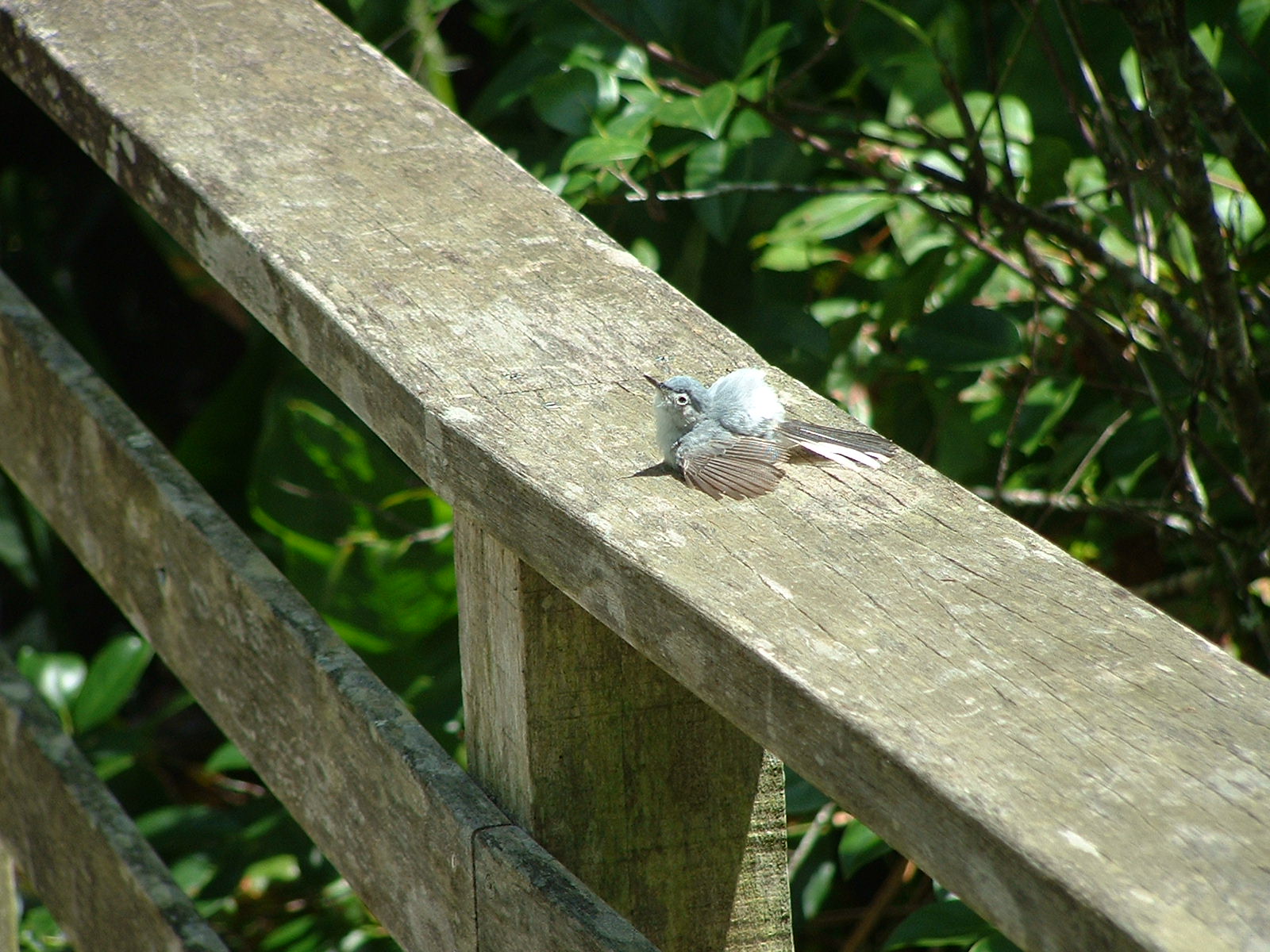
Blue-Gray Gnatcatcher
In sun-spotted shadow worn wood railing
half hidden, so at first I did not know
what I saw--a shadow that fluttered and limped
and then I saw the small wounded bird, wing
broken, it flopped pitifully, drawing
me closer, calling me for help, but not
really. Clever mother bird leads me far
from the nest of her precious young. I hear
a cry for help, she presents a meal
for the taking. All so her children, those
small peeps might live to one day
face their own monsters.
[cayo hueso]
Posted by Steven Riddle at 8:33 AM | Comments (0) | TrackBack
More (Not Less) of Cayo Hueso
Fragments toward an End
i
shard of beach bleached bone
shredding the shore sand
raised ribs breathing water
femur forming a bone bridge
tibia fibula phalanges
mandibula scapulum no scapula
vertebrae (amazing though they do not
know it hyoid bone)
radius ulna ilium ischium
a catalog of catastrophe
an abundance an overflowing of death
all applies a nameii
Breathing as through some horrible
dream, mist thick and magic
he sees without seeing.Breathing a thick mist dream
a laboring, long shuddering
intake that seeks to calm the inner
trembling that threatens to shake
all apart, he seeks to not see
what is plainly before him.
Posted by Steven Riddle at 8:16 AM | Comments (0) | TrackBack
Cayo Hueso the Poem
I know you're tired of seeing the words and probably don't much care what they are about. However, this is the first try after about thirty drafts of making sense of the title poem.
Cayo Hueso
i
Stark
beach-bleached
white, shards not sand
that stick up seaside
a primordial picket fence
or cage, clearly
visible even from the uneven
burnt blue ocean.ii
I cannot know how I am loved, I
do not know how I love. The word
means as much as "cloud" and has
all the substance--cotton puff
pushing across blue springtime's face.iii
"Call me an ambulance."The wind
rushing over the grey water's wash
drowns sound so I must say,
"Excuse me."
____________"I don't feel so good,"
and indeed on this very coldest
of days, the coldest seen here
in forty years, his face is as
grey as the sky and sea.
And so I call.
____________It's a small
island, a speck in the sea
and in no time measured from a
city-dweller's point of view,
the flashing lights pull up the narrow
way. "What's up, old man?" the beard speaks
almost before the ambulance has stopped.And I remember it started life
as Cayo Hueso, and bones,
even if shrouded in a little flesh
still stud the shores on windy days.iv
I wanted to go winter sailing
even though the sea upset
me. But I didn't
even get to see the sea I had
come to love.But consolation is a restaurant
on the marina that serves
steaming bowls of tomatoey
conch chowder. And so I rest
content in grey.v.
The bones are still here,
they hire small children
to walk the beaches before
dawn and collect them
in baskets, so the tourists
will not be upset and call
for help.
________Sometimes they fail.vi.
Named then for the strand washed
reminders of our interiority--
what is not seen lies below
and upholds what is.
For this there is no help
on cold grey days. Or,
it is indeed its own help.
It's rough, I admit--an still isn't quite there. It is, perhaps, at times too blunt and too much. And yet, it hints at what I'm trying to get at. It serves well as a draft to move forward with, perhaps adding parts, certainly reworking some lines and sections. It is, in sum, a very interior poem that really resisted ever becoming exterior.
Posted by Steven Riddle at 7:59 AM | Comments (2) | TrackBack
April 9, 2008
Poem in a confessional vein
I have to admit that it scares me a little to bring this one to light because it may be one of the more raw and for that one of the more true poems that I have ever written. Not true in the sense of portraying objective reality, but true rather in the grasping at a sense of the interior reality that sometimes becomes known to us.
So, as the audience is so tiny, and consists mostly of the sympathetic, I garner the courage to place this among the poems of the recent past.
Advent
They say a season of light
but this light comes from fuel
of the human heart and thus becomes
a season of ash and dust
a season of endless lament
as we wait for a joyless birth
as we wait for the disappointing
consummation of all.In the vast meaningless
emptiness of what we see and do
Advent is the hardest darkness
because the heart that has been
indurated cannot bear nor even see
the light.For some joy, for others an endless
tunnel and this hand is dealt out
blindly. God allows what He allows
and there is no stinting on it.
For some the love of God is made
manifest in this bitterness
in the taste of ash.
I can pretend no longer
His absence cracks my heart
and releases nothing
chained as I am to dust.
Somewhat more bleak (rueful grin) than some of the others--but a glimpse of the landscape. For those who have seen it, think of the Anthony Hopkins version of Titus Andronicus and the finding of the sister and you have a sense of it. It comes and it goes and it does not torment even as it does and I can't explain it any more than that--chained as I am to dust.
Posted by Steven Riddle at 7:57 AM | Comments (0) | TrackBack
Another for Cayo Hueso
The True Disciple
God's holy hate sanctifies my own
for hear these words He has uttered
Jacob have I loved but Esau have I hated
so simply He blesses me when I blast
those who do not know Him and many that do
the people who have abandoned Him and those
who lyingly stayed nearbyHe blesses every thought that passes through my head
they all are holy as He is holy
placed there by the Lord who is the God
who made me as I am
Holy in my lust
Holy in my hate
all my desires are sanctified by His will
all my spite righteous through His might and love
Posted by Steven Riddle at 7:51 AM | Comments (1) | TrackBack
Cayo Hueso, Cont.
The Friction of Trees
In this grey, loud noise
who would think that
it is the friction of trees,
bushes, grass, rocks, roads
that weeds the winds of the storm?
What seems a sandpiper's hop
from the shore, and yet
when the wind winds through,
combed and pulled by
leafy limbs, clawed by sawgrass
and palmettos, threaded and
braided by bush, brush, and grass
it is thinned from roar to shriek.
Posted by Steven Riddle at 7:45 AM | Comments (0) | TrackBack
April 2, 2008
Today's Cayo Hueso again
From a recent trip:
Boston Cobblestones
The narrow way between
the Oyster House and the Bell-in-Hand
is paved with cobbles that knew
and shaped the first streets here.I step on the same stones that bore
the weight of independence; that
carried those who planned
to tan the sea with British tea.And in the misty too cool
evening it is easy to see that
they walk here still--that what we are
and what we have was given to us
from the hands of ghosts
who linger here to remind us
of the meaning that is beyond us.
Posted by Steven Riddle at 6:44 AM | Comments (3) | TrackBack
Continuing Cayo Hueso
Mortality
I carry this decay in my body
a sign of its destruction and the source
of my uneasy delight.
As I chart its progress
I see how what is outside
reflects what's within. No sign that this
may be a sickness unto death,
a small discomfort, a little pain
a swelling, a redness, the sweet
throbbing--almost bliss--that is the warning
not all is well. And I have within
my power, the ability to change
this, at least postpone what will be
awhile. And yet, frozen, I do nothing.
Posted by Steven Riddle at 6:39 AM | Comments (0) | TrackBack
April 1, 2008
Cloud of Unknowing
The first part of this poem appeared earlier:
Unknowing
And so I move from knowing
to unknowing--not merely ignorance
but undoing the knowing I have
untying the knots and staring underneath
at what cannot be known once it is known.When you choose to unknow
you cannot. It comes upon you
as a gift,the promise of bliss
that unmakes what you have known--
makes holes in what is
through which light might shine.But the gift is two-edged
and what is unknown
breaks the links between things
known. Knowledge leaks out
mystery seeps in.Our broken knowledge
is the gift of humility,
it isn't forgetting--a loss,
and absence. It is a secret
unraveling, a complete undoing.Not passive, not receding
prominent and pointed
as the needle that breaches
the fabric, making holes
that let us know what is real.
Posted by Steven Riddle at 6:58 AM | Comments (0) | TrackBack
Untitled Poem [Cayo Hueso]
These clouds move with this wind
and their motion moves and
changes all the changes
they have made. What are they
that their change can make what
we see different? We
see in a new way, see
as we are meant to, as
we must if we wish to
know what cannot be known.
All changed by lax clouds, all
that we known is unknown
even by us, even
by those so near us, by
those who would love us, those
who would hate us, all who
touch us, whom we all touch.
Posted by Steven Riddle at 6:50 AM | Comments (0) | TrackBack
Another Poem [Cayo Hueso]
Fort Jefferson
The world changed that day when the white rock shifted
and became the small shell of a turbaned
snail, harsh in sunlight against the red brick.
Posted by Steven Riddle at 6:47 AM | Comments (2) | TrackBack
More Cayo Hueso
Bahia Honda
When I try to see,
to match that blue that
eludes me, that sea
melting into sky--
when I try to see
it, become lost in
it, wear it ribbon-
like on my clothes. I
hear then the sound of
it, smell the smell it
makes. I see the sun
the clouds, the loose strife
of it broken on
the beach bench, stranding
the red-brown algae.
And wonder at seas
that hold so much brown
being, alone so
blue.Posted by Steven Riddle at 6:42 AM | Comments (0) | TrackBack
March 26, 2008
Nighttime Series
Shades of Night
I: Cornflower
Flat cornflower sky at the edge of dusk
the buildings, telephone towers, trees, and traffic
pressed hard against it, only their overlap
providing perspective. Behind a light
winks out and shadow deepens--the shadows
on the ground and pressed against the sky.II:Indigo
They took it out of the spectrum
because no one could quite say what
it was. They had stopped watching
nightfall, when cornflower
mixes with star black
until neither blue, nor black, nor
purple, nor any other color
but indigo rings the world with purpose
before starlight shatters it.[cayo hueso]
First two of what I hope will be a subsequence in the larger work.
Posted by Steven Riddle at 7:34 PM | Comments (0) | TrackBack
More Poems NOT about Buildings or Food
The Quantum of Desire
I discovered the quantum of desire:
the exact measure
of how much a prize
is treasured, how much
a woman is prized,
how much you will spend
to get what you think
you want. I have made
a measure, a pure
geometry of lust--
with my machine I
can measure what you
want against what I
want and will always
find that my desire
is greater. No one
can want as I want.[cayo hueso!!!]
Posted by Steven Riddle at 7:28 PM | Comments (0) | TrackBack
March 25, 2008
Last for Today
[untitled]
She spoke and the world melted with her words;
what was green turned brown, and white became clear
streams flowing to the sea. Of what she said,
no sense or meaning. Simple word simply
spoken, no promise, no threat, no intent
beyond the magic of language.Who knew how powerful a single word?
[cayo hueso]
Posted by Steven Riddle at 6:36 AM | Comments (1) | TrackBack
And More
[Chained Fragments]
I have said one thing too many
times, so the words have worn smooth as
pebbles on the shingle and some
have worn away completely.The eyes I see with today have transformed
the world for me, coloring it with shades
that have taken a lifetime to form.What we wait for, what we dream, never comes
never because no matter how close
some difference remains.Three lines are enough to say what needs said,
more lines are just more lines.[cayo hueso]
Posted by Steven Riddle at 6:30 AM | Comments (0) | TrackBack
Yet More
Chained to Dust
you'd think the spirit
would move easily
like a wind weaving
through the spaces between
motes setting them dancing.But it may as well be whistling
between electron cloud and nucleus
for all the motion it makes in this
relentless sedentary waste.If the spirit moves the earthly shell
contains and constrains it
so that at times a hollow moaning
sounds--a whirlwind echoing in the void.How could the All-Knowing
make such a marriage of eternal
and ephemeral?[cayo hueso]
Posted by Steven Riddle at 6:24 AM | Comments (0) | TrackBack
Cayo Hueso??
Without offering more:
A Litany of Miracles
Take a look at the hand
that holds the pen or floats over keyboard
as though not attached to your humanity.
Ghost pale in glowing light, flex it, fingers
move in ways at once simple, beautiful,
light, impossible. Who would have thought such a
stretch was mere bone in flesh and not the pure
motion of the divine?
____________________What could be more
perfect, a better pointer to what is
beyond motion? No sign you can see shows
at the surface of skin, and yet it moves
the hand, powered by a stream of human
current, the shocks and jolts of jumping nerve
impulses across a chemical sea--
a distance so vast and so perfectly
spaced that everything moves together, so
a jazz-hand dancer, then a fist, then what?
Whatever the hand has been trained to do,
whenever it has been shown to move--all
motion not its own.Posted by Steven Riddle at 6:16 AM | Comments (2) | TrackBack
March 24, 2008
A Poem
At the End of the Road
What will happen
will. There's no need
to cover plants
in the cold, if
they cannot make
it through the night,
they don't belong
here anyway.[cayo hueso?]
Posted by Steven Riddle at 12:07 PM | Comments (0) | TrackBack
Permettez-moi de vous presenter. . .
mon ami, Charles Baudelaire.
And while I'm not saying the intent is my intent, the capitalization of Toi allows me to read it in a way that perhaps M. Baudelaire did not intend. (Almost certainly did not intend given the title of his chief work--Les Fleurs du Mal.)
De profundis clamavi
Charles BaudelaireJ'implore ta pitié, Toi, l'unique que j'aime,
Du fond du gouffre obscur où mon coeur est tombé.
C'est un univers morne à l'horizon plombé,
Où nagent dans la nuit l'horreur et le blasphème;Un soleil sans chaleur plane au-dessus six mois,
Et les six autres mois la nuit couvre la terre;
C'est un pays plus nu que la terre polaire
— Ni bêtes, ni ruisseaux, ni verdure, ni bois!Or il n'est pas d'horreur au monde qui surpasse
La froide cruauté de ce soleil de glace
Et cette immense nuit semblable au vieux Chaos;Je jalouse le sort des plus vils animaux
Qui peuvent se plonger dans un sommeil stupide,
Tant l'écheveau du temps lentement se dévide!A translation, more poetic than accurate, but aiming at the spirit:
De Profundis Clamavi
Roy CampbellHave pity, my one love and sole delight!
Down to a dark abyss my heart has sounded,
A mournful world, by grey horizons bounded,
Where blasphemy and horror swim by night.For half the year a heatless sun gives light,
The other half the night obscures the earth.
The arctic regions never knew such dearth.
No woods, nor streams, nor creatures meet the sight.No horror in the world could match in dread
The cruelty of that dire sun of frost,
And that huge night like primal chaos spread.I envy creatures of the vilest kind
That they in stupid slumber can be lost —
So slowly does the skein of time unwind!And another, again, poetic, not literal
Out of the Depths
Jacques LeClercqSole Being I love, Your mercy I implore
Out of the bitter pit of my heart's night,
With leaden skyscapes on a dismal shore,
Peopled only by blasphemy and fright;
For six months frigid suns float overhead,
For six months more darkness and solitude.
No polar wastes are bleaker and more dead,
With never beast nor stream nor plant nor wood.No horror in this world but is outdone
By the cold razor of this glacial sun
And this chaotic night's immensities.
I envy the most humble beast that ease
Which brings dull slumber to his brutish soul
So slowly does my skein of time unroll.And then this, which comes from the same hand that gave us the delights of The Importance of Being Earnest
from De Profundis
Oscar WildeProsperity, pleasure and success, may be rough of grain and common in fibre, but sorrow is the most sensitive of all created things. There is nothing that stirs in the whole world of thought to which sorrow does not vibrate in terrible and exquisite pulsation. The thin beaten-out leaf of tremulous gold that chronicles the direction of forces the eye cannot see is in comparison coarse. It is a wound that bleeds when any hand but that of love touches it, and even then must bleed again, though not in pain.
Which leads us to:
Psalm 129/130
De profundis clamavi ad te, Domine;
Domine, exaudi vocem meam.
Fiant aures tuæ intendentes in vocem deprecationis meæ.Si iniquitates observaveris, Domine,
Domine, quis sustinebit?Quia apud te propitiatio est;
et propter legem tuam sustinui te, Domine.
Sustinuit anima mea in verbo ejus:speravit anima mea in Domino.
A custodia matutina usque ad noctem,
speret Israël in Domino.Quia apud Dominum misericordia,
et copiosa apud eum redemptio.Et ipse redimet Israël
ex omnibus iniquitatibus ejus.Which, in those most magnificent of translations are:
Psalm 130
KJV
Out of the depths have I cried unto thee, O LORD.Lord, hear my voice: let thine ears be attentive to the voice of my supplications.
If thou, LORD, shouldest mark iniquities, O Lord, who shall stand?
But there is forgiveness with thee, that thou mayest be feared.
I wait for the LORD, my soul doth wait, and in his word do I hope.
My soul waiteth for the Lord more than they that watch for the morning: I say, more than they that watch for the morning.
Let Israel hope in the LORD: for with the LORD there is mercy, and with him is plenteous redemption.
And he shall redeem Israel from all his iniquities.
1662 BOCP
OUT of the deep have I called unto thee, O Lord : Lord, hear my voice.
O let thine ears consider well : the voice of my complaint.
If thou, Lord, wilt be extreme to mark what is done amiss : O Lord, who may abide it?
For there is mercy with thee : therefore shalt thou be feared.
I look for the Lord; my soul doth wait for him : in his word is my trust.
My soul fleeth unto the Lord : before the morning watch, I say, before the morning watch.
O Israel, trust in the Lord, for with the Lord there is mercy : and with him is plenteous redemption.
And he shall redeem Israel : from all his sins.
To which I append,[temp title] The Cloud of Unknowing
And so I move from knowing
to unknowing--not merely ignorance
but undoing the knowing I have
untying the knots and staring underneath
at what cannot be known once it is known.Later: Upon review I discovered that I was remiss in citing my sources. This very fine site presents the original poems from Les Fleurs du Mals with several different English translations. I took the poem and the translations from that site.
Posted by Steven Riddle at 9:03 AM | Comments (1) | TrackBack
September 14, 2007
Speaking of Critics
I love it when this happens and I'm alert enough to recognize it. This started out as a critique of something quite different and quite personal; however, as I allowed it to grow, it turned into something much more interesting. Yes--it probably still needs some work to get the remaining hitches out. But I rather like what it has become.
The Informed Churchman Examines Recently Confirmed Artifact 361752 ("Holy Grail")
Doesn't gold resist tarnish? and yet, look
there, that little spot from which no light shines.
And why, after all, gold and not silver,
wood, glass, or antimony pewter? While
we're at it, who designed this lumpen cup?
Didn't they know we'd make of it a chalice?
Could they not see how inelegant the
lines? Unseemly bulges, awkward in hand.
What are we to make of such unruly
work? Miracles? Pah. What's a miracle
with such a declassé design? Who cares
what superstition has imbued it with?
Anyone with half an eye can see it
for what it is--bargain basement gimcrack
finery. Our Lord (who had a fine sense
of style) would never have set lips to such
a cup as this. Who could think so? No, go
find another--this one will never do.Posted by Steven Riddle at 7:30 AM | Comments (0) | TrackBack
September 13, 2007
More Reflections
Pardon the pun. . .
Mirror
When we can penetrate the lies we do
not know we tell, and see for one moment
what we protect, we can begin to know.
Knowledge is a perfect mirror--bright, sharp,
hard, and cold--a knife all blade, no handle,
that cuts what it touches as easily
as it reflects light. To know truth invites
hardship and a long unknowing. And so
we avoid the knife as long as we can,
or many of us do; but some, wiser
perhaps, or more daring, learn the art of
naked steel, learn the caress of the blade
that opens up all. Knowledge is hard, but
not so stony and unyielding as willed
ignorance; it's blade cuts deep and yet heals.
To choose not to know is to lean too far
out a window without a sill, to stretch
our bodies out on the thin wind of a
perpetual fall, no skillful clean cut,
nor surgical strike; no--rather an all
out plummet to a meaningless blot,
a rorschach. Pain either way, no matter
what people end up thinking, no matter
which we choose. So, why not truth? Pain then in
the service of an end that brings us
all together, soldiers-in-arms against
the same sad nameless terminal disease.In making this I had to cut a simile that I like very much because it cuts two ways--"we are no more what we say than air is wind."
Later: If you stop by frequently you may have noticed two or three drafts of this. Lunch hour is remarkably productive.
Posted by Steven Riddle at 7:59 AM | Comments (0) | TrackBack
September 10, 2007
Final Poem for the Day
See H.P. Lovecraft's "In the Walls of Eryx." Yes, I know, a penny-dreadful inspiration for a poem, but the images of that story tend to stick with you.
A Condo in Eryx
Glass tunnel in a wide
open field, perfectly
clear so I cannot see
the prison maze that binds
me to my choices. I
make these walls, no one can
see me here, no one wants
to. In time I could die
here, out in the open
unseen, unmourned, unknown,
unneeded, and alone;
but until then, I build,
making walls with the fierce
determination shown
by colonies of ants--
labyrinthine, involute,
spiraling, in and out
but always ending in
hollow chambers, the lair
of the Queen, the meaning
of the colony. And
so, lacking a queen, this
endless building tends to
end--bloated nothingness.Posted by Steven Riddle at 8:08 AM | Comments (0) | TrackBack
After Robert Frost
Not really. For one thing Frost's poetry was more measured, less inclined to enjambment. However, I saw an anthology of poetry from some years back that was dedicated to and in honor of Robert Frost, and I thought about "The Road Less Traveled" and "How that made all the difference." And, in truth, it does. But that's not the road most of us end up seeing and so it seemed, another poem was required.
The Road Well Rutted
We travel as we travel; at the end
we are surprised to arrive at a place
we never thought to visit; and then, when
we glance at the map, we see empty space--Terra incognita, here be monsters.
The road we have worn, worn to uselessness,
has guided us here, and made us wonder
why we chose, a barren path to endlesswaste. Truth is, we don't see so well down here
beneath the level of the land. Once we
had bearings, could see the landmarks, over there
the pine barrens that guard the dunes and sea,over here the road to the city, winding
strange and imperfect through the lonely miles.
But we walk the same old ground, now tramping
down the earth, back and forth, restless now whilewe still can see, and becoming at home
as we obscure our vision. Sightless we
see what we always wanted to see, tombs
become palaces, walls-windows, we seewhat we dreamed only dimmer, until all
light goes out. The well-rutted road now falls
away, and we are left with appalling
signs of how foolish we have been--how small.Posted by Steven Riddle at 7:52 AM | Comments (0) | TrackBack
Reflecting
Much of poetry is a kind of posed reflection--an internalized debate, conversation, or extended thought that has had the messiness pruned away and has been made ready for general consumption. When we encounter poetry that we don't "get" it is often because we don't understand the terms of the debate or the center of reflection. I say this because the poem I am presenting may have elements that are too personal for them to mean much to anyone else. And the job of the poet is to identify such poems and attempt to enlarge their terms so that they do mean beyond the narrow limits of the personal experience. However, this should be done within the poem itself. So, if you give this a couple of tries and still cannot make sense of it, please drop me a line to help in the revision of it.
Rock in Water
"Don't touch that!" the guide's words echo in the
empty chambers of eerie light, this rock
and void wonder that makes of Earth a womb,
and the object under protection of
so vigilant a guardian--living
rock, onyx growing through the ages. One
human touch, one fingerprint, kills the stone,
one sheen of oil seals out healing water
and the white rock ends. The human touch tends
to end all things and begin truncated
projects, odd and ends, all unfinished and
so always unending.
___________________ My totem in years
that were to come, the durable, shaped by
the ephemeral, the solid made whole by
the shifting. In the depths of the water
an egg of basalt, size of a football,
weight of a car, posed on a slate shelf, smoothed
and waiting for one who will carry it
away--and a waking dream of a stone
pillar swirled round by raging water, a
flood that does not move, cannot sway, lets stand
a rock unperturbed and changed entirely.
Story of a life the solid mired, swamped,
changed and the same amid all the shifting.Posted by Steven Riddle at 7:40 AM | Comments (0) | TrackBack
September 7, 2007
Too Short a Respite
See, a hiatus doesn't last all that long--unfortunately for you.
Shantytown
People to throw
away; discards,
the world's refuse,
underfoot dirt,
dust, and sweepings.Intended as
temporary--
thrown together
in less time than
it took to think
of it, age-stained
before they're done,
designed to make
each feel smaller
that humanly
possible.And more to come--beware.
Posted by Steven Riddle at 8:32 PM | Comments (0) | TrackBack
September 5, 2007
Reading too Much Roethke
Practical wisdom: Read not too much of poets inclined to depression and naturalism.
"I wake to sleep and take my waking slow. . ."
What waking and what sleep? What images
of all and nothing mixed, all one line one
meaning? The arrow through the small bedroom
with black-framed doors and yellow walls winds up
at here and now by the blue sea rising
only in memory. The sandcastle
crab scuttling through my earliest age,
and the dolphin and the shark that mark my
present time. A friend confided a ray
sounding spoke in salty dialect of
God who is not and hears not or does and
he instead does not hear.
[________________________] This slow waking,
this reach for light that comes when I go as
I am meant to, a sounding, surfacing--
grabbing hollow air to fill a hollow
man is all that moves me now, as I have
no motion that can be moved, no movement
that can mean or be or stay or away
drift--red autumn on dark water. Where I
found myself, between rock and water, soothed
and rounded by the cool swirl, made real by
the insects and fish that move with the true
motion of innocence, of what needs no
redemption because its only fall was my
own fall--pulled down in sullied brotherhood
and brought up again in light and darkness
that mix in the autumn waters of streams
that follow their own motion and make it
new.
{___} To join them then and there in the pools
where darkness cannot consume the light and
all motion moves in secret silence and
what is know is what is seen--innocence
is the unchurned, sun-warmed top twelve inches
still and moving where they must. An ending
that is not seen and so becomes a new
beginning that is.
__________________Full memory is
sorrow, an unending world of shadow
that shifts and shapes a life unlived but walked
through. Who I am and am to be is known
only in the motion I do not make.I'd like to explain it, but any explanation would take far, far too many words and leave what is here spoken in ways that mean less while they say more.
And I should note that some lines were suggested, indeed nearly cribbed from a great underpublished poet friend of min, Jay Bradford Fowler, Jr. The world is a lesser place without him.
Posted by Steven Riddle at 9:31 AM | Comments (0) | TrackBack
September 4, 2007
Aphorisms That Form a Whole
Call them a form of admonishment--a reminder. Nothing profound, but worth recording for reasons all my own.
Aphorisms
Powerlessness is bred of my motionlessness.
I fail because I do not, not because
I cannot. I have never tested "can."Posted by Steven Riddle at 7:55 AM | Comments (0) | TrackBack
What Can Be Shown
Excerpt from a journal:
Either/Or
It seems there is a choice to live in fear,
regret, jealousy, and gradually
increasing bitterness, or to be alive,
casting habits of fear aside, become
open, outward, alive, loving, looking
for meaning beyond what most frightens me.
Fear is emptiness, the true death of trust,
or perhaps the knowledge that trust never lived.I remarked to a correspondent that all of my prose is broken poetry, and that exalts my prose too much, but I hear within it the struggle to mean in the relationship of words by sound. There are echoes and echoing phrases and bells and drums within words that wrap the words around and make them mean. And so, I write what I must write and I recognize it for what it is--poor poetry, worse prose. But poetry is the exercise of control on language, it is the struggle for meaning in the mundane--it is the high frontier of communication and so, better to lose the struggle there than to never attempt it.
Boy that sound pretentious. It doesn't mean to be--but it's difficult to say in other words what is meant. I suppose each writer is stamped with the form most familiar, most comfortable, most reliable--for me, for better or worse, that form is poetry--and if I make a mess of it, well that certainly isn't the fault of the muse.
Posted by Steven Riddle at 7:44 AM | Comments (0) | TrackBack
Two Ways of Saying the Same Thing
Two quite similar poems about the same thing:
Dark, Dark My Light, and Darker My Desire
The world is haunted
by shadows
flattened people and places
words spoken once
repeated endlessly
in a million places
all at once.What we see is not
real and all that is
real is haunted by the shadows
that change the warp and weft
of what is.We quote words we've
heard too many times
but never spoken
by a person--only
the words of colored shadows.
ShadowlandsWe live in the shadow of shadows
in the haunted specter
of what once was real
and has no substance even nowa world haunted by shadows
flattened people and places
that grow to be more real
than those we walk through every day.We listen to the words spoken
once and resounding
through the universe
filling up time and space.What we see is not now real
and it replaces what we
can touch as more cherished,
more worshipped, more respected.As poetry, I don't suppose either is terribly good. I'm not pretending that. But I like the idea behind them enough to preserve them and perhaps work from them to a more robust representation of what is in my mind.
Posted by Steven Riddle at 7:35 AM | Comments (0) | TrackBack
August 31, 2007
A Theory of Poetry
Not really. Theories of poetry are bloated, self-referential, and filled with all sorts of erroneous assumptions. Let's call this more self-referential revelations about one poet.
And there won't be many of those. I just wanted to note that while I greatly appreciate those poets who are able to use rhyme naturally and fluidly--Eliot and Frost come to mind, my own poetry doesnt' fit well into that schema. I have found over the years that I tend to prefer alliterative, assonant, and resonant poetry. I like the internal and external sounds of the words to work in more intricate ways than rhyme. I like the complexity of the music of words. And it was hammered home to me more and more as I wrote the following:
These Woods
How very easy it is to become
lost, to wonder down the wrong trail looking
for some sign of having passed by this way,
forgetting that the only motion is
forward, even when it seems like standing
still or continuous circling. Shadow
and light, the sound of leaves in wind, perhaps
a nearby stream trickling over rocks in
the late summer heat. Or, if these trees were
mangroves and the scuttling black ghosts were
crabs, the vision beyond the tangled limbs
would be the sea--blue-green immensity
stretching out to a sky that thins, becomes
transparent and lingers on the distant
horizon.
[_____] Or, these woods are a muddle
a confusion of all forests, all lands,
all times. Whatever they are, I am lost
in them, stopped by a pebble from moving
forward, transfixed by a shadow, caught out
by the sudden unsearched for splash of sun--
light in eyes more blinding than the dimness
of the domain in which I wander. Where
am I? I want to call out shattering
a sylvan stillness, thoughtless blind silence.
And within me, the echo, "Where indeed?"
Still stopped, now I stoop to touch the pebble
that seemed to bar my way and feel its cool
damp surface and it's sun-stored warmth all at
once.
[__] When will I want to move on? Is it
even a question I should ask? Still here
touching the smooth white that first distracted
me in my headstrong stomping through the gloom,
I dare now to ask what I would not know.Posted by Steven Riddle at 7:47 AM | Comments (0) | TrackBack
August 30, 2007
Morning Thoughts
You know, poetry really says it all. If you bother to listen to the voice under the voice, if you read between the lines, or if you just enjoy for the moment and let the moment linger--poetry says it all. I suppose that is one reason, one very good reason for praying the psalms. Poetry is, by its nature, closer to God. Which is not to imply that God is a poem--but God is at the heart of every good poem--just as He is waiting to surprise you in every work of art and nature, if only you are willing to be surprised.
It's amazing to me how the night
passes and the morning thoughts
born of dreams pass silently away,
unencumbered by the obligation
to teach, unaffected by the need
to nurture. They present and then fold
passing briefly into the light of memory
and fading with the stronger morning.Posted by Steven Riddle at 7:35 AM | Comments (0) | TrackBack
Stumbling into the Light
Time has always intrigued me, and the experience of time is even more fascinating. I have nothing deep or insightful to say about it. Nevertheless, to attempt to say it I shall because I have ever learned that discretion is the bitter part of valor. [No, that wasn't a typo.]
The Mystery of Time
A clock ticks, arbitrary measure
of a moment--a waterclock drips
and each tiny splash gives weight to now:
but what is now? And even as I
think the word the now of that moment
passes and the thought became memory
of what slipped by.
[______________] There is no now, each
now is gone before it can be named.
A chronic waterfall, the seconds
wash over the rock ledge and vanish
with a tumble and turn; at this joint,
poised on the brink, I can see but can't
move the water flowing to, water
cascading away; no more can I
halt it, stop it on the brink, study
it, name it, and then let it flood pst.
One moment it is the unspoken
future, trips over the rocky juncture
and then is past, but no held, not owned
not ever my present, but always
passing.In some sense now is never. That is, by the time you recognize NOW it has already slipped by. By the time you think NOW, that now is an instant in the past. In a sense all though is memory. It happens in the moment, and people constrained to our linear experience of it, it seems like now.
The Buddhists seek to plumb this mystery by mindfulness--living in the now. And if one could truly live in the NOW one would actually be living in eternity where all the chained together nows have a meaning the transcends the sequential NOW of our experience.
Or something like that.
Posted by Steven Riddle at 7:14 AM | Comments (0) | TrackBack
August 29, 2007
The Way Words Shape Themselves
This poem started off going one direction and ended up in another entirely. It isn't particularly good and isn't presented as a sterling example of the poetic art, but rather as what happens when poetry begins to take over prose. These are essentially stray thoughts from a journal--although that wasn't the intent upon composition.
And so we're back to the observation made the other day regarding authorial intent with particular reference to William Butler Yeats. It doesn't much matter what an author intends, means, or even overtly states as he writes because meaning is, in some sense, collaborative--it is the work of the artist that brings it forth, but the work of the reader and the place of the reader at that time that gives it force. If the reader intends differently from the author, the work can likely be interpreted in that light. I often wonder about the many works of scholarship surrounding written work. I suspect there are darn few authors who would admit it, but the object of composition is not necessarily deep meaning--in fact, there may be no object at all--it may simply be that the artist cannot do otherwise; it is in the nature of the beast.
Karma
The actions put in place today
spring from seeds planted in the past.
The actions taken today
set seeds that form the future.
In the moment of movement the past
and the future are fused
to become the present.
We cannot see the present come
into being, the bridges between
seconds are burned as one
instant ticks over into another.
But in some shared space
we enter together the only
time any of us have.Posted by Steven Riddle at 7:28 AM | Comments (0) | TrackBack
August 28, 2007
The Wonders of Waiting
Sam has three hours of dance classes on Monday night. As a result there is much waiting. Last night as I was pacing up and down in front of the strip mall where the dance classes occur, a middle aged, probably Vietnamese lady emerged from a nail salon. As she opened the door and turned to lock it, I caught a whiff of acetone and it resulted in this:
Nail Salon
A life of volatile organics--of
making life better by painting the stuff
of beetle wings bright red, soft pink, polished
orange, dusty cherry, hot brick, beryllium
blue, cobalt, aster, seafoam, or buffing
them to high gloss shine and making them as
nature intended, flesh and pale off-white.
Who's to say if it could be lived better?Posted by Steven Riddle at 7:36 AM | Comments (0) | TrackBack
The Next to Last for the Day
Study in Red
Not a shred of it--
not in the rolling river
or mid-day sun-drenched
sky or trees limned against
the etched and eerie never-ending horizon,
or in the grass-bleached, burnt brown
by rainless days and dewless evenings
nor in the road that threads
the landscape, nor in the wildflowers
relentlessly blue, so blue, so sky-blue deep
blue they tip the scales
and roll into purple.There in purple petaled blossom
splendor it hides, the only tinge
the only suggestion of it in
the whole world.Posted by Steven Riddle at 7:30 AM | Comments (0) | TrackBack
Another Observation
[untitled]
To stand for just an evening moment
and see the oak, spanish-moss tufted, pinned
against a still blue but fading sky, scraggly,
mostly naked branches, knobbed and curled, spiky
balls of bromeliad, pierced through on twigs--
sea urchins on a thread--is to know with
some assurance how strange we really are.Posted by Steven Riddle at 7:28 AM | Comments (0) | TrackBack
Providing Insight
Praying the Psalms
Words on paper, meaning in black and white
and I wonder how to transform static
image into heartfelt prayer.
[--------------------------------] A pause
a silent moment thickening into
a knot that hardens in the throat. What once
I prayed eagerly, I pray now as dust.
The overfamiliar words stumble out
of my mouth, overflow my lips, and when
they mean, they mean lightly, barely denting
the lips, barely weighing on the tongue, now
falling off, vanishing in weeds that choke
what wheat sprouts.
[----------------]And yet isn't there something
in obedience? Is there no merit
in doing what you've been charged to do? In
saying the words and joining the torrent
that flows through the centuries, baptising
the world anew in each generation? But
beautiful words and bright blossoms don't change
a landscape of ash--the bitter ashes
of obedience, humility, and
duty.
{----} The good that is done is buried
with us, words not ours have refreshed the world
and borne us to the grave with no sign of
any difference. We're told that our words do
untold good, sanctifying the hours and
redeeming the unredeemed day. Weary
and tired of prayer's trying toil, I try
to remember how much worse all might be
if I did not pray, and for a brief time
I'm on fire again. This moment dies in
an ashy sirocco, a dust-devil
through the solitary inner desert
landscape of prayer when the wadi's dry.Posted by Steven Riddle at 7:13 AM | Comments (0) | TrackBack
August 27, 2007
Another Poem
Writ in Water
Who you are changes
with the day.
Yesterday's poet is long gone
replaced now
by the accountant, husband,
father, unquiet man,
disturbed soul, unrested in his
rest with all this change.
Changed and changeable
look around
for the person you remember.Posted by Steven Riddle at 8:43 AM | Comments (0) | TrackBack
Another, with a couple to come
[as yet untitled]
Words have no weight
no heft, no meaning
unless you are there
to make them mean.They say what others
say they say and so
they say nothing at all
of what you intended.But should that stop you
from saying at the start?
Should the novel rest unwritten
the poem unpenned?What weight words have
will gives them, intent
imbues with purpose;
a sentence unsaidfor fear it will be
resaid, misunderstood
is a tragedy and a selfishness--
depriving all.I wrote this upon reading Harold Bloom's comments on W.B. Yeats. He typified Yeats as "virulently anti-Christian," and yet, one can read Yeats very much within a Christian context and have it make perfect sense. In a sense, this must be enormously frustrating (for Yeats, who is in a position to no longer care). But for me it is one of the great wonders of the written world. What I write will mean differently as it is encountered by different people who read the poem from the poem they are.
Posted by Steven Riddle at 8:28 AM | Comments (0) | TrackBack
August 23, 2007
A New Poem
In the Sequence:
Seed
Can we count the branches of the tree
from the oak's catkin?
The needles on the branches
from the pine cone?Can we tell how well
it will winter? What burden of snow it will
shed? What summer's heat will wilt
and burn--all from a seed?And from this one, how many others?
Can we know whether from this one
a whole forest springs or the sapling fails?Posted by Steven Riddle at 7:59 AM | Comments (2) | TrackBack
August 21, 2007
One more
A draft.
Dark Swimming
An everyday mystery
enmeshed in flesh,
the dark swimming
from one to another
that results in a third;a third so small she
can be held in the crook
of an arm, cradled
and rocked, this small
sighing and cryingimage of the two of us,
mirror in the flesh
who came from nowhere,
who came from a moment,
who makes real what isn'tseen. An everyday mystery
no less deep because we
make it happen; in the stillness
of the night of who we are,
another life comes to beout of air, out of nowhere
or even out of us,
it doesn't matter because
the mystery is darker
than that dark, dark swimmingthat brought her home to us.
Very different in mood and tone from the one below, and possibly one of a series. Will depend upon what it is upon redraft.
Posted by Steven Riddle at 8:36 AM | Comments (0) | TrackBack
A New Poem
Something relatively new both in content and style
Impression: Sunrise, 2007
I
I cannot breathe
the air here stinks
of rotted root and sawdustII
Where the end was
it still is sharp
and deeply visible
limned against the sky
a ragged woundIII
You wish
you could
speak to
flowers
static
and
aloneIV
who thought the ice flowed
who knew the cracking song
of water shatteringV
the red eyes
do not see
and light up the red night
each time my eyes
snatch openVI
suddenly the one I knew
I thought blind
and stood him naked
on the shore
for the breeze
above
Posted by Steven Riddle at 8:28 AM | Comments (0) | TrackBack
September 26, 2006
A Taste of Heaven
from Hammer and Fire
Fr. Raphael Simon, OCSOAs human beings we are a composite of body and soul. Our heats will be captivated by the sweetness of the society of Jesus and Mary, our eyes by the loveliness of their countenances, our ears by their voices. In their company we will be at home at last.
There will be the joy of the companionship of the saints, including relatives, friends, and intercessors.
No one will be lost in this multitude, no one unknown, no one neglected. Each will be, as it were, the center of attraction of all, of all-embracing love and amiable companionship, without trace of discord.
In heaven's ballroom there are no wallflowers,
no last-chosen left standing
for long hours
as the teams are formed.In heaven's throne room, every child is
an only child with the full
attention of every person in the room.God loves each as though
each one were His only child.
Posted by Steven Riddle at 11:39 AM | Comments (0) | TrackBack
September 25, 2006
An Invitation to Versify
The haiku below serves as the blog invitation to linked-verse:
Fall fell in one night
cold crept in, painting the sky,
summer's cessation
To help in the project, use the comments box to complete the haiku above by adding two seven syllable lines to form a tanka and then adding a haiku (5-7-5) for the next contributor to complete. I'll leave this open for a couple of days to give us a chance to generate some responses. The theme is autumn wherever you happen to be--which may mean spring for those of you down-under.I'll take one or two of the ones that appeal to me and continue. But if there are other entries and other people would like to continue them at their own blogs, I am open to that as well. The object here is not high literature, but an enjoyable exercise that everyone can engage in and begin to discovery the intricacies and beauties that are Poetry first hand. So please contribute!
Posted by Steven Riddle at 12:03 PM | Comments (6) | TrackBack
September 21, 2006
There Is Comfort in the Thunder
Comfort in the ThunderIn the dark of dawn
the double thunder signals
they are safely home.
Okay a bad haiku, but being awakened at 6:21 by the double sonic boom of the returning shuttle provides some small comfort to those of us who live nearby. Or perhaps, for some, just a momentary annoyance. I can only speak for myself.Posted by Steven Riddle at 8:45 AM | Comments (0) | TrackBack
September 18, 2006
From the Vaults--A Meditation on the Shema
Shema
Hear, O Israel
the Lord your God--
the Lord is One.There is no seam or division,
His will is one will, His direction is one direction
with no shadow of turning.
He is the eternal ascendant.He is the garment of hope and love,
the prop and the mainstay
at the center of life
with Him life is hollow
with Him there is only
one way, eternally homeward.
Love Him
and you lean on Him.
Turn away from Him
and still he hold the place at the center,
eternally patient,
ever-loving and kind.
He knows no deceit--
He is all love.(from 17 November 1991)
Posted by Steven Riddle at 12:47 PM | Comments (0) | TrackBack
September 7, 2006
A Repeat
A repeat, one of my more deliberately Carmelite poems--but I needed the reminder. Written in a form of japanese linked verse, often used as a court game--I had wondered at its structure when I read it again because it was so regular and then I realized where the form came from. Sometimes I surprise myself with the influences that have taken so firm a hold without real consciousness. And what a pleasure such surprises are.
Chains of Desire
Desire-memory
of heaven painted on things
as we see them now.Object of desire--sure sign
of its maker--Lord of life.In not holding on
to things we know, need, and love,
we grow heavenward.The sky is His-promise-blue--
beyond blue--no clouds--no rain.Learn now how to be--
see--autumn sky, fall leaves--cool
promise of winter.Desire--good as it seeks He
who is end of all desire.Desire--ill wind that
keeps blowing as it is fed--
seeking self alone.Desire teaches us good, shows
us how to see, be, and want.I want the ocean
broad salt, the great rivers, I
want and do not need.Desire stretches want into
need. It doesn't know its end.Stalk the white egret
for its plumage finery
for a woman's hatwhatever we want becomes
the end to which we will go.The heart's home, the warmth
of the breath breathed at the start,
Holy Spirit's flame.How then can we know the line--
want and need, shadow and light?Seek first the kingdom
and His righteousness, all else
comes to you through these.But the human heart is trained
to want far beyond its means.Trained to desire, chained
to desire--the will gives way
in the face of it.So we must learn to not want
to have without having now.To enjoy all things
both for themselves as they are
God's own goodly work.But also to see within
them God's shadow. Taste God there.Desire would hold you
bound, pining, dying not
for itself but for want.Desire is the spur, the goad, God's
direction arrow pointed home.Love without keeping,
take without taking, gold chips
in the chilly stream.Glint for those who come after,
for you, the moment God spoke.Hear Him in every word,
see in every motion, not one
thing is without Him.Desire calls us home-answer
and discover where home is.Posted by Steven Riddle at 9:13 AM | Comments (1) | TrackBack
A Poem of Parting
Don't know where this came from (in terms of inspiration), but rereading it, I like it.
Green and White
I dream of a green room
where all is painted white;
of rivers in wheels that roll
like a wisdom of wild-cast weeds.I swim to the surface
of bubble-white air.
And inhale the green scent
of milk-fresh peonies.Where are you, the one
I have never loved?
Never have I dallied
in your langorous embraces,Never smelled the green apple smell
of your pearl-white hair.Posted by Steven Riddle at 8:58 AM | Comments (0) | TrackBack
Some of this Summer's Stock
Attempting to take Mir's advice in the comment's yesterday, I came upon a couple of things I thought worth sharing. What may be worth noting here is that the poem is written in slant rhyme/imperfectly rhymed couplets, for the most part. Imperfect spacing in html does not allow me to set it exactly as it appears on paper. Where you see two very short lines together, think of the second of those lines starting a new poetic paragraph immediately beneath the space after the end-stop of the line above.
Ruins Awaiting the Tide
What seems solid is shifting-- waterside
shapes that stand in heaps and mounds between tides.
Castle and moat, mere sand, but the solid
matter of dream. Inner life now amid
the salt and sand and sun. Green water now
blue, now darkened by clouds, all serves to show
the limits of this light-brown world--alone.Whose inner life is here displayed? No one
remains, no one lingers nearby, the beach
is empty. And yet these lone ruins seek
a ruler, a Lord, a central being
whose breath and life and vision give meaning
to laying lonely in the wash--to here
and now.
Five mounds--towers against the fear
that made them tall, that tears this uncanny
place each day. A world now water, now land,
never even momentarily the same.These ruins stand for now, awaiting rain,
portended in the clouds, awaiting tide
to wash away the memory, to slide
into the sea without a trace. Ruins
that crumble with a breeze, and vanish in
salt spray and morning rime stand for a time,
the lesser mirror of not-yet-ruins
that glower down the beach-front, challenging
the elements to find them so wanting
as these small sand mounds. Sheer hubris, in less
time than tide would take to take away these
idle thoughts, monuments to a beach-trip
the wind and waves and sand and sun could rip
calm disdain apart and spread its remains
as far as sea stretches and tide touches
the land.What thought itself grand is made less
by nature and by One at whose command
nature takes its form.
This castle now stands,
or slumps the perfect monument to this
morning's moment of thoughtlessness, a space
that brings light and shape and meaning to this place.Posted by Steven Riddle at 8:55 AM | Comments (0) | TrackBack
September 6, 2006
Ukiyo-e as of Yesterday
As you could tell, the piece needs work, and I'm not certain that even at this it is finished. There may be other pieces to add. The chief difficulty is to express what I meant to say for part V. Another difficulty is a certain vagueness of language in some parts that may not be something I can overcome due to the subject matter. For example, what is the proper word for the part of a bottle that has a twist-top cap where the threads run? And what is the name for the little piece of remnant metal left on after the twist-top is removed?
Anyway, it is a work in progress, and it may be a much larger work by the time I'm done. The point is the poetry need not be about matters poetic, nor prose about matters prosaic. Ukiyo-e, "Pictures of the Floating World" are images out of daily life that help to expand the meaning of the everyday when looked at closely enough.
Posted by Steven Riddle at 8:45 AM | Comments (3) | TrackBack
September 5, 2006
Ukiyo-e As of Today
Ukiyo-e I--Before Bed
Blue shadows spill from the unseen new moon. The eaves etch navy ridges against the milk-lit stucco walls and the thick grass is no-color-at-all.
Three lights flashing, an airplane lumbers across the field of pinpoint white stars. The warmth of the summer night fills my lungs with each breath. If only I smoked or drank or took interest in women other than my wife I could be standing here in my boxers in my screened porch cradling a world-weary scotch, or stirring my Sangria with a finger, or puffing away on my little black filterless belgians, or lightly rolling my Ybor City mock Cuban between thumb and forefinger, or stroking the taut but silky smooth stomach and lower breasts of this week's love while waiting for my dog to do his business. But I'm not. I'm standing here thinking how wet this heat feels, and watching the plane vanish across the sky above the pink sodium lights of the neighborhood pool.
Ukiyo-e II--Arriving
Sun-faded pink fabric walls catch the trickle of sunlight that passes mylar shade and mini-blind. Dusty rose makes so much more pleasant a cell compared to the gray walls of just a few years back.
The windows drip with the dew of too cold a building just emerging from Florida night, blurring the figures of the live oak, hedge, elephant-ear philodendron, and the gray strip of pavement that through the crawl of countless cars separates us from the dolphin-pools and tourists that throng in these summer months.
Ukiyo-e III--Junk Mail
Yellow and black, bright red, Sale! Sale! Sale! Letters fan out in stationery blue, clear plastic windows crinkling as the mail is sifted. Two tan envelops fall, the paper equivalent of a rock slide, as they tumble toward the black mouth of the abyss that yawns wide to receive all that falls, or is hurled into it.
A brick of a book of beads, bright beryl and malachite and hematite and onyx, rolled out against a calla-white cover. And here a craft catalogue, a litany of linen, threads and yarn.
The chunk, chunk, chunk of paper fall, the dark pull of the black.
Ukiyo-e IV--Clouds
A
The eye of Horus, huge and blank and blue stares down at me from between two banks of cloud-blanched sky. The eye of the son of the sun reminds me just in time that providence rewards the wise eye and I tap on my brakes to avoid the bumper of the car driving free-form in planck-space.Waiting now in the slow-crawl-stop of the turn lane. Trees, wires, telephone poles, ibis-necked street lamps transform the eye from merely blank to baleful or beautiful. I make my turn.
B
Have you ever stood connected to the sky watching the convecting clouds? The boundless yearning upward surge, the penetration of deepest blue by rising white. The cloud cap expands and then subsides, vanishing entirely into the growing bank.You expected the water to be blue, but nothing had prepared you for this shade. You had expected sapphire but had no idea that the sun off the sand in the shallows yields turquoise. In fact, when you first see it it is so gorgeous you're certain that only terrible chemical pollution could have resulted in such a color.
Ukiyo-e V--The Trip to Lover's Key
Another beach I have not seen on a thread-thin barrier island that connects Bonita Beach to Fort Myers and Sanibel.
Ukiyo-e VI--The God-Shaped Hole
I got back to filling the God-shaped hole today. I can't tell you what a nuisance it has been, what with people and things falling in all the time. Last week two vintage Ferraris, the week before my mother and my aunt. And the hole keeps growing.When I first found it, a smoldering pit in the middle of my best field, I called the fire department and paid to have sea-water helicoptered in to fill it. Thought perhaps I could make a pond of it. But the water just kept on running and the hole got no fuller and no cooler.
So then I realized that I needed to line it. Started with quikcrete and figured I cover it with gunite smooth it out and line it with white Carrera marble, from that quarry that gave us David and Moses. It's a good thing I'm a man of means because six million cubic yards of quikcrete later and still no sign of an end.
If I couldn't fill it up, perhaps I could cover it over. That's what we're trying today. Three different ways. I figured I could span it with chicken wire and then plaster it over. When that's done, we'll drape it with crêpe de chîne and silk streamers--make it at kind of neo-Cristo pavilion type experience.
So we'll see. One way or the other, we'll find a way to fill it. With rocks and sand, with books and paper, with long dark alcoholic nights, with prada shoes and Givenchy and Chanel, with polo clubs and yachts, with coq au vin and curry poulet vindaloo with a Dom Perignon '65, with Picasso and Matisse and Gaugin and Brancusi. Cover it up, fill it in, one way or another we'll close that gap and I'll feel whole again, my perfect field restored.
Ukiyo-e VII--RashomonA-Two Older Women in a Corner Booth
Look at that man, a book and all alone. Where's his wife? How do you know he has one? He's wearing a ring. But is it on the right hand? It's been so long I don't know. Look at that, he's reading while eating, not even looking around..Oh dear. Look at that. What? What he's reading. What is it, how do you know? Sh. . . I saw it on the suggestion shelf. Well, what is it? Breakfast at Tiffanies. Ohhhhh. Yes. Yes. Well we know why there's no wife.
B- Two..Men of a Kind at a. Center Table
I don't care what he's reading--he's gay like I'm getting married. Just look at that shirt. When was the last time that shirt saw an iron? And who told him he could wear either silk or yellow? And those shoes! Can we say lumberjack? I've known a few lumberjacks and they wouldn't be caught dead in those, what, two years ago Rockport knockoffs.. But it's Holly Golightly. I don't care if he walked through the door with Madonna, Barbra, and Cher. He's just not one of us.
C- The Man Himself-Window Table
This has to be the longest book ever written. I've been reading it forever. Where's the fabled charm?Ukiyo-e VIII-Centerpiece
A spray of Dendrobium in a stocky blue-glass bottle that yields a stroboscopic flash of bright blue light where the sun alternately shown and hidden by overhead fan blades stir the light, all this at the point where smooth bottle joins twist-top neck. Velvet purple petals shade to magenta throats and fade to white where white and lavender stem join the blossom to the green mainline of the spray.
Posted by Steven Riddle at 9:20 PM | Comments (0) | TrackBack
August 11, 2006
Ukiyo-e IV and V
For those kind enough to ask, I present below a preliminary of Ukiyo-e IV--it may be finished, but I'm waiting for some sense of doneness--can't say it any better than that. V is too preliminary to Post. VII and VIII are underway with one mostly complete.
Hope that these really do work as the Japanese Prints were meant to do, even if they cannot compare in magnificence. Please consider it my way of remembrance, my memorial.
Ukiyo-e IV--Clouds
I
The eye of Horus, huge and blank and blue stares down at me from between two banks of cloud-blanched sky. The eye of the son of the sun reminds me just in time that providence rewards the
wise eye and I tap on my brakes to avoid the bumper of the car driving free-form in planck-space.Waiting now in the slow-crawl-stop of the turn lane. Trees, wires, telephone poles, ibis-necked street lamps transform the eye from merely blank to baleful or beautiful. I make my turn.
II
Have you ever stood connected to the sky watching the convecting clouds? The boundless yearning upward surge, the penetration of deepest blue by rising white. The cloud cap expands and then subsides, vanishing entirely into the growing bank.
Posted by Steven Riddle at 8:47 PM | Comments (0) | TrackBack
Ukiyo-e VI--Metaphysical Conceit Break
Ukiyo-e VI--The God-Shaped Hole
I got back to filling the God-shaped hole today. I can't tell you what a nuisance it has been, what with people and things falling in all the time. Last week two vintage Ferraris, the week before my mother and my aunt. And the hole keeps growing.
When I first found it, a smoldering pit in the middle of my best field, I called the fire department and paid to have sea-water helicoptered in to fill it. Thought perhaps I could make a pond of it. But the water just kept on running and the hole got no fuller and no cooler.
So then I realized that I needed to line it. Started with quikcrete and figured I cover it with gunite smooth it out and line it with white Carrera marble, from that quarry that gave us David and Moses. It's a good thing I'm a man of means because six million cubic yards of quikcrete later and still no sign of an end.
If I couldn't fill it up, perhaps I could cover it over. That's what we're trying today. Three different ways. I figured I could span it with chicken wire and then plaster it over. When that's done, we'll drape it with crêpe de chîne and silk streamers--make it at kind of neo-Cristo pavilion type experience.
So we'll see. One way or the other, we'll find a way to fill it. With rocks and sand, with books and paper, with long dark alcoholic nights, with prada shoes and Givenchy and Chanel, with polo clubs and yachts, with coq au vin and curry poulet vindaloo with a Dom Perignon '65, with Picasso and Matisse and Gaugin and Brancusi. Cover it up, fill it in, one way or another we'll close that gap and I'll feel whole again, my perfect field restored.
Posted by Steven Riddle at 8:44 AM | Comments (1) | TrackBack
August 9, 2006
Ukiyo-e III-Junk Mail
Ukiyo-e III--Junk Mail
Yellow and black, bright red, Sale! Sale! Sale! Letters fan out in stationery blue, clear plastic windows crinkling as the mail is sifted. Two tan envelops fall, the paper equivalent of a rock slide, as they tumble toward the black mouth of the abyss that yawns wide to receive all that falls, or is hurled into it.
A brick of a book of beads, bright beryl and malachite and hematite and onyx, rolled out against a calla-white cover. And here a craft catalogue, a litany of linen, threads and yarn.
The chunk, chunk, chunk of paper fall, the dark pull of the black.
Posted by Steven Riddle at 8:12 PM | Comments (1) | TrackBack
August 8, 2006
Ukiyo-e II-- Arriving
Understand that I don't claim that these little pieces begin to approach the beauty of the wood-block prints by masters such as Ando Hiroshige or Hokusai Katsushika or Utagawa Toyokuni II. But eventually, I would like to contribute some small part to the beauty of the world even in its ordinariness.
Ukiyo-e II--ArrivingSun-faded pink fabric walls catch the trickle of sunlight that passes mylar shade and mini-blind. Dusty rose makes so much more pleasant a cell compared to the gray walls of just a few years back.
The windows drip with the dew of too cold a building just emerging from Florida night, blurring the figures of the live oak, hedge, elephant-ear philodendron, and the gray strip of pavement that through the crawl of countless cars separates us from the dolphin-pools and tourists that throng in these summer months.
Mundane and ordinary, the world is nevertheless beautiful beyond my poor ability to express. But it will always remain out of my reach if I do not try.
Posted by Steven Riddle at 8:08 PM | Comments (0) | TrackBack
Ukiyo-e I
Ukiyo-e-Pictures of the floating world. Mundane life distilled from ordinary images of the day. Edo period. Beautiful in its sameness.
Ukiyo-e I
Blue shadows spil from the unseen new moon. The eaves etch navy ridges against the milk-lit stucco walls and the thick grass is no-color-at-all.
Three lights flashing, an airplane lumbers across the field of pinpoint white stars. The warmth of the summer night fills my lungs with each breath. If only I smoked or drank or took interest in women other than my wife I could be standing here in my boxers in my screened porch cradling a world weary scotch, or stirring my Sangria with a finger, or puffing away on my little black filterless Belgians, or lightly rolling my Ybor City mock Cuban between thumb and forefinger, or stroking the taut but silky smooth stomach and lower breasts of this week's love while waiting for my dog to do his business. But I'm not. I'm standing here thinking how wet this heat feels, and watching the plane vanish across the sky above the pink sodium lights of the neighborhood pool.
Posted by Steven Riddle at 8:03 PM | Comments (1) | TrackBack
July 17, 2006
A Moment
At my desk the sounds
at nine-twelve--double thunder--
promise they've come homeNot a great haiku, but a small way to remember the sound that says "We're back."
Posted by Steven Riddle at 10:28 PM | Comments (0) | TrackBack
June 18, 2006
To Samuel: Verse? Poetry? Well, Hardly.
Some Doggerel for Samuel on Father's Day
I'm a father in absentia
because of where I sent ya
and it drives me to dementia
to be without you.Father's day is not the same
when the boy who shares your name
isn't there to play a game,
so I'm missing you.So tonight I'll thank my Father
who went to all the bother
to give my son a father
while I'm missing you.Kisses and warm hugs from a distance for Boy and his Mom, whose absence forced me to the library where I checked out another two dozen books to stack in neat piles around my desk and probably never read. Books, even in a house of books, are ever a solace, but never a replacement--and all of them could be gone and never missed if it meant being with you. But you'll be home soon enough, and grandma and grandpa will love the time with you. And it's only fair to share what God has so graciously granted me in your little person. Just know that your daddy is thinking about you and counts the days until you and mom return.
(To L.:And yes, I miss you too, if you happen to read this. You're both in my prayers.)
Posted by Steven Riddle at 9:14 PM | Comments (1) | TrackBack
April 5, 2006
One Thing I Ask
Some psalms are so transcendentally beautiful that there is nothing more to be said:
from Psalm 27
There is one thing I ask of the Lord,
for this I long,
to live in the house of the Lord,
all the days of my life,
to savor the sweetness of the Lord,
to behold his temple.(in the tumid translation of the present Liturgy of the Hours)
One thing have I desired of the LORD,
that will I seek after;
that I may dwell in the house of the LORD
all the days of my life,
to behold the beauty of the LORD,
and to enquire in his temple.
(KJV)4 One thing have I desired of the LORD,
which I will require;
* even that I may dwell in the house of the LORD
all the days of my life,
to behold the fair beauty of the LORD,
and to visit his temple.
(BCP)One thing I have asked of the Lord,
this will I seek after;
that I may dwell in the house of the Lord
all the days of my life.
That I may see the delight of the Lord,
and may visit his temple.
(DRC)One thing have I asked of the LORD,
that will I seek after;
that I may dwell in the house of the LORD
all the days of my life,
to behold the beauty of the LORD,
and to inquire in his temple.
(RSV)One thing I ask of the Lord.
this one only favor is the desire of my heart
that all the days of my life
I will live in the house of the Lord, my God,
that I will ever behold His beauty
and linger in the spaces of His temple.One thing. One thing.
The only One thing--
the one thing that matters.
God and God alone,
my heart, my life,
my hope, in the time
before me and in the time
that is out of time.
Ever to be His,
to attend upon Him in His every desire,
to be the servant of His servants
and to praise Him with glad cries.Oh my savior God
that you might take me for yourself
and honor me by your Lordship
and accept the nothing I can bring.One thing I ask,
to be yours forever.Let me set you as a seal
upon my heart, as a seal
upon my arm,
let my heart know no
other but you.
My Lord and my God.Posted by Steven Riddle at 9:03 PM | Comments (3) | TrackBack
March 7, 2006
Another from the Retreat
Be My Lord
In the Glory of the night
be my Lord,
in the beauty of the light upon the waters,
be my Lord,
in silence that is not silent,
be my Lord,
in the stillness that is ever-moving
be my Lord,
in the chill and dark
be my Lord,
in the cold that is cold to me alone,
be my Lord,
in the shade beneath the hollow-bellied moon,
be my Lord,
in the shade of broad branched trees at night,
be my Lord,
in the memory of sound,
be my Lord,
in the lights of passing boats,
be my Lord,
as I slip beneath the black waters,
be my Lord,
in cricket chirp and frog song,
be my Lord,
in the promise of the light
be my Lord.Let there be no other for me,
in our walking let it be our footsteps alone
that bend the blades and thresh the air,
let my song be a song for you and no other,
let my Lord have no others to stand beside Him.Oh my heart be silent
for just this moment
and hear his breathing,
the sweet breath of hay-mow breeze
is not sweeter than the gentle
stir of his hushed breathing
in my hair, and in this breathing
be all my heart can want,
all my soul can see.
Be my Lord.© 2006, Steven Riddle
By the way, I will note that I didn't claim they were good. But this is a way of marking them so that I'll come back and revise--if the spirit leads.
Posted by Steven Riddle at 9:13 PM | Comments (0) | TrackBack
Unrevised, Unrefined, from the Retreat
Hosea 2:14
I I
allure and lead and speak
her her her
into the desert/speak to her heartHow do I hear you
when I am so ready to speak?I have no ears for listening
when my heart is loading up words
that will spill-a cataract-out of the tomb of my mouth.I stuff my head with the sounds
of my own broken words
like bottleglass on a fence top
they are enough to keep all out.Oh my heart is full to breaking
full of myself, my thoughts, my ways.
It is not a tender place but a thicket
and forked and poisonous as an adder's tongue.And still it keeps filling,
filling until bursting--
bursting completely
with my self.
Bursting with the poison of the self.How can I hear you over
the chirrupping, clattering, clanking,
drumming, roaring, droning,
humming, buzzing, chiming,
ringing, three-ring circus I laugh and call myself.© 2006, Steven Riddle
Posted by Steven Riddle at 9:12 PM | Comments (0) | TrackBack
January 6, 2006
Nada, Nada, Nada, Nada, Nada, Nada, and again Nada
For some sets,
it is emptiness
that makes them whole.
The bounding matter
is twisted, turned
bent between two
competing sides.
Meaning flows from
the interface
between the two.
The line between all and nothing
is thin as a laser-level line
as firm as Cantor's dust
as solid as serpienski's gasket
as clear as the absolute length of the shoreline
as bounded as the shell of a cloud.That's all you can know about it.
That's all you need to know about it, except--the line between all and nothing
is the only line.
Everything sits on one side
or the other.
And closer to the boundary
is closer to the heart of all.
Posted by Steven Riddle at 8:38 AM | Comments (0) | TrackBack
July 23, 2005
A Garden Plot
A Garden PlotOn paper I ordained my garden grid
neat and sqaure and true, laid out with no
vanishing point, t-square perfect, a grim
mathematician's dream of order. And so
I went out to the real garden--neither wide
nor true, squared with no boundaries I could
see, rough, rocky, low, unkempt--and I tried
to set my level straight upon the ground.
With stakes and twine I pinned the garden's frame,
here I hit a pebble and so moved the stake,
for a tree the line bowed out there, a claim
from a neighbor moved a line, a stream made
a jog, and so it continued until
I had the whole laid out--to no avail--
my grid, a wrecked rhombus, skewed in untilled
soil, shaped by Earth, not by hand, not the plot
I had plotted but one completed by
hands unseen. My vision of a perfect
garden plot came undone, and with it me.
I stand, unmade by my own attempt to
make, and delighted with the design that
moves beyond my own meager means and ways.
What can I find in this design? Can I
come to better know the hand that formed it
the mind that made it? Can I come to love
what I could not see 'til I failed in my
design? Can I give myself over to
another, grander designer--a new
lover who will love me to perfection--
who I cannot see and do not know? Only
if I abandone plumb and t-square, only
if I give Him the chance to shape me as
His secret garden, His perfected love.
Only if I abandon me among
the garden paths, amid the perfections
I had no hand in making--I strive so
hard to see. Here among the lilies and
the irises, amid the willows, oaks
and maples. Here alone may I again
find the me the Maker made me to be.Posted by Steven Riddle at 2:58 PM | Comments (0)
June 28, 2005
Composed in the Storm Last Night
Evening Prayer
A few quiet moments now to pray before payer begins,
a moment to taste being, to listen to the rain,
Florida rain, rain in rivers not in drops and dabs,
and in all of this to see grace, to hear God.
The God who loves me, calls me His own beloved.
The same God who made the blue of ocean and sky,
who fed Elijah by the Wadi Cherith when all hope
was lost. The same God who opened his arms and died
for me as if I were the only one.
So called free verse is the stream of consciousness of the poetry world. It has its functions and purposes as in this free-form meditation. I could sculpt it into something other, but then it would not be what captured that moment. Sometimes a poem is a painting, sometimes it is a polaroid. This one is a polaroid--snapped at the time of its happening, without deliberate art or artifice, but nevertheless true for all that.Posted by Steven Riddle at 8:59 AM | Comments (1) | TrackBack
May 29, 2005
History of My Errors: Part II
This time, a 2005/2002 time warp.
The Space BetweenMore times than not,
the space between
dominates all.
You cannot be
closer if there
is no distance
to begin with.Living spaces
never/always
filled. The space where
I wait for you.Because there are
open spaces,
interior
places made for
fillling. And with
You the pattern
is completed
as no other.Frozen instants
when nothing is
and one second
flashes over
into the next.
Those strained spaces
flash on and off
with passing time
so fast no one
else can see them.I say say you
love me in a
space between soup
and meat between
myself and cool
sheets. I say show
me as space turns
on and off. I'm
sure you can't fill
the space between.So I'm surprised
again as you
never fail to
fill the empty
spaces your lips
against mine, our
bodies bending
the space between.© 2005, Steven Riddle
And the original--actually the third revision circa 2002
The Space Between
I.
More often than not,
the space between
dominates. You cannot be
closer if there
is no distance
to begin.More simply:
the space between seconds
makes time flow evenly.
Measure it down to
size unimaginablefinally
there is a break
when one second spills
over into the next.More importantly:
the breathing
spaces, the livingspace
never/always filled,
the space where
I waitfor you. Because some
spaces
interiorplaces were made to be
filled. You complete
the pattern as
no other.
II.The frozen instants
when nothing is
and one second flashes
over into another.
Those strained spaces
flash on and off
with passing time
so fast no one can see.I say
say you love me
in the space between
the soup and meat
between myself
and the cool sheets.
I say show me
as space turns on
and off. I'm sure
you can't
fill the space
between us.So I'm surprised
again and again
as you never fail to
fill the empty spaces
your lips against mine,
our bodies bending
the space between.© 2005, Steven Riddle
In this case, I didn't formalize the structure as much. There is no rhyme scheme--deliberately, but the line length is dictated syllabically. The plus side of this is that it forces language control and energizes the lines naturally. In the "free verse version" there were all sorts of spacing tricks and line break tricks to beef up what is really pretty lame in terms of line breaks. In addition, there is an odd sort of relativity element that intrudes and nearly takes over the middle of the poem. By forcing the lines into strict syllable counts, I also force the directness of thought. What happens is that the first part of the poem takes on a "Song of Solomon" like love poem quality in which the speaker appears to address God. It only becomes clear in the last stanza that he addresses God through the person most immediately with him. There's still work to be done--but I thought you'd like to see what goes on in a poetry workshop--how things are shaped, cobbled together, taken apart and restructured. In actuality, I had to go back to a version of this poem composed in 1984 to get to the new version. That is why versioning is so important, and why the computer at once does us a service and a disservice. Too often we leave no paper record of all the versions and this is bad because it is sometimes an early or intermediate version that more directly inspires the finished product. Anyway--here's one more example of how to build a poem--and this, as always is awaiting polish.Posted by Steven Riddle at 7:37 PM | Comments (0) | TrackBack
A History of My Errors
First, the new version:
And Like Shadows, Flow Away
Meet me on the plain of glass, fly to me
there where we name us the summit of all.
Come to me across the water, I see
you chasing reflections until you fall
in love with a shadow twin. Together
we will bind reflection, shackle shadows
until we, lords of the world though we may
be, fold up and like shadows flow away.
© 2005, Steven RiddleAnd the version circa 2002:
And Like Shadows, Flow Away
Meet me on a plain
of glass.
Fly to me there
where
we are the only monuments.
Come to me
across the water
chasing your reflection
until you fall
in love
with a shadow
twin. Together
we will bind
our reflections,
shackle
the shadows that chase
us. And flow away.
© 2005, Steven RiddleI like the free verse version. It means differently than the more structured version. But I like the meaning imposed by structure. It forces one's hand--you need to make some decisions--for good or for ill. In this case, perhaps to the detriment of the original. But each now makes a statement and the statements are distinctly different.
Posted by Steven Riddle at 6:30 PM | Comments (2) | TrackBack
May 24, 2005
Revelations
What surprised me
is that you were
surprised at all.
I thought you knew
what men thought. And
then when it (you'll
pardon the pun)
arose in our
discussion and
you said, "It can't
be that way with
all men." It was
my turn to be
suprised and say,
"I thought you knew."
You shook your head
and said, "I don't,
I won't believe it."
What was left for
me to do but
shrug and reply,
"As you wish. . . but
it is better
for you to know
the way things are."
And smiling you
said, "Not if that's
not the way they
are." And you laughed
invincible
in certainty.
But watching you
then, demure smile,
shoulders faintly
moving, I'd say,
nay testify
to its iron clad
certainty. If
not all men then
at least me, at
least now. And now
it is my turn
to be surprised.
This time by me.© 2005, Steven Riddle
The poem probably could do with a little background. As with fiction, it isn't really about the poet, but it was spawned from an experience in a Bible Study class that I hope to relate in more detail in another post. The lines are a strict four-syllable count to attempt to capture the breathlessness with which certain sudden knowledge sometimes leaves us. The nature of that knowledge should be clear enough in the context of the poem, but if not, then perhaps that is for the better--leaving it to the reader to construct the pretext.
Anyway, poems like this are fun to write and can be very effective in limited doses. I think of Jacques Prévert.
Déjeuner du matin
Il a mis le café
Dans la tasse
Il a mis le lait
Dans la tasse de café
Il a mis le sucre
Dans le café au lait
Avec la petite cuiller
Il a tourné
Il a bu le café au lait
Et il a reposé la tasse
Sans me parler
Il a allumé
Une cigarette
Il a fait des ronds
Avec la fumée
Il a mis les cendres
Dans le cendrier
Sans me parler
Sans me regarder
Il s'est levé
Il a mis
Son chapeau sur sa tête
Il a mis
Son manteau de pluie
Parce qu'il pleuvait
Et il est parti
Sous la pluie
Sans une parole
Sans me regarder
Et moi j'ai pris
Ma tête dans ma main
Et j'ai pleuré.My poor translation:
Breakfast
He put the coffee
in the cup
He put milk
in the cup of coffee
He put sugar
in the cafe au lait
With a small spoon
he stirred
He drank the cafe au lait
and he replaced the cup
without speaking to me
He lit
a cigarette
He made rings
with the smoke
He put the ashes
into the ashtray
Without speaking to me
Without looking at me
He got up
He put
his hat on his head
He put on
his raincoat
because it was raining
And he left
Under the rain
Without a word
Without looking at me
And me I put
my head in my hands
and I cried.There's an effectiveness in these short lines, than longer more descriptive lines would undermine. But it's a trick one shouldn't pull too often.
Posted by Steven Riddle at 2:23 PM | Comments (0) | TrackBack
May 22, 2005
Two Poems
Florida Easter Song
I live in the land of the lizard king,
brown anole, and green tree frog.
Orchids here catch the sun
on back porches
and light
the night
as bright torches
with the scent of honey.
On the lake, what looks like a log
moves by itself--gator ripples that ring
out into the moonlight. That shriek--frogs sing
to find mates. Soon the night is done,
And Our Lord's victory is won
as all things rise on daylight's gaudy wings.© 2005, Steven Riddle
This is a sonnet with a progressively decreasing syllable count and a rhyme scheme of abcdeedcbaacca. I'm not completely satisfied with it because it seems to me the end is too rushed--probably too big a topic to fit into this compressed version of the sonnet. Nevertheless, I am particularly pleased with the sound-pun in the last line where "gaudy" suggests "Godly." I provide these insights because I am often interested in how others think about their writing and what they are doing. It may give you perspective on intent, it may not. Hope you enjoy the poem. And now for something completely different.
Song of CreationYou have heard, but have you listened? The tale
of the stork clatters out against the dark
purple of the evening, and this noise marks
the start of the tale. You listen but fail
to make sense of the story. The pond and
the wood are too distant, too alien--
the words cannot make sense. You see God's hand
in the lowering night, and wonder when
the Word He sends can be heard and heeded
by you, by those around you. You don't know
why the heron and wren know what's needed,
and men are so reluctant and so slow
to understand--the evening and the night
the stars, the moon-- all God's created things
Rejoice with a great glad noise, without shame,
Man alone pines, mourns, walks as though he's lame,
Til one Man returns to teach him to sing.© 2005, Steven Riddle
A poem is too short to allow anything to go to waste, even the title. I'm of the opinion that poems are better for titles, but the title should not give away anything already present in the poem. It should, if possible, provide a light to see the poem somewhat differently than one might without the title. All of that seems perhaps a little pretentious and it is mere poetic theory, but as poetry is compressed speech, I think it best to make the most of the least.
Posted by Steven Riddle at 7:27 PM | Comments (3) | TrackBack
May 16, 2005
Hear His Voice
I have heard His Word as spoken early
in the day. I have followed in His Way
as He says stay, wait awhile with me. See!
I am God indeed, the very seed from
which springs life, all earthly things that sing His
blessed name, that same name that seals open
lips with His seal and the real song that brought
forth all that is is heard. His name is made
holy when all creation, fallen and
redeemed intones as one, at once a lone
and plural voice, calling to all--Rejoice!© 2005, Steven Riddle
Please forgive me, work pressures and other requirements force me to brevity, and thus I share what I most treasure. I have a number of these in "production." And I have a great deal more to say about a number of other items. But I fear I shall not get to them.
Posted by Steven Riddle at 6:40 AM | Comments (0) | TrackBack
May 7, 2005
Space Regulations
As an average male
of standard height and weight
(and age) you shoud know the
regulations surrounding
personal space. Of course as
an American, these are
roomier by far than
say your every day run-
of-the-mill Italian,
absolute luxury
compared to the knee room
of your standard Japanese.The perimeter defined
as sister-like woman
you would not hit on--norm.
Standard measures require
adjustment for woman
you would date (not measured)
but approximately
two-thirds the distance. Then
there's wife, fiancée, or
woman who is surely wife
material- one-half to
one-third.As known by clear
instinct, the space expands
rapidly when setting
a boundary defined
by contact with any
other male (one and one
half to three-minimum
four times for cases of
unusual dress or
body odor). All rates are
subject to change without
notice due to unknown
or combination factors.Some exceptions occur
for nonregulation
persons, relationships
or conditions. As these
are oddly variable
only experience will
attune you to requirements.
Expect anomalies.
© 2005, Steven RiddlePossibly the first of a series. I'll wait and see how the Lord leads.
Posted by Steven Riddle at 12:15 PM | Comments (1) | TrackBack
God Calling
Although you can't see him
you know by the itching
underneath your skin that
He is there. Patiently
or not so waiting for
you to come around. And
so long as you deny
it, He'll be there waiting.
And you will know no end
of itching until you
stop and call on Him to
let you in. And he will.
© 2005, Steven RiddlePosted by Steven Riddle at 12:11 PM | Comments (1) | TrackBack
May 5, 2005
Love Poem
where you were
you are not
now begins
time and our
minutes are
muted only
the space you
once filled speaks
in ways you
never didyour warmth is
absence your
whisper cold
your eyes my
comfort blue© 2005, Steven Riddle
Posted by Steven Riddle at 7:06 PM | Comments (0) | TrackBack
Poem for Ascension
after William Carlos Williams
So much depends
on aGreat God Savior
who gracedby death ascends
to joyamong all his
people.
© 2005, Steven Riddleor
so much ascends
with aGreat God Savior
who rosefrom the dead to
bring joyto his people
on earth© 2005, Steven Riddle
Which goes to show you the tremendous art and difficulty of Williams's little game. I love "Red Wheelbarrow" as a slight imagist game, but that is how it should be regarded--delightful for what it is--a trifle. In this case, I think we can dispence with all of those specious arguments about Williams'a poem. In this case, it is very easy to argue that so much does depend on ....
Posted by Steven Riddle at 7:03 PM | Comments (3) | TrackBack
Rock Collecting
For SamuelHe hands me another rock, his brown eyes
wide and says, "Daddy, what kind of rock is
this?" And living where we do the answer is
nearly always the same, "That's a limestone
sweetheart." And I expect him to drop it
and say, "Again?" Instead he slips it so
carefully into the pocket of his
jeans, you would have thought I'd said, "A ruby"
when he'd asked.But searching the ground, he stoops
again to pull a raw white treasure from
the earth. I rejoice that the same answer
is always new to him. Limestone, white rock
does not stop him from looking as he walks
picking now a pebble, now a stone, all
his, in a whole new world made just for him.
© 2005, Steven Riddle
Posted by Steven Riddle at 6:58 PM | Comments (2) | TrackBack
May 4, 2005
Jonah
You were sent to a city of ashes
a people more dead than alive.
I said, "You show them my mercy."
You said, "Lord, will I survive?"You ran from my mission of mercy,
I sent you a storm and a fish,
three days and three nights in darkness,
before you said, "Lord, as you wish."Nineveh, city of ashes,
you wandered from east to the west,
in three days journey across it,
you spoke and you did all your best.Nineveh heard your preaching,
he summoned his councilors near,
he said, "All people in sackcloth,
that the Lord's anger visit not here."At repentence my anger abated,
I spared the city its doom,
but you saw my mercy as weakness,
and now you sit here in gloom.A bean tree for shade I gave you,
The bean tree I withered as well,
Now you sit here in anger,
saying, "Lord just send me to hell."My mercy, dear prophet, is boundless,
would you think I'd leave them to fall?
Should I not pity that city
where people know nothing at all?© 2005, Steven Riddle
Posted by Steven Riddle at 10:21 AM | Comments (2) | TrackBack
May 2, 2005
Meta-Haiku Compressed NOW with More Homage (Proportionally)
words wasted
to make lines work--doomed
to failurewords wasted
to fill lines--reduced
to white noiseto fill lines
words wasted--flaccid
poetryToo many
words to make the count
poems flabbyadd words--force
lines--chaos--can't get
your wordsworth© 2005, Steven Riddle
I was talking about how the Japanese compose haiku and how in some cases the lines consist of a single word and its identifier particles. I had read it suggested that the syllabification for an English form that presented the same challenges would be 3-5-3--reducing 17 syllables to 11. Above is the transformation that occurs when it is tried on the admittedly poor hiaku of the previous version.
Posted by Steven Riddle at 11:13 AM | Comments (2) | TrackBack
April 30, 2005
Metahaiku--Theme and Variations with an Homage
words are wasted to
make lines work; a poetic
form doomed to failurewords wasted to fill
out lines, a poetic form
reduced to white noiseto fill the lines words
are wasted, a poetic
form of impotencetoo many words just
for the count, poems flabby with
verbiage, leakinga poet adds words
to force lines, sheer chaos, you
don't get your wordsworthPosted by Steven Riddle at 4:56 PM | Comments (2) | TrackBack
Chains of Desire
Desire-memory
of heaven painted on things
as we see them now.Object of desire--sure sign
of its maker--Lord of life.In not holding on
to things we know, need, and love,
we grow heavenward.The sky is His-promise-blue--
beyond blue--no clouds--no rain.Learn now how to be--
see--autumn sky, fall leaves--cool
promise of winter.Desire--good as it seeks He
who is end of all desire.Desire--ill wind that
keeps blowing as it is fed--
seeking self alone.Desire teaches us good, shows
us how to see, be, and want.I want the ocean
broad salt, the great rivers, I
want and do not need.Desire stretches want into
need. It doesn't know its end.Stalk the white egret
for its plumage finery
for a woman's hatwhatever we want becomes
the end to which we will go.The heart's home, the warmth
of the breath breathed at the start,
Holy Spirit's flame.How then can we know the line--
want and need, shadow and light?Seek first the kingdom
and His righteousness, all else
comes to you through these.But the human heart is trained
to want far beyond its means.Trained to desire, chained
to desire--the will gives way
in the face of it.So we must learn to not want
to have without having now.To enjoy all things
both for themselves as they are
God's own goodly work.But also to see within
them God's shadow. Taste God there.Desire would hold you
bound, pining, dying not
for itself but for want.Desire is the spur, the goad, God's
direction arrow pointed home.Love without keeping,
take without taking, gold chips
in the chilly stream.Glint for those who come after,
for you, the moment God spoke.Hear Him in every word,
see in every motion, not one
thing is without Him.Desire calls us home-answer
and discover where home is.Okay, it's only a start. There seem to be much, much more to say on the matter, but I must come back to it. Too much compressed poetry squeezes the mind and the japanese forms were not meant to do this. Nevertheless, it comes off rather like the Analects, so not a complete failure--and by way of an answer to one at Lofted Nest.
Between the heron
and the wren--silence builds a
home, spring comes early.Posted by Steven Riddle at 3:16 PM | Comments (4) | TrackBack
April 21, 2005
A New Poem
Okay, I suppose I shouldn't, but I'll share the draft of this--the longest poem I've written in twenty years and it is simultaneously about three or four quite different things, so it may be a muddle. Whatever--it does need some work--but here's a start--or at least a finish of a draft. Please note due to my lack of ability with HTML coding, the line below that begins "Consider this" should start immediately under the second space after the period in the line above. Doesn't matter to most, but makes a great difference in how the poem is read/intended.
Meander Plain
Long ago, this laughing water flowed
straight over the plain, seeking its level
in the sea. It danced and played in its banks,
it jumped and tumbled in its rough channel.
So it should have flowed, straight and true, through time
but rough water holds its own mind, obeys
its own rules. And so the curling tumbles
shocked the rock and mudsteeped banks into new,
unknown shapes. And so the silver flow laughed
its way into channels shaped by wayward
yearnings and wanderings, still swift and cool
running yet headlong, following now not
just its own way, but the way it had shaped.
No longer the true straight path that runs so
swiftly to its close, now bending, winding
turning in churning pools that roil nowhere,
pools that spin and turn and cut and shape, change
to no end but that the water might move
and keep moving, now more slowly than it
had ever known. Still the wayward currents
shape and change the bank and channel, bending
ever more from the straight and true start. Does
water have thoughts? Regrets? Does water know
its past? Do the fingerling currents feel
for the grip that they knew in the straight true
days? If so, to what end? The bank has changed--
the water runs quietly, quickly moving
even more slowly. But the old power
is there, strong even in the slowness, now
renewed by a surge of spring, a summer
thunderstorm jolt. It cuts away, changes
its own changes endlessly. At the end
it travels ten times its length to arrive,
to merge with the ocean.
Consider this
as a stream--the frustration of being there,
seeing the sea-glint, the sun-spot that marks
the rampant waves, surging forward to find
your course suddenly changed. You cannot get
there from here and the sad thing is you made
this place yourself. Longing for reunion
with its ocean birthplace, the stream winds in banks
of its own making. The water here might
never reach the great salt, it might simply
vanish, drawn into oblivion, skyward
reaching only to condense, a cloud or
less, drops falling even further away.But one spring the silver winter sun-warmed
thaws into a flood and strikes downstream--rage
in water--passion throwing banks aside.
The graceful surge, the fresh tide, forces banks
to bend, rock to sway and break, and what was
an age of swerving away and back, now
becomes a breakneck flash, a raging white
that plunges to its end, its shape reformed
by sun and snow and surge and sea-longing.The straightaway leaves stranded crescent lakes
carved scars that pock the land surface beside
the silver stream that freed from itself, flows
swiftly jumping joyful to join the sea--
the birthplace and the end. Where it began
where now it slows and mingles with the salt
and never loses shimmer, glint, and light.There you have it. There are some lines that I really, really love, some that need some work and probably some excesses and some repetitions that need to be excised. But this work is respectfully dedicated to our previous Holy Father, John Paul the Great, whose teaching and whose courage renewed my own and gave me something worth writing about. It is also dedicated to the poet trio of Lofted Nest who sparked an urge to speak in this language again.
Posted by Steven Riddle at 7:45 PM | Comments (4) | TrackBack
April 4, 2005
Elegy for Pope John Paul II
My two way heart cannot decide
which way to let you go,
with rejoicing at your triumph above,
or mourning for us below.That you have been our father now
for more years that I can know,
I cannot think of you above
and all of us below.That God has made His place for you,
I cannot help but know,
that you rejoice with Him above,
and pray for us below.Longtime your flock has prayed for you
and watched your spirit grow,
do not think it lack of love
that lays my spirit low.I rejoice in God's peace with you
and home my spirits knows
that forward, onward you lead me
to where I would not goExcept your love had made it clear
all paths to this end lead--
I may take it for good or ill
for living or for dead.But your voice, your staff is there
leading ever on,
"Be not afraid," your strong voice said,
and pointed ever on.I follow you, my shepherd
now with greater Shepherd met,
and ask myself this question--
Do I ever letMy selfish heart keep loved one home?
Or rather do I let
my spirit soar to the abode
where faces are not wet--where I might see
our loved one now
embraced by heavenly kin,
and know that sinners though we be,we are God's chosen ones.
Dear Father you have spent your life,
to show us all this truth.
Grant through your prayersI can see it now,
when I most want you here.
Grief is fresh
and tears will pass,and then there will be only joy,
that the God you know
has shown Himself,
through His gift of you to us.Posted by Steven Riddle at 1:19 AM | Comments (0) | TrackBack
February 27, 2005
Is Judas Saved?
Because he knew you once, Lord,
and loved you. More than I can really claim.
He sat at your feet with the others.
And when the time came he did like Peter
and turned away.And knew, knew in his heart the wrong
he had done.
And sought in this frail human way
to make it right.
In the way that we have always sought
to make things right.But didn't we learn from Abraham
and Isaac, that it isn't blood
that you want?Not the destruction of sinners
but their redemption?Oh Good Lord, you could not abandon one of your own twelve.
And so my hope is that
I can ride his coattails in
because I am not nearly so honest
so straightforward.I have not sat at your feet as this one did.
I did not love you and serve you.So I can hope that my betrayal, the betrayal of a stranger
does not hurt as much.
Oh, but it hurts me--
beyond the words I can find to say it,
beyond the feeling in the heart squeezed by it,
beyond the hope of finding you again.And so I know that I cannot do it.
Oh, Lord, is Judas saved?
The answer matters so much to me
because if one you loved so much cannot see your face,
then what about one who loves only himself?Lord, do you love me as Judas?
Then give me at least his share of love for you,
and let that grow.
If I cannot be your saint,
then at least let me be your sinner,
your tired betrayer,
your constant companion.If your grace extend so far,
grant me at least the love of Judas,
the hope of heaven of one who was your friend.
Let me live to say my sorrow
all my days at what I have done.
Let me live to rejoice in the new creation
and to learn to love in ways at once unlovely
and true. Let me learn to be a son to You.Posted by Steven Riddle at 11:01 PM | Comments (2) | TrackBack
My God, My God, Why Have I Abandoned You?
Silence is shattering.
It says nothing more than what you hear in it and what you see in it.
Sometimes it shows you the numbness of the heart.
Other times it shows you the hardness of the heart.
But silence cannot be silence without grace, and grace prevails.Still you are left asking, "Why have I abandoned you?"
I am bewildered and wondering--not knowing what I have always known
and wanting now to know the way home--
to know if for ever so small a span of time
that there is a home. And the question returnsin the span of years of silence,
"Why have I abandoned you?"
Where did I turn away?
The spectre of Judas hangs before me
over and over again I see myselfaccused and not noble enough to at least
be ashamed. Uncaring enough to spare myself.
In shattering silence I cry at first
why have you abandoned me?
Becomes, why have I abandoned you?Daddy, come and rescue me.
Posted by Steven Riddle at 10:51 PM | Comments (2) | TrackBack
September 9, 2003
First in a Projected Series
The first part of a sequence poem.
Florida FallThis morning a lizard
not much larger than a large ant
fled my foot,
a leaf of Florida fall.
I gently tapped it off
the pavement in hopes
that he would greet
my Florida spring.© 2003, Steven Riddle
Posted by Steven Riddle at 7:30 AM | Comments (1) | TrackBack
April 30, 2003
Final Poem of the Day
Untitled--part of a sequence
Is it okay to wonder what You were
about when You took her away from us?
Can we ask why? It's better than crying
and finding no end of fault with doctors
who could not keep her here. And look how much
good there is still, maybe by her constant
prayers. As much as I sorrow that she
cannot see the son You won for me; still
she can see, the Son you won for us all.
But I cannot honestly say that I
don't want her back to be a grandmother
just for a while, just a moment--just now.© 2003 Steven Riddle
Posted by Steven Riddle at 6:53 PM
Another New Poem--Modern Coffee House--Written In Situ
Modern Coffee House--Written In Situ
I see myself in the humid
smoky dark of a 1950s coffeehouse
with a demitasse on a cracked
plate that no chinamaker
would ever call a saucer,
sipping the dusky brew and
listening with maybe a gentle
tap of pen on paper as the poet
beats out wave after wave
of anguish, disgust, anger.
Flash to reality--and I'm
here at McDonald's with a mess
of undigestable, most half-eaten
ends and fringes of things,
picking up more trash than any one
human could produce (but much less
than the average child's quota)
waiting for my boy to go down
the pink slide. And you know,
the thought of the one is so much better,
but the reality of the pink slide--unbeatable.© 2003 Steven Riddle
Posted by Steven Riddle at 6:50 PM
Poem for an Anniversary
On Your Birthday
I remember
and I know your
other sons miss
you like an arm
or an eye and
wish you were here
with our sons and
our families.
It's okay, you're
there where all is
made better by
your prayers. So--
pray for us O
mama, keep us
in mind as you
glory in His
presence. We'll be
there soon enough.
We all love you.
© 2003 Steven Riddle
Posted by Steven Riddle at 6:38 PM
April 28, 2003
Poetry Break
Inspired by the Holy Father, I type these much-less-worthy works. But we all work in our own ways.
Ten Views from a Summer Boat
Moonlight on the stream's
inky surface, whitewash waves
ripple toward the shore.Mosquito harbor
the wooden boat
alone, broken ripplesThe slap, slap,
slap waves
that have not
found their wayWhere are you
in the flickering
night? Where now?Rope trailing
weeds in water,
underneath all.Even at night
even on water
shadows of shadows
whiteness worn to silver.Wave
water and wood,
the gentle slip of oars.
Where are we?Candle-gathered unknown
spirits, paper boats
from chrysanthemum night
suddenly spring dive
in the memory of the river.It is said the poet drunk
reached out to embrace the moon
and found himself
wed to darkness
as how could he not?Water washes reeds in still
slow eddies
In pools so quiet they
have the
memory of ages, water so deep
it bleeds.© 2003 Steven Riddle
Posted by Steven Riddle at 5:06 PM
March 18, 2003
Maggie, Lock the Door: Three Views
Maggie, Lock the Door:Three Views
I
That girl has life in her
oh yes, in the sparks in those eyes.Witness to the endless
chain of human self-calamity
her heart is held in holy love,
love that embraces in its whiteness,
that warms in its purity.
We're through with lies
and yet we live one more
asking ourselves not to see it.II
One long day of noneck monsters
and moving from sterility to
futility among the enemy,Oh, you stand there resplendent
in white, fierce heart
spoken--now the only words.III
White the cross
that woman has life in her.No, she does not,
a simple removal turns a life
into a lie
and she has seen the world
of lies and longs
to see the end of them all--an end to pain,
a birth from pain, a promise
of deliverance
in white. Oh the putrid smell
of mendacity
fills this room, drags her
white dress and all
to the edge of who she is and
a heart stands
arrayed and open livelyand bright. Oh yes,
that body has life in it
and longs for life
as what body does not no matter
what we say?And when our door closes
will we see what
we love or what we would destroy?© 2003 Steven Riddle
Posted by Steven Riddle at 7:41 AM
Winter White
Winter White
suggested by a title by Zelazny and EllisonOur snow has wings.
When in winter's worst days
the temperatures plunge to sixty
or below, and all the fields and lawns
are burnt brown from lack of sun
and water--our snowfalls.It falls in flocks and flurries.
It falls with the whiteness of winters.
It falls in feathers and frail bird bones,
and it lands lightly as its northern brother.It lingers in patchy whiteness,
on the ground and in the trees, and
then when spring's wanton warmth
beckons, it too dissolves and all but vanishes.© 2003 Steven Riddle
Posted by Steven Riddle at 7:33 AM
Woodstorks
Woodstorks
Black heads
bobbing and swaying
now here and now
under the water.Feathers in a disarraay
blown apart by the
mysterious storms that
seem to buffet themas they walk. Not the bird
I would choose to be
the symbol of what I hold
dear, and yetfor all their limbs-askew
awkwardness, for their
vulture-headed hideousness
I hold these visitorsdear, nearly holy
a gift that shows mebright and beautiful
bold and brittle
awkward and alien
Loving God made us all.© 2002 Steven Riddle
Posted by Steven Riddle at 7:26 AM
A Fragment
Background: The Oriskany Sandstone is a huge rock formation that crops out in New York, Pennsylvania, West Virginia, and Virginia. In some places it is highly fossiliferous. In Virginia these fossils consist almost entirely of "gaps" or holes in the rock called molds.
Oriskany Sandstone
This yellow once-beach rises at the crest
of an inland hill, reminder of waves
and storms reduced to grains and lines and caves
that once were living clams. These hollows pressed
tight by passing years, remind us
now of how the sea swept beaches clean and
forced the living water down through sand
that human feet had never known and rose
to swirl away again, new grains on old
each leaving traces in the lines that form
whisper-thin beds that mean years have worn
away. No shells for these fossils, these molds
are now empty, the wash of years having
wasted away.We stand on the roadside
staring blankly at this beach where no wash
moves sand, no live sea thing is left to cling
to rocks against the battering assault of tide
and briny spray. And yet--these rocks do live
if you hear past hollowing years and dive
into the pulse that drives the ocean depths.
© 2002 Steven Riddle
Posted by Steven Riddle at 7:22 AM
March 14, 2003
I'm Sure This Will Get a Sigh of Relief--Last Poem for the Day
Jesus Laughing
Do you suppose at Cana Jesus frowned
at all the guests? Scowled at all the requests
from host and hostess, mother and all? Droned
endlessly about Himself and suggested
ways each person could improve his life and
then stormed away like a prima donna
when they were far too drunk to understand
a word He said? Or do you think he laughed
and sang and wished the couple joy, and ate
and danced and showed all there how to live well?Do you suppose he stood away, now quiet
distant and removed? Or did Jesus tell
a joke and talk to everyone?© 2002 Steven Riddle
Posted by Steven Riddle at 7:55 AM
Elijah It took you
Elijah
It took you so long
to hear the still small
voice that had been speaking
to you from the beginning.To travel through fire
and Earthquake
to face Ahab and worse yet
Jezebel, we know the
end of it.When you stood before
the prophets of Ba'al
did doubt assail you?
Did you tremble
in the deep fear
of what if?Yet you soaked that wood,
not once, nor twice
but three times,
letting it soak in--
a new lesson in trust.You knew in your
marrow God could not
abandon those He
so loved.Teach me.
© 2002 Steven Riddle
Posted by Steven Riddle at 7:51 AM
Chanterelles
Chanterelles
When I first learned of them
they were a form of poetry,
a small French song.Indeed, they are.
© 2002 Steven Riddle
Posted by Steven Riddle at 7:47 AM
Haiku al Fresco (since I can't be)
Haiku al Fresco (since I can't be)
These flags fluttering
like thick water over thin
rocks, speak with the wind.A small miracle
heron and lizard in sun
side by side, at ease.We write haiku to
be flowers, edelweiss on
less than alpine slopes.© 2002 Steven Riddle
Posted by Steven Riddle at 7:45 AM
Breath of the Sea
Breath of the Sea
The hope I hang onto
as I sit here so distant
from anything natural
is the scent of the sea
the shimmer of sun
on thin water sinking
into sand, the hop
of sandpiper, the call
of gulls, the sussuration
of the waves as they
return to their watery
vault. Oh, I hope
they will not be
drowned by the still
low drone of the human
buzz. How I hope
I can hold on
and hear again
the conversation
of the sea and sky
of sand and air,
the song of salt
and wave spume.© 2002 Steven Riddle
Posted by Steven Riddle at 7:42 AM
More Poetry
Reminders
Bauhaus monument
to utilitarian bad taste,
buff concrete and rebar,
these block buildings
dot our landscape
boldly declaring
our independence
from all bounding
principles, making
our formal offering
to the only God
we acknowledge--
call it what we will--
liberty, equality,
beauty, personality--
it all becomes the same--
ourselves.© 2002 Steven Riddle
Posted by Steven Riddle at 7:37 AM
March 13, 2003
Poetic Offering
from 31 Poems for 31 Days
VIII
Night shattered
by the noise of the first
two bare twigs counting out
the time of the breathing
wind.IX
Apples, the last and first
of the season,
the taste of that last
bee-buzzed cider.X
All that isn't
begins to come together
the promises of vacant days
thee abandonment of beach umbrellasXI
Ask where and who and why
and kick the leaves as
they die and fall and float
and drift and fill
the fields and choke the
streets with color.XII
I have seen the birds
fail. I do not hear
the chirp of frogs
and I know I am not home.XIII
Turn me around and I am the end,
Read me as I am and I am the end.
Mute, imperfect, and prime as my mirror.XIV
Full fire the color flashes
destroying all illusion
of lingering summer
the illness has come upon
the yearXV
Clap hands, dance
and sound the tambourine,
sing your voice back
into its birth,
join in making all things new
by coming to birth
yourself.© 2002 Steven Riddle
You can see that the punctuation is still crude and the definition of some of the days not quite there--but I had dismissed this handful of trivia some time ago and was surprised at how fresh it seemed this morning.
Posted by Steven Riddle at 10:58 AM
March 12, 2003
Unusual Untitled
Your speech, your song,
winds words breathed with arctic
breath that burns like tropic sun.You have convicted me with the lies
I tell others and acquitted me in my
sin, freely without costbut at such great cost I cannot
bear it--freely as water in a well
costly as a fragrant oil orfrankincense purging all
impurity left behind and asking
God to hear us alland bate that winter's breath
that arctic tropic sun that burns
with such cold beamO my seigneur
© 2003 Steven Riddle
Posted by Steven Riddle at 7:59 AM
More Poetry--Can You Imagine?
Serenity Wake
The vortex that passes where she walks
unstirs the vibrations of the air,
undoes the coils of conspiracy
untwists the lies that have woven so thick
a web on lives all around.She passes scentless, like a dream
of roses--color and light and the promise
of a gentle aroma--and yet
nothing. She is precious.© 2003 Steven Riddle
Posted by Steven Riddle at 7:54 AM
March 11, 2003
A Poetic Offering
What I See When God Looks at Me
When His pale eye searches me
a mourning light wings a little way
from heart to spirit, proud night
stars unfurled in the giant space
that perfects me, wink out and then
glare with brilliance that makes
translucent bones that throb in His
agony. That beam clarifies the eye
so that once seen blue oceans
turn under the cloudlit sky to
pale ochre, sunset rouged
and back again with jeweled
intensity that dazzles not just
the eye, but every sense is subdued
renewed, made over again so that
things without scent now writhe
with fragrance--silent spaces
are filled with the sounds of His
voice, salt-burned tongue can
taste light, sense-worn skin
wears air as bright as rainbow droplets.
What have You asked of me
for all that You are? Where have
you hidden my heart? Will the
years shyly drop away until
unclothed I stand in the center
of Your glorious eye wearing the Glory
you wreathe me in, the patina of spilled
blood so red it is white?© 2003 Steven Riddle
Posted by Steven Riddle at 8:10 AM
February 26, 2003
An Offering of Poetry
The Big Drop (a fragment)
Steven RiddleI Paddling Out
Paddling out shows you that you have
placed yourself in the hand of God.
Mountains shift around you, moving past
as you cut through the aquamarine frame.
Did you know that this blueness, this clarity
this water as sharp as glass means no life
flourishes here? And yet you set youself,
a fleshly jewel amid the adamantine, sapphire rolls,
and your entire world ascends until the slope
you ride embraces the cloud weary sky,
and desends to where the kraken's eyes
are the sole source of light.
And they stare through you.II-Catching the Wave
Catching the wave, you weigh the world of water
that passes just beneath you. A breath of wind
a hint of the passing swell, and liver, heart, or brain,
you know this is not the one, it waits
and you smell it, hear it, taste it,
it weighs in your stomach a finely balanced stone
that shifts and shifts until it tilts and you are
up, standing at the edge of the abyss,
and you caught it.III-The Big Drop
From shifting mountains as blue as God's eye,
the white water crest chases you down the wall,
A continuing and relentless all-embracing fall.
This is it, the big drop, that leaves your stomach
at the top, fine-balanced stone and all.
You ride your breath down the massive waterwall© 2003 Steven Riddle
Posted by Steven Riddle at 8:11 AM
December 18, 2002
A Mere Occasional Poem
Not as bad as many, not terribly good as it stands, but worthy of work and therefore of any comment. Ignore the spacing troubles--notoriously difficult to get right in html--the indents should align just after the last character of the previous line.
On a Blossom of Hibiscus
This hibiscus flower flutters open
here in the bright sun, orange folds expand
and remind me how much good that I have
now is due to others.All I have built
kingdoms of the mind unimagined in my
youth, has been sweetened by waters many
others have drawn, brightened by the sunlight,
undimmed even by my own reluctance,
fear, anger, and sheer sloth.Look and see the
orange flower in open-faced surprise
rippling in the wind’s cool embrace. What joy—
being where this is a commonplace, where
every breath is a breath of the sea, where
I can hear in bird-call and in storm winds
not only the voice of nature but the
glorious chorus of all those who knew
how to teach me to see, to hear, to know.Each bloom, each surprised face a lingering
revelation of the light that charges
everything and transforms all living things.
© 2002
Note: The poem is an acrostic and though written for an occasion, I hope transcends the event and speaks to issues beyond the isolated event.
Posted by Steven Riddle at 7:34 AM
November 7, 2002
Poetry From a Rag-Tag Burnt Out Butt-End of a Day
I'll share with you as a précis of the day, one long observation of people meeting.
Closed Meeting
Two Haikus and Two Quatrains on Eternity
I
The buzzing of these human bees
rapidly threatens to deafen me.II
Round and round and round
and round and round and round and round
it starts out being just like words
and ends up merely soundIII
I have learned my great
ideas are made of air.
I shall swallow them.IV
Do these vibrations try the air
the way they try my ear?
Thank God they go, I don't know where,
just anywhere but here.© 2002, Steven Riddle
Sheer unadulterated doggerel. But hey at least it's unadulterated.
Posted by Steven Riddle at 4:50 PM
October 31, 2002
Make That Two Poems
Make That Two Poems
Another poem, more recent vintage (only just slightly) from the working files, so expect the occasional clinker.
Sinner's Song
A Journey from near Repentance to (self) JustificationI have so long annihilated self
on the altar of self,
so often sacrificed myself to myself--
the God of my own body,
tastebuds, passion, blood.I have sought to forget myself
in self, to hide from
who I am in what I do.
So long have I fled myself
I have come not to know
Him whom I flee.I have cut off offending
hands, plucked out offending
eyes to find they
hydra-like return, now
twice as active.I have hidden from the truth
and marred the truth
beyond hope of recognition.
I have a pretended virginity
that I use to seduce
those so sure of themselves.I have spoken to God, to myself,
wondering always if it
is to Him or to me all homage
is due. I have taken
His tribute upon me and
returned nothing.Will God ever cut me loose
say, "Begone sinner from
my sight?" Does His patience
last forever, does His
mercy endure beyond knowing?I live only because He gives
thought to me, to the atoms
that move through me. I draw
breath by His sweet will
and I move at His command.
So I must conclude that He
keeps me, no matter how far
I am from Him.And I resent His care
with the resentment of one
poor offered charity unasked for.
I resent his love as a man
resents the wife of his youth
who he hopes will let go
and give him back
new vistas of women.I am lost in God
without a compass, drowned
in love, and thrashing.
I sin and sin again, and marvel
as He stays His hand.
And taunt Him--what kind
of king are you who
offers me everything that does
not matter here on Earth?
Come down from that cross
and give me something
that matters.I don't want redemption
and joy, I want only
the freedom to be me
and to find myself
in all my revels and my
dreams, in all the things
that now only taunt me
with pale hints of freedom.I do not ask for Mercy,
nor for love, nor passion,
nor any distant spiritual
thing. I ask only for the
reality that is me. I ask only
the favor of being
who I am and knowing
it for the first time.
I ask only for the freedom
to ask no more and make
my path MY path.
I ask only for the reign of the
simple hell of self rather
than perpetual bondage to those
who do not love me.Give me all the world, I do not
as for more.I do not ask for all the worlds,
for dead eternity.Only for the light I am.
© 2002, Steven Riddle
Posted by Steven Riddle at 5:18 PM
Another Day, Another Poem
Another Day, Another Poem
A reply, after a fashion, to the contentions of the murderer in Name of the Rose.
The Wedding
Do you suppose at Cana Jesus frowned
at all the guests? Scowled at every request
from host and hostess, mother and all? Droned
endlessly about Himself and suggested
ways each person could improve his life and
then stormed away like a prima donna
when they were far too drunk to understand
a word He said? Or do you think He laughed
and sang and wished the couple joy, and ate
and danced and showed all there how to live well?
Do you suppose he stood away, now quiet
distant and removed? Or did Jesus tell
a joke and talk to everyone?© 2002, Steven Riddle
Posted by Steven Riddle at 5:01 PM
October 19, 2002
A Different Kind of Poem
A different kind of offering:
Shimmering Ridge
They tore down the firetower on Shimmering Ridge,
or so my grandmother told me last night.
Somehow, I can't imagine it.She said some person bought the land,
thought the tower a threat
to children (more likely he thought it
a place to attract visitors--and rightfully so).From the height of the tower
(even though you could not get
into the grey painted house itself,
you could stand on a landing
just below it and look)what you would see...
it's hard to say,
the ridge changed in a hour
so in a day, month or year,
a thousand, a million pictures of what
is and what is to come, what was,
and what will be again.So he tore it down.
Every Shimmering Ridge has its tower
and children have climbed them for ages.
When I went, I could see the ghostly
guards in green who chased children
away from the dangerous heights,
the perilous, life-changing sights.But, when it closed down
parents were still there,
underneath, telling their children
to be careful
to take it easy
the platform is high,
they might fall.And, of course, it never occurred
to the children that they might fall too.
No, they would drift, a softest
flailing drift and land
as autumn leaves at its base.The tower held no terror
for those whose eyes were set on
the Shimmering Ridge,
no fear for those who fell
into the rich foliage of fall.And now, it is no more,
but must always be, a way of
seeing beyond sight, a way of
being beyond mere construction.The firetower is no more
and stands still on the ridge,
looking out as it always did,
shimmering with the ridge itself.© 2002 Steven Riddle
Posted by Steven Riddle at 8:50 AM
October 15, 2002
An Acrostic for those too Irish for their Own Good
Okay Celtiphiles, see how many of the following references you can identify clearly and place in Irish Folklore/Poetry. (Note: all spellings anglicized--even then--good luck pronouncing them. Irish orthography and phonemics, fundamental contradictions in terminology) Good luck.
Battle Song of the Sons of Cuchulain
Ta na la the trumpets sound to herald day from her sweet rest
even now the bird calls throng, boring through the darkened forest.
Of heroes old and days of deeds only ancients can remember,
knolls of Fay, the Sidhe of Dannan Oisin and his fated family,
fireside stories for the evening when the slaughter will be over.
Hence now for the frosty fields where Emer wandered all alone, where the
Druid sought out Fergus, and where Ulster won their battles.
Not for such as Maeve's beauty can we stay our swords much longer,
Only now we seek our vengeance where our fathers died in battle.© 2002, Steven Riddle
Note, these are supposed to be two approximately equal half-lines on the same level--many browsers will not display them that way. Sorry.
Posted by Steven Riddle at 5:23 PM
Beginning the Evening Blogging--With A Poem
Dedicated with great admiration and gratitude to those in the forefront of those who support the sanctity of human life.
Soon
Soon they all say.
It is so soon too.Soon say the doctors
with the big spoons.
Soon momma says.
They nod their heads.
Smoothely the mound of her
belly moves--so slowly.Is the music playing
says momma.
The music is playing.The doctors play
with the shiny spoons.
The light
inside is warm
and dark.Soon the slide will speed me
out to momma. Soon in
all the quiet.Momma's belly
moves,O momma, I say
as the slide moves me.
Is the music playing
momma. Inside
she says, soon soon.© 2002, Steven Riddle
Posted by Steven Riddle at 4:50 PM
October 14, 2002
For a Fellow-Traveler, a Fragment
This poem is not completely ready for prime-time. Something is missing and I'm uncertain where to take it or how to go. But I'm convinced that this fragment was given me to address a specific misconception that many may secretly hold.
Homecoming
What a narrow hardened place, the human heart
where you have deigned to have your home,
where wizened walls would squeeze you out,
and we would live, imperious, alone.Locked outside this chamber sere and harsh,
the hardest place that God has ever known--
You who came in love to die for all beg leave
to change to flesh this heart of stone.You ask the master of this desert place
if you might enter and start to sweep it clean,
an indifferent shrug the single silent reply
and a door left ajar that could only meancome in and be about your business now,
before I have a chance to change my mind.© 2002, Steven Riddle
Posted by Steven Riddle at 7:37 AM
October 12, 2002
Une Piece Surrealiste
I may have complained publicly about so-called surrealist poetry that consists largely of strings of words that together mean nothing. The following, imperfect though it may be, gets at what i would like surrealist poetry to be. So, maybe it's just a different brand of poetry entirely and I'm arguing semantics.
Impromptu
at a lectureDo we need a synthesis? Sometimes
my ears cannot hear
words and must hear past
words. Then you
wonder which way.
Too much, too often,
and speaking up, the small man said,
"Black please," but they spilled
the milk. And served it
black anayway. It was swept away on the
shoestring of an
old woman's sneakers
as she was shopping through
bin after bin for bargain shoes.
The salesman thought it best to pass
on the bootblack, the season being warm
and the weather turning wet.
Don't you wander where you're going
sometimes, she said, he said, but they doubted both,
and listened to the minister himself.
Where do you find remainders after division has healed
the multiplication of ills? Not as easily
the blacksmith would reply were
he not a
ferrier.© 2002 Steven Riddle
To paraphrase Eugene Ionesco, from one of the most amusing plays I have read--"Have a lovely cartesian quarter of an hour with it."
Later in the same play, a conversation overheard,
"What about the Bald Soprano?" (La Cantatrice Chauve)
"I love the way she does her hair."
Posted by Steven Riddle at 6:54 AM
October 10, 2002
Work in Progress I wanted
Work in Progress
I wanted to share this for any comments or reactions. There are two points that I am a bit concerned about. First, I realized the title is suggestive of Vachel Lindsay's magnificent "General Booth Enters Heaven." It is not intended to refer to that poem, nor is the content even remotely similar. The second is that it may seem to approach universalism by implication. I am not a universalist, largely because the Church has put the whole idea under Anathema. But let me say that my approach is very similar to what I understand of both Hans Balthasar and, more recently, Richard John Neuhaus. I am somewhat concerned about Jesus saying, "Judge not lest ye be judged." Here I hope I have not judged, but only played out a scenario both possible, and it is my prayer, probable for all us weak mortals.
Jesus Greets Sir Richard Rich
My perjurer,
My chancellor,
my saint-maker,
my conniving fool,
my puppet,
my liar,
my escapee.Your fine clothes
betray you,
lock you up
again and again.You ask no
quarter, gave
none. You gave
me a martyr,
and helped to slay
the conscience
of a king
already
far gone along
that way.Oh my fellow,
what shall I
do to you?
But for the
prayers of
that merry
one, who twists
words with the rest
of the puzzlers--
with Good Robert
of the Canon Code,
and Jerome
who made me
known to all.
With Thomas
who loved me
with words all straw,
and Francis
who laughs them all
to silliness.
That man, good
Erasmus'
friend, has bent
my ear for
year upon year.So though your case
was perilous
close, my father's
Grace, through my
mother's hands
brought me yet
another bought
with my own blood.Oh my perjurer,
meet him whom
you doomed and be
welcomed through
his love to
this heaven, though
it be hell
your actions earned.© 2002 Steven Riddle
Posted by Steven Riddle at 7:45 AM
October 9, 2002
Camera Obscura Literally. And Like
Camera Obscura
Literally.
And Like Shadows, Flow Away
Meet me on a plain
of glass.
Fly to me there
where
we are the only monuments.Come to me
across the water
chasing your reflection
until you fall
in love
with a shadowtwin. Together
we will bind
our reflections,
shackle
the shadows that chase
us. And flow away.© 2002, Steven Riddle
Posted by Steven Riddle at 7:26 PM
Poetry Offering
Here's my offering for the day. Duck everyone!
Waking
Chains bind
and part. They close,
in fences they unite.My chains burn,
they freeze
and I am part of them,
unwilling to part.So I wake from darkness
and fall to darkness.
Unclear eyesrefuse to focus
on the world around me.Seeking to rip
the veils,
I slip on the chains
that bind me.© 2002, Steven Riddle
Posted by Steven Riddle at 6:54 PM
October 8, 2002
We Are All Passersby
We Are All Passersby
We are a pilgrim people, set on Earth with Heaven at the end. I do not claim to understand this, but the knowledge is burned deep into my bones and as much as I set my mind to deny it, I cannot do so and remain rational. Though I have spent a great deal of my journey wandering down side paths and into alley-ways, I have never once been tempted with the thought that there is no God. Now when I say tempted, I mean not that the thought hasn't crossed my mind, because it has, but that the thought had absolutely no weight in crossing and left no mark. I have never once in my life doubted the existence of God, but I have doubted, and continue to doubt my ability to recognize. Him. Even if I cannot see Him, I will love Him nevertheless by proclaiming to any who will listen that He cannot be doubted without a serious compromise of our ability to operate intellectually and emotionally in the real world. And thus--this imperfect poem--about a pilgrim people.
Finding the Way
Steven RiddlePilgrim feet wear flat the coldest cobbles
of a country lane. Bare feet have long trod
and worked the way of water on these bold
markers. Once white, now mottled blue, the veins
of Earth rise with wear. Off this path weary
travelers have rutted clotted red clay
roads to runnels, ditches, paths and dreary
dead ends. An Absolute balm--endless day
lilies embedded in the banks wave heads
heavy with bowing blossom, salute those
who pass but once and walk straight, scent the thread
of people who weave to and fro, who choose
not one step, but a warp and weft--going
and coming, not certain of direction.
These poor souls who wander without knowing
destination, look for benediction
in their motion. Some day these feet will wear
away any sign of stone, and yet they will
not know which way to go--never nearing
the end of the journey because they still
seek the assurance that comes only from
taking one step at a time in the dark,
not seeking light, not trying to see. Home
is as foreign as this unknown, this stark
reality some embrace. Cold stone chills bone
but the dark-opened heart is never alone.
© 2002, Steven Riddle
Posted by Steven Riddle at 9:05 AM
October 6, 2002
Another--The Space Between
The Space Between
I.
More often than not,
the space between
dominates. You cannot be
closer if there
is no distance
to begin.More simply:
the space between seconds
makes time flow evenly.
Measure it down to
size unimaginablefinally
there is a break
when one second spills
over into the next.More importantly:
the breathing
spaces, the livingspace
never/always filled,
the space where
I waitfor you. Because some
spaces
interiorplaces were made to be
filled. You complete
the pattern as
no other.II.
The frozen instants
when nothing is
and one second flashes
over into another.
Those strained spaces
flash on and off
with passing time
so fast no one can see.I say
say you love me
in the space between
the soup and meat
between myself
and the cool sheets.
I say show me
as space turns on
and off. I'm sure
you can'tfill the space
between us.So I'm surprised
again and again
as you never fail to
fill the empty spaces
your lips against mine,
our bodies bending
the space between.© 2002 Steven Riddle
Sorry, can't get the spacing exactly right--proportional font with exact spacing just doesn't work out and I don't want to put this in some ugly courier face.
Posted by Steven Riddle at 8:05 AM
Poem Appropriate for October
As with many this is old and needs a bit more shaping than the swift brush up it is getting in retyping, but, all of that said, it seemed particularly apropos to October. The poem is build on productive ambiguity of phrase that helps by resonance to expand the poem.
Ars Poetica
Steven RiddleLet's not talk words
though I am armed
in this escalating racewith books that tell
me how to pull shape
from shapelessnessand how to tell the sound
of a silver bell from a brass.Sharp words slice the enveloping
sac and lay bare fragile flesh
to scouring sand, wind, and sun.Words turn on those who utter them
and exact vengeance
for being loose and freein a world that scarcely
notices a cyclone of them.
Words wrap around the blasted heath
descending to the body of the poet
spent with rage
and hope and feed there.Promethean in their vengeance
eumenidic in their exactionsthey rest forever
outside once uttered always
eating a way in.©2002 Steven Riddle
The two lines that begin with Greek references seem somewhat weak to me, so abstract as to be flabby and unnecessary, so likely in subsequent renditions they will either be cut or transmuted. I hesitate to bore you with the details, on the other hand, some find the process of growth and revision, particularly of a type of writing they are less familiar with, to be of interest. I'm sure, all of you being quite courteous, I sha'n't hear any complaints, but if you would prefer to hear only perfect and polished gems, drop me a line. I am certain that I can find some somewhere in the works of the 16th-17th century! :-)
Posted by Steven Riddle at 7:51 AM
October 4, 2002
A Poem in a State of Flux--Evening Gown
Here is one that I have wrestled with a great deal and still am not certain about some of the decisions made.
Evening Gown
Steven RiddleHer shoulders
cattle-bone
white against
starkest black--
a velvet
bodice.Matte
black promise,
the plump breasts
perfumed, ask
no questions,
and yet are
soft and wise
as eggswarm
as salmon
in the stream.
Rounded now
hidden now
revealed, seen
anew by
icy eyes.
Seducing
senses now
perfect, now
promising
perfection.
Unblooming,
bountiful,
promiseless,
and alone.Forlorn and
lying,
they
neither speak
nor know the truth.
Posted by Steven Riddle at 9:03 AM
October 2, 2002
Poetic Offering--Evening Conversation
I was going to post a little ditty called "Sybaritic Luxuries," influenced by imagist and symbolist schools of poets, but I fear that doing so would make already similar sites almost indistinguishable. So, enjoy the wonderful, exotic, almost overripe offering chez La Vita Nuova and then return for the following non-symbolist, non-imagist (well, at least nearly so) poem:
Evening Conversation
Steven RiddleThe chill evening--the conversation a grey fruit
gravid--with what seed and
future generation--
nightshade, hollyhock, belladonna, yew--
this ghost-breath filled nursery
is silent.Not until the tick-tick-ticking of the cooling engine
plucks gently and asks,
"Where now, how far, where should we go?"
do you remember how dangerous the prospect
of transplanting any growth, and question
the wisdom of planting at this time
when the workers for the harvest are so uncertain.But the spell of things now possible hangs thick
in that silver air, and the conversation
coils around again to separate the space from the silence.©2002 Steven Riddle
Posted by Steven Riddle at 8:22 AM
September 30, 2002
Poem of the Day--Tiers of Women
Another one from the vaults--ancient beyond reckoning. Okay, not that old, but old enough.
Tiers of Women
Steven RiddleThere is a churning
unreality
about everything she does.
A smoldering chaos
that folds
in tight coils in her wake.
The atmosphere is
charged by her
discharged by her
in slick
second-point
splits of light.
She doesn't know
where to go
or who to belets her soul
fly thread-bound
angel on its
silvery lead.
And wakes up
someone new
every day
forgetting the way
she used to be.©2002 Steven Riddle
Posted by Steven Riddle at 5:25 PM
September 28, 2002
Another, Much Older, Much More Fun
Here's another poem, much older, and more for fun. It is loosely patterned after an idea first presented by the Greeks and Romans and taken up in earnest by Alexander Pope in his Essay on Criticism and Essay on Man. This is the idea of treating serious thoughts and investigations in poetry rather than prose. It doesn't hold up well in the 21st century, but that may be more perception than reality.
Making Sense Out of Time
Steven RiddleThe bridge
between this second and the
next is burned before
this second has elapsed.How lightly we talk about time
as running or flowing as a brook
when we all know it shakes
and shudders, stumblingone second to the next,
with never a certainty that we
have chosen the right way
to see it moveor that one second will
not crowd another
and trip the crucial domino
that will spin out some grand design.We know we cannot trust
glass metal, springs and gears,
we use the moon to spell out months,
out place in the sun to name a year.If we stop all clocks,
calendars and dates
have we stopped time?
Or if we use them stilland let them run does time move
all the same, or is it some
vast lake which moves little
if at all, and we movethrough it, measuring
by our stroke as we go? Is time like
space, measured in length and breadth
and depth that we have not yet seen?Now check, stop and see
if time flows past
or if we flow
and time stands still.© 2002 Steven Riddle
Posted by Steven Riddle at 9:50 AM
Another Poem This time
This time it's mine, and because it is very highly personal, don't expect that meaning will necessary leap out at you. It was also highly experimental for me at the time, although I think most traces of that have more or less vanished. Just as a point of information--I consider the silver birch and the white birch among the most beautiful trees in the world (at least for northern climes).
The Meaning of the Birch
Steven RiddleIn a twist of air on an ragged day,
the last of a raw burnt-out stretch of ember days and nights,
when the only thoughts have been the pains of yesterday
and tomorrow, the hours stretching to the white
hot edge of time and whatever passes for a life,
one afternoon I tasted a trace of mystery,
a tantilizing breath, a glimpse of knife-
sharp childhood days seeking the perfect tree--
a birch to plant in the neglected nation of our back
yard, in the wide stretch of green ocean that became,
on the shores of memory, the home ground, rack
and hew of all the days of summer, curiously the same,
and yet perfect in distant vision. And in that moment
catching that tremor of a taste, I think I can
pierce the veil that keeps me here in ageless days pent
up and longing for a time that now is
more than memory and
less than real. How can the longing heart not skip a beat,
when it stands transfixed by that it can never again meet.©2000,2002 Steven Riddle
Posted by Steven Riddle at 9:35 AM
September 27, 2002
Poem du Jour
Poem du Jour
This is one of three that I wrote over a very unproductive twelve-month period. I was engaged in trying to write some serious prose at the time so there was little time for poetry. But I liked this a great deal--it was one of the many outpourings of grace received during a protracted (nine month) Ignatian Retreat that moved me firmly and relentlessly into my Carmelite vocation. The title is still a working title that doesn't quite indicate the theme I had in mind. I need to give the casual reader more of a clue, but for the moment, this will do.
Waiting on Perfection
Steven RiddleI dream of a last rose of summer
bloomed late
in August that somehow outlasts
autumn's weary weight,
and meets December on its doorstep
still white
like a perfect winter morning's first light.Full blown, bloomed,
brilliant in the wind
that winds around the month,
it waits on snow;
each petal braced to bear
the winter white
and chill beneath it.And though it waits
on snow, is kissed
by ice instead and wakes
glittering more brilliantly
than dew and frost and snow
could make--
its petals perfected under
icy weight.© 1996, 2002 Steven Riddle
Posted by Steven Riddle at 8:25 AM
September 26, 2002
More Poetry--Threnody
I acknowledge that most occasional, strike that, almost all occasional poetry is bad. Nevertheless. sometimes, because the occasion does not depart, it is needed. Therefore I contribute my meager offering to the cause.
Threnody for the Victims of Abortion
Steven RiddleWeep for the children
unborn, unheard, unmourned.
Weep for the mothers
with unseen scars
that harden their lives
and selves.
Weep for the people
lost in themselves
who think they've
found freedom.
Weep for the nation
reduced to
whimpering for rights
and devouring its young.
Weep for the trespass
of God's law
that marks us
all.
Weep for the land
that does not know
it should weep.©2002 Steven Riddle
Posted by Steven Riddle at 8:20 AM
September 25, 2002
Poem for an Approaching
Poem for an Approaching Date
In honor of a coming change of date and the Patroness of the Missions (though this poem has nothing whatsoever to do with the latter):
October First
Steven RiddleOld ladies still
cling to September's masts,
climb the rigging
of their laundry lines
to hang sheets that bear
the wind.
They go to captain
old wooden ships driven before
these sails,
to watch as they pass
over the dateline into October.At night they hang
kerosene lanterns
from pegs--a sign to others
passing.Long winter ahead--they signal
over vast seas
that separate each
from her neighbor,
They greet the change
with great woolen shawls pulled over
shriveled shoulders and salute
each other from deck chairs
on the bow.c 2002 Steven Riddle
Posted by Steven Riddle at 4:18 AM
September 23, 2002
One Last, More Serious Poem
One Last, More Serious Poem
Okay, here's one last orignially unfinished poem that decided it was actually finished after all. I had three more lines that trailed off into oblivion, but upon reflection, the poem called itself complete as I present it below.
Impression: San Antonio
Steven RiddleFrom a perch in Hill Country my fake-adobe cell
opens onto iron grillwork of a ledge, not a balcony,
that hangs tightly over a handsbreadth
of green and flowers. "Just press here. Some folks seen
a wasp's nest and called and we come right out and
take care of it." I thank him and pass a small
baton of green and see him out. A wasp's nest--
I'm thinking now how did I happen to be here--all
the way across the river and the wide expanse
of plain from where my heart cries out to be,
here in the city that sat at the crossroads of
a history--reduced now to a swarming black sea
of twisted, braided byways. As I look
into the distance
will the church that once transformed a world
loom up and fill the horizon? Or will the waste
of plastic malls and all-the-same eateries mold
this landscape into unhallowed ground.©2002 Steven Riddle
Posted by Steven Riddle at 8:25 AM
September 22, 2002
Another Very Old Poem
This one needs some work about the edges, but I like the central image--I need to rethink certain aspects of how it is handled and have been questioned as to whether it might not be too esoteric.
Bubble Chamber
Steven RiddleGolden Alpha skater
inscribes arcs in ice
chills steel
to cut sunlight.Six straight lines
around a central hub
perfectly skated
forward and back.Alpha stops
to admire his work,
sees a spiral that
worms away from the center.Six straight lines
perfectly skated, forward and back--
a spiral inscribed
that was never skated.c 2002 Steven Riddle
Yes, you can see bristling from the edges all of the imperfections; nevertheless, the central image is intriguing. For the central image always struck me as an instance of God's handwriting--clues for those looking that ultimately, when you had explained everything, there would remain things that could not be explained. Just as Gödel's theorem hints at a larger realtiy, so too this image.
For those who don't know, Gödel's theorem proves mathematically that within any closed system there are theorems that can be proposed but cannot be proven by the elements of the system. Ultimately, that there are things that simply cannot be known. It is a daring, intriguing, and fascinating theorem. Every time I think about it or study it, it becomes more and more suggestive. Some have posited it as a "proof" of faith or of God. It is nothing of the sort, of course, although it hints at a metasystem in which all closed systems operate, and thus an operation of an ultimately open system. But, that is perhaps drawing too much even from such a rich stream.
Posted by Steven Riddle at 8:27 AM
September 21, 2002
Another Very Old Poem Here's
Another Very Old Poem
Here's another from the archives:
She Encounters Herself Unclothed
Wishing she could pull
the dew up into a
cloak, like the moon
does, she stoops on
the bank to touch
the mirror, and perhaps
disturb the eyes that
watch from above.c2002 Steven Riddle
Posted by Steven Riddle at 8:35 AM
September 20, 2002
An Older Poem from "Monet at Giverny"
from "Monet at Giverny"
Steven RiddleJune 1922
The end
of my stay, my art,
my canvasses, my footbridge,
the waterlilies will be here
when I cannot see them.
Just now they fade from my sight,
dimming against the water.
I think it is sunset.My house is cold,
a rose in frost with no door.
I am alone,
the evening is more red than sunset,
I stand at the center of a flower
opening dew-laden petals.
It is morning.c 2002 Steven Riddle
Posted by Steven Riddle at 8:06 AM | Comments (1)
September 16, 2002
Return to Poetry--God's Storm
Return to Poetry
I know I said I would cease, but Dylan's wonderful post this weekend caused me to reconsider (read: inspired me to continue). The following poem needs work--as does everything placed here so far, but I hope that you will enjoy it.
God's Storm
Steven RiddleGod storms in me--
the brightest sun
and sky deepest
Caribbean--
cotton puff pure
white clouds and breeze
that breathes the scent
of fresh-mown grass;
noises of children
in yards as deep
as the sea and
taste of cool tea
on a shaded
porch with neighbors
out walking by
remembering
this once to raise
a greeting hand
and smile.In me God rages
waiting in the womb
unborn and kicking
caught in fowlers nets
a macaw calling
a single crystal
bell so clear and loud
calling first to me
and then to all who
will hear, "Come to me
all who bear heavy
burdens and cry out;
Come to me thirsty
for living water
and see what I can
give you. Come to me
and quietly rage--fight
the war of flowers
and of dew. Come you
who know the world so
well, and you who know
yourselves. Rage with me
the rage of healing
and hope, the anger
of joy and repose,
the wrath of turtle
doves and lambs."God strikes me
compassion,
sympathy,
concern and
deep caring
I must take
and others
strike to make
them simple,
whole and one.
He tells me
"Feed my sheep."
And I say,
"Love me, Lord."
As at my
command, He
does.
c 2002 Steven Riddle
Posted by Steven Riddle at 8:13 AM
September 13, 2002
Two Poems
Two Poems
Okay, these are the last for a while. One does not wish to wear out one's welcome and inundating a captive audience is the best way to do so. So far, everyone has been very polite--nary a jeer or a hiss from the audience, and I thank you. But I've selected two shorter and much lighter poems, and I thank you for being a polite and respectful audience.
Angel Head
I close my eyes and
see a black bowl
filled with golden stars.
A head from a painting--
An angel head
Dali's momentary genius.
And I wonder
at the meaningless meaning
I find for it.
A bowl of black and gold
black and gold.c 2002 Steven Riddle
The following is a variation on a haiku suggested by American poets that found the 5-7-5 syllabification too expansive. In this case they suggested the much tighter compression of 3-5-3. I have further varied it by my own addition of a 3 syllable line. This is a very small sketch of an incident occuring as we were returning across the bridge from Merritt Island (Cape Canaveral's location) across the Indian River to the mainland.
Haiku
Eighteen inch
triangular fin
smooth surface
(summer light)c2002 Steven Riddle
Posted by Steven Riddle at 8:17 AM
September 11, 2002
A Small Tribute
On the anniversary of such a somber ocassion, there is little to say that does not border on the mawkish or the idiotic. This, in fact, will be all that I say on the matter--other than the prayers that I offer for all.
I wrote the following poem after my mother died and I dedicate it respectfully to all of those who have been left behind.
Orpheus
Steven Riddle
for my motherIn green finery she walks the hallowed floor
(the clipping of her slippers on the wood
throws me off guard) and moves to the door
that leads to the hall where the glass-cased
Bastille key fills the wall (more or less)
and onward without a word into the blue
ballroom with chairs along the wall as though just
moments ago cleared for the first dance.
She neither glances back nor moves her head,
but glides on quietly, assured of her step--
her destination--the boxwood hedge--she leads
me and seems to know I follow, though how
I cannot say. Through the wrought-iron gate,
she scuffs the brownstones of the path
as she moves to the center, there to wait
for me. Still she does not face me, but I know
her for one who lost me years ago as she went
on and I was left behind. So now I go
through the gate and up the garden path,
praying as I do that she does not look back.
And then a glance, a moment's lapse, a laugh
(or is it a cry?) breaks the quiet and
as a storm surge tears the sand from the beach
I am pulled from the path-gone-out of her reach.
Pulled back, bereft of this promised paradise,
I now know what it is to be Eurydice.c2002 Steven Riddle
Posted by Steven Riddle at 7:37 AM
September 10, 2002
Poetry du Jour
I have thought long and hard before deciding to take this step. And the conclusion of my thought is that I have determined to try to share some of my own poetic endeavors from time to time. The poetry market seems mostly closed--I've tried time and again to break in, but other than little magazines, no one is really taking anything from any new voice. Or, perhaps, (and believe me this reality has hit home often) my poetry really doesn't deserve publication. That's hard for me to believe, particularly when I look at some of the stuff that does make its way into the paying market. Surely there is good stuff, and just as surely there is stuff that amounts to the emperor's new clothes. People have been told that it is good, and it is new, and that has been accepted. Whatever the reality, I humbly offer this poem for your delectation and delight (please keep any horror and repugnance to yourself--some things are best savored alone). And please pardon me if this seems too bold a step.
Completion: A Valediction
Steven Riddle
for Joyce MThe thousand paper cranes have been folded.
The day has come to set them to their flight.
As we pause to ponder, something like dread
threatens to consume us, as though we might
not be able to fold these birds again.
Our touch will be gone, the paper too coarse,
the folds too hard, our hearts too sad. But when
we think of our first efforts, and rehearse
our first completed crane, we see the hands
that guided us, feel their touch, and know that
they will show us how to shape and mold and
make new figures even at a distance. What
we thought would be the end, becomes the start
of even greater paper-folding art.c. 2002 Steven Riddle
Posted by Steven Riddle at 8:11 AM
August 22, 2002
Dylan's Challenge
Dylan's Challenge
Okay, I've waited all my blogging career to share some of my own poetry and here it goes. Technically it doesn't meet any of Dylan's requirements (delineated below) In point of fact, it doesn't meet any of them at all, but I thought I'd add it to the challenge.
-- Give me the most ridiculous rhymed couplet of pentameter, tetrameter, or the strangest haiku ever composed in the history of literature! Write it yourself, if you like. In fact, that would be good.
Here is the very best derivative double dactyl I've ever seen:
Battling Heresy
Higgledy-Piggledy
Righteous Pelagius
Got off his horse and
fell on his face.Said Bishop Hippo quite
unsympathetically,
"Surely your doctrine
leaves some room for grace."The rules of a double dactyl are elaborate and here's what I remember of them:
(1) scansion must be dactylic (stress and two unstress)
(2) there must be one line that is basically nonsense syllables and
(3) one line must consist of a single word
Here's a place for the complete list of rules.Okay, so it isn't a very good double-dactyl (as if there is such a thing) violating as many rules as it does. In addition, this is made especially awful by the punning on the word Grace. This has been in my head so long (at least 20 years) I don't know whether it is mine or if it is the work of another that I have adapted. My apologies if I have appropriated your work.
There, that will teach you to issue a challenge for remarkably bad poetry.
Posted by Steven Riddle at 8:13 AM