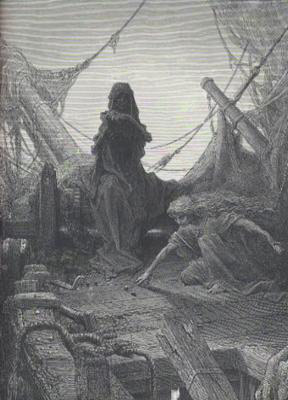
March 24, 2008
Permettez-moi de vous presenter. . .
mon ami, Charles Baudelaire.
And while I'm not saying the intent is my intent, the capitalization of Toi allows me to read it in a way that perhaps M. Baudelaire did not intend. (Almost certainly did not intend given the title of his chief work--Les Fleurs du Mal.)
De profundis clamavi
Charles BaudelaireJ'implore ta pitié, Toi, l'unique que j'aime,
Du fond du gouffre obscur où mon coeur est tombé.
C'est un univers morne à l'horizon plombé,
Où nagent dans la nuit l'horreur et le blasphème;Un soleil sans chaleur plane au-dessus six mois,
Et les six autres mois la nuit couvre la terre;
C'est un pays plus nu que la terre polaire
— Ni bêtes, ni ruisseaux, ni verdure, ni bois!Or il n'est pas d'horreur au monde qui surpasse
La froide cruauté de ce soleil de glace
Et cette immense nuit semblable au vieux Chaos;Je jalouse le sort des plus vils animaux
Qui peuvent se plonger dans un sommeil stupide,
Tant l'écheveau du temps lentement se dévide!
A translation, more poetic than accurate, but aiming at the spirit:
De Profundis Clamavi
Roy CampbellHave pity, my one love and sole delight!
Down to a dark abyss my heart has sounded,
A mournful world, by grey horizons bounded,
Where blasphemy and horror swim by night.For half the year a heatless sun gives light,
The other half the night obscures the earth.
The arctic regions never knew such dearth.
No woods, nor streams, nor creatures meet the sight.No horror in the world could match in dread
The cruelty of that dire sun of frost,
And that huge night like primal chaos spread.I envy creatures of the vilest kind
That they in stupid slumber can be lost —
So slowly does the skein of time unwind!
And another, again, poetic, not literal
Out of the Depths
Jacques LeClercqSole Being I love, Your mercy I implore
Out of the bitter pit of my heart's night,
With leaden skyscapes on a dismal shore,
Peopled only by blasphemy and fright;
For six months frigid suns float overhead,
For six months more darkness and solitude.
No polar wastes are bleaker and more dead,
With never beast nor stream nor plant nor wood.No horror in this world but is outdone
By the cold razor of this glacial sun
And this chaotic night's immensities.
I envy the most humble beast that ease
Which brings dull slumber to his brutish soul
So slowly does my skein of time unroll.
And then this, which comes from the same hand that gave us the delights of The Importance of Being Earnest
from De Profundis
Oscar WildeProsperity, pleasure and success, may be rough of grain and common in fibre, but sorrow is the most sensitive of all created things. There is nothing that stirs in the whole world of thought to which sorrow does not vibrate in terrible and exquisite pulsation. The thin beaten-out leaf of tremulous gold that chronicles the direction of forces the eye cannot see is in comparison coarse. It is a wound that bleeds when any hand but that of love touches it, and even then must bleed again, though not in pain.
Which leads us to:
Psalm 129/130
De profundis clamavi ad te, Domine;
Domine, exaudi vocem meam.
Fiant aures tuæ intendentes in vocem deprecationis meæ.Si iniquitates observaveris, Domine,
Domine, quis sustinebit?Quia apud te propitiatio est;
et propter legem tuam sustinui te, Domine.
Sustinuit anima mea in verbo ejus:speravit anima mea in Domino.
A custodia matutina usque ad noctem,
speret Israël in Domino.Quia apud Dominum misericordia,
et copiosa apud eum redemptio.Et ipse redimet Israël
ex omnibus iniquitatibus ejus.
Which, in those most magnificent of translations are:
Psalm 130
KJV
Out of the depths have I cried unto thee, O LORD.Lord, hear my voice: let thine ears be attentive to the voice of my supplications.
If thou, LORD, shouldest mark iniquities, O Lord, who shall stand?
But there is forgiveness with thee, that thou mayest be feared.
I wait for the LORD, my soul doth wait, and in his word do I hope.
My soul waiteth for the Lord more than they that watch for the morning: I say, more than they that watch for the morning.
Let Israel hope in the LORD: for with the LORD there is mercy, and with him is plenteous redemption.
And he shall redeem Israel from all his iniquities.
1662 BOCP
OUT of the deep have I called unto thee, O Lord : Lord, hear my voice.
O let thine ears consider well : the voice of my complaint.
If thou, Lord, wilt be extreme to mark what is done amiss : O Lord, who may abide it?
For there is mercy with thee : therefore shalt thou be feared.
I look for the Lord; my soul doth wait for him : in his word is my trust.
My soul fleeth unto the Lord : before the morning watch, I say, before the morning watch.
O Israel, trust in the Lord, for with the Lord there is mercy : and with him is plenteous redemption.
And he shall redeem Israel : from all his sins.
To which I append,
[temp title] The Cloud of Unknowing
And so I move from knowing
to unknowing--not merely ignorance
but undoing the knowing I have
untying the knots and staring underneath
at what cannot be known once it is known.
Later: Upon review I discovered that I was remiss in citing my sources. This very fine site presents the original poems from Les Fleurs du Mals with several different English translations. I took the poem and the translations from that site.
Posted by Steven Riddle at 9:03 AM | Comments (1) | TrackBack
March 4, 2008
The Realm of the Inconstant
The first person we have speak to us from the realm of the Inconstant (the lowest and slowest sphere of heaven) is a woman named Piccarda. She is consigned to this realm because of her "inconstancy" to her holy vows of a religious. However:
from Paradiso
notes by John CiardiPiccarda was already a nun and living in her convent when her brother Corso, needing to establish a political alliance, forced her to marry Rossellino della Tossa of Florence. Various commentators report that Piccarda sickened and soon died as aconsequence of having been so forced against her will and vows.
It is this kind of reasoning that throughout time has bred atheists. Circumstances that we do not will nor do we consent to force us to actions that we would not take for which God, who created and allowed these very circumstances, then punishes or demotes us.
Piccarda had no choice in this matter. For much of medieval time in many places women were just a step (and a very small step) above chattel. A few extraordinary women did rise above these circumstances--but for the most part your lot in life as a woman was to do what the men around you told you to.
But in Dante's mind, a woman who against her will is forced to marry and is basically raped, is inconstant to her vow. I'm surprised she isn't in The Inferno for being false to her vow. Instead God in his infinite love and mercy says--"you were trapped by circumstance and by the situations my will allows, and couldn't puzzle your way out of it--so off to the lowest circle of beatitude and be glad I don't kick you downstairs."
Yuck! This is what I constantly run up against in Paradise. A strange sort of paradise it makes it.
Posted by Steven Riddle at 7:54 AM | Comments (1) | TrackBack
Beatrice--Snide and Smug
Here's an example of what I spoke of before. Beatrice speaks to Dante:
from Paradiso
Dante (tr. John Ciardi)"Are you surprised that I smile at this childish act
of reasoning?" she said, "since even now
you dare not trust your sense of the true fact,but turn, as usual back to vacancy?
Charming. Simply charming. There's nothing to inspire love and admiration like some smug, self-righteous, overly informed combatant smiling at your stupidity and then telling you so. I'm supposd to be enchanted/enthralled by this? Color me appalled.
Fortunately Dante's goal was not entirely to make me love Beatrice as he did. If so, his cause is utterly lost. Unfortunately, I perceive that this guide to the celestial realms will not be nearly so convivial as our guide through the other two. We can expect to be laughed at, lectured sternly, and variously assaulted and accosted as we try to enjoy the scenery.
Posted by Steven Riddle at 7:46 AM | Comments (2) | TrackBack
February 26, 2008
Reflections on Purgatorio
I feel obliged to start this discussion with the customary disclaimers. I don't claim to be a deep reader, one filled with wisdom and overflowing with information about Dante. I am, like most of you who read this, a reader--one who enjoys reading things that challenge me and provoke me. I find most readings of critiques to be highly worked up and overwrought--often I find myself doubting that any author would have so contrived and twisted the work they were completing to meet the gyrations of the critics. A critic lays a layer atop a work even though the seeming effort is to explore the labyrinth laid before them.
On the other hand, a reader sees the work from within the labyrinth. There may not be a complete sense of its design, nor may we see clearly all the elements that make up the patterns; however, we see clearly what is clearly spoken and we appreciate the work for that.
That said, let me start these reflections by sharing one line that really struck me. Bear in mind that the translation I am using, for a great many reasons, is the one by John Ciardi:
". . . the blessed wormwood of my agony."
It is strictly out of context, but it started the other chain of thought I wanted to share. This line is spoken by one in purgatory. Speaking of his wife's ardent prayers on his behalf, he notes that her prayers have lifted him already so high in purgatory, setting aside years and years of suffering that would otherwise be required for purgation.
But notice the way he refers to this suffering--"the blessed wormwood of my agony." The suffering is real--it is as real as the suffering in Hell, and yet it is not torment. Over and over again Dante makes the point that this suffering is gladly engaged in, indeed embraced by the souls themselves as they know the end of it in time. The Lustful souls in conversation with Dante stay strictly within their sheets of flame, and so it is throughout the Purgatory. The souls know that this suffering cleanses, this suffering purifies, this suffering leads to heaven.
Extend that a bit--human suffering, properly viewed and with a heart set on God's will is purgative. And that suffering be it "Nella's tears" (the wife referred to above) for the loss of her husband and for the sympathy with his suffering, or our own physical pain borne with the expectation of seeing God, is purgative not only for ourselves but for others as well. In the Christian context, suffering has meaning. But so too does the beatific vision. Those in purgatory do not needless extend their stay, reveling in their suffering and purgation. Rather, they move on to the beatific vision and to the enjoyment of the presence of God. This is where I part company with many of the Saints. While suffering is purgative, life is filled with enough--we needn't add to it through our own contrived mortifications that have as their end release from attachment. Properly lived, life has quite enough that should provoke us to give up the things we are attached to--the celice and the discipline are neither required, nor, it seems to me, within God's ordained will for us. He hands out the suffering we require--we need not add to it. And indeed, adding to it is contradictory to His will, it is clinging to purgatory when He has decided we need bliss.
Purgation happens. Life carries with it enough of heaviness. Little things like denying ourselves too much food or food of a certain kind--that isn't really suffering, or if it is it is suffering borne of our own selfishness and self-centeredness. People in India live very well without a Hershey's bar a day. Real suffering--not having enough to eat, losing someone we love, living through a terrible wasting disease with Death hanging over us--is not something we choose. It is something that with the grace of God we live through and by living through it contribute both to our own purgation and to the purgation of those around us. We are not saved singly, although salvation is individual and singular for each person. Rather, we are saved within the community, the entire Body of Christ is resurrected, not merely a cell on the big toe. Our own bliss in salvation comes in part from the knowledge that salvation is for all and we have worked for it through our many small works of spiritual and corporeal mercy.
Thus purgation can begin here as we abide in God's will, accept what life brings us, and relish God's perfect plan expressed through it. That doesn't mean we do not mourn or hurt. But it does mean that our pain has meaning both for us and for those around us. When we live through a time of suffering, we are in sympathy with those in Purgatory and we are spending a little of our own time there as we head for heaven. Suffering isn't to be sought out--it will find us soon enough. But once we have been found, bearing with the suffering through the strength of the One who saves us strengthens both us and those around us even though we do not necessarily see this effect.
One last point on Purgatorio comes from a provocative note by the translator in the endnotes. I will let it stand without further comment:
from "How to Read Dante"
John CiardiThe Seven Deadly Sin for which souls suffer in Purgatory are--in ascending order--Pride, Envy, Wrath, Adedia, Avarice, Gluttony, and Lust. Acedia is the central one, and it may well be the sin the twentieth centruy lost track of. Acedia is generally translated as Sloth. But that term in English tends to connote not much more than laziness and physical slovenliness. For Dante, Acedia was a central spiritual failure. It was the failure to be sufficiently active in the pursuit of the recognized Good. It was to acknowledge Good, but without fervor.
Posted by Steven Riddle at 7:36 AM | Comments (0) | TrackBack
November 13, 2007
"The Figure a Poem Makes"
from "The Figure a Poem Makes"
Robert FrostIt should be of the pleasure of a poem itself to tell how it can. The figure a poem makes. It begins in delight and ends in wisdom. The figure is the same as for love. No one can really hold that the ecstasy should be static and stand still in one place. It begins in delight, it inclines to the impulse, it assumes direction with the first line laid down, it runs a course of lucky events, and ends in a clarification of life-not necessarily a great clarification, such as sects and cults are founded on, but in a momentary stay against confusion.
The entire essay or, at least, a longer excerpt, here. For those interested--here's a link to an Arabic translation. Isn't it lovely even to look at?
Posted by Steven Riddle at 8:05 AM | Comments (0) | TrackBack
October 9, 2007
Bewteen Truth and . . .
from Puragatorio
Dante, tr. John Ciardi[Virgil speaking to Dante]
But save all questions of such consequence
till you meet her who will become your lamp
between the Truth and mere intelligence.
How many aspire to the Truth by means of human reason alone. And I don't refer to the scholastics or their followers but the benighted Dawkinses and Hitchenses of the world who claiming liberation from the hoary old ties that bind, bind us in new and more severe chains, because within these we could easily be cast into the Hell of our own making. Human intelligence is faulty and frankly, in my experience, often not much interested in the Truth so much as in making a display of itself for others to admire.
Posted by Steven Riddle at 8:48 AM | Comments (0) | TrackBack
At Home (or in Vegas) with Dante
from Purgatorio
Dante, tr. John CiardiThe loser, when a game of dice is done,
remains behind reviewing every roll
sadly, and sadly wiser, and alone.The crowd leaves with the winner: one behind
tugs at him, one ahead, one at his side--
all calling their long loyalty to his mind.Not stopping, he hands out a coin or two
and those he has rewarded let him be.
So he fights off the crowd and pushes through.Such was I then, turning my face now here,
now there, among that rout and promising
on every hand, till I at last fought clear. . . .When I had won my way free of that press
of shades whose one prayer was that others pray
and so advance them toward their blessedness. . .
What Dante is promising is to remember those who approach him to those who love them back home and to remind all to pray for the poor souls in purgatory whose progress toward heaven is sped by the prayers of those in a state of grace. As we approach the days in which we recall the Saints and all the dead, Purgatorio is perfect reading--a reminder always to bear in mind those who suffer now for eventual glory. And a reminder to us to cut our suffering hereafter short by living a life that has as its goal an ever nearer approach to God in the life of this world.
Posted by Steven Riddle at 8:24 AM | Comments (0) | TrackBack
October 8, 2007
The pre-Blessed Spirits
One of the truly wonderful things about Purgatorio is that Dante over and over again affirms that these souls who arrive on the shore of the island of Purgatory are already blessed. They arrive and proceed through at their own pace, a pace determined by their lives on Earth.
Among those moving very slowly on the shores of the island we meet Manfred:
from Purgatorio
Dante, tr. John CiardiMy flesh had been twice hacked, and each wound mortal
when, tearfully, I yielded up my soul
to HIm whose pardon gladly waits for all.Horrible were my sins, but infinite
is the abiding Goodness which hold out
its open arms to all who tun to It. . . .No man may be so cursed by priest or pope
but what the Eternal Love may still return
while any thread of green lives on in hope.Those who die contumacious, it is true,
though they repent their feud with Holy Church,
must wait outside here on the bank, as we do,for thirty times as long as they refused
to be obedient, though by good prayers
in their behalf, that time may be reduced.
I quote this passage for several reasons. One is to give a sense of Dante's vision. Ciardi notes that there seems to be no real significance to 30 as opposed to say 50 or 100. In fact, except that it probably doesn't work in Italian 33 might be more apropos.
Another reason is that reading this one gets the sense of a need for real notes. What's this about twice hacked, what actually went on. In a section I didn't quote there is a mention of him being transported with "tapers quenched" after his death. Good notes are essential to any real understanding of these works. Either that or a fairly thorough understanding of the history of all the kingdom that made up Italy at the time of Dante--an expertise almost none of us command.
Finally I quoted it because it contains a line that I have borne in memory since the eighth or ninth grade when we were called upon to read Robert Penn Warren's All the King's Men. There is either in an epigraph or in a chapter proper, a quotation which, in the book, is a reference to the office set-up of Willie Stark, but which is reflected clearly here
Mentre che la speranza ha fior del verde
which is translated in that book As long as hope still has its bit of green. Here is is translated "while any thread of green lives on in hope."
For whatever reason, that line has stuck with me, and I scoured Dante several times looking for it. And this morning, it just popped out at me as I was reading. God's sheer grace and goodness and perhaps a message for meant for this day.
Posted by Steven Riddle at 7:12 AM | Comments (0) | TrackBack
October 4, 2007
A Dantean Invocation for the Day
from The Inferno--Canto XXIV (46-51)
Dante (tr. John Ciardi)"Up on your feet! This is no time to tire!"
my Master cried. "The man who lies asleep
will never waken fame, and his desireand all his life drift past him like a dream,
and the traces of his memory fade from time
like smoke in air, or ripples on a stream. . . ."
Posted by Steven Riddle at 7:38 AM | Comments (0) | TrackBack
September 5, 2007
Cold Truth
The cold light of truth in four lines from a poem.
from "The Imaginary Iceberg"
Elizabeth BishopWe'd rather have the iceberg than the ship,
Although it mean the end of travel.
Although it stood stock still like cloudy rock
And all the sea were moving marble.
Posted by Steven Riddle at 10:36 AM | Comments (0) | TrackBack
September 4, 2007
Correspondences
To make good sense of Roethke's poem, you may want to visit one by Charles Baudelaire, Correspondences, another translation of which is appended below.
Correspondances
Charles BaudelaireLa Nature est un temple où de vivants piliers
Laissent parfois sortir de confuses paroles;
L'homme y passe à travers des forêts de symboles
Qui l'observent avec des regards familiers.
Comme de longs échos qui de loin se confondent
Dans une ténébreuse et profonde unité,
Vaste comme la nuit et comme la clarté,
Les parfums, les couleurs et les sons se répondent.
II est des parfums frais comme des chairs d'enfants,
Doux comme les hautbois, verts comme les prairies,
— Et d'autres, corrompus, riches et triomphants,
Ayant l'expansion des choses infinies,
Comme l'ambre, le musc, le benjoin et l'encens,
Qui chantent les transports de l'esprit et des sens.Correspondences
Nature is a temple where living pillars
Let escape sometimes confused words;
Man traverses it through forests of symbols
That observe him with familiar glances.Like long echoes that intermingle from afar
In a dark and profound unity,
Vast like the night and like the light,
The perfumes, the colors and the sounds respond.There are perfumes fresh like the skin of infants
Sweet like oboes, green like prairies,
—And others corrupted, rich and triumphantThat have the expanse of infinite things,
Like ambergris, musk, balsam and incense,
Which sing the ecstasies of the mind and senses.
Translation from this site q.v. for an interesting explicative note.
Posted by Steven Riddle at 12:03 PM | Comments (1) | TrackBack
The Body of Allusion
The text of one of my all-time favorite poem--posted or reposted. Magnificent and beautiful. I am often stunned by Roethke's poetry and I remember really disliking it when I first read it--go figure.:
In a Dark Time
Theodore RoethkeIn a dark time, the eye begins to see,
I meet my shadow in the deepening shade;
I hear my echo in the echoing wood--
A lord of nature weeping to a tree,
I live between the heron and the wren,
Beasts of the hill and serpents of the den.What's madness but nobility of soul
At odds with circumstance? The day's on fire!
I know the purity of pure despair,
My shadow pinned against a sweating wall,
That place among the rocks--is it a cave,
Or winding path? The edge is what I have.A steady storm of correspondences!
A night flowing with birds, a ragged moon,
And in broad day the midnight come again!
A man goes far to find out what he is--
Death of the self in a long, tearless night,
All natural shapes blazing unnatural light.Dark,dark my light, and darker my desire.
My soul, like some heat-maddened summer fly,
Keeps buzzing at the sill. Which I is I?
A fallen man, I climb out of my fear.
The mind enters itself, and God the mind,
And one is One, free in the tearing wind.
Posted by Steven Riddle at 10:57 AM | Comments (0) | TrackBack
August 31, 2007
Another Theory About Poetry
Sometimes I wonder if any great work of poetry actually sprang from a poet who wrote with intention rather that wrote from his or her own experience. That is not to say that there is no meaning in poetry, but those poems most fraught with meaning, most bound up in intention may be only secondarily so. That is, the poet in the composition of them followed the muse (inspiration, the Holy Spirit--you name the mysterious element that gives birth to art).
I ask because when I look around at all the earnest young artists today whose intent is to jolt, shock, and pull us out of our blase day-to-day plumbing of reality, their work is mostly of a moment. The shock wears off and the work becomes an artifact--a remnant of an era.
I look at some of the great poetry of the past and I see story telling, and yes, some kernel of a notion, some idea that gave birth to the whole--but I don't necessarily buy that the whole poem was constructed toward the end represented by the kernel. It may have been refined and perfected with the end in mind--but as I think about my poetry, I realize I don't think, "I'm going to bring this symbol and that symbol into conjunction and by their juxtaposition undermine this linguistic element. I think instead of a moment--real or imagined--a moment that means something--not in the sense of universal meaning, but in the sense of having importance in my understanding of how the world works. And thinking of that moment, I attempt to convey that understanding as best I can. There is no intent for this or that meaning. The words lead, I follow them.
And because that is the pattern, I often wonder whether all that is made of Eliot is purposive, or if rather he composed what made sense to him in all the complexity that is Eliot and we are left to divine purpose and intent where indeed the only purpose may have been to expel the irritant. When it happens we sometimes have pearls--but mostly we have dross--even in the works of the greatest poets--the discards more than likely greatly outnumber the poems that are worked to completion.
Just some thoughts, with no proof behind them.
Posted by Steven Riddle at 8:00 AM | Comments (0) | TrackBack
August 5, 2007
Revisiting Break, Blow, Burn
Some time back I reviewed Break, Blow, Burn by Camille Paglia and remember being put off by some of her idiosyncratic choices for modern poetry. Perhaps I focused too much attention on that.
Ms. Paglia has a distinct voice, self-assured, self-assertive, urbane, and elegant. Her personal opinions have the solidity of the throne of God and she expresses them as though they were edicts passed down from the time of Moses. She triumphs the artistry of Stevie Nix while decrying the depredations of the European post-structuralists.
What she says deserves attention, not because she says it does, but because her voice has an authority that comes from deep engagement with the materials she studies. Agree or disagree as you will, one thing will be certain--you will be perfectly clear on what you are agreeing or disagreeing with. Ms. Paglia's prose is bereft of the academic apparatus of most critics. And for good reason, "Good writing comes from good reading. Humanists must set an example: all literary criticism should be accessible to the general reader. Criticism at its best is re-creative, not spirit-killing." And so the criticism she tenders in this book fits that pattern she assumes for criticism in general.
One might argue with some of the re-creations--for example, the excessive rhapsodic waxings on William Carlos Williams and on Joni Mitchell's "Woodstock," can strike one as overwrought and grasping at straws. But then, her passionate enthusiasm for these works deserves our attention. Perhaps we overlook something that might well be worth consideration. Perhaps there is something here that we must learn from an enthusiast disguised as a critic.
But I picked up the book , once again charmed into reading by the beautifully fashioned introduction in which Ms. Paglia sets herself up as pedant and tour-guide in a whirlwind cruise through English poetry from Shakespeare to Joni Mitchell. And her first stop is what gave me pause and begged for a more gentle reconsideration of the book:
Sonnet 73
William ShakespeareThat time of year thou mayst in me behold
When yellow leaves, or none, or few, do hang
Upon those boughs which shake against the cold,
Bare ruin'd choirs, where late the sweet birds sang.
In me thou seest the twilight of such day
As after sunset fadeth in the west,
Which by and by black night doth take away,
Death's second self, that seals up all in rest.
In me thou see'st the glowing of such fire
That on the ashes of his youth doth lie,
As the death-bed whereon it must expire
Consumed with that which it was nourish'd by.
This thou perceivest, which makes thy love more strong,
To love that well which thou must leave ere long.
Of the great bard's sonnets, one of the more melancholy and searching--bleak as a desert and therefore refreshing in a way that only truth and emptiness can be.
Ms. Paglia goes on to point out matters structural: The three quatrains are single sentence-metaphors each applied to is subject and accumulating into the final couplet. Matters linguistic: you can identify each by the presence of the phrase "in me." And matters symbolic--"bare ruined choirs" being both the life of the poet and the destruction of Henry VIII. Here, perhaps because of her own attempt at making a secular scripture, she may not have as full a reading as might be possible were she to plumb the depths of Shakespeare's faith. She asserts that, "There is no reference to God or an afterlife. Consciousness itself is elemental, an effect of light and heat that dissipates when our bodies are reabsorbed by nature." Here she follows the fatal flaw of her mentor Harold Bloom, who cannot seem to see that Shakespeare, far from being a secularist, was deeply spiritual, and the threads of this poem speak both to the fate of the human person, but also to the fate of that subject to the human person. "Bare ruined choirs where late the sweet birds sang," is indeed the work of man--the attempt to drive out God and replace Him with what man hath wrought--the Reformation religion.
But enough. The point here was two-fold--to present a kind of apology for the first review and to present this lovely sonnet. And it was slanted more to the second. When I opened the book and saw it there I read it. Then I read it again. Then I read it aloud. Then I read it again. Then I read Ms. Paglia's enlightening gloss of it. And then I read it again, recognize the partial truth of Ms. Paglia's interpretation. But also realizing that in three pages she could hardly do justice to the tight compression of this gem of the English language.
So do yourself a favor. Go back up to the poem and read it. Really read it. Don't let your eyes cascade down it. Stop at each word. Say it out loud. Say it slowly. Then read it quickly. Then force it into it's iambic pentameter and see where the stresses fall (this indeed is part of the amazing genius of Shakespeare--not only did he use Iambic pentameter, he also used the meter to undercut or enhance the message and meaning of the words resting upon that base. And if you don't think this is any big deal, try it yourself.)
Shakespeare is a place to start. But as I thought about it, what if one were to approach scripture in the same way. Read it, read it again. Read it out loud. If it's poetry try singing it, or letting it roll in a rhythm of poetry. Try rephrasing it. Listen to it in all those ways and you will be astonished at what may come through for you. Words you've heard more times than you can count come alive--they breathe and make new strong-fashioned art. No wonder Shakespeare so easily confuses atheist academics who wish to make of him a secular scripture. He had himself internalized these rhythms of the language and used them in a way that at that crossroads of time and art turned him into an archetype. No wonder George Bernard Shaw spent all of his time despising Shakespeare, always concerned that he would never escape the Bard's long shadow. And indeed, he did not.
Posted by Steven Riddle at 7:46 PM | Comments (2) | TrackBack
August 1, 2007
For the Poets Among Us
Perhaps you all can advise.
When I write and let the words flow as they naturally flow and follow carefully their internal rhythms and mechanics, I almost always wind up with lines of 9 or 11 syllables.
For example, this line,
and richly has delivered on that promise.
I can change it and make it conform to "standard" prosody, and yet to do so changes the meaning, rhythm, and meter to such an extent that the poem, while it may be technically perfect thuds and limps.
Some poetic voices conform nicely to iambic pentameter, but I'll be honest, I've never thought it the rhythm of English speech, though many will swear that it is the "natural rhythm of English." To me it always sounds a little stilted, a little forced, a little off. Not badly so, but enough so that you can tell you're hearing a line of poetry--and while that isn't bad, it seems rather like letting the audience know how you made the penny vanish.
Any opinions, ideas, suggestions, notions, or . . . I don't know. I'd love to hear any feedback.
Posted by Steven Riddle at 5:28 PM | Comments (3) | TrackBack
July 31, 2007
An Observation
Let me start, apropos of nothing, with a revised line from my journal this morning because it allows me to think about some beautiful things.
"Life without prayer is Life-in-Death."
Originally, I said, "half-life." But then I thought of Coleridge's poem and the remarkable image of Death and a woman casting dice for the Mariner's fate.
from "Rime of the Ancient Mariner"
Samuel Taylor ColeridgeHer lips were red, her looks were free,
Her locks were yellow as gold:
Her skin was as white as leprosy,
The Nightmare Life-in-Death was she,
Who thicks man's blood with cold.
Life-in-Death wins the Ancient Mariner. And it's interesting that the first part of the description of Life-in-Death is rather attractive in a seductive sort of way. And even white skin is lovely until we reach "as leprosy."
Life without prayer is succumbing to Life-in-Death--a life of sensuality that misses the point of life at all--not really living, but living in Death.
We have a choice--God or anything else because God has made it clear that He is not a God of half-measures, and He will let us have our choice. Not easily, He'll fight for us, but if we insist, He will not overwhelm us and subdue our wills to his choice.
And so, life without prayer is life without God and not a life at all.
Posted by Steven Riddle at 5:40 PM | Comments (0) | TrackBack
July 26, 2007
Seeking the Perfect Line
And my candidates:
Her changes change her changes constantly--Dante speaking of Dame Fortune
Nor ever chaste, except you ravish me--John Donne Holy Sonnet XIV
Set me as a seal upon thine heart, as a seal upon thine arm--Song of Songs 8:6
Undoubtedly, there are others, but these are a start and cause me to want to seek more.
Posted by Steven Riddle at 7:16 AM | Comments (0) | TrackBack
June 7, 2007
Fierce Poetry, Fragile Poet
I post these because they speak for me when I have no tongue or sense and they say what cannot be said by me even were I longing to say it.
To My Lady of Poetry
Alfonsina StorniI throw myself here at your feet, sinful,
my dark face against your blue earth,
you the virgin among armies of palm trees
that never grow old as humans do.I don't dare look at your pure eyes
or dare touch your miraculous hand:
I look behind me and a river of rashness
urges me guiltlessly on against you.With a promise to mend my ways through your
divine grace, I humbly place on our
hem a little green branch,for I couldn't have possibly lived
cut off from your shadow, since you blinded me
at birth with your fierce branding iron.
Note "My lady" not "Our lady." The poem seems to be about the Blessed Virgin and is certainly strewn with her trappings, but what is adored here is not Mary, Mother of God, but the muse of poetry. And what is said here is said thoroughly in the last tercet because it seems to me that there is a way of seeing that cannot be undone or unseen, a blindsight that is the gift and curse of the poet and no amount of undoing can change it or alter it one iota--it is laid upon one at birth, or at least very early on and it is through that lens that all is seen that can be seen and seen in ways that it seems others do not. Although that last may simply be pretension and pride.
Posted by Steven Riddle at 7:15 AM | Comments (0) | TrackBack
Confused Love
And love can be most confusing:
I Do Not Love You Except Because I Love You
Pablo Neruda
I do not love you except because I love you;
I go from loving to not loving you,
From waiting to not waiting for you
My heart moves from cold to fire.I love you only because it's you the one I love;
I hate you deeply, and hating you
Bend to you, and the measure of my changing love for you
Is that I do not see you but love you blindly.Maybe January light will consume
My heart with its cruel
Ray, stealing my key to true calm.In this part of the story I am the one who
Dies, the only one, and I will die of love because I love you,
Because I love you, Love, in fire and blood.
And another, quite lovely even in translation:
Saddest Poem
Pablo Neruda
I can write the saddest poem of all tonight.Write, for instance: "The night is full of stars,
and the stars, blue, shiver in the distance."The night wind whirls in the sky and sings.
I can write the saddest poem of all tonight.
I loved her, and sometimes she loved me too.On nights like this, I held her in my arms.
I kissed her so many times under the infinite sky.She loved me, sometimes I loved her.
How could I not have loved her large, still eyes?I can write the saddest poem of all tonight.
To think I don't have her. To feel that I've lost her.To hear the immense night, more immense without her.
And the poem falls to the soul as dew to grass.What does it matter that my love couldn't keep her.
The night is full of stars and she is not with me.That's all. Far away, someone sings. Far away.
My soul is lost without her.As if to bring her near, my eyes search for her.
My heart searches for her and she is not with me.The same night that whitens the same trees.
We, we who were, we are the same no longer.I no longer love her, true, but how much I loved her.
My voice searched the wind to touch her ear.Someone else's. She will be someone else's. As she once
belonged to my kisses.
Her voice, her light body. Her infinite eyes.I no longer love her, true, but perhaps I love her.
Love is so short and oblivion so long.Because on nights like this I held her in my arms,
my soul is lost without her.Although this may be the last pain she causes me,
and this may be the last poem I write for her.
Posted by Steven Riddle at 7:04 AM | Comments (0) | TrackBack
June 6, 2007
In the Season of the Spirit
Veni Creator
Czeslaw Milosz
Come, Holy Spirit,
bending or not bending the grasses,
appearing or not above our heads in a tongue of flame,
at hay harvest or when they plough in the orchards,
or when snow covers crippled firs in the Sierra Nevada.I am only a human being: I need visible signs.
I tire easily, building the stairway of abstraction.
Many a time I asked, you know it well,
that the statue in church lift its hand, only once, just once, for me.
But I understand that signs must be human,
therefore, call one person, anywhere on earth,
not me-after all I have some decency-
and allow me, when I look at that person,
to marvel at you.
And as a result, my life is better.
Posted by Steven Riddle at 7:52 AM | Comments (0) | TrackBack
Lest We Seem Too Far Gone
A contemporary British haiku, thank you.
[Haiku] Wendy Cope(iii)
November evening:
The moon is up, rooks settle,
The pubs are open.
That never-ending Japanese obsession with the pubs here creeps into British poetry.
Posted by Steven Riddle at 7:01 AM | Comments (0) | TrackBack
A Purgatorial Poem
Being of a melancholy cast of mind this morning, a purgatorial poem seems best to fit the mood:
Cuchulain Comforted
William Butler YeatsA man that had six mortal wounds, a man
violent and famous, strode among the dead;
Eyes stared out of the branches and were gone.Then certain Shrouds that mutter head to head
Came and were gone. He leant upon a tree
As though to meditate on wounds and blood.A Shroud that seemed to have authority
Among those bird-like things came, and let fall
A bundle of linen. Shrouds by two and threeCame creeping up because the man was still.
And thereupon that linen-carrier said
'Your life can grow much sweeter if you will'Obey our ancient rule and make a shroud;
Mainly because of what we only know
The rattle of those arms makes us afraid,'We thread the needles' eyes and all we do
All must together do.' That done, the man
Took up the nearest and began to sew.'Now we shall sing and sing the best we can
But first you must be told our character:
Convicted cowards all by kindred slain'Or driven from home and left to die in fear.'
The sand, but had not human notes n or words,
Though all was done in common as before.They had changed their throats and had the throats of birds.
Something about these shades resonates within me. The poem speaks out of shadow and into shadow and is shadow-strewn all about.
Posted by Steven Riddle at 6:50 AM | Comments (0) | TrackBack
January 31, 2007
A Source for the Title
And a resource for thinking more about the book Cold Heaven.
THE COLD HEAVEN
William Butler YeatsSUDDENLY I saw the cold and rook-delighting Heaven
That seemed as though ice burned and was but the more ice,
And thereupon imagination and heart were driven
So wild that every casual thought of that and this
Vanished, and left but memories, that should be out of season
With the hot blood of youth, of love crossed long ago;
And I took all the blame out of all sense and reason,
Until I cried and trembled and rocked to and fro,
Riddled with light. Ah! when the ghost begins to quicken,
Confusion of the death-bed over, is it sent
Out naked on the roads, as the books say, and stricken
By the injustice of the skies for punishment?
Posted by Steven Riddle at 8:34 AM | Comments (0) | TrackBack
January 9, 2007
Unaccustomed as I am to Public Speaking
I don't much like self-promotion, but presumably by posting this link I am also increasing the audience for the on-line magazine. So, if you're so inclined go and see my latest publication here.
Posted by Steven Riddle at 12:00 PM | Comments (1) | TrackBack
October 8, 2006
Linked Verse, Ended
My thanks to everyone who contributed to this wonderful experiment. There were a small number of entries, but we got from it three interesting poems that would not otherwise be.
Linked verse is a kind of word game. It served as a sort of community building exercise among the poets of the Japanese Court. Of course, there was oneupsmanship and all manner of odd exercises that go with poets writing poetry together; however, it is an elegant and charming way to introduce the poetry shy into the art of poetry and to give the participant some sense of the diffiuclty of composing images in few words.
Everyone who chose to partipcate did a magnificent job of fulfilling the object of the exercise and producing their links. Thank you so much. I emjoyed, as well, watching the verse grow from its separate pieces and influences.
Posted by Steven Riddle at 10:16 AM | Comments (1) | TrackBack
October 7, 2006
Three Strains of Autumn--Linked Verse Continued
Be sure to check below this first post for additional posts. This is being kept high up on the list so that people will continue to add and admire the works of others. Autumn Brightness is really taking off, and we've even had an adidition to "Autumn? What Autumn?" thanks to Mrs. Darwin.
While it is more usual to assemble linked verse one contribution at a time, because so much good was offered and so much that will work together, I have assembled the following offerings.
The next step is to choose a strain (please indicate in your contribution) and add the next link in the verse.
To be faithful to the authors--I removed additional indications of break as they are not usual part of the linking. In one case I made a plausible edit, in another requested an author's permission to add to the contribution.
Now I present my compilation and ask for the next contributions. The fun of linked verse is to wrench the poem out of the direction it was going and give it a new heading that still makes sense. I hope these do that so far.
Autumn Brightness
Fall fell in one night
cold crept in, painting the sky,
summer's cessationThe calendar page rustles
Smoke in the rain wind wakes meOne last cricket song
Train whistles while gutters drip
Dark night but cheerfulNow grass is dry from summer
Heat lingers on golden hillsAs our summer ends
We wait for the winter rain
But first the wild firesfires that burn in falling leaves
in leaves in swirls underfootCool in the nostrils
Running loose on the wet grass
Fall remembers meThe sounds of dried leaves crunching
The smell of hot dogs cookingCheers from the home crowd,
On a crisp fall afternoon:
Football has returned!Winter grey-brown sea begins
to limn the shoreline--salt frostBirds return, ibis
once again strut and pluck lawns--
bold October looms.Seeking porchlights, out past dark
Muffled laughter, running feetTennis-shoed pirates,
Princesses, ninjas and ghosts;
Ding-dong: Trick or Treat!Blue Angels each October,
While the ocean turns cooler.Fog in the morning
Near the sea, sunny afternoons,
November fireplaces.Autumn. Poor Souls Purgatory
Reminds us of death decay.But my Spirit rises
As I see resurrection
In luminous leaves.dewdrop on red leaf fallen
in the early autumn grasscolor surprises
morning's brightness magnified
with a trace of chill
Autumn Bleakness
Fall fell in one night
cold crept in, painting the sky,
summer's cessationI am her friend and lover
waking to her misty dawnprayers spill from mouths --
cloudy little pools of hope
lost as the day warmsLike grey leaves, our lives grow dim.
Will we see the winter's birth?Drive, work, a pay stub:
These define life's borderlines.
Happiness eludes.To be found again in sweat
Spent for love without reward.O little bold squirrel,
You cross the road fearlessly,
But brother lies dead
Autumn? What Autumn?
Fall fell in one night
cold crept in, painting the sky,
summer's cessationBut not all is quiet,
with the children who are working together
to create a puzzle picture
while Mama writes a poem.Images alive become
Images living in words.Happy laughter rings.
Mama pauses, wishes she
Could find the camera.
Note this last strain is a more avant-garde form in which the more or less thirty-one syllables are used at the poet's command. A much more challenging linkage.
Remember, to add on--2 7-syllable lines, and a 5-7-5. So, overall you have: 7-7-5-7-5--thirty-one delectable little syllables to share autumn where you are.
Posted by Steven Riddle at 9:51 AM | Comments (10) | TrackBack
October 1, 2006
Linked Verse
I want to encourage everyone to continue to contribute. We've had several really nice additions to the "brightness" thread over the past few days from people who very modestly say "We're not poets." The reality is that every person is a poet from birth--we just have it drummed out of us as we study the mind-numbing nonsense that most people consider literature classes. We won't all produce world-class poetry, but as children of that greatest Poet, we each have our own voice and charms. The constrained form of the linked verse also helps in versifying--it gives strong rules that help to guide the writing in distinct ways. So all you not-poets out there, abandon your inhibitions, drop your protections, and give us some linkages to our verse. So far, Autumn Brightness is a pretty good read, and give a nice sense of the diversity of Autumn around the country.
Posted by Steven Riddle at 10:23 AM | Comments (0) | TrackBack
September 28, 2006
Playing Catch-Up
Those of you favoring moribund images of autumn are WAYYYYY behind. Get moving, add to your linked verse!
Posted by Steven Riddle at 11:41 AM | Comments (0) | TrackBack
September 25, 2006
Linked Verse
I'm closing the linked verse post below as I compile the three main threads I've identified thematically--the melancholy, the joyous, and the avant garde. I've decided to use everything I've received if I can work the pieces correctly and we'll use that as the basis for our next linkages. Thanks to everyone who has participated so far.
Posted by Steven Riddle at 1:11 PM | Comments (0) | TrackBack
Step Right Up, Don't Be Afraid
So, you say you're not a poet.
You say you don't know nothing about versifying no poem.
No print, No poem, NO PROBLEM!
If you can count, you can add to the linked verse. Yep, a mere 31 syllables about what is happening around you right now. A moment away from Dancing with the Wife Swap Next Door Neighbors Survivor: East OskKosh, 24 Found (or is it 24 Lost?) CSI: Milledgeville or whatever other pressingly urgent event is impinging on your conscience. Set them aside for a moment and take a stab at it. You'll be glad you did.
Homeschool moms, send your kids. Ideal for you, old, elderly shut-ins and ingenues, Nascar Fans, and just mean old curmudgeons.
Let's make a poem together. All you have to lose is about 30 seconds and 31 syllables. Even James would be impressed with the curb on the tongue!
So step right up. That's it, just spin the magic syllable wheel and churn out the next link in our poem.
Posted by Steven Riddle at 8:52 AM | Comments (0) | TrackBack
Here, I'll Even Loan You a Starter
"But not all is quiet. . .
There, six syllables. Cut off the but, and you've got five, only 25 or 26 more to go!
Posted by Steven Riddle at 8:51 AM | Comments (1) | TrackBack
September 7, 2006
A Poetic Invitation
It occurred to me as I posted the previous poem that I would like to run an experiment in blogging linked-verse. I don't know how many poets there are out there who would be willing to go along, but let me explain what I have in mind.
In a couple of days, I will post a haiku that will be the "seed" of the linked verse experiment. I will also remind everyone that the theme will be "Autumn" or "October," wherever you happen to be. What I hope we can create through the linked verse is a celebration of my favorite season from people in different places (Sorry Aussies and Kiwis, to join in you'll just have to remember what Autumn is like where y'all live while those Northern Hemispherer's are actually experiencing it.)
The rules of linked verse are very simple. The person who wishes to add completes the Haiku by making it a tanka. That is, two seven syllable lines are added to the original haiku that complete that thought and begin the transition into the next thought. Then you also add the new haiku--as a reminder that is a poem of syllable pattern 5-7-5.
Thus each addition will take the form 7-7/5-7-5.
Now here's what I will do. As you post these in comments, I will choose the two or three that most appeal to me and post them along with the original, thus making the linked verse, and I'll add the author's name to the author list. No matter how often you add, you'll be on the author list once.
If you post additions to the linked verse, you are allowing use of that work here or anywhere else someone wishes to carry on a variant of the verse--in short a creative commons license limited to this work alone.
What I hope will happen is that others will be inspired and moved by other connections than I was, they will take those to their own sites and become their own author/editors of linked verse. I'm hoping that here we will have at least one continuation on the theme of autumn and that we get other variations that give rise to other poems.
No previous poetic experience required. Help provided upon request. Enjoy. I'd like this to be a fun and interesting game that engages people in the creation of simple works of beauty. Together we'll discover that linked verse cannot be forced into a channel and allowed to run wild, it will emulate the season and the theme of nature. At least I hope that's what everyone will discover.
I hope you all feel open to participating and enjoying the experience. And remember, given where I live, my Autumn imagery is likely to be quite different from what the rest of you all see. Mir can vouch for that.
Of what I've explained is unclear, please ask questions so we can clarify all points before we begin. There are no prizes and no right answers, the object is to enjoy and to see how many different things can grow from a simple seed.
Posted by Steven Riddle at 6:59 PM | Comments (0) | TrackBack
July 20, 2006
Laying My Cards on the Table
This is extremely difficult, so please forgive the following for whatever it lacks in cohesion, it is excerpted from my part of a private correspondence:
But let me tell you about my experience. Someone took one of the poems I wrote, altered a few words akin to the example I published regarding racism and published it in their own magazine. The magazine was a marginal one anyway and I didn't have the money to go after these people, but they took my poem about the glory of diversity and changed it into a hymn to conformity and supremacy and left my name on it. The poem may not have been high art--in fact, it may not have been particularly good--so Art doesn't enter into it. But someone took my words, edited them for their own sense of suitability and then proclaimed the work to be my own. I only found out when I started to get angry looks/comments and letters about the poem.
Now, naturally, I have to repudiate the entire poem, and I don't even mention the incident lest it bring up the whole subject.
In other words, I know what it feels like when one takes it upon oneself to alter the work of another without proper acknowledgment of what has been done. And it hurts--tremendously.
This isn't mere wounded pride or vanity. This is stomach-churning horror and sickness. This is nauseating to the extreme because I have been saddled and labeled to with the name of racist for something I never even did. This hurts--a lot. It hurts because I have a child who may find this out in the future. amd if he does, what is he to think--that his own life with me has been a lie, or merely a means of atonement for past sins? It hurts because there is always the remote possibility my friends or acquaintances may discover it and make me a pariah. Sure, I can explain it--I can show copies of the original that even have comments on them from the professor who originally read it--so they can see its authenticity. But I can never escape from the shadow of it.
So none of this is theoretical to me. It is all factual--harsh reality. I know, as you do in a different way, whereof I speak. This is what impels me to the limits of politeness when I talk about the subject.
And it impels me to judge that the practice is immoral, unethical, and completely unallowable. This is what we are discussing here--the unilaterally transformation of a work and the republication of that work as the work of the original author. If what has been done to me is not immoral or unethical, what description might it travel under?
Later--I see that I did not make clear one essential ingredient of this stew. The poem that was published was not merely edited. It was taken from a previous publication and altered beyond recognition without my consent and republished with my name on it. This makes it the equivalent of the case I have been mistakenly referring to. We're not talking editorial changes in the act of creation, but rather usurpation with misrepresentation. Neither the orginal magazine nor I had any capability of fighting this legally--and fortunately (I hope) the incident was local and the publication that reprinted it hopefully remanded to the compost heap of time. But I lived with the consequences of it for several years.
Posted by Steven Riddle at 8:32 AM | Comments (6) | TrackBack
May 12, 2006
John Drinkwater
An Edwardian poet quoted in The Girls of Slender Means. This appealed to me.
Moonlit Apples
John DrinkwaterAt the top of the house the apples are laid in rows,
And the skylight lets the moonlight in, and those
Apples are deep-sea apples of green. There goes
A cloud on the moon in the autumn light.A mouse in the wainscot scratches, and scratches, and then
There is no souund at the top of the house of men
Or mice; and the cloud is blown, and the moon again
Dapples the apples with deep-sea light.They are lying in rows there, under the gloomy beams;
On the sagging floor; they gather the silver streams
Out of the moon, those moonlit apples of dreams,
And quiet is the steep stair under.In the corridors under there is nothing but sleep.
And stiller than ever on orchard boughs they keep
Tryst with the moon,and deep is the silence, deep
On moon-washed apples of wonder.
Posted by Steven Riddle at 10:51 AM | Comments (2) | TrackBack
May 3, 2006
The Enormity of Eliot on Love
Reading Howard's wonderful Dove Descending, I am reminded of how much goes into the art of poetry--every ounce of the life of a poet, and all of the skill that goes into summoning words into living, meaningful, vibrant representations of what is in the poet's head. Eliot was one of the last to write truly meaningful "exterior" poetry. After him a seemingly endless parade of posturing, grinning, self-aggrandizing, self-destructive confessional poets who have as their wares only themselves and their numbingly wearing and wearying dreary dull lives. (Any life lived where the sole object of attention is that person in the mirror who hates me is not worthy of the word "life.") Eliot is one of the few with something important to say. And this is what I both love and hate about Eliot. Unfortunately, there are times when he is all too aware that he has something to say. And sometimes it shows.
But putting that aside for the moment. This morning opening up Howard I tripped over a passage that sent me back to the poem leading me to share with you this marvelous sentence.
"Love is most nearly itself
When here and now cease to matter."
It is literally dropped in from nowhere at the end of East Coker, and it is a magnificent and true observation. Love is only love when the self is out of the equation. That can only happen when here and now cease to matter. Howard makes the point a different way:
from Dove Descending
Thomas HowardBut what is this about love being most nearly itself when her and now cease to matter? Just that. The man in whom love has been perfected is at home in any place (here or there) and in any time (now or then). He has gone beyond the futility of nostalgia and wistfulness. He is as fully at peace under the lamplight as he was under the stars with his new beloved. No lamenting a lost youth for him. There is a time for this. It is appointed. The wise man of Ecclesiasitcus has already told us so.
(With that last sentence, I'm a little confused, perhaps because I don't know Ecclesiasticus the way I ought, but isn't it the wise man of Ecclesiastes who told us that "there was a time for every purpose under heaven?")
Selflessness allows the person to range freely and comfortably through time and space. No Billy Pilgrim here with the vertiginous careening through Trafalmadorian interference. Even unstuck in time, the person in whom love is perfected is not disoriented by where or when. Because the where and when is eternal. When love is perfected on participates fully in the life of God and thus partakes of eternity while here on Earth.
So once again, I encourage you all--all you fans of Flannery, you champions of Walker, you admirers of Waugh and friends of Spark; in short, all you who love and support Catholic literature--seek out Eliot's poem (you can find it on the web, if you don't care to embarrass yourself with pretentiousness in a library) and read it. And if it makes no sense, read it again. And if there still isn't an inkling, do Ignatius Press and Mr. Howard a favor and buy the book. You really will be glad you did.
Posted by Steven Riddle at 9:17 AM | Comments (1) | TrackBack
May 1, 2006
Prevents
from Dove Descending
Thomas Howard[Writing about "East Coker-IV"
The whole earth is our hospital
Endowed by the ruined millionaire,
Wherein, if we do well, we shall
Die of the absolute paternal care
That will not leave us, but prevents us everywhere.]Readers may get lost there [refering to the last three lines noted above]. Can we put it like this:"Die", by this time in the lyric , is our dath to sin and death and hence our birth into Everlasting Life; and it is God who embraces us with his paternal care, never leaving us, but rather going before us all the way ("prevent" is an archaic ususage, meaning precedes").
Now, "prevents" may well mean precedes, and that is a useful help here. However, "precedes" is just as useful and has both the same number of syllables and same emphasis. So why use prevents rather than precedes here? Do we cherish deiberate obscurity? Is Eliot being precious?
Because Mr. Howard is producing a short commentary to ease people into reading the poem, there simply isn't time and space to note every interesting term and every fascinating poetic choice. Therefore, if you're inclined to indulge, some speculations will be recorded here.
Perhaps Eliot is suggesting that as we grow more aware of God's strength through our own weakness and death, we also become more aware of how we are hedged around by love. That is, His will prevents us everywhere from straying over the cliff into the unredeemable. Indeed, within His mercy there is no unredeemable, and so within His grace those who know Him are "prevented" everywhere from wholly falling out of touch with Him.
There are, perhaps other intricacies involved with this word choice. It seems important because it is more than merely delbierately obscure, and by the rules of poetic diction and analysis, that implies a meaning that is not necessarily transparent, nor so easily arrived at as might be for other lines.
Perhaps it goes without saying how much I am enjoying Mr. Howards reintroduction to the great T.S. Eliot. It's been a while since I've spent so much fruitful time with this, or any, great poet.
Posted by Steven Riddle at 1:51 PM | Comments (0) | TrackBack
Wow, The Blogging Experience
. . .in a nutshell.
from Four Quartets: East Coker V
T.S. EliotSo here I am, in the middle way, having had twenty years—
Twenty years largely wasted, the years of l'entre deux guerres
Trying to use words, and every attempt
Is a wholly new start, and a different kind of failure
Because one has only learnt to get the better of words
For the thing one no longer has to say, or the way in which
One is no longer disposed to say it. And so each venture
Is a new beginning, a raid on the inarticulate
With shabby equipment always deteriorating
In the general mess of imprecision of feeling,
Undisciplined squads of emotion. And what there is to conquer
By strength and submission, has already been discovered
Once or twice, or several times, by men whom one cannot hope
To emulate—but there is no competition—
There is only the fight to recover what has been lost
And found and lost again and again: and now, under conditions
That seem unpropitious. But perhaps neither gain nor loss.
For us, there is only the trying. The rest is not our business.
It was the underlined section that first led me to post, but reading more carefully and more closely, it seemed that the remainder might also serve as comment on the blogosphere.
Posted by Steven Riddle at 1:32 PM | Comments (0) | TrackBack
T.S.Eliot's Riff on St. John of the Cross
from Four Quartets: "East Coker" III
T.S. EliotYou say I am repeating
Something I have said before. I shall say it again.
Shall I say it again? In order to arrive there,
To arrive where you are, to get from where you are not,
You must go by a way wherein there is no ecstasy.
In order to arrive at what you do not know
You must go by a way which is the way of ignorance.
In order to possess what you do not possess
You must go by the way of dispossession.
In order to arrive at what you are not
You must go through the way in which you are not.
And what you do not know is the only thing you know
And what you own is what you do not own
And where you are is where you are not.
from Ascent of Mount Carmel I.13.11
St. John of the Cross
To reach satisfaction in all
Desire its possession in nothing,
To come to the knowledge of all
Desire the knowledge of nothing.
To come to possess all
Desire the possession of nothing.
To arrive at being all
Desire to be nothing.
To come to the pleasure you have not
You must go by a way in which you enjoy not.
To come to the knowledge you have not
You must go by a way in which you know not.
To come to the possession you have not
You must go by a way in which you possess not.
To come to be what you are not
You must go by a way in which you are not.
When you turn toward something
You cease to cast yourself upon the all,
For to go from the all to the all
You must possess it without wanting anything.
In this nakedness the spirit finds its rest,
for when it covets nothing
nothing raises it up and nothing weighs it down,
because it stands in the centre of its humility.
In the third division of East Coker, T.S. Eliot embarks upon the journey into dark. At first this journey is equated with death, "O dark, dark, dark. They all go into the dark," is the first line of the section. He then goes through a litany of who "they all" are and the fact that they all go into the dark. He seems to make the point that the dark comes upon everyone whether or not they are prepared to enter it. Then, at the end of the section, Eliot segues to a different dark, another kind of death--the death, while yet willing, of the self and selfishness, which can only proceed along the dark way, the via negativa the "dark night of the soul." It is a dark night because cherished false images of self must die in the light of God Himself. Indeed, the light of God Himself is so light that it appear dark to those ill-equipped to receive it.
Death to self is not death of self. To travel to God in this life, one must die to self, to selfishness, to self-involvement, to all the illusions and images of oneself that have become so cherished. One must consent to being stripped down to the barest nothingness and reconstructed in God's image. This is terrifying, at least in the abstract. But when one stops to consider that nearly everyone experiences this to one degree or another without tremendous instantaneous repercussions, it becomes less terrifying and more inviting. Children are taught by the parents from very early on not to be selfish and self centered. They are constantly reminded "please, thank you, excuse me." They are constantly told, although not in so many words, to die to self.
When a person behaves in "conventional" ways, following the rules of courtesy or etiquette, that person dies to self a little. It isn't a major, earth-shaking trauma, but a small turning away from serving oneself and toward serving another. When one gives place, willingly or unwillingly to another, one dies to self--sometimes reluctantly and bitterly, engendering rage and a desire for vengeance. Sometimes willingly, engendering love and charity.
The death to self must be complete to continue on the path to God. These many small things add up, but each person is asked for more. Each person is asked, in fact, for everything. But most of the time they are not asked for every at once. It is a slow growth, a gentle path, as yet winding through the foothills that lead up to Mount Carmel. The steep ascent is another matter entirely, and there must be a certain amount of shedding of self that occurs before one can set foot on the mountain proper.
But everyone is called, and in this life or the next, all will Ascend through the darkness of the weight of self into the light of the Father. This is what purgatory and heaven are all about--shedding self to become God while remaining distinctly who one is in Him. Salvation--to be who one is without shame; to shine always with His light. But the path of salvation is dark because people tend to love themselves almost to the exclusion of everything else. So it is through darkness that we arrive at light, although as we travel, God's light is all around--so brilliant one calls it darkness.
Later: One is lead to wonder as well whether the first lines of this section of East Coker are not meant to hearken back to a previous poet. Tennyson seems to be referred to, particularly with reference to this poem:
Break, Break, Break
Break, break, break
On thy cold grey stones, O Sea!
And I would that my tongue could utter
The thoughts that arise in me.O well for the fisherman's boy,
That he shouts with his sister at play!
O well for the sailor lad,
That he sings in his boat on the bay!And the stately ships go on
To their haven under the hill;
But O for the touch of a vanished hand,
And the sound of a voice that is still!Break, break, break
At the foot of thy crags, O Sea!
But the tender grace of a day that is dead
Will never come back to me.
But following the rule of three, one would have to find other correspondences before anything so bold could be asserted. Notes for a future consideration of the two.
Posted by Steven Riddle at 10:30 AM | Comments (0) | TrackBack
April 7, 2006
Theodore Roethke--In a Dark Time
I've been thinking about this poem for much of the afternoon. A friend and I were talking about Paul's "thorn in the flesh" and for some reason, this came to mind. I've probably posed it before, but here it is again.
In a Dark Time
Theodore RoethkeIn a Dark Time
In a dark time, the eye begins to see,
I meet my shadow in the deepening shade;
I hear my echo in the echoing wood--
A lord of nature weeping to a tree,
I live between the heron and the wren,
Beasts of the hill and serpents of the den.What's madness but nobility of soul
At odds with circumstance? The day's on fire!
I know the purity of pure despair,
My shadow pinned against a sweating wall,
That place among the rocks--is it a cave,
Or winding path? The edge is what I have.A steady storm of correspondences!
A night flowing with birds, a ragged moon,
And in broad day the midnight come again!
A man goes far to find out what he is--
Death of the self in a long, tearless night,
All natural shapes blazing unnatural light.Dark,dark my light, and darker my desire.
My soul, like some heat-maddened summer fly,
Keeps buzzing at the sill. Which I is I?
A fallen man, I climb out of my fear.
The mind enters itself, and God the mind,
And one is One, free in the tearing wind.
Posted by Steven Riddle at 4:42 PM | Comments (0) | TrackBack
April 6, 2006
Little Surprises Everywhere
Reading Eliot's Four Quartets: East Coker prior to reading Howard's study of the East Coker section of the poem. I stumble onto this very interesting, very surprising passage.
In that open field
If you do not come too close, if you do not come too close,
On a summer midnight, you can hear the music
Of the weak pipe and the little drum
And see them dancing around the bonfire
The association of man and woman
In daunsinge, signifying matrimonie—
A dignified and commodiois sacrament.
Two and two, necessarye coniunction,
Holding eche other by the hand or the arm
Whiche betokeneth concorde. Round and round the fire
Leaping through the flames, or joined in circles,
Rustically solemn or in rustic laughter
Lifting heavy feet in clumsy shoes,
Earth feet, loam feet, lifted in country mirth
Mirth of those long since under earth
Nourishing the corn. Keeping time,
Keeping the rhythm in their dancing
As in their living in the living seasons
The time of the seasons and the constellations
The time of milking and the time of harvest
The time of the coupling of man and woman
And that of beasts. Feet rising and falling.
Eating and drinking. Dung and death.
The entire poem is a meditation on time (among other things). Here is an interesting moment of becoming "unstuck in time." When I first encountered "In daunsinge" I was ready to run for the dictionary again (Eliot can do that to one.) And then I read"signifying matrimonie," and I started to be clued in. With "A dignified and commodiois sacrament" I knew that I had been transported back into time, most likely to the glorious 17th century, the century of Eliot's beloved metaphysical poets.
Eliot can do that to one, can turn one around and deliver new shocks and surprises in the language. It's both the pleasure and the panic of reading Eliot. Is this a new word, is this made up, or does this have some other meaning? The answer might be all three at once. And yet the poetry is tight and strong and far more interesting that those who followed in imitation, because Eliot still had something to say. Most of his imitators do not.
Posted by Steven Riddle at 9:13 AM | Comments (0) | TrackBack
April 5, 2006
One Thing I Ask
Some psalms are so transcendentally beautiful that there is nothing more to be said:
from Psalm 27
There is one thing I ask of the Lord,
for this I long,
to live in the house of the Lord,
all the days of my life,
to savor the sweetness of the Lord,
to behold his temple.
(in the tumid translation of the present Liturgy of the Hours)
One thing have I desired of the LORD,
that will I seek after;
that I may dwell in the house of the LORD
all the days of my life,
to behold the beauty of the LORD,
and to enquire in his temple.
(KJV)
4 One thing have I desired of the LORD,
which I will require;
* even that I may dwell in the house of the LORD
all the days of my life,
to behold the fair beauty of the LORD,
and to visit his temple.
(BCP)
One thing I have asked of the Lord,
this will I seek after;
that I may dwell in the house of the Lord
all the days of my life.
That I may see the delight of the Lord,
and may visit his temple.
(DRC)
One thing have I asked of the LORD,
that will I seek after;
that I may dwell in the house of the LORD
all the days of my life,
to behold the beauty of the LORD,
and to inquire in his temple.
(RSV)
One thing I ask of the Lord.
this one only favor is the desire of my heart
that all the days of my life
I will live in the house of the Lord, my God,
that I will ever behold His beauty
and linger in the spaces of His temple.
One thing. One thing.
The only One thing--
the one thing that matters.
God and God alone,
my heart, my life,
my hope, in the time
before me and in the time
that is out of time.
Ever to be His,
to attend upon Him in His every desire,
to be the servant of His servants
and to praise Him with glad cries.
Oh my savior God
that you might take me for yourself
and honor me by your Lordship
and accept the nothing I can bring.
One thing I ask,
to be yours forever.
Let me set you as a seal
upon my heart, as a seal
upon my arm,
let my heart know no
other but you.
My Lord and my God.
Posted by Steven Riddle at 9:03 PM | Comments (3) | TrackBack
April 3, 2006
Ahem! The Teacher Speaks
I have noted that while there is great concern with matters of universalism and other such esoteric issues, the masses are curiously silent on the Subject of T.S. Eliot. I get the impression some of you may not have done your homework or may not have been listening closely!
Seriously, though, if you wish to read a very important piece of modern poetry and have a well-versed person to assist you in analysis of it, you need to look up Thomas Howard's book. It will give you an opportunity to drop T.S. Eliot's name in your favorite poetry slam, cocktail party, or office luncheon gathering!
In the silence that ensues drop a sewing pin and test the cliché.
Posted by Steven Riddle at 8:46 PM | Comments (4) | TrackBack
Smokefall
Being a lunchtime fantasia borne of reading Thomas Howard/T.S, Eliot and listening to Josh Turner at the same time.
Thomas Howard provides a very nice commentary to Eliot's poem, but there are points at which I think things are glossed in such a way as to convey a less full sense of the language in the poem. The following is an excerpt from the first of the Four Quartets, "Burnt Norton."
from Four Quartets
T.S. EliotTime past and time future
Allow but a little consciousness.
To be conscious is not to be in time
But only in time can the moment in the rose-garden,
The moment in the arbour where the rain beat,
The moment in the draughty church at smokefall
Be remembered; involved with past and future.
Only through time time is conquered.
Hauntingly beautiful lines, that Howard does an excellent job of starting to unpack. (Of course he's writing a commentary to a point he's not going to unpack everything for us. Where I think there is a slight faulting is in Howard's analysis of "smokefall."
from Dove Descending
Thomas HowardAnd what's this "smokefall"? There is no such word. No: but Eliot, the poet ("makers" is what Aristotle called poets), can make up the word, and none of us need be in any confusion as to what it means. High noon? No. Rosy dawn? No. The quivering heat of mid-afternoon? No. It is twilight, probably the most apt time for this sort of haunting vision.
I think this is partly true. But I think smokefall is also a reference to the timeless eternity of the blessing with incense. Perhaps at twilight, whose very atmosphere conveys the sense of smoke falling, but certainly as the altar is censed, and certainly as the people are censed, and as the Holy Relics are censed, there is smokefall with its blessing of the sense of smell, that momentary transport of eternity--a fragmentary blessing that blesses us even in the recollection of it.
I think smokefall suggests this moment in the draughty Church as much as it suggests twilight. Perhaps I read too much into it, but given the context of the rest of the poem, it fits nicely.
Posted by Steven Riddle at 1:59 PM | Comments (0) | TrackBack
Grace and Salvation--Universalism Revisited
In the previous entry on Universalism, I made what might be a tactical argument in approaching the argument from the negative side. What I hope to present here is the mirror image. The two are of a piece, but they say things in somewhat different ways and perhaps clarify the point of what I was trying to say.
The beginning of this post is in the three below. When we consider God's Sovereignty, God's emeth and hesed and the "power in the blood," things seem to come together in a pattern. To me the pattern suggests that God is reluctant to let anyone go. That is, rather than the great and unmoved judge (which He also is) He is the God who goes out seeking His people and inviting them back.
When I think about sovereignty and emeth and hesed, I think about a fundamental commitment to all of His people. When I concentrate on these aspects of God, I am left to wonder how many people have the strength to resist God's grace. Yes, it can be resisted, but God is the importunate widow for most of us--He accosts us right and left, day after day, every day, every hour, every minute, until we give in. It takes a great deal of resistance to be able to resist so long.
So what I have is not an argument, although on both sides of this issue one could compile scriptural references and quotes from the Fathers and any number of other "proofs" until the cows come home. Ultimately, we must go on what we know about God. If our vision of God is that of a Father, the father who welcomes the prodigal, we might be hard-pressed to envision how such a father would not go to all extremes to assure the safety and integrity of His children. That is not to say that all people will return the Father's love--I will never deny that it is possible. But when someone is wooing you every day of your life, every moment of every day, when someone is completely interested in every aspect of your life and existence, completely devoted to you and to your salvation, it is going to be difficult to escape Him.
Francis Thompson said it rather well.
from "The Hound of Heaven"
Francis ThompsonI fled Him, down the nights and down the days;
I fled Him, down the arches of the years;
I fled Him, down the labyrinthine ways
Of my own mind; and in the mist of tears
I hid from Him, and under running laughter.Up vistaed hopes I sped;
And shot, precipitated,Adown Titanic glooms of chasmèd fears,
From those strong Feet that followed, followed after.But with unhurrying chase,
And unperturbèd pace,Deliberate speed, majestic instancy,
They beat -- and a voice beat
More instant than the Feet --"All things betray thee, who betrayest Me."
It's a negative way to think about it, but here is the divine stalker, the one who pursues and will not lose the object of His desire. However, this is not stalking as we know it, because the end of this is rapture in eternity. Does the Hound of Heaven capture every fleeing soul? Perhaps not, but given His strength, His knowledge, His power, and His endless self-giving love, it is my belief that it is a very rare and extraordinary soul who manages to escape this much attention.
Hence, we have not so much an argument as an intuition. It could be wrong. But the image it gives me of God is one that allows me to love God more because I see how much care and love He has lavished on me and on all the people around me, all of whom flee--some at a greater rate than others. The God I see in this is one who prizes each one of us so much that the loss of one is unthinkable. It puts me in mind of the Father who sacrificed everything in His Son to bring us back to Him.
Ultimately it puts me in mind of the fact that I am not grateful enough for so generous a God. My love fails, but His does not. And with enough time and with grace, His love becomes my own.
Posted by Steven Riddle at 9:23 AM | Comments (0) | TrackBack
November 20, 2005
From Christina Rosetti
Goblin Market, The Prince's Progress, and Other Poems
SLEEP AT SEA
Christina RossettiSound the deep waters:—
Who shall sound that deep?—
Too short the plummet,
And the watchmen sleep.
Some dream of effort
Up a toilsome steep;
Some dream of pasture grounds
For harmless sheep.White shapes flit to and fro
From mast to mast;
They feel the distant tempest
That nears them fast:
Great rocks are straight ahead,
Great shoals not past;
They shout to one another
Upon the blast.Oh, soft the streams drop music
Between the hills,
And musical the birds' nests
Beside those rills:
The nests are types of home
Love-hidden from ills,
The nests are types of spirits
Love-music fills.So dream the sleepers,
Each man in his place;
The lightning shows the smile
Upon each face:
The ship is driving, driving,
It drives apace:
And sleepers smile, and spirits
Bewail their case.The lightning glares and reddens
Across the skies;
It seems but sunset
To those sleeping eyes.
When did the sun go down
On such a wise?
From such a sunset
When shall day arise?'Wake,' call the spirits:
But to heedless ears:
They have forgotten sorrows
And hopes and fears;
They have forgotten perils
And smiles and tears;
Their dream has held them long,
Long years and years.'Wake,' call the spirits again:
But it would take
A louder summons
To bid them awake.
Some dream of pleasure
For another's sake;
Some dream, forgetful
Of a lifelong ache.One by one slowly,
Ah, how sad and slow!
Wailing and praying
The spirits rise and go:
Clear stainless spirits
White as white as snow;
Pale spirits, wailing
For an overthrow.One by one flitting,
Like a mournful bird
Whose song is tired at last
For no mate is heard.
The loving voice is silent,
The useless word;
One by one flitting
Sick with hope deferred.Driving and driving,
The ship drives amain:
While swift from mast to mast
Shapes flit again,
Flit silent as the silence
Where men lie slain;
Their shadow cast upon the sails
Is like a stain.No voice to call the sleepers,
No hand to raise:
They sleep to death in dreaming,
Of length of days.
Vanity of vanities,
The Preacher says:
Vanity is the end
Of all their ways.
You know how there are some writers, who through no fault of your own you just discover very late on, wishing you'd been aware of them somewhat earlier? Christina Rossetti is like that for me. I'd been aware of the long ballad "Goblin Market" from college years, but that was insufficient for me to want to find more. More's the pity. Well, now I share with you some of the good things I have found in recent reading.
Posted by Steven Riddle at 11:59 AM | Comments (0) | TrackBack
October 9, 2005
Another Excerpt from the Browning Biography
To say that the man is an unabashed admirer of Browning would be to damn with faint praise. The poem is a marvel of rhythmic regularity. What is most interesting is that there are points at which the rhythm is subtly shifted as it would be in any natural ride.
No one has ever, so far as I know, criticised _Ghent to Aix_ adversely except Owen Wister's Virginian; and his strictures are hypercritical. As Roland threw his head back fiercely to scatter the spume-flakes, it would be easy enough for the rider to see the eye-sockets and the bloodfull nostrils. Every one has noticed how a horse will do the ear-shift, putting one ear forward and one back at the same moment. Browning has an imaginative reason for it. One ear is pushed forward to listen for danger ahead; the other bent back, to catch his master's voice. Was there ever a greater study in passionate cooperation between man and beast than this splendid poem?
"HOW THEY BROUGHT THE GOOD NEWS FROM GHENT TO AIX"
1845
I sprang to the stirrup, and Joris, and he;
I galloped, Dirck galloped, we galloped all three;
"Good speed!" cried the watch, as the gate-bolts undrew;
"Speed!" echoed the wall to us galloping through;
Behind shut the postern, the lights sank to rest,
And into the midnight we galloped abreast.
Not a word to each other; we kept the great pace
Neck by neck, stride by stride, never changing our place;
I turned in my saddle and made its girths tight,
Then shortened each stirrup, and set the pique right,
Rebuckled the cheek-strap, chained slacker the bit,
Nor galloped less steadily Roland a whit'Twas moonset at starting; but while we drew near
Lokeren, the cocks crew and twilight dawned clear;
At Boom, a great yellow star came out to see;
At Duffeld, 'twas morning as plain as could be;
And from Mecheln church-steeple we heard the half-chime,
So Joris broke silence with, "Yet there is time!"At Aershot, up leaped of a sudden the sun,
And against him the cattle stood black every one,
To stare through the mist at us galloping past,
And I saw my stout galloper Roland at last,
With resolute shoulders, each butting away
The haze, as some bluff river headland its spray:And his low head and crest, just one sharp ear bent back
For my voice, and the other pricked out on his track;
And one eye's black intelligence,--ever that glance
O'er its white edge at me, his own master, askance!
And the thick heavy spume-flakes which aye and anon
His fierce lips shook upwards in galloping on.By Hasselt, Dirck groaned; and cried Joris, "Stay spur!
Your Roos galloped bravely, the fault's not in her,
We'll remember at Aix"--for one heard the quick wheeze
Of her chest, saw the stretched neck and staggering knees,
And sunk tail, and horrible heave of the flank,
As down on her haunches she shuddered and sank.So, we were left galloping, Joris and I,
Past Looz and past Tongres, no cloud in the sky;
The broad sun above laughed a pitiless laugh,
'Neath our feet broke the brittle bright stubble like chaff;
Till over by Dalhem a dome-spire sprang white,
And "Gallop," gasped Joris, "for Aix is in sight!""How they'll greet us!"--and all in a moment his roan
Rolled neck and croup over, lay dead as a stone;
And there was my Roland to bear the whole weight
Of the news which alone could save Aix from her fate,
With his nostrils like pits full of blood to the brim,
And with circles of red for his eye-sockets' rim.Then I cast loose my buffcoat, each holster let fall,
Shook off both my jack-boots, let go belt and all,
Stood up in the stirrup, leaned, patted his ear,
Called my Roland his pet-name, my horse without peer;
Clapped my hands, laughed and sang, any noise, bad or good,
Till at length into Aix Roland galloped and stood.And all I remember is--friends flocking round
As I sat with his head 'twixt my knees on the ground;
And no voice but was praising this Roland of mine,
As I poured down his throat our last measure of wine,
Which (the burgesses voted by common consent)
Was no more than his due who brought good news from Ghent.
Posted by Steven Riddle at 12:08 PM | Comments (0) | TrackBack
October 3, 2005
Keats and Philosophy
Eve Tushnet, who I have somehow managed to overlook for all this time makes a post on poets and philosophy, with which I must take some small exception. (And as I'm far too lazy to e-mail, I figured I would just do it here.) My exception has to do with the particularly example of John Keats whom, she avers, has no "philosophical spine" to his poetry.
I would argue on the contrary that of all the Romantic poets he is, perhaps the most philosophical. For one example, in "Ode on a Grecian Urn" Keats "breaks" the famous platonic triad with his "Beauty is truth, truth beauty. . ." Goodness, as Mae West might say, has nothing to do with it. If this isn't a philosophical foray, I'd be hard-pressed to identify one.
Further, as can be sensed in a great many of Keats's poems, he is ardently a supporter of a philocophical aesthetic of intense experience. Even should that experience be painful, it should be completely embraced and indulged in. He referred to our present life not as "this vale of tears," but as "this vale of Soul-Making." If one reads "To Autumn" one is almost overwhelmed by the sense of ripeness and abundance overflowing the poem--a rich sensory overload. So, too, with "La Belle Dame Sans Merci" one is inundated with the lethargy also made famous in "Ode to a Nightingale."
In the Letters, one gets a much fuller sense of Keatsian philosophy. Indeed, his philosophy is so robust and so rigorous, it occasionally threatens to overrun his poetry. (For an example, take the fifth excerpt on this page, often used as an introductory read to the "Ode to Psyche.")
Now, that all being said, one might legitimately ask the question as to whether Keats's is a coherent or viable philosophy--which is quite another matter.
Contra Ms. Tushnet, I think nearly every poet writes out of a very strong philosophical melieu. I agree with her essential premise in that when I encounter a poet who has little or no world view--one who seems to be playing with words for the sake of play--I might momentarily be amused, but there is no "there there"--nothing to return to--the well is dry, with a thin sheen of water to deceive us that there is a depth to plumb.
In reading Keats's thought and philosophy, one must be careful not to overlooks the idea of negative capability as defined in one of Keats's letters to his brothers, George and Thomas Keats.
I had not a dispute but a disquisition, with Dilke on various subjects; several things dove-tailed in my mind, and at once it struck me what quality went to form a Man of Achievement, especially in Literature, and which Shakespeare possessed so enormously - I mean Negative Capability, that is, when a man is capable of being in uncertainties, mysteries, doubts, without any irritable reaching after fact and reason-Coleridge, for instance, would let go by a fine isolated verisimilitude caught from the Penetralium of mystery, from being incapable of remaining content with half-knowledge. This pursued through volumes would perhaps take us no further than this, that with a great poet the sense of Beauty overcomes every other consideration, or rather obliterates all consideration.
While one might disagree with what he has to say, it undoubtedly constitutes a core or pillar of his philosophy. (If you google negative capability, you'll find a plethora of articles are arguing about what Keats actually meant when he used the term "negative capability."
Ms. Tushnet writes, "Keats, on the other hand, strikes me as a talented poet severely weakened by a tendency to lushness in absence of philosophy. (And this weakness of Keats in turn weakened Anne Carson's interesting mess, The Beauty of the Husband.)" I think what may be more to the point is that Keats's poetry is weakened (for some readers, not for me) by his philosophy which emphasizes lushness, or the primacy of experience as "soul-formative." I do think the statement holds true for some of Keats's poems. I've always thought "To Autumn," though lovely, was almost over-the-top in its "lushness" and its insistence on the sensory experience. That said, perhaps I should allow you to decide for yourselves. Without further ado:
To Autumn
John KeatsSeason of mists and mellow fruitfulness,
Close bosom-friend of the maturing sun;
Conspiring with him how to load and bless
With fruit the vines that round the thatch-eaves run;
To bend with apples the mossed cottage-trees,
And fill all fruit with ripeness to the core;
To swell the gourd, and plump the hazel shells
With a sweet kernel; to set budding more,
And still more, later flowers for the bees,
Until they think warm days will never cease,
For Summer has o'er-brimmed their clammy cell.Who hath not seen thee oft amid thy store?
Sometimes whoever seeks abroad may find
Thee sitting careless on a granary floor,
Thy hair soft-lifted by the winnowing wind;
Or on a half-reaped furrow sound asleep,
Drowsed with the fume of poppies, while thy hook
Spares the next swath and all its twined flowers;
And sometimes like a gleaner thou dost keep
Steady thy laden head across a brook;
Or by a cider-press, with patient look,
Thou watchest the last oozings, hours by hours.Where are the songs of Spring? Aye, where are they?
Think not of them, thou hast thy music too--
While barred clouds bloom the soft-dying day,
And touch the stubble-plains with rosy hue;
Then in a wailful choir, the small gnats mourn
Among the river sallows, borne aloft
Or sinking as the light wind lives or dies;
And full-grown lambs loud bleat from hilly bourn;
Hedge-crickets sing; and now with treble soft
The redbreast whistles from a garden-croft,
And gathering swallows twitter in the skies.
In sum, I think it fine not to care for the poetry of Keats. I would disagree. However, I don't think it is his lack of philosophy that makes the poetry weak, if it is so perceived. In fact, it may be the very essence of his philosophy that contributes to perceived weaknesses.
Posted by Steven Riddle at 10:05 AM | Comments (2) | TrackBack
September 27, 2005
Long Ages of Cat's Eyes
Not the title he gave to the poem, but a most remarkable line and a fascinating subject for speculation. Works perfectly with the title. For those who enjoy poetry, go and enjoy this. It has some remarkable, remarkable things in it.
Lofted Nest, why so short on poetry of recent date?
Posted by Steven Riddle at 7:47 PM | Comments (1) | TrackBack
June 24, 2005
Contemplation--Wordsworth Style
For those interested in what exactly contemplation is or does, you could have no better description than this passage from the first book of The Prelude.
from The Prelude
William WordsworthContent and not unwilling now to give
A respite to this passion, I paced on
With brisk and eager steps; and came, at length,
To a green shady place, where down I sate
Beneath a tree, slackening my thoughts by choice
And settling into gentler happiness.
'Twas autumn, and a clear and placid day,
With warmth, as much as needed, from a sun
Two hours declined towards the west; a day
With silver clouds, and sunshine on the grass,
And in the sheltered and the sheltering grove
A perfect stillness. Many were the thoughts
Encouraged and dismissed, till choice was made
Of a known Vale, whither my feet should turn,
Nor rest till they had reached the very door
Of the one cottage which methought I saw.
No picture of mere memory ever looked
So fair; and while upon the fancied scene
I gazed with growing love, a higher power
Than Fancy gave assurance of some work
Of glory there forthwith to be begun,
Perhaps too there performed. Thus long I mused,
Nor e'er lost sight of what I mused upon,
Save when, amid the stately grove of oaks,
Now here, now there, an acorn, from its cup
Dislodged, through sere leaves rustled, or at once
To the bare earth dropped with a startling sound.
We have the poet clearing his mind to focus it, and then focusing it upon such things that the imagination leaves off and
"a higher power
Than Fancy gave assurance of some work
Of glory there forthwith to be begun,
Perhaps too there performed."
This becomes the perfect metaphor for the entry into the state of acquired contemplation. One exercises the imaginative faculty and the will in the course of meditation, until suddenly meditation leaves off and a conversation begins. We start to speak with God almost unknowingly. He has entered quietly through the door we have left open by asking His presence. He sits down and when we are focused enough, we see Him and begin to treat Him as the honored guest He is.
For Wordsworth (and for St. John of the Cross, and though I'm less well versed, for St. Francis of Assisi, as well) nature gave entry into this place. Nature is not the end, but it is in reading the book of nature and accepting its welcome that some can enter the realm of meditation and contemplation.
Add to that vision this:
From that soft couch I rose not, till the sun
Had almost touched the horizon; casting then
A backward glance upon the curling cloud
Of city smoke, by distance ruralised;
Keen as a Truant or a Fugitive,
But as a Pilgrim resolute, I took,
Even with the chance equipment of that hour,
The road that pointed toward the chosen Vale.
It was a splendid evening, and my soul
Once more made trial of her strength, nor lacked
Aeolian visitations; but the harp
Was soon defrauded, and the banded host
Of harmony dispersed in straggling sounds,
And lastly utter silence! "Be it so;
Why think of anything but present good?" 100
So, like a home-bound labourer, I pursued
My way beneath the mellowing sun, that shed
Mild influence; nor left in me one wish
Again to bend the Sabbath of that time
To a servile yoke. What need of many words?
Makes a pretty convincing picture of some of the solace captured in contemplation and some of the trial of emerging from it. And then "of harmony dispersed in straggling sounds,/ and lastly utter silence!" This seems to speak of the time that we leave the consolation of acquired contemplation and move into the realm of infused contemplation and spiritual dryness where we no longer "feel" the consolations and yet we are not deprived of peace. We come to undersand "What need of many words?"
God speaks in so many places. When I first read these words, I had no idea of their weight or their meaning. Now I do, although I am not so close as I would like to be to the experience. I understand more fully what Wordsworth speaks of, and it sounds as if he were a "natural mystic" something akin to an Emerson--which to be speaks profoundly of God's grace and His constant reaching out to us to correct our error and lead us to Him.
Posted by Steven Riddle at 7:41 AM | Comments (1) | TrackBack
June 22, 2005
Oblivion Only Seems Romantic
. . . pardon the pun. But Keats's poem, which follows, is truly one of the gems of the English Language and perhaps the high point of the Romantic Movement. I choose it today because there are strains and notes of it that speak to my present situation. And I lovingly dedicate it to Linda and Samuel--my heart away from home.
"Ode to a Nightingale"
John KeatsMY heart aches, and a drowsy numbness pains
My sense, as though of hemlock I had drunk,
Or emptied some dull opiate to the drains
One minute past, and Lethe-wards had sunk:
'Tis not through envy of thy happy lot,
But being too happy in thine happiness,
That thou, light-wingèd Dryad of the trees,
In some melodious plot
Of beechen green, and shadows numberless,
Singest of summer in full-throated ease.
O for a draught of vintage! that hath been
Cool'd a long age in the deep-delvèd earth,
Tasting of Flora and the country-green,
Dance, and Provençal song, and sunburnt mirth!
O for a beaker full of the warm South!
Full of the true, the blushful Hippocrene,
With beaded bubbles winking at the brim,
And purple-stainèd mouth;
That I might drink, and leave the world unseen,
And with thee fade away into the forest dim:
With my penchant for reading into rather than merely reading, and keeping in mind that Keats was not a known Christian adherent (to say the least), I still can see some wonderful Christian sentiment in the poem. If we take for the Nightingale, God himself, then, in at least these two stanzas we come to an understanding of the longing of the contemplative. In fact, it would not be an exaggeration to suggest that the poetry of the Romantic Era is really about contemplation. Often it is a pantheistic contemplation that is suggested. In Shelley's case it may be more an introspection than a contemplation. But much of what they write is about being transported out of self by engagement with the Other--usually in the form of Nature. And it is an odd zeitgeist that gives us the Romantics in England approximately cotemporaneous with Emerson and his lot of transcendentalists here in the U.S. The Enlightenment provided us with a watchmaker God who did not interfere in His creation, and the Romantic Rebellion found in nature itself an object of contemplation to replace God. Obviously this is not a salutary move, nevertheless, that they still sought to find Him when they were told that He would not be found, or if found could not be moved, is characteristic of the longing of the human heart.
Posted by Steven Riddle at 7:35 AM | Comments (0) | TrackBack
June 21, 2005
A Prediction from Wordsworth
From one of the great long poems of modern times by a poet for whom I cared little in my college years, but whose attraction grows with each passing year. I am not at the place described below yet, not quite yet dug out from the avalanche that consumes me, however, soon. . .
from The Prelude "Book First--Introduction--Childhood and School-time"
William WordsworthOH there is blessing in this gentle breeze,
A visitant that while it fans my cheek
Doth seem half-conscious of the joy it brings
From the green fields, and from yon azure sky.
Whate'er its mission, the soft breeze can come
To none more grateful than to me; escaped
From the vast city, where I long had pined
A discontented sojourner: now free,
Free as a bird to settle where I will.
What dwelling shall receive me? in what vale
Shall be my harbour? underneath what grove
Shall I take up my home? and what clear stream
Shall with its murmur lull me into rest?
The earth is all before me. With a heart
Joyous, nor scared at its own liberty,
I look about; and should the chosen guide
Be nothing better than a wandering cloud,
I cannot miss my way. I breathe again!
It is times like what I am enduring now that I turn to God and to poetry to be sustained. Nothing earthly lasts forever and so this too shall pass. And in this particular instance, it is rather like a kidney stone, once passed it will not be missed.
The Prelude is a poem some 200 pages in length. So far as I know it is the only book-length autobiography in poetry. (One could make arguments for La Vita Nuova but I think that is a different category of things.) When I had to read this in college I thought I would die. I didn't care for Wordworth--to my mind the blandest of the Romantic Poets. But the riches of his thought and poetry become all the more clear as time passes. Wordsworth, unlike Keats, Byron, and Shelley (Coleridge falls into a different class) is not a poet for youth. He is a poet for maturity. The attractions of his poetry are likely to be lost on those who rush from day to day crowding in all that can be done in a day. He is a poet of leisurely, deep thought--a poet who rewards close reading and careful attention. One might wish to start with shorter lyrics--"Tintern Abbey" "Ode on the Intimations of Immortality Recollected from Early Childhood," "Daffodils," and the Lucy poems. But eventually The Prelude looms, like Browning's The Ring and the Book a magnificent epic. Whereas the latter is a chronicle of another life, the former is the chronicle of the poet's life commited to poetry and thus all the stronger a representation of the man.
Posted by Steven Riddle at 7:43 AM | Comments (0) | TrackBack
June 20, 2005
A Note for Lofted Nest and Other Poetry Fans
At the library the other day I chanced upon a volume compile by the prolific Harold Bloom of the world's greatest poetry. Of course, Bloom, as usual quite full of himself, pontificates and expostulates on each of the selections he has made. In the process, he takes quick jabs at those people he does not like and seeks to make his vision of High Poetry the only vision of poetry.
Problem is, Bloom doesn't appear to really understand poetry all that well. He seems to think that any reading of a poem outside of his own is completely incorrect. Needless to say, it is attitudes like this that made reading poetry a chore for the vast majority of us.
However, in the course of all of his comment Bloom does say emphatically that EAR is one of his very favorite poets and he cannot understand why he is not more popular today. He then goes on to relate some of the strengths of Robinson's verse--and when he is in this mode he is usually quite acute as a critic and as a poetic ear.
So, while I can't say much for his opinion of Poe, T.S. Eliot (as a critic), or his selection of Alan Tate's poetry, I do admire the strength of his vision and opinion when it comes to the poets he happens to like. And, commendably for him, he does not stint on poetry by those he does not care for as people.
Posted by Steven Riddle at 7:54 AM | Comments (1) | TrackBack
May 7, 2005
Too Much on Poetry
An interested reader wrote and asked if it felt good to be speaking poetry once again. And it does. It is my native tongue. When I'm here I hear it everywhere. I hear people speak and it is natural poetry, I see the orchids on the altar and it is natural poetry, I move and it is kinesthetic poetry (only internally--I can't vouch for those of you watching).
Poetry is a native tongue and I have been speaking it too infrequently in the past several years. I am glad to be back and I have to thank for it the inspiration of the Holy Spirit and the constant creativity of Lofted Nest. Thank you.
Posted by Steven Riddle at 12:18 PM | Comments (1) | TrackBack
May 5, 2005
Knowing Tomorrow--a Broken Sonnet
No measure I could make of today could
tell me what tomorrow holds, neither heat
nor height, rain nor depths, clouds nor width, none would
tell me what's in the day ahead. I see
not through a glass darkly, I do not see
at all, and count myself blessed for blindness.
If I knew all that lay in store, courage
would fail me. In this silence God gives rest
from the world, its woes, its wealth, its well
of sorrow, poverty, despair and strife,
and awakens joy in the day--a swell
of gratitiude that overshadows life.
Seeing our future might seem a delight
but God is good to keep tomorrow night.© 2005, Steven Riddle
Posted by Steven Riddle at 7:14 AM | Comments (2) | TrackBack
May 3, 2005
Modern Poetry--Footnotes to Emptiness
Yesterday I meant to say something about modern poetry. I had checked two books of The Year's Best Poetry out of the library to see if trends had changed yet.
The answer is, unfortunately, no. The Academic community appears to have poetry still firmly in its death grip, determined to choke the life out of it. And but for places like this and Lofted Nest, and other appreciators of poetry scattered around, they might well succeed. Although they tried the same with the novel, but Beckett, Robbe-Grillet, and their ilk could not kill a genre so entrenched in the popular mind. However, as we enter the age of the post literate, it appears that they may have their way with the novel yet. (My only hope comes from the popularity of The DaVinci Code, which convinces me that the academics have a ways to go before they can overcome the lure of truly poor writing.)
But, back to poetry for the moment. Flipping through this book of best of, I came upon a "poem" that consisted of nothing but blank pages with a small line and a series of footnotes. The postmoderns have triumphed in making modern poetry as vacuous and empty of delight as most postmodern art. There's no point in belaboring this--what the academic community has served up as great poetry has all but killed the genre. There is no delight in language, the is no sense of joy in discovery. Instead, we have the apotheosis of the confessional poets, staring in the mirror and noting what they see as footnotes to emptiness.
In these anthologies, there was not a single poem in a classic mode. Nothing that required the skill and artifice of a villanelle, a sonnet, or even a haiku. Free verse, and less, made up the entirety of the contents. And this is a shame because there are a great many poets producing poetry of substance that cannot make it into the market because of the academic stranglehold.
Dana Gioia asked the question some years ago as to whether poetry were dead or not. It's not dead, to that I can testify, but it's looking a lot moribund. I can only hope that the establishment eventually peters out and poetry is recovered by poets who (a) have something to say and (b) say it in a way that is memorable.
No wonder poetry has so small an audience. It's a shame because as children we have Dr. Seuss and Shel Silverstein and endless other wonderful, rollicking poems to read that vanish as we head toward adulthood. Perhaps children's poets should enter the market and take over. A Child's Book of Verse for adults--think about the potential. I have no doubt that nearly everyone out there can think about snippets of stuff they liked as a child. It was merely the first whiff of modern free verse that we instinctively recoiled at.
I look at the great forked road in poetry--Dickinson on one hand, Whitman on the other. And though I used to be a partisan of the latter, I discover now my affinity for the former. There is less and less of Whitman about me, and more and more of Dickinson, and I consider that a blessing.
So it leads me to my new motto--Free Verse! Write sonnets
Posted by Steven Riddle at 7:23 AM | Comments (7) | TrackBack
April 30, 2005
The Haiku
Haiku is a strange verse form. It's hard to write one in English that isn't at least partially successful. This may be why they are so often assigned to children who are learning to write creatively.
There are theorists who say that the form as we know it in English is too roomy. That is, the structre of japanese is such that the seventeend syllables we are familiar with constitute between four and seven words. The claim that a fairer test of being able to master the Japanese form as it was to the Japanese would be to make the poem something like 3-5-3 syllables. I've written haiku to these specifications--they are tougher and resemble more the Japanese form.
One of the challenges I try for myself is to see how "long" I can make a haiku. Can I compose one that contains seventeen words. What is the maximum length of a word of one syllable--of two? For this reason the words strength and strengthened are appealing.
But experiments with haiku seem to be one predominant strain of poetry in the past and up to the present day. What makes it work so well?
Posted by Steven Riddle at 5:03 PM | Comments (7) | TrackBack
April 29, 2005
For TSO and Bill White
Who were waxing poetic on similar strains yesterday. Go Here and partake of "Ode." I'm sure you will find it salutary, sobering, and edifying. :-D
Side note to Julie--this is one way to see some of X.J. Kennedy's stuff. May have sent you there in comment, but I suspect you will not find "Ode" as uplifting as the two stalwart gentlemen.
Posted by Steven Riddle at 10:56 AM | Comments (6) | TrackBack
From "The Seven Deadly Virtues"
Hey, I said I was going to stop running off at the mouth about poetry, NOT that I was going to stop loving it or posting it.
from "The Seven Deadly Virtues
X. J. KennedyGood Cheer
When grief and gloom are what you want, good cheer
Is nothing but a big pain in the rear.
Posted by Steven Riddle at 10:22 AM | Comments (0) | TrackBack
Reading Poetry--A Final Word
My dear wife has just started reading the blog and states that when I get going on poetry, her eyes glaze over. And frankly, for the time being, I'm at the end of what I have to say, in general, about the subject. So this will be the last for a while at least on this theme in this way.
I have been asked where one might start with poetry. I think Talmida said it best below--you start where they poetry speaks to you, and that will be different for each person. However, if you don't know what will speak to you, where will you start?
Well, it is probably best to start where the language is rich, yet simple--where the poetry is obvious, but should you care to pursue it, deep. For this reason I recommend of the older poets William Blake and Emily Dickinson. Both are straightforward. Both have large collections of poetry available on the web. Both have seemingly simply lyrics that when carefully examined open up into interesting worlds of revelations.
Of the modern poets, for similar reasons I recommend Robert Frost and William Butler Yeats. Yeats is a bit more complex, but lyrics like "The Lake Isle of Innisfree" and "The Second Coming" are rich, and yet not so abstruse as to dissuade the beginner from attempting anything else.
Another thing you don't find in these poets is some of the tortured syntax and particularly "poetic" diction that one might find in other poets.
Another poet I like tremendously, but who takes some reading and getting used to is Henry Wadsworth Longfellow. Many of his poems are "story" poems, but there are some very fine, simple lyrics.
Spoon River Anthology is a nice collection for people who want poems to tell stories. You might want to know that the poems are all spoken by those who have died in Spoon River--many of them tend to be a touch downbeat.
Finally, a much neglected twentieth century poet--Edward Arlington Robinson comes to mind as a great favorite. Few people seem to read him any more, and yet his Merlin is one of the great Arthurian poems of recent date. More often than not his contribution to poetry is recognized in anthologies as "Miniver Cheevy" or "Richard Corey," both fine poems, but hardly representative of this great poet.
These are, of course, only some suggested starting places. There are a great many, wonderful, readable, interesting poets. Once you get started, you will find others. The web is a wonderful resource and the links in my side column will take you to poetry sites featuring poetry of many different cultures.
Enjoy as you explore. And for now, I live you with a nice envoi from Emily Dickinson--one of my favorite:
Emily DickinsonA narrow Fellow in the Grass
Occasionally rides--
You may have met Him--
did you not
His notice sudden is--The Grass divides as with a Comb--
A spotted shaft is seen--
And then it closes at your feet
And opens further on--He likes a Boggy Acre
A Floor too cool for Corn--
Yet when a Boy, and Barefoot--
I more than once at NoonHave passed, I thought, a Whip lash
Unbraiding in the Sun
When stooping to secure it
It wrinkled, and was gone--Several of Nature's People
I know, and they know me--
I feel for them a transport
Of cordiality--But never met this Fellow
Attended, or alone
Without a tighter breathing
And Zero at the Bone--
Posted by Steven Riddle at 5:26 AM | Comments (8) | TrackBack
April 28, 2005
Reading Poetry Part III
Questions have been raised about where to begin.
My suggestions will start with things that should already be familiar.
For narrative poetry--the Book of Job, and The Song of Songs (sort of).
For lyric poetry The Psalms.
There is a tendency not to remember that these are poetic forms. They are presented as poetry for a reason--for several reasons.
Poetry is usually more easily memorized than prose--it has hooks like rhythm or rhyme, which unfortunately, modern translations largely remove. But memorizability was an extremely important feature in an oral culture.
But the next time you set out to read the psalms, push the lines. Read them intentionally as poetry. Understand the line-breaks, understand the possible meanings that build up. Read them in several different versions and hear how different translators interpreted them. This is a critical factor so you can understand why some of us (me in particular) go on and on and on about the KJV or the circa 1660 BCP translations--or the Translations of the Countess of Pembroke , Mary Sidney. The language is older, and bit harder to slip into. But that's okay, it will slow you down, make you intentional in your reading. Poetry should be allowed to melt in the mouth like Neuhaus or Godiva--not chewed and swallowed like Hershey's. The savor of it should linger--but for that to happen it must be heard. As silly as you may feel about it, read what ever poetry you read aloud. Hear it, allow the words to sink in. The Liturgy of the Hours, properly done, should be vocalized, and at a minimum our mouths should form the words. There are good reasons for these rules--they slow us down. They force us to move at the speed of speaking rather than the speed of thought. More, they train our mouths to say words of praise, they train our minds to hear and recognize them.
Reading poetry should engage as many of the sense as possible.
(must run now--have the most unpoetic engagement you could possibly conceive of--I'll be back later to proofread revise, amend and perhaps post more.)
Posted by Steven Riddle at 9:13 AM | Comments (0) | TrackBack
Advice?
I need a "roomy" but strictly formal and recursive poetic form for a new poem I'm trying to put together.
I thought of both villanelle (insufficient room) and sestina (may be insufficient room). I'm wondering about the possibility of a septina--new form modeled on the changes in the Sestina; however, I'm not sure it works numerically, and I don't think I need the room of an "octina."
In fact, I'm thinking of going to some Persian forms. Or perhaps some Sanskrit forms. After all the Vedas are hundreds of thousands of lines long, surely that would be enough "room."
Would welcome input.
Posted by Steven Riddle at 8:30 AM | Comments (4) | TrackBack
Poetry and Religion
A neat discovery bei Scipio. Does anyone know the German for chez?
Later: Someone DID know. What a surprise that it should have been Scipio himself. Anyway, it's altered above so nothing any longer makes sense. And that's just the way I like it.
Posted by Steven Riddle at 6:03 AM | Comments (2) | TrackBack
April 27, 2005
Fear/Dislike of Poetry--Reading Poetry Part II
Sorry, I will prevail upon your patience/endurance once again today.
Tom made such a good point in the comments box that I wanted to pull it out and center a post around it:
I can't speak for all the poetry-shy, but I suspect there are many for whom poetry is not disheartening or uncomfortable so much as frustrating, because they regard a poem as a puzzle to be properly arranged rather than a toy to be played with.
Also, don't underestimate the impact of exposure to bad poetry.
With respect to the first point--"because they regard a poem as a puzzle to be properly arranged." This is one of the institutional defects of our educational system. Whether they intend to or not, whether it is conscious on their part or not, when often leave high school with the notion, garnered from our teachers, that there is a "meaning" to a poem that can be puzzled out if only you read the words right and get all the symbols in a row. Many teachers graded our papers on how well we understood THE meaning of the poem. And we always speak in terms of "the" meaning of a poem as though there were only one.
Well now, ladies and gentlemen, I am about to share a secret of the profession. Sometimes a poem has no meaning at all--sometimes it catches a moment, a sensation, an emotion, a strange pattern, and does little or nothing else. Such poems should not be excavated, interrogated, turned inside out or otherwise discombobulated. They should be savored like fine wine. Take Ezra Pound's famous imagist haiku:
At a Station of the Metro
The apparition of these faces in the crowd:
Petals on a wet black bough.
Any meaning it has is drawn not from the words but from the sense they conjure up in the reader. Are petals on a wet black bow unhappy, happy, formless, industrial, bad, good? Are they anything of themselves? For me this suggests the magnificent paintings and engravings of Hokusai and the entire Ukiyo-e painting school of Edo period Japan. In other words--good, very good. For my English teacher in my Senior year of College, this was an image of blank despair. Who is right about it? Both of us. One brings one set of images, one another, but the poem (as a proper imagist poem should) makes no value judgment at all. Yes, you can do intricate semantic analysis to try to determine how Pound felt about it, but, pardon me for speaking frankly, who cares? Pound is dead, his poem still lives and he has no say about what it means to anyone.
I could leave an entire book of possible meanings and intentions in my poems, but if they don't say it themselves, a ream of prose exposition isn't going to help.
So, the first secret, there is no THE meaning. There is the multiplicity of meanings that spring from your interaction with the poem. Just as when you read scripture, it seems to reinvent itself revealing new facets depending on when and in what emotional state you read it, so too with great poetry.
Now, we mustn't lay aside the most critical part of Tom's very good points.
Also, don't underestimate the impact of exposure to bad poetry.
Over at Lofted Nest there was a discussion going on about how academia has seized and placed a strangle-hold on poetry. Bad poetry comes in two versions: the Helen Steiner Rice/Rod McKuen school and the Poeme-Concrete-and-other-pretentiously-named-psuedo-schools. There is a wealth of bad poetry out there to read. It can be found in every anthology and in every course on poetry. Even more so now that our focus is more "multi-culti" and representation than on quality. In most of these schools the idea of poetry is carried to rarified heights of utter abstruseness and silliness.
One of the poets ill-favored at Lofted Nest is William Carlos Williams. I don't happen to agree with the evaluation, but I can agree with their essential point, which is that academics have taken what is a cute little imagist joke and turned it into some portentously deep meaningful poetic experience. I'm sorry, a red wheel barrow glazed with rain among some chickens is a delightful rural image, nothing more, nothing less. Absolutely nothing depends upon it. Williams knew it, and anyone who reads it for the real pleasure of it knows it. It's a toss off. I happen to think it is a nice toss-off and it conjures up all kinds of invented memories and imagined rural states. But, let's face it, it is not fraught with deep meaning. Yes, you can read a tremendous amount into it.
Even more silly is the adulation over the lunchbox note of Williams to his wife This Is Just to Say. Again a cute idea with a couple of nice touches--but really the stuff of parody. These are not the stuff of say Wallace Steven's "Disillusionment of 10 O'Clock," The Emperor of Ice Cream, or even the imagist riff Thirteen Ways of Looking at a Blackbird, a poem which both in title and in the haiku- and tanka-like strophes suggests Hokusai's famous print series Thirty-Six Views of Mount Fuji. (The number varies up to 100. The prints inspired a story by Roger Zelazny "24 Views of Mount Fuji." The Series includes the very famous print "The Great Wave of Kanagawa.) They are not even cummings sonnet "the cambridge ladies live in furnished souls. . ."
That is one branch of bad poetry. I won't include examples because there is no need, you've had enough stuffed down your throat. The other side of this is the schmaltzier than hallmark school of sing-song ring-rhymy verse that canters along to the tune of "Mary Had a Little Lamb" and inevitably end-rhymes no matter how tortured or convoluted a line must be produced in order to make it work. You've all probably seen much of this, but one of the great mavens of this sort of thing is Helen Steiner Rice. I'll reproduce a single line which is sufficient to encompass the oeuvre, "Peace on earth will come to stay, When we live Christmas every day." Now, this is bad poetry. That is not to say there is not a modicum of enjoyment in it, but it simply does not do a service to either rhyme or meter and trivializes a great art. There is no harm in liking it, and rather like reading "Captain Underpants" books, if it allows you access to poetry, it is good to read it. But it doesn't celebrate the greatness of great poetry.
These two factors--trying to puzzle out meaning where what the poet may have intended is "a momentary taste of being from the well amid the waste," and constant exposure to the bad poetry academics and greeting card writers push on us as exemplary of the art--are truly enough to drain all the joy from poetry. But there is a sufficiently large oeuvre between these two poles that you will find much to enjoy if you keep in mind that poetry is an invitation to come out and play, to frolic in the sun, or to have a conversation on the porch with the poet. T.S. Eliot doesn't often frolic, but if one looks at Old Possum's Book of Practical Cats one gets a sense of the playfulness and genuine love of language that underlay all great poets.
Poetry is a much misunderstood, mistaught, and maligned art. I love the language, I love to get inside and crawl around and see all sorts of things that one cannot see standing outside and merely using it as though it were a tool. It is a tool, but it is the gracious and wonderful gift of God as well--and it were well to use it as such.
The short version of this is: I concur precisely with Tom's well-made and cogent points.
Posted by Steven Riddle at 5:22 PM | Comments (4) | TrackBack
Shakespeare CL
. . . or, God speaks to His Children--pay attention particularly to the last two lines.
CL. William ShakespeareO, from what power hast thou this powerful might
With insufficiency my heart to sway?
To make me give the lie to my true sight,
And swear that brightness doth not grace the day?
Whence hast thou this becoming of things ill,
That in the very refuse of thy deeds
There is such strength and warrantize of skill
That, in my mind, thy worst all best exceeds?
Who taught thee how to make me love thee more
The more I hear and see just cause of hate?
O, though I love what others do abhor,
With others thou shouldst not abhor my state:
If thy unworthiness raised love in me,
More worthy I to be beloved of thee.
Posted by Steven Riddle at 9:10 AM | Comments (1) | TrackBack
Reading Poetry Part II
As a coda to what is below:
The surest way to kill poetry and its joy is to do as your teachers taught you and search for THE meaning--as though there were only one. One of the great surprises of poetry is its suppleness--the chameleon-like quality it can possess to say any number of things with the same words. Look at the comments on some of the poems from earlier this week and see the diverging visions of what is said. Blake is considerably instructive, but also the comments on my own unpolished work.
Harold Bloom tells us that great literature "reads us" as much as we read it. The meaning of a poem is a conjuction of who you are and what the poem can say. A great poem can speak beyond the strict bounds of its metaphor to the heart of the individual encountering it. When we read Blake, or Keats, or Quarles, we hear the poet, but we also hear the echoes of our own hearts and beings.
And perhaps that is another reason why many are frightened of poetry--sometimes they may not care for what they hear.
Posted by Steven Riddle at 7:31 AM | Comments (1) | TrackBack
A Mystical Poem and Reading Poetry--Part I
My beloved is mine, and I am his; He feedeth among the lilies
Francis Quarles (1592–1644)
EV’N like two little bank-dividing brooks,
That wash the pebbles with their wanton streams,
And having rang’d and search’d a thousand nooks,
Meet both at length in silver-breasted Thames,
Where in a greater current they conjoin:
So I my best-beloved’s am; so he is mine.
Ev’n so we met; and after long pursuit,
Ev’n so we joyn’d; we both became entire;
No need for either to renew a suit,
For I was flax and he was flames of fire:
Our firm-united souls did more than twine;
So I my best-beloved’s am; so he is mine.
If all those glitt’ring Monarchs that command
The servile quarters of this earthly ball,
Should tender, in exchange, their shares of land,
I would not change my fortunes for them all:
Their wealth is but a counter to my coin:
The world’s but theirs; but my beloved’s mine.
Nay, more; If the fair Thespian Ladies all
Should heap together their diviner treasure:
That treasure should be deem’d a price too small
To buy a minute’s lease of half my pleasure;
’Tis not the sacred wealth of all the nine
Can buy my heart from him, or his, from being mine.
Nor Time, nor Place, nor Chance, nor Death can bow
My least desires unto the least remove;
He’s firmly mine by oath; I his by vow;
He’s mine by faith; and I am his by love;
He’s mine by water; I am his by wine,
Thus I my best-beloved’s am; thus he is mine.
He is my Altar; I, his Holy Place;
I am his guest; and he, my living food;
I’m his by penitence; he mine by grace;
I’m his by purchase; he is mine, by blood;
He’s my supporting elm; and I his vine;
Thus I my best beloved’s am; thus he is mine.
He gives me wealth; I give him all my vows:
I give him songs; he gives me length of dayes;
With wreaths of grace he crowns my conqu’ring brows,
And I his temples with a crown of Praise,
Which he accepts as an everlasting signe,
That I my best-beloved’s am; that he is mine.
I often wonder if there is some way in which poetry and mysticism are linked. I tend to think that there is, as many of the great mystics were pure poets, and many poets show a rather mystical bent. I suspect that it is the strength of language and the usefulness of metaphor. The mystical experience, from all accounts, can barely be talked about at all much less explicated in some elaborate treatise. As the experience is interior and not fully accessible to the merely sensory, it is suggestive rather than demonstrative, and so lends itself to poetic expression more than prose delineation.
I could be wrong about this. But I look at the works of great poets--Blake, Whitman, Keats, Tennyson, Shelley, Arnold, and others--some of them doubters and even atheists, and they show evidence of contact with another world. In this way they are rather like theoretical mathematicians who push the boundaries of our knowledge of math. Perhaps it is working in words--climbing inside and seeing how they tick and HOW they mean and resonate. Perhaps this too is the thing about poetry that tends to discomfit readers of poetry. They are used to the solid, sturdy meanings of words. Poetry is like a glass floor over an aquarium--you begin to see through the words and think that they might fail you and you would fall through them. They begin to mean more than they mean, and so simultaneously they begin to mean less. Our initial encounter with the multiplicity of meanings tends to force us back to strict definition. I remember the awe and wonder I experienced as I began to consider the word "still" in this line from Keats:
"Thou still unravish'd bride of quietness."
The first line of "Ode on a Grecian Urn." At first glance the meaning is solid, there is no question about what it means and yet it sets up its own resonance. What does the word "still" mean? Well, for one thing, it means silent. So the line becomes "Thou silent unravish'd bride of quietness." It also means unmoving. In further stretches of the meaning it become nearly synonymous with eternity, as in "Are you still here?" And another meaning--often urns were made to hold wine and other offerings to the Gods. In this sense the still could be the distillation of the spirits, both alcohol and the communion of the Saints. That is, the urn suggests a connection to all of those for whom the urn was used as vessel or as decoration and with all of those for whom the urn had some special meaning. As such, it also suggests the container itself--the thing within which the distillation is made. We would have to see as we continue exploration of the poem which of these meanings is borne out. I could reasonably argue that most of them are meant and used in the depth of the poem.
This kind of fruitful ambiguity is often very disheartening and very uncomfortable for people who want a word to mean one thing and to mean that thing only. But it is really the gateway to an entirely new way of seeing things. Poetry uses simile and metaphor, in a sense it seeks the connections between all things. And I suppose in this sense it IS mystical, because the ultimate, underlying connection between all things is that God sustains each one of them. There is nothing that is without the constant mindfulness of God with respect to its being. Nothing can exist outside His will and His constant care. In one way poetry seeks to explore this truth even if the poet explicitly denies it. Poetry tends to give us transcendentalists--Emerson and Whitman; but it also gives us the Divine--St. John of the Cross.
Those who deny themselves the pleasures of poetry deny themselves one means of seeing God. Poetry engages the reason even as it engages the heart and it speaks in a way that prose simply cannot speak. The Psalms tell us nothing "new" about God, but they tell us in a way that may bypass resistance and go straight to the heart. "The Song of Songs" while definitely about erotic love is also about the soul's communion with God--it tells us something of the person whose life is utterly dedicated to God.
And the Song of Songs brings us back to Francis Quarles who started our little conversation. First, note the turns on a simple phrase that adorn the last, and sometimes the last two lines. These set up the interconnections within the poem. They set up the resonances, the echoes that draw you into what is being said. They emphasize and reiterate the point of all that occurs before them, and they ring changes on the simple theme, "I am my beloved's and he is mine."
Examine carefully the third stanza and particularly the changes it rings on the line. "The world’s but theirs; but my beloved’s mine." Notice how "beloved's" here has taken on a dual meaning. It means not only the possessive of beloved, but it also reflects the opposite side of the semi-colon and suggests that the mundane world belongs to those who search for wealth, but the world of the beloved belongs to those who cling to him. It's simple, it's subtle, but it opens up the world of possibilities in interpreting and understanding the poem.
Go on then to the fourth stanza where we are told in the final line:
"Can buy my heart from him, or his, from being mine."
This is in answer to the temptation of the nine muses--the entertaining and lively arts of this world. The poet assures us that all these passing pleasures could not lure him away from the beloved. But notice the end of the line--"or his, from being mine." That is that the heart of the beloved becomes the heart of the speaker/poet.
Continue through, examine the changes rung on the theme. See how poetry pierces through the clatter of argumentation and elaborate logical constructs. I sometimes wonder if this is what St. Thomas Aquinas meant about his words being "as straw." That is, they couldn't begin to give an insight into the actual experience he had even though they gave one of the great pictures of what God is like. However, he would have been wrong, because his hymns and poetry do climb to those heights. They get under the weight of the disputations and arguments and reasoning and pull out from them the simple straight contours of what St. Thomas is trying to tell us all in his great work. Obviously the Summa and the other great works are not mere passing fancies--they are not straw, but a powerful means of coming to know about God and thus ultimately to knowing God Himself, if one is properly disposed. I suspect St. Thomas was merely trying to indicate to us the depth and breadth and height that is achieved in the vision of God that comes to one who dedicates his entire life to God's work cannot be expressed in the way he chose to express the reallities of theology. And He chose to tell us in a simile--in a line of poetry, because only poetry is strong enough to contain the meaning he wanted to convey. Poetry is an exceedingly sturdy vessel for both thought and emotion--and because it does not seek to divorce the one from the other, it allows a different angle from which to view the Glory of God.
So, you poetry-shy out there. Get started. Read slowly, read aloud. Listen to the words and explore and play with them. Poetry is a play-date. It is an invitation to joy. Accept and enter this miraculous world in which things are said without being said.
Afterword: This is not at all what I set out to write this morning. And that is one of the joys of writing, you discover new things as you go. I really just wanted to present this wonderful little gem of Quarles's with perhaps a bit of commentary, but as I wrote, I discovered new things to say. I hope this was as pleasant for you to read as it was for me to discover in writing. Oh, and do let me know what you think about Quarles and any new things you may find in the stanzas.
Posted by Steven Riddle at 7:24 AM | Comments (4) | TrackBack
April 25, 2005
Evelyn Underhill
One of the early twentieth century's finest writers on spirituality, I did not realize that she had a poetic oeuvre, from which this is taken.
Corpus Christi
Evelyn Underhill
COME, dear Heart!
The fields are white to harvest: come and see
As in a glass the timeless mystery
Of love, whereby we feed
On God, our bread indeed.
Torn by the sickles, see him share the smart
Of travailing Creation: maimed, despised,
Yet by his lovers the more dearly prized
Because for us he lays his beauty down—
Last toll paid by Perfection for our loss!
Trace on these fields his everlasting Cross,
And o’er the stricken sheaves the Immortal Victim’s crown.
From far horizons came a Voice that said,
‘Lo! from the hand of Death take thou thy daily bread.’
Then I, awakening, saw
A splendour burning in the heart of things:
The flame of living love which lights the law
Of mystic death that works the mystic birth.
I knew the patient passion of the earth,
Maternal, everlasting, whence there springs
The Bread of Angels and the life of man.
Now in each blade
I, blind no longer, see
The glory of God’s growth: know it to be
An earnest of the Immemorial Plan.
Yea, I have understood
How all things are one great oblation made:
He on our altars, we on the world’s rood.
Even as this corn,
Earth-born,
We are snatched from the sod;
Reaped, ground to grist,
Crushed and tormented in the Mills of God,
And offered at Life’s hands, a living Eucharist.
What is one to make of that last stanza?
Posted by Steven Riddle at 7:46 AM | Comments (3) | TrackBack
Poetry of Robert Hugh Benson
In general, Benson was a far better prose artist than poet; however, occasionally a piece shines through"
from ‘Christian Evidences’
Robert Hugh Benson (1871–1914)
NOW God forbid that Faith be blind assent,
Grasping what others know; else Faith were nought
But learning, as of some far continent
Which others sought,
And carried thence, better the tale to teach,
Pebbles and sheels, poor fragments of the beach.
Now God forbid that Faith be built on dates,
Cursive or uncial letters, scribe or gloss,
What one conjectures, proves, or demonstrates:
This were the loss
Of all to which God bids that man aspire,
This were the death of life, quenching of fire.
Nay, but with Faith I see. Not even Hope,
Her glorious sister, stands so high as she.
For this but stands expectant on the slope
That leads where He
Her source and consummation sets His seat,
Where Faith dwells always to caress His Feet.
Nay, but with Faith I saw my Lord and God
Walk in the fragrant garden yesterday.
Ah! how the thrushes sang; and, where He trod
Like spikenard lay
Jewels of dew, fresh-fallen from the sky,
While all the lawn rang round with melody.
Nay, but with Faith I marked my Saviour go,
One August noonday, down the stifling street
That reeked with filth and man; marked from Him flow
Radiance so sweet,
The man ceased cursing, laughter lit the child,
The woman hoped again, as Jesus smiled.
Nay, but with Faith I sought my Lord last night,
And found Him shining where the lamp was dim;
The shadowy altar glimmered, height on height,
A throne for Him:
Seen as through lattice work His gracious Face
Looked forth on me and filled the dark with grace.
Nay then, if proof and tortured argument
Content thee—teach thee that the Lord is there,
Or risen again; I pray thee be content,
But leave me here
With eye unsealed by any proof of thine,
With eye unsealed to know the Lord is mine.
Posted by Steven Riddle at 7:20 AM | Comments (0) | TrackBack
April 21, 2005
Your Turn
The Divine Image
William Blake (1757–1827)
TO Mercy, Pity, Peace, and Love
All pray in their distress;
And to these virtues of delight
Return their thankfulness.
For Mercy, Pity, Peace, and Love
Is God, our Father dear,
And Mercy, Pity, Peace, and Love
Is man, His child and care.
For Mercy has a human heart,
Pity a human face,
And Love, the human form divine,
And Peace, the human dress.
Then every man, of every clime,
That prays in his distress,
Prays to the human form divine,
Love, Mercy, Pity, Peace.
And all must love the human form,
In heathen, Turk, or Jew;
Where Mercy, Love, and Pity dwell
There God is dwelling too.
I post without much comment but solicit your own. Is Blake right? If so, how? If not, in what does he err? What does one make of what he is saying here? I'd love to know what you think, and I picked a poet I think everyone can access. Please tell me what you hear when you read Blake. Thank you.
Posted by Steven Riddle at 7:04 AM | Comments (12) | TrackBack
April 20, 2005
A Cry for Help
E Tenebris
Oscar Wilde (1856–1900)
COME down, O Christ, and help me! reach thy hand,
For I am drowning in a stormier sea
Than Simon on thy lake of Galilee:
The wine of life is spilt upon the sand,
My heart is as some famine-murdered land
Whence all good things have perished utterly,
And well I know my soul in Hell must lie
If I this night before God’s throne should stand.
‘He sleeps perchance, or rideth to the chase,
Like Baal, when his prophets howled that name
From morn to noon on Carmel’s smitten height.’
Nay, peace, I shall behold, before the night,
The feet of brass, the robe more white than flame,
The wounded hands, the weary human face.
This reflects my mood of the day. For some reason I am better at brooding than at sustained celebration. With the great relief of having the new Pope so swiftly installed, I can turn back to the concerns of my life--why am I, despite all good intention, so distant from God? God is not distant from me--why do I choose not to approach more closely?
The answer all boils down to perceived economics. Consciously or unconsciously, I ask myself the question, "What will it cost?" And the cost piles up--I might lose friends (heaven knows I have precious few), I might become "weird" (that's actually much less of a fear as I already qualify in many people's books for that), I might lose esteem from those around me (this one is more difficult to parse, because I don't know why I should care, and yet the question always comes up), but after these surface thoughts we get down to the nitty-gritty--I will have to change. I will not be able to maintain my comfortable routine. I will have to find His way for me, and I do not walk in the dark well.
Frankly, I'm frightened. God loves me, He always wishes my good--He wishes it more than I am willing to see it. A love this powerful is frightening, it's overwhelming--if it were human we'd be thinking Glen Close and Michael Douglas. But it is not human, it is supernatural and transcendent. And that makes it all the more frightening.
I think that is why John Paul the Great's continuing message to us all appealed so much to me. "Be not afraid." My conception of God is not God, my thoughts about God are not God, my fears about God are not God. I am afraid of change. I'm afraid of trusting one to walk in the dark. And I do not need to be afraid.
And all of that wars against this still stronger urge to follow wherever He might lead. He will show me the way home. He will find for me the right path. He will be my friend, my guide, and my Lord.
And vacillating I say, "And what will I have to give up for this great guide?" What will it cost me. Will I, like John Bunyan's Pilgrim, leave my house alone and wander the countryside through Vanity Fair and the Slough of Despond, forsaking what is familiar for what is cold and uncertain? And if I do, what will happen? All of this is colored by past experience, by the antipathy of society for religion, by the antipathy of most for a true follower of Christ. Do I want to forsake what little I possess in the way of positive popular opinion for Jesus Christ? Do I want to sink still lower in the chain of being, so far as those around me are concerned?
The truth is, I am weak. I am led more by my head than by my heart. This was one of the chief reasons St. John of the Cross and St. Teresa of Avila spoke so much to me. They are led by the heart. And what is more, my head is not nearly so strong, so useful as I would like to think. I used to have a pretty high estimate of my own abilities, but a few months in St. Blogs will cut that down to proper size. One quickly learns that what one thought to be first rank is once again revealed to be second, third, or fourth rank. That realization is frightening, but in the mysterious way of God it is also heartening.
But all of this is the work of the Holy Spirit, cajoling me along, encouraging me to abandon my opinion of myself, to leave myself behind to emerge as God would have me be.
Inside every single person there is a Saint who desires to be released to effect his or her work on the world. To do so will dramatically change our lives, who and what we think we are. To realize my Saint, I will have to abandon illusion and self-deception. That is why I said that the revelations of a time in St. Blogs are salutary. The self deceptions, the places one uses to hide oneself, are gradually removed. Nothing is left but the raw encounter with the mirror, and with time the Holy Spirit changes our fun-house mirrors into flat reflecting glass. And I, for one, don't much care for the image that is materializing in that mirror. Rather, I should become the mirror that reflects the glory of the Son. That is what Sainthood is all about.
And I become less afraid when I realize that the road to Sainthood is not the road to oblivion, as it would be were I Buddhist. I do not seek the annihilation of the self, but rather I seek to extinguish the false self, the little candle that I carry before me to ward off the dark. And in the darkness that prevails afterwards, there stands revealed the light which is so brilliant that it can be seen only as darkness so long as we are following our own lights. It is like that moment in the old movie Journey to the Center of the Earth when they extinguish their lanterns to discover all around them a phosphorescent glow that gives off far more light that their little lanterns generated. I am afraid of the darkness, but I need not be, because in that darkness I will see the true light, and that true light will show me who I am in Christ. I will not be so much extinguished as lit from within, I will become Light for the World, the lamp to place on a lampstand. And my doing so will not be to my credit, nor will I even see that light. Rather it will all redound to the greatness and the glory of God.
But the human self says, "What will it cost." I'm afraid of spending a few pennies, of losing my hard-won meager human estate because I don't believe that it will result in a wealth beyond imaging. Not mine to hold, but mine to distribute to all the needy--freely given and overflowing--the munificence of God Himself. So I cling to the poverty I imagine as wealth.
This vast "commodius vicus of recirculation brings us back to Howth Castle and Environs,"--the poem that started this chain of thought. Out of the shadows, out of the depths, out of the darkness, I cry, Lord help me. I am drowning in a stormier sea--a storm of my own making in the shallow sea of self--the tempest I toss up every time I want to run away--my good excuse for battening the hatches and closing down all possible access. When I cry out of the darkness, the cry is always the same--save me from my headstrong ways. "My heart is as some famine-murdered land," I am selfish and self centered--completely caught up in me, because after all the vast story of salvation really is all about ME. When I read the Bible, it isn't a message for the world, it's all for ME. I am the center and all circulates about I. I, I. And in a moment it is possible to see that attitude for the ugliness it is. My heart is a famine-murdered land, and yet in that land are the Elijahs, fed by ravens, the Widow of Zarapheth who offers her last food. The sun that burnt this land to dryness because that was the only way to purify it from the weeds that had taken it over, that same Sun will restore the produce of the land, if only I consent to it.
I stand in the darkness of the night of self and call on God to help me out of the shadow into light. I have lived my life in such a way as to swell that shadow to so great an extent that it will require many days' passage to escape from it. And yet, if I am willing, I shall be healed. That is the paradox of the biblical passage. The leper who approaches Jesus and says, if you are willing, I shall be cleansed. But it isn't Jesus' willingness that is the key factor, he is always willing. We learn that he was unable to work any miracles in his homeland--not because He was unwilling, but because those in the land were. It is my willingness that predicates healing. I say in Mass, "Only say the word and I shall be healed." But if I put up a shield and barrier to keep Him out, I will not be healed. I can resist the healing touch, I can refuse change, I can snuff out any candle, and light. But if I am willing, I shall be healed. There is my hope, because I am willing. At the same time as I am frightened, I am willing to be transformed. Like standing at the edge of a vast pool of cold water on the first day of summer, it is only a matter of taking the plunge--of losing my breath for a single moment to emerge in a new world.
Oh, but how the old man resists, how his head is filled with thoughts of how unpleasant that coldness is. How he dips in a toe, perhaps a whole foot. He walks to the pool ladder and lowers himself halfway, but when that cold water reaches his belly, he pulls himself out of the pool as fast as he can. The only thing for it is a trusting plunge--very few make it by degrees. It may not be impossible, but it certainly is the more difficult way. But the old man resists this transformation.
If only I could learn to see the sun and stop staring at the feeble candle I carry thinking it the source of all light. For indeed, it is a greater source of shadow than of light. E tenebris.
Posted by Steven Riddle at 7:21 AM | Comments (6) | TrackBack
April 18, 2005
Two By Herbert
Jordan (I)
George HerbertWho says that fictions only and false hair
Become a verse? Is there in truth no beauty?
Is all good structure in a winding stair?
May no lines pass, except they do their duty
Not to a true, but painted chair?Is it no verse, except enchanted groves
And sudden arbours shadow coarse-spun lines?
Must purling streams refresh a lover's loves?
Must all be veil'd, while he that reads, divines,
Catching the sense at two removes?Shepherds are honest people; let them sing;
Riddle who list, for me, and pull for prime;
I envy no man's nightingale or spring;
Nor let them punish me with loss of rhyme,
Who plainly say, my God, my King.Easter Wings
George Herbert (1593-1633)Lord, who createdst man in wealth and store,
Though foolishly he lost the same,
Decaying more and more,
Till he became
Most poore:
With thee
O let me rise
As larks, harmoniously,
And sing this day thy victories:
Then shall the fall further the flight in me.My tender age in sorrow did beginne
And still with sicknesses and shame.
Thou didst so punish sinne,
That I became
Most thinne.
With thee
Let me combine,
And feel thy victorie:
For, if I imp my wing on thine,
Affliction shall advance the flight in me.
Posted by Steven Riddle at 8:47 AM | Comments (0) | TrackBack
April 13, 2005
Brush Up Your Shakespeare. . .
Context is not everything, but it certainly changes a lot:
Sonnet XCVII: How like a Winter hath my Absence been
William ShakespeareHow like a winter hath my absence been
From thee, the pleasure of the fleeting year!
What freezings have I felt, what dark days seen!
What old December's bareness everywhere!
And yet this time remov'd was summer's time,
The teeming autumn, big with rich increase,
Bearing the wanton burthen of the prime,
Like widow'd wombs after their lords' decease:
Yet this abundant issue seem'd to me
But hope of orphans and unfather'd fruit;
For summer and his pleasures wait on thee,
And thou away, the very birds are mute;
Or if they sing, 'tis with so dull a cheer
That leaves look pale, dreading the winter's near.
I thought about this in the context of my own wanderings toward and away from God. I really like the image of the labyrinth as a metaphor for the spiritual journey. If I keep walking it, I will make it to the center; however, along the way I will have a great many close approaches after which the vagaries of human nature causes me to turn away. Then I am walking directly away, for what seems like a long time before the path switches and I'm on my way back. Human nature is flawed. I think many of us have an approach/avoidance encounter with God. I might get close and then I get scared. I turn away because the cost seems to great--I will be deprived on one or another illicit pleasure. Then, I'm back on track.
This may be why the emphasis of the reign of Pope John Paul the Great appeal to me so much. "Be not afraid." Approach God boldly, as any son who knows that his father loves him will approach his Father. Ask for what you need. Don't be afraid, the only thing you have to lose is your fear. This message resonates in me. In a previous post, I called it marching orders. That's how I view it. I need to break through the labyrinth wall and stop following its arbitrary dictates. Of course, I do not do this alone. Nothing worthwhile is accomplished on my own. Only with God as my shield and help will I be able to withstand the blast that would destroy so strong a wall as makes us the labyrinth in which I walk.
So what has this to do with the poem above. Every moment away from God, no matter how good those moment are, are times of winter wandering, desperately cold and dry. Every moment away from His love--"What old December's bareness everywhere!" Everything done without Him is a falseness, a kind of betrayal--the richness of the widow's womb after her Lord's decease. And yet, isn't even this the promise of what one receives from the hand of a generous God.
Reading, reading anything, can activate the mind in the way few forms of more passive entertainment can do. Shakespeare speaks of his dark lady or lost love, but the Christian who encounters the great poet hears the lament of one turning this way and that in his journey to God. Because we are Christians, context is everything. Every work of art is a cocreation. Because of this, I think we know instinctively when we have encountered art and when we have encountered playtime, mockery, or idiocy. Even those who stood steadfast against God could not create in His absence, and their diatribes and writings are inevitable expositions of Him. From Huysmans La-Bas to Lautreamont's Les Chants de Maldoror, from Joyce's Ulysses to the maunderings of H.P. Lovecraft and Robert Heinlein, a gifted writer cannot, despite his own intention, help but reveal the hand of God, because his gift is God-given, and his writing, no matter how overtly directed against God, ultimately shows us who God is, if only as a photographic negative reveals the image.
So, take your pick, Shakespeare, J.D. Robb, Patricia Cornwell, G.K. Chesterton. In the Christian frame of mind you will hear and see things of God. And perhaps one day these things will help crumble the walls of the labyrinth that prevent a direct path toward His glory.
Posted by Steven Riddle at 7:05 AM | Comments (5) | TrackBack
April 12, 2005
Losing Trust--Things Modern Poetry Teaches Us--Part I
from "Love Song of J. Alfred Prufrock"
T.S. Eliot, 1917LET us go then, you and I,
When the evening is spread out against the sky
Like a patient etherised upon a table;
Let us go, through certain half-deserted streets,
The muttering retreats
Of restless nights in one-night cheap hotels
And sawdust restaurants with oyster-shells:
Streets that follow like a tedious argument
Of insidious intent
To lead you to an overwhelming question …
Oh, do not ask, “What is it?”
Let us go and make our visit.
In the room the women come and go
Talking of Michelangelo.. . .
Shall I part my hair behind? Do I dare to eat a peach?
I shall wear white flannel trousers, and walk upon the beach.
I have heard the mermaids singing, each to each.
I do not think that they will sing to me.
I have seen them riding seaward on the waves
Combing the white hair of the waves blown back
When the wind blows the water white and black.
We have lingered in the chambers of the sea
By sea-girls wreathed with seaweed red and brown
Till human voices wake us, and we drown.
I have selected the antipodes of the poem, because in them we see the drama of the last century which extends into this one.
As believers we are subject to innumerable challenges. Each of these is God's way of testing us. Testing here means not examining, but rather refining, making us durable--as gold is tested in fire. God does this not to torment me, but rather "to lead us to an overwhelming question." The problem is that too often, like Prufrock, we refuse to ask the question--we divert our attention elsewhere.
God's ways do sometimes seem like a "tedious argument of insidious intent." Indeed, from the point of view of the selfish ego, what God asks of us is insidious indeed. We can see the fear and the crisis it causes in the desires of a million people to reform the Church each in their own image. One group desires ordination for women, another agitates for freedom from contraception, another says that if only we had married Priests we would not have this, that, or the other crisis. Many do not wish to serve the Church as it is. Many do not desire to serve the truth unless they have first recast it in their own image.
But God leads each of us individually to the overwhelming question. He does not ask a gaggle of thousands, He asks me, personally. As a result the events that lead to that question are different for each person. What they call from each person is different.
What is the overwhelming question? I think that the question which has become more pressing and more urgent throughout the last century and into this one, the question that has been prevalent through all of time is "Do you love Me?" The form that this question has taken on more and more is , "Do you trust Me?"
Many of us no longer live in anything recognizable as the neighborhood of our youth. Many have people who live in houses all around them, but there is no communal sharing. In fact, the only contact one is likely to have with one's neighbor is the notice to weed your lawn from the community association, or perhaps a lawsuit for some perceived infraction or another. Some of our priests plunged us into a crisis of trust with the pedophilia scandal. Each day we read headlines that reinforce to us that we cannot be too careful with our money, our children, our possessions, ourselves. In September of 2001 we suffered a tremendous blow against our security which still has many of us reeling. There is nothing to trust. The overwhelming question indeed overwhelms us and we look another way.
But St. Faustina Kowalska taught us, "Jesus, I trust in you." We have so unlearned trust that it is hard to learn this lesson. We need to remake our entire lives to reify this truth--to manifest it to the world. And there are consequences for refusing to do so. There are consequences for not answering the question. These too are spelled out throughout the poem. The person who refuses to face the question turns gradually inward becoming obsessed with everything about himself. "Shall I part my hair behind? Do I dare to eat a peach?" Who cares? And yet, are these not the truly overwhelming questions that we face and our children face each day? Aren't we often afraid of how we will be judged when people see us? Don't we go out of our way to make a good impression? Look at the advertisements on television--tooth whitener, hair replacement, "natural male enhancement," wrinkle cream, age-spot remover, the list is endless. If you watch enough television you will eventually see an advertisement that leads to a product designed to improve every part of you. All the while we are posing, "I shall wear white flannel trousers and walk upon the beach." Why? Because it will cut an impressive figure. People will see me and they will comment on how romantic, ironic, dashing, or interesting I am.
All because we refuse to face the overwhelming question.
But wait, there's more. Elsewhere in the poem we see yet other consequences of refusal. "Have known the evenings, mornings, afternoons,/I have measured out my life with coffee spoons." Our lives are not beautiful, romantic, and perfect. They are the apotheosis of automation, of turning self off and turning autopilot on. Time is measured out in coffee spoons, in the mundane acts of the every day. We are weighed down by our trivia. We are weighed down by ourselves. So much so that, "I have heard the mermaids singing, each to each.//I do not think that they will sing to me." Perhaps some of the saddest lines of poetry ever written. I have come face to face with the ineffable, and because I refuse the question, because I refuse to look into the abyss of trust, I cannot experience it. I hear them singing to each other, but I am not invited to the chorus. Rather. "We have lingered in the chambers of the sea. . . Till human voices wake us, and we drown." We are submerged once again in the expectations and the forces of those who surround us. We are plunged into a sea of selfishness even though we have seen a better way.
What is the solution? "Be not afraid." Follow Jesus' admonition, listen to how our Holy Father of recent memory explained it. Do not be afraid of the overwhelming question. It is overwhelming precisely because it portends changes. Ask it anyway. "Do I love Jesus? Do I trust Jesus?" And then face the real answer as spelled out in your life everyday. For most of us I suspect the answer shall be, "Not nearly so much as I would like," or perhaps a step beyond, "No, I don't really." Perhaps we love Jesus but we have learned too well from our families not to trust anyone. Life experiences show us that humans are untrustworthy, and perverting the principle found in the first Letter of John, we say to ourselves, "If I cannot trust what I can see, how can I trust what I cannot see?" The irony is that it is precisely what we cannot see that is most trustworthy. We can be certain that under ordinary circumstances hydrogen will form one bond in which it tends to "lose" an electron. We can pretty much rely upon the Kreb's cycle. When we move from the unseen to the seen, we begin to doubt. We are children of the enlightenment. We think Descartes got it right with "Dubito ergo cogito ergo sum." But followed its full length we wind up square in the middle of solipsism, not reality.
Be not afraid. Ask the question. Answer it. And if the answer doesn't suit, choose to do something about it. Trust God. To trust Him you must know and love Him. To know and love Him, you must fill every moment with reminders of His presence. Before you start a new task, you can say, "I can do all things through Christ who strengthens me." Before you begin the day, "This is the day the Lord has made, let us rejoice and be glad." Upon retiring, "I love you Lord, my strength." Hear His word, tell the story He would have you tell. Substitute the useless, self-serving self-talk with God-talk. What He has to say is true, eternal, and infinite, what you tell yourself is limited by your own narrow perceptions.
Do not be afraid to ask the question. This our Holy Father taught. Ask and ask again. Ask every moment of every day. Ask when you know the answer to be negative and turn your heart around. "If God be for us, who can stand against?" We need to recover trust. The end of trust is being in the company of the mermaids, being in the presence of God. The end of distrust is drowning in our human surroundings. There doesn't really seem to be much of a choice. The Lord commands us in Deuteronomy, "Choose life." To do so, we must choose Him, completely and without any reservation.
Posted by Steven Riddle at 7:27 AM | Comments (4) | TrackBack
April 11, 2005
Maturing
More wisdom from the poetry of Pope John Paul the Great:
from "Thoughts on Maturing"
from The Space Within
tr. Jerzy PeterkiewiczI
Maturity: a descent to a hidden core,
leaves fall from the imagination
like leaves once locked in the trunk of their tree,
the cells grow calm--though their sensitivity still stirs;
the body in its own fullness
reaches the shores of autumn.
Maturity: the surface meets the depth;
maturity: penetrating the depth,
the soul more reconciled with the body,
but more opposed to death,
uneasy about the resurrection.
Maturing toward difficult encounters.
How well and in how few words Pope John Paul captured the essence of some of the changes that we go through as we age. We often speak of youth thinking that it is immortal. No! Youth knows in its bones, in an immediate knowledge that comes only from those who see angels and sense the presence all around them of the mysterious, that we are destined for immortality. Youth sometimes does stupid things to arrive there more quickly; however, it knows with a certainty that fades away as we grow used to our bones and flesh. We are lulled into a sense that all we knew before is false and unclear.
Look to the young, particularly to the very young. In those first inarticulate, nearly incomprehensible words, you will find a world of knowledge, of things we have long forgotten. Samuel used to talk frequently about when "I was heaven before I was born." I think he was trying to convey something of his sense of life. Older and resistant, I'm not sure I heard the fullness of it. I must learn to listen more closely.
Posted by Steven Riddle at 7:00 AM | Comments (0) | TrackBack
April 6, 2005
John Paul the Great--Artist
I'm sure it will come as no surprise to anyone when I reveal that I do not spend my days meditating upon the encyclicals of John Paul II. I have neither the mind nor the attention span for it. I have read them, I acknowledge their wisdom and greatness, and I retreat to things that speak to me in ways that the encyclicals can only begin to approximate.
Take for example this excerpt spoken by St. John the Apostle:
from "Space Which Remains in You"
in The Place Within: The Poetry of John Paul II
Tr. Jerzy PeterkiewiczYour arms now remember His space, the little head
snuggling to your shoulder,
for the space has remained in You,
for it was taken from You.And shining never empty. So very present in You.
When with my trembling hands I broke the bread
to give it to you, Mother,
I stood for a moment amazed as I saw
the whole truth through one single tear
in your eye.
I won't presume to pronounce on the worth of this as poetry, as it is a translation--I will see merely that I find the substance of what is said beautiful. This speaks to me directly, in a way that I cannot begin to derive from the admittedly great encyclicals. I struggle with them--knocking my head against the words and working until I torture from them some fragment of what they really mean. I can read all the study guides in the world and not get from them the image of Jesus and Mary and their intricate intertwining--the way her Yes created a "shining" space within her that did not ever go away even after the source of that light had been translated to Heaven. That John sees everything revealed in the single tear that Mary sheds as she remembers the ritual sharing of Passover that Jesus presided over in their home, speaks to me more directly, more to both heart and mind than do many of the arguments and chains of reason that make up the bodies of some of the more formidable encyclicals. This is one reason to be in wonder at this Pope. He did everything possible to make God known to the world at large.
Take this prophetic writing:
from "Stanislaus"
source as aboveI want to describe the Church, my Church,
born with me, not dying with me--
nor do I die with it,
which always grows beyond me--
the Church: the lowest depth of my existence
and its peak,
the Church--the root which I thrust
into the past and future alike,
the sacrament of my being in God
who is the Father.
At once, what a tremendous depth of understanding of the nature of the Church and what a prophetic utterance. With each new Pope the Church is, in a sense, born again--brought into new light--the same light from a different angle. It is the angle that Pope John Paul II has given us that is such a tremendous blessing. It is the light of reason and of art, the light of mind, soul, and heart, the light of intellect and love. It is the light of the Church Fathers and of the Great Saints of the Church. Pope John Paul II uncovered the greatest number of Saints of any Pope and we owe to him a tremendous debt of gratitude. Under his tutelage, we learned how to cut through the unnecessary burdens that belabored past causes and begin to understand Saints in a new light. Many have criticized him for that--but what sense is there in it taking four centuries to canonize Juan Diego? We don't need the span of four centuries to know the truth of a person's sanctity. But I belabor and minor point. The real point is that if you don't care for the poetry, try the encyclicals, If they prove too trying a workout, read the Angelus meditations, or the Catecheses on various subjects. And if this doesn't help try one of the various collections of prayers and devotions. There are many, many ways to hear from our Holy Father. And now, more than ever, it is possible to have a private audience and know that your concerns are carried straight to God.
Posted by Steven Riddle at 5:55 PM | Comments (2) | TrackBack
Two Short Tributes from Tennyson
from In Memoriam, A.H.H.
Alfred, Lord TennysonV
I sometimes hold it half a sin
To put in words the grief I feel;
For words, like Nature, half reveal
And half conceal the Soul within.But, for the unquiet heart and brain,
A use in measured language lies;
The sad mechanic exercise,
Like dull narcotics, numbing pain.In words, like weeds, I'll wrap me o'er,
Like coarsest clothes against the cold:
But that large grief which these enfold
Is given in outline and no more.
And this very famous one. Not only do I hope to see Our Pilot, but also the Fisherman who introduced me to Him.
Crossing the Bar
Alfred, Lord TennysonAlfred Lord Tennyson (1809-1892)
Crossing the BarSunset and evening star,
And one clear call for me!
And may there be no moaning of the bar,
When I put out to sea,But such a tide as moving seems asleep,
Too full for sound and foam,
When that which drew from out the boundless deep
Turns again home.Twilight and evening bell,
And after that the dark!
And may there be no sadness of farewell,
When I embark;For tho' from out our bourne of Time and Place
The flood may bear me far,
I hope to see my Pilot face to face
When I have crost the bar.
Posted by Steven Riddle at 7:16 AM | Comments (0) | TrackBack
April 5, 2005
From the Glorious Seventeenth Century
A tribute to the Holy Father:
My beloved is mine, and I am his; He feedeth among the lilies
Francis Quarles
EV’N like two little bank-dividing brooks,
That wash the pebbles with their wanton streams,
And having rang’d and search’d a thousand nooks,
Meet both at length in silver-breasted Thames,
Where in a greater current they conjoin:
So I my best-beloved’s am; so he is mine.
Ev’n so we met; and after long pursuit,
Ev’n so we joyn’d; we both became entire;
No need for either to renew a suit,
For I was flax and he was flames of fire:
Our firm-united souls did more than twine;
So I my best-beloved’s am; so he is mine.
If all those glitt’ring Monarchs that command
The servile quarters of this earthly ball,
Should tender, in exchange, their shares of land,
I would not change my fortunes for them all:
Their wealth is but a counter to my coin:
The world’s but theirs; but my beloved’s mine.
Nay, more; If the fair Thespian Ladies all
Should heap together their diviner treasure:
That treasure should be deem’d a price too small
To buy a minute’s lease of half my pleasure;
’Tis not the sacred wealth of all the nine
Can buy my heart from him, or his, from being mine.
Nor Time, nor Place, nor Chance, nor Death can bow
My least desires unto the least remove;
He’s firmly mine by oath; I his by vow;
He’s mine by faith; and I am his by love;
He’s mine by water; I am his by wine,
Thus I my best-beloved’s am; thus he is mine.
He is my Altar; I, his Holy Place;
I am his guest; and he, my living food;
I’m his by penitence; he mine by grace;
I’m his by purchase; he is mine, by blood;
He’s my supporting elm; and I his vine;
Thus I my best beloved’s am; thus he is mine.
He gives me wealth; I give him all my vows:
I give him songs; he gives me length of dayes;
With wreaths of grace he crowns my conqu’ring brows,
And I his temples with a crown of Praise,
Which he accepts as an everlasting signe,
That I my best-beloved’s am; that he is mine.
Posted by Steven Riddle at 7:38 AM | Comments (0) | TrackBack
March 9, 2005
Co-Redemptrix in the Seventeenth Century
from Good-Friday, 1613, Riding Westward
John DonneIf on these things I durst not look, durst I
On His distressed Mother cast mine eye,
Who was God's partner here, and furnish'd thus
Half of that sacrifice which ransom'd us ?
Interesting isn't it? The Anglican Church took a long time to shake off the chains of Catholicism, and early on, and perhaps in some places even today, the respect and veneration for the Blessed Virgin remained quite profound, as well they should. And I've never seen it more succinctly or certainly phrased than in this lovely pair of couplets.
Posted by Steven Riddle at 8:40 AM | Comments (0) | TrackBack
God Speaks in the Metaphysical Night
THE NIGHT.
John, Cap, 3. Ver 2.
Henry Vaughan
THROUGH that pure virgin shrine,
That sacred veil drawn o'er Thy glorious noon,
That men might look and live, as glow-worms shine,
And face the moon :
Wise Nicodemus saw such light
As made him know his God by night.Most blest believer he !
Who in that land of darkness and blind eyes
Thy long-expected healing wings could see
When Thou didst rise !
And, what can never more be done,
Did at midnight speak with the Sun !O who will tell me, where
He found Thee at that dead and silent hour ?
What hallow'd solitary ground did bear
So rare a flower ;
Within whose sacred leaves did lie
The fulness of the Deity ?No mercy-seat of gold,
No dead and dusty cherub, nor carv'd stone,
But His own living works did my Lord hold
And lodge alone ;
Where trees and herbs did watch and peep
And wonder, while the Jews did sleep.Dear Night ! this world's defeat ;
The stop to busy fools ; cares check and curb ;
The day of spirits ; my soul's calm retreat
Which none disturb !
Christ's* progress, and His prayer-time ;
The hours to which high Heaven doth chime.God's silent, searching flight ;
When my Lord's head is fill'd with dew, and all
His locks are wet with the clear drops of night ;
His still, soft call ;
His knocking-time ; the soul's dumb watch,
When spirits their fair kindred catch.Were all my loud, evil days
Calm and unhaunted as is thy dark tent,
Whose peace but by some angel's wing or voice
Is seldom rent ;
Then I in Heaven all the long year
Would keep, and never wander here.But living where the sun
Doth all things wake, and where all mix and tire
Themselves and others, I consent and run
To ev'ry mire ;
And by this world's ill-guiding light,
Err more than I can do by night.There is in God—some say—
A deep, but dazzling darkness ; as men here
Say it is late and dusky, because they
See not all clear.
O for that Night ! where I in Him
Might live invisible and dim !* St. Mark, cap. I, ver. 35. St. Luke, cap. 21, ver. 37.
What I love about this poem is the metaphysical conceit that centers around Nicodemus seeking Jesus by night. It suggests either a zeitgeist or the dissemination of the teachings of St. John of the Cross. What is particularly lovely is the couplet:
"And, what can never more be done,
Did at midnight speak with the Sun !"
Thus Nicodemus was privileged, in a special way, to speak with the Source of Light under the cover of darkness. The brilliance of eternity comes only under the cloak of night, with the deadening of all the sensate world and the concentration on the things of God.
Once again, in an interesting trope, we see the day turned into darkness, and the darkness that blinds the senses and provides us with real and certain knowledge of God, becoming the true purveyor of eternity:
"And by this world's ill-guiding light,
Err more than I can do by night."
And there is the final turn, the last stanza that wraps it all together and makes the conceit meaningful. It has within it an absolutely lovely turn of phrase, "There is in God--some say--/A deep, but dazzling darkness." St. John of the Cross says that true knowledge of God is darkness to the intellect because God cannot be comprehended by the senses nor by the intellect. The divide that separated us from Him in the fall separated us so thoroughly that we cannot by our own lights see Him in His glory--we can only make out the barest outline. But in the darkness of the intellect, the Light of God shines brilliantly and the knowledge of Him is made secure. Thus Vaughn concludes:
"There is in God—some say—
A deep, but dazzling darkness ; as men here
Say it is late and dusky, because they
See not all clear.
O for that Night ! where I in Him
Might live invisible and dim !"
That I might live invisible and dim in the light of eternity and not in the false light, which is really darkness, that I draw around myself when I pretend to greater knowledge than I have!
Posted by Steven Riddle at 8:02 AM | Comments (0) | TrackBack
February 14, 2005
Another Poem
I'm sorry for yet another, but I came upon it in searching through some other things and wanted to be able to find it again. The best way is to place it here and I will be able to see it in the commonplace book or among the poets. Please pardon my self-indulgence.
Azrael
Robert Gilbert Welshfrom The Little Book of Modern Verse (1917)
ed. Jessie Rittnehouse (available from Bartleby, linked above)
THE ANGELS in high places
Who minister to us,
Reflect God’s smile,—their faces
Are luminous;
Save one, whose face is hidden,
(The Prophet saith),
The unwelcome, the unbidden,
Azrael, Angel of Death.
And yet that veilèd face, I know
Is lit with pitying eyes,
Like those faint stars, the first to glow
Through cloudy winter skies.
That they may never tire,
Angels, by God’s decree,
Bear wings of snow and fire,—
Passion and purity;
Save one, all unavailing,
(The Prophet saith),
His wings are gray and trailing,
Azrael, Angel of Death.
And yet the souls that Azrael brings
Across the dark and cold,
Look up beneath those folded wings,
And find them lined with gold.
Posted by Steven Riddle at 8:23 AM | Comments (0) | TrackBack
A Poem in Honor of this Month
February is often honored as African-American History month. So I offer this poem.
The Feet of Judas
George Marion McClellan
CHRIST washed the feet of Judas!
The dark and evil passions of his soul,
His secret plot, and sordidness complete,
His hate, his purposing, Christ knew the whole,
And still in love he stooped and washed his feet.
Christ washed the feet of Judas!
Yet all his lurking sin was bare to him,
His bargain with the priest, and more than this,
In Olivet, beneath the moonlight dim,
Aforehand knew and felt his treacherous kiss.
Christ washed the feet of Judas!
And so ineffable his love ’twas meet,
That pity fill his great forgiving heart,
And tenderly to wash the traitor’s feet,
Who in his Lord had basely sold his part.
Christ washed the feet of Judas!
And thus a girded servant, self-abased,
Taught that no wrong this side the gate of heaven
Was ever too great to wholly be effaced,
And though unasked, in spirit be forgiven.
And so if we have ever felt the wrong
Of Trampled rights, of caste, it matters not,
What e’er the soul has felt or suffered long,
Oh, heart! this one thing should not be forgot:
Christ washed the feet of Judas.
Posted by Steven Riddle at 8:14 AM | Comments (1) | TrackBack
January 21, 2005
An Odd Encounter on the Internet Superhighway
Vision
Harry Crosby
I exchange eyes with the Mad Queen
the mirror crashes against my face
and bursts into a thousand suns
all over the city flags crackle and bang
fog horns scream in the harbor
the wind hurricanes through the window
and I begin to dance the dance of the
Kurd ShepherdsI stamp upon the floor
I whirl like dervishescolors revolve dressing and undressing
I lash them with my fury
stark white with iron black
harsh red with blue
marble green with bright orange
and only gold remains nakedcolumns of steel rise and plunge
emerge and disappear
pistoning in the river of my soul
thrusting upwards
thrusting downwards
thrusting inwards
thrusting outwards
penetratingI roar with pain
black-footed ferrets disappear into holes
the sun tattooed on my back
begins to spin
faster and faster
whirring whirling
throwing out a glory of sparks
sparks shoot off into space
sparks into shooting stars
shooting stars collide with cometsExplosions
Naked Colors Explode
Into
Red DisasterI crash out through the
window naked, widespread
upon a
Heliosaurus
I uproot an obelisk and plunge
it into the ink-pot of the
Black Sea
I write the word
SUN
A heliosaurus no less! Remarkable. One wonders under what stimulus this vision?
Posted by Steven Riddle at 8:10 AM | Comments (1) | TrackBack
November 1, 2004
All Saints' Day Hymn
For all the Saints, who from their labors rest
William Walsham HoweFor all the saints, who from their labors rest,
who thee by faith before the world confessed,
thy Name, O Jesus, be forever blessed.
Alleluia, Alleluia!Thou wast their Rock, their Fortress and their Might;
thou, Lord, their Captain in the well fought fight;
thou, in the darkness drear, their one true Light.
Alleluia, Alleluia!For the apostles' glorious company,
who bearing forth the cross o'er land and sea,
shook all the mighty world, we sing to Thee:
Alleluia, Alleluia!For the Evangelists, by whose blest word,
like fourfold streams, the garden of the Lord,
is fair and fruitful, be thy Name adored.
Alleluia, Alleluia!For Martyrs, who with rapture kindled eye,
saw the bright crown descending from the sky,
and seeing, grasped it, thee we glorify.
Alleluia, Alleluia!O may thy soldiers, faithful, true, and bold,
fight as the saints who nobly fought of old,
and win, with them the victor's crown of gold.
Alleluia, Alleluia!O blest communion, fellowship divine!
we feebly struggle, they in glory shine;
all are one in thee, for all are thine.
Alleluia, Alleluia!And when the strife is fierce, the warfare long,
steals on the ear the distant triumph song,
and hearts are brave, again, and arms are strong.
Alleluia, Alleluia!The golden evening brightens in the west;
soon, soon to faithful warriors comes their rest;
sweet is the calm of paradise the blessed.
Alleluia, Alleluia!But lo! there breaks a yet more glorious day;
the saints triumphant rise in bright array;
the King of glory passes on his way.
Alleluia, Alleluia!From earth's wide bounds, from ocean's farthest coast,
through gates of pearl streams in the countless host,
and singing to Father, Son and Holy Ghost:
Alleluia, Alleluia!
Posted by Steven Riddle at 7:35 AM | Comments (2) | TrackBack
Prayer Request
Today being All Saints, let us invoke their aid as our nation approaches an election debacle. May the mighty Lord intervene in this election that we get the elected officials we need rather than those we deserve.
Posted by Steven Riddle at 7:30 AM | Comments (1) | TrackBack
October 28, 2004
And One From Sara Teasdale
A poet I don't often visit because so much of her work is so dreadfully bad. Nearly the Ed Wood of poetry--perhaps that is strong. But here's a soft piece--not spectacular poetry, but quite fine in Teasdale's oeuvre, and nice for the season.
ARCTURUS IN AUTUMN
Sara TeasdaleWhen, in the gold October dusk, I saw you near to setting,
Arcturus, bringer of spring,
Lord of the summer nights, leaving us now in autumn,
Having no pity on our withering;
Oh, then I knew at last that my own autumn was upon me,
I felt it in my blood,
Restless as dwindling streams that still remember
The music of their flood. There in the thickening dark a wind-bent tree above me
Loosed its last leaves in flight--
I saw you sink and vanish, pitiless Arcturus,
You will not stay to share our lengthening night.
Posted by Steven Riddle at 7:07 AM | Comments (0) | TrackBack
Hiawatha or Not?
A somewhat more rarely seen piece by Lewis Carroll. But worthy of greater circulation by virtue of its very clever parody in a a very difficult rhythm.
Hiawatha's Photographing
By Lewis CarrollFrom his shoulder Hiawatha
Took the camera of rosewood,
Made of sliding, folding rosewood;
Neatly put it all together.
In its case it lay compactly,
Folded into nearly nothing;But he opened out the hinges,
Pushed and pulled the joints and hinges,
Till it looked all squares and oblongs,
Like a complicated figure
In the Second Book of Euclid.This he perched upon a tripod -
Crouched beneath its dusky cover -
Stretched his hand, enforcing silence -
Said, "Be motionless, I beg you!"
Mystic, awful was the process.
All the family in order
Sat before him for their pictures:
Each in turn, as he was taken,
Volunteered his own suggestions,
His ingenious suggestions.First the Governor, the Father:
He suggested velvet curtains
Looped about a massy pillar;
And the corner of a table,
Of a rosewood dining-table.
He would hold a scroll of something,
Hold it firmly in his left-hand;
He would keep his right-hand buried
(Like Napoleon) in his waistcoat;
He would contemplate the distance
With a look of pensive meaning,
As of ducks that die ill tempests.Grand, heroic was the notion:
Yet the picture failed entirely:
Failed, because he moved a little,
Moved, because he couldn't help it.Next, his better half took courage;
SHE would have her picture taken.
She came dressed beyond description,
Dressed in jewels and in satin
Far too gorgeous for an empress.
Gracefully she sat down sideways,
With a simper scarcely human,
Holding in her hand a bouquet
Rather larger than a cabbage.
All the while that she was sitting,
Still the lady chattered, chattered,
Like a monkey in the forest.
"Am I sitting still?" she asked him.
"Is my face enough in profile?
Shall I hold the bouquet higher?
Will it came into the picture?"
And the picture failed completely.Next the Son, the Stunning-Cantab:
He suggested curves of beauty,
Curves pervading all his figure,
Which the eye might follow onward,
Till they centered in the breast-pin,
Centered in the golden breast-pin.
He had learnt it all from Ruskin
(Author of 'The Stones of Venice,'
'Seven Lamps of Architecture,'
'Modern Painters,' and some others);
And perhaps he had not fully
Understood his author's meaning;
But, whatever was the reason,
All was fruitless, as the picture
Ended in an utter failure.Next to him the eldest daughter:
She suggested very little,
Only asked if he would take her
With her look of 'passive beauty.'Her idea of passive beauty
Was a squinting of the left-eye,
Was a drooping of the right-eye,
Was a smile that went up sideways
To the corner of the nostrils.Hiawatha, when she asked him,
Took no notice of the question,
Looked as if he hadn't heard it;
But, when pointedly appealed to,
Smiled in his peculiar manner,
Coughed and said it 'didn't matter,'
Bit his lip and changed the subject.Nor in this was he mistaken,
As the picture failed completely.So in turn the other sisters.
Last, the youngest son was taken:
Very rough and thick his hair was,
Very round and red his face was,
Very dusty was his jacket,
Very fidgety his manner.
And his overbearing sisters
Called him names he disapproved of:
Called him Johnny, 'Daddy's Darling,'
Called him Jacky, 'Scrubby School-boy.'
And, so awful was the picture,
In comparison the others
Seemed, to one's bewildered fancy,
To have partially succeeded.Finally my Hiawatha
Tumbled all the tribe together,
('Grouped' is not the right expression),
And, as happy chance would have it
Did at last obtain a picture
Where the faces all succeeded:
Each came out a perfect likeness.Then they joined and all abused it,
Unrestrainedly abused it,
As the worst and ugliest picture
They could possibly have dreamed of.
'Giving one such strange expressions -
Sullen, stupid, pert expressions.
Really any one would take us
(Any one that did not know us)
For the most unpleasant people!'
(Hiawatha seemed to think so,
Seemed to think it not unlikely).
All together rang their voices,
Angry, loud, discordant voices,
As of dogs that howl in concert,
As of cats that wail in chorus.But my Hiawatha's patience,
His politeness and his patience,
Unaccountably had vanished,
And he left that happy party.
Neither did he leave them slowly,
With the calm deliberation,
The intense deliberation
Of a photographic artist:
But he left them in a hurry,
Left them in a mighty hurry,
Stating that he would not stand it,
Stating in emphatic language
What he'd be before he'd stand it.
Hurriedly he packed his boxes:
Hurriedly the porter trundled
On a barrow all his boxes:
Hurriedly he took his ticket:
Hurriedly the train received him:
Thus departed Hiawatha.
Posted by Steven Riddle at 7:02 AM | Comments (1) | TrackBack
October 25, 2004
William Cullent Bryant
To think that the wisdom of this poem came from a mere 17 year old! Most interesting of all, Mr. Bryant created no other works of such power or interest. And this definitely bears the imprint of Wordsworth, and perhaps even of the remarkable Thomas Gray, whom I may post later today.
Thanatopsis
William Cullen BryantTo him who in the love of Nature holds
Communion with her visible forms, she speaks
A various language; for his gayer hours
She has a voice of gladness, and a smile
And eloquence of beauty, and she glides
Into his darker musings, with a mild
And gentle sympathy, that steals away
Their sharpness, ere he is aware.[no break--enjambment of previous line] When thoughts
Of the last bitter hour come like a blight
Over thy spirit, and sad images
Of the stern agony, and shroud, and pall,
And breathless darkness, and the narrow house,
Make thee to shudder, and grow sick at heart;--
Go forth under the open sky, and list
To Nature's teachings, while from all around--
Earth and her waters, and the depths of air,--
Comes a still voice--Yet a few days, and thee
The all-beholding sun shall see no more
In all his course; nor yet in the cold ground,
Where thy pale form was laid, with many tears,
Nor in the embrace of ocean shall exist
Thy image. Earth, that hourished thee, shall claim
Thy growth, to be resolv'd to earth again;
And, lost each human trace, surrend'ring up
Thine individual being, shalt thou go
To mix forever with the elements,
To be a brother to th' insensible rock
And to the sluggish clod, which the rude swain
Turns with his share, and treads upon. The oak
Shall send his roots abroad, and pierce thy mould.
Yet not to thy eternal resting place
Shalt thou retire alone--nor couldst thou wish
Couch more magnificent. Thou shalt lie down
, With patriarchs of the infant world--with kings
The powerful of the earth--the wise, the good,
Fair forms, and hoary seers of ages past,
All in one mighty sepulchre.--The hills
Rock-ribb'd and ancient as the sun,--the vales
Stretching in pensive quietness between;
The vernal woods--rivers that move
In majesty, and the complaining brooks
That make the meadows green; and pour'd round all,
Old ocean's grey and melancholy waste,--
Are but the solemn decorations all
Of the great tomb of man. The golden sun,
The planets, all the infinite host of heaven,
Are shining on the sad abodes of death,
Through the still lapse of ages. All that tread
The globe are but a handful to the tribes
That slumber in its bosom.--Take the wings
Of morning--and the Barcan desert pierce,
Or lost thyself in the continuous woods
Where rolls the Oregan, and hears no sound,
Save his own dashings--yet--the dead are there,
And millions in those solitudes, since first
The flight of years began, have laid them down
In their last sleep--the dead reign there alone.--
So shalt thou rest--and what if thou shalt fall
Unnoticed by the living--and no friend
Take note of thy departure? All that breathe
Will share thy destiny. The gay will laugh,
When thou art gone, the solemn brood of care
Plod on, and each one as before will chase
His favourite phantom; yet all these shall leave
Their mirth and their employments, and shall come,
And make their bed with thee. As the long train
Of ages glide away, the sons of men,
The youth in life's green spring, and he who goes
In the full strength of years, matron, and maid,
The bow'd with age, the infant in the smiles
And beauty of its innocent age cut off,--
Shall one by one be gathered to thy side,
By those, who in their turn shall follow them.
So live, that when thy summons comes to join
The innumerable caravan, that moves
To the pale realms of shade, where each shall take
His chamber in the silent halls of death,
Thou go not, like the quarry-slave at night,
Scourged to his dungeon, but sustain'd and sooth'd
By an unfaltering trust, approach thy grave,
Like one who wraps the drapery of his couch
About him, and lies down to pleasant dreams.
Posted by Steven Riddle at 7:02 AM | Comments (1) | TrackBack
October 22, 2004
Back to the Glorious Seventeenth Century
Richard Crashaw, I reintroduce as one of the two major Catholic poets of the Metaphysical Era. There may have been others, my study has been broad, but not terribly deep. Nevertheless, Crashaw and Vaughn are well worth our attention at their best.
The Recommendation
Richard CrashawTHESE Houres, and that which hovers o’re my End,
Into thy hands, and hart, lord, I commend.
Take Both to Thine Account, that I and mine
In that Hour, and in these, may be all thine.
That as I dedicate my devoutest Breath
To make a kind of Life for my lord’s Death,
So from his living, and life-giving Death,
My dying Life may draw a new, and never fleeting Breath.
Posted by Steven Riddle at 7:43 AM | Comments (0) | TrackBack
An Odd Ode by Thomas Gray
I stumbled on this this morning while looking for "Elegy in a Country Churchyard." The notes to the poem (at Representative Poetry On-Line) say that it is a free paraphrase from an Icelandic tale called "Lay of the Darts." Translated from Icelandic to Norwegian and Latin, Gray apparently got hold of the Latin version and produced this oddity.
The Fatal Sisters: An Ode
Thomas GrayNow the storm begins to lower,
(Haste, the loom of Hell prepare.)
Iron-sleet of arrowy shower
Hurtles in the darken'd air.Glitt'ring lances are the loom,
Where the dusky warp we strain,
Weaving many a soldier's doom,
Orkney's woe, and Randver's bane.See the grisly texture grow,
('Tis of human entrails made,)
And the weights, that play below,
Each a gasping warrior's head.Shafts for shuttles, dipt in gore,
Shoot the trembling cords along.
Sword, that once a monarch bore,
Keep the tissue close and strong.Mista black, terrific maid,
Sangrida, and Hilda see,
Join the wayward work to aid:
Tis the woof of victory.Ere the ruddy sun be set,
Pikes must shiver, javelins sing,
Blade with clatt'ring buckler meet,
Hauberk crash, and helmet ring.(Weave the crimson web of war)
Let us go, and let us fly,
Where our friends the conflict share,
Where they triumph, where they die.As the paths of fate we tread,
Wading thro' th' ensanguin'd field:
Gondula, and Geira, spread
O'er the youthful king your shield.We the reins to slaughter give,
Ours to kill, and ours to spare:
Spite of danger he shall live.
(Weave the crimson web of war.)They, whom once the desert-beach
Pent within its bleak domain,
Soon their ample sway shall stretch
O'er the plenty of the plain.Low the dauntless earl is laid
Gor'd with many a gaping wound:
Fate demands a nobler head;
Soon a king shall bite the ground.Long his loss shall Erin weep,
Ne'er again his likeness see;
Long her strains in sorrow steep,
Strains of immortality.Horror covers all the heath,
Clouds of carnage blot the sun.
Sisters, weave the web of death;
Sisters, cease, the work is done.Hail the task, and hail the hands!
Songs of joy and triumph sing!
Joy to the victorious bands;
Triumph to the younger king.Mortal, thou that hear'st the tale,
Learn the tenor of our song.
Scotland thro' each winding vale
Far and wide the notes prolong.Sisters, hence with spurs of speed:
Each her thund'ring falchion wield;
Each bestride her sable steed.
Hurry, hurry to the field.
Posted by Steven Riddle at 7:33 AM | Comments (0) | TrackBack
Three Views of Mutability and Impermanence--Christina Rossetti Revisited
This is one of those poems about which your teacher would require you to write a compare and contrast "theme." Don't do that. Just enjoy the language and the message--distinct, straightforward, clear.
Passing away, Saith the World
Christina RossettiPassing away, saith the World, passing away:
Chances, beauty and youth, sapp'd day by day:
Thy life never continueth in one stay.
Is the eye waxen dim, is the dark hair changing to grey
That hath won neither laurel nor bay?
I shall clothe myself in Spring and bud in May:
Thou, root-stricken, shalt not rebuild thy decay
On my bosom for aye.
Then I answer'd: Yea.
Passing away, saith my Soul, passing away:
With its burden of fear and hope, of labour and play,
Hearken what the past doth witness and say:
Rust in thy gold, a moth is in thine array,
A canker is in thy bud, thy leaf must decay.
At midnight, at cockcrow, at morning, one certain day
Lo, the Bridegroom shall come and shall not delay:
Watch thou and pray.
Then I answer'd: Yea.Passing away, saith my God, passing away:
Winter passeth after the long delay:
New grapes on the vine, new figs on the tender spray,
Turtle calleth turtle in Heaven's May.
Though I tarry, wait for Me, trust Me, watch and pray.
Arise, come away, night is past and lo it is day,
My love, My sister, My spouse, thou shalt hear Me say.
Then I answer'd: Yea.
Posted by Steven Riddle at 7:22 AM | Comments (0) | TrackBack
October 21, 2004
A Song for Our Time
The follow excerpt from Alfred, Lord Tennyson's poem speaks volumes both then and now. Think about our modern plight and see if it is not well reflected in this past of the song.
from "The Lotos-Eaters"--8th Strophe of the Choric Song
Alfred, Lord TennysonThe Lotos blooms below the barren peak,
The Lotos blows by every winding creek;
All day the wind breathes low with mellower tone;
Thro’ every hollow cave and alley lone
Round and round the spicy downs the yellow Lotos-dust is blown.
We have had enough of action, and of motion we,
Roll’d to starboard, roll’d to larboard, when the surge was seething free,
Where the wallowing monster spouted his foam-fountains in the sea.
Let us swear an oath, and keep it with an equal mind,
In the hollow Lotos-land to live and lie reclined
On the hills like Gods together, careless of mankind.
For they lie beside their nectar, and the bolts are hurl’d
Far below them in the valleys, and the clouds are lightly curl’d
Round their golden houses, girdled with the gleaming world;
Where they smile in secret, looking over wasted lands,
Blight and famine, plague and earthquake, roaring deeps and fiery sands,
Clanging fights, and flaming towns, and sinking ships, and praying hands.
But they smile, they find a music centred in a doleful song
Steaming up, a lamentation and an ancient tale of wrong,
Like a tale of little meaning tho’ the words are strong;
Chanted from an ill-used race of men that cleave the soil,
Sow the seed, and reap the harvest with enduring toil,
Storing yearly little dues of wheat, and wine and oil;
Till they perish and they suffer—some, ’tis whisper’d—down in hell
Suffer endless anguish, others in Elysian valleys dwell,
Resting weary limbs at last on beds of asphodel.
Surely, surely, slumber is more sweet than toil, the shore
Than labor in the deep mid-ocean, wind and wave and oar;
O, rest ye, brother mariners, we will not wander more.
The Lotos-Eaters
Alfred, Lord Tennyson“COURAGE!” he said, and pointed toward the land,
“This mounting wave will roll us shoreward soon.”
In the afternoon they came unto a land
In which it seemed always afternoon.
All round the coast the languid air did swoon,
Breathing like one that hath a weary dream.
Full-faced above the valley stood the moon;
And, like a downward smoke, the slender stream
Along the cliff to fall and pause and fall did seem.
A land of streams! some, like a downward smoke,
Slow-dropping veils of thinnest lawn, did go;
And some thro’ wavering lights and shadows broke,
Rolling a slumbrous sheet of foam below.
They saw the gleaming river seaward flow
From the inner land; far off, three mountain-tops,
Three silent pinnacles of aged snow,
Stood sunset-flush’d; and, dew’d with showery drops,
Up-clomb the shadowy pine above the woven copse.
The charmed sunset linger’d low adown
In the red West; thro’ mountain clefts the dale
Was seen far inland, and the yellow down
Border’d with palm, and many a winding vale
And meadow, set with slender galingale;
A land where all things always seem’d the same!
And round about the keel with faces pale,
Dark faces pale against that rosy flame,
The mild-eyed melancholy Lotos-eaters came.
Branches they bore of that enchanted stem,
Laden with flower and fruit, whereof they gave
To each, but whoso did receive of them
And taste, to him the gushing of the wave
Far far away did seem to mourn and rave
On alien shores; and if his fellow spake,
His voice was thin, as voices from the grave;
And deep-asleep he seem’d, yet all awake,
And music in his ears his beating heart did make.
They sat them down upon the yellow sand,
Between the sun and moon upon the shore;
And sweet it was to dream of Fatherland,
Of child, and wife, and slave; but evermore
Most weary seem’d the sea, weary the oar,
Weary the wandering fields of barren foam.
Then some one said, “We will return no more;”
And all at once they sang, “Our island home
Is far beyond the wave; we will no longer roam.”
CHORIC SONG
I
There is sweet music here that softer falls
Than petals from blown roses on the grass,
Or night-dews on still waters between walls
Of shadowy granite, in a gleaming pass;
Music that gentlier on the spirit lies,
Than tir’d eyelids upon tir’d eyes;
Music that brings sweet sleep down from the blissful skies.
Here are cool mosses deep,
And thro’ the moss the ivies creep,
And in the stream the long-leaved flowers weep,
And from the craggy ledge the poppy hangs in sleep.
II
Why are we weigh’d upon with heaviness,
And utterly consumed with sharp distress,
While all things else have rest from weariness?
All things have rest: why should we toil alone,
We only toil, who are the first of things,
And make perpetual moan,
Still from one sorrow to another thrown;
Nor ever fold our wings,
And cease from wanderings,
Nor steep our brows in slumber’s holy balm;
Nor harken what the inner spirit sings,
“There is no joy but calm!”—
Why should we only toil, the roof and crown of things?
III
Lo! in the middle of the wood,
The folded leaf is woo’d from out the bud
With winds upon the branch, and there
Grows green and broad, and takes no care,
Sun-steep’d at noon, and in the moon
Nightly dew-fed; and turning yellow
Falls, and floats adown the air.
Lo! sweeten’d with the summer light,
The full-juiced apple, waxing over-mellow,
Drops in a silent autumn night.
All its allotted length of days
The flower ripens in its place,
Ripens and fades, and falls, and hath no toil,
Fast-rooted in the fruitful soil.
IV
Hateful is the dark-blue sky,
Vaulted o’er the dark-blue sea.
Death is the end of life; ah, why
Should life all labor be?
Let us alone. Time driveth onward fast,
And in a little while our lips are dumb.
Let us alone. What is it that will last?
All things are taken from us, and become
Portions and parcels of the dreadful past.
Let us alone. What pleasure can we have
To war with evil? Is there any peace
In ever climbing up the climbing wave?
All things have rest, and ripen toward the grave
In silence—ripen, fall, and cease:
Give us long rest or death, dark death, or dreamful ease.
V
How sweet it were, hearing the downward stream,
With half-shut eyes ever to seem
Falling asleep in a half-dream!
To dream and dream, like yonder amber light,
Which will not leave the myrrh-bush on the height;
To hear each other’s whisper’d speech;
Eating the Lotos day by day,
To watch the crisping ripples on the beach,
And tender curving lines of creamy spray;
To lend our hearts and spirits wholly
To the influence of mild-minded melancholy;
To muse and brood and live again in memory,
With those old faces of our infancy
Heap’d over with a mound of grass,
Two handfuls of white dust, shut in an urn of brass!
VI
Dear is the memory of our wedded lives,
And dear the last embraces of our wives
And their warm tears; but all hath suffer’d change;
For surely now our household hearths are cold,
Our sons inherit us, our looks are strange,
And we should come like ghosts to trouble joy.
Or else the island princes over-bold
Have eat our substance, and the minstrel sings
Before them of the ten years’ war in Troy,
And our great deeds, as half-forgotten things.
Is there confusion in the little isle?
Let what is broken so remain.
The Gods are hard to reconcile;
’Tis hard to settle order once again.
There is confusion worse than death,
Trouble on trouble, pain on pain,
Long labor unto aged breath,
Sore task to hearts worn out by many wars
And eyes grown dim with gazing on the pilot-stars.
VII
But, propped on beds of amaranth and moly,
How sweet—while warm airs lull us, blowing lowly—
With half-dropped eyelids still,
Beneath a heaven dark and holy,
To watch the long bright river drawing slowly
His waters from the purple hill—
To hear the dewy echoes calling
From cave to cave thro’ the thick-twined vine—
To watch the emerald-color’d water falling
Thro’ many a woven acanthus-wreath divine!
Only to hear and see the far-off sparkling brine,
Only to hear were sweet, stretch’d out beneath the pine.
VIII
The Lotos blooms below the barren peak,
The Lotos blows by every winding creek;
All day the wind breathes low with mellower tone;
Thro’ every hollow cave and alley lone
Round and round the spicy downs the yellow Lotos-dust is blown.
We have had enough of action, and of motion we,
Roll’d to starboard, roll’d to larboard, when the surge was seething free,
Where the wallowing monster spouted his foam-fountains in the sea.
Let us swear an oath, and keep it with an equal mind,
In the hollow Lotos-land to live and lie reclined
On the hills like Gods together, careless of mankind.
For they lie beside their nectar, and the bolts are hurl’d
Far below them in the valleys, and the clouds are lightly curl’d
Round their golden houses, girdled with the gleaming world;
Where they smile in secret, looking over wasted lands,
Blight and famine, plague and earthquake, roaring deeps and fiery sands,
Clanging fights, and flaming towns, and sinking ships, and praying hands.
But they smile, they find a music centred in a doleful song
Steaming up, a lamentation and an ancient tale of wrong,
Like a tale of little meaning tho’ the words are strong;
Chanted from an ill-used race of men that cleave the soil,
Sow the seed, and reap the harvest with enduring toil,
Storing yearly little dues of wheat, and wine and oil;
Till they perish and they suffer—some, ’tis whisper’d—down in hell
Suffer endless anguish, others in Elysian valleys dwell,
Resting weary limbs at last on beds of asphodel.
Surely, surely, slumber is more sweet than toil, the shore
Than labor in the deep mid-ocean, wind and wave and oar;
O, rest ye, brother mariners, we will not wander more.
Posted by Steven Riddle at 7:54 AM | Comments (0) | TrackBack
"La Belle Dame Sans Merci"
From the original 1819 "Lamia" version, in which "wretched wight" is used instead of "knight-at-arms."
from "La Belle Dame Sans Merci"
John KeatsAnd there we slumber'd on the moss,
And there I dream'd, ah woe betide,
The latest dream I ever dream'd
On the cold hill side.I saw pale kings, and princes too,
Pale warriors, death-pale were they all;
Who cry'd--"La belle Dame sans merci
Hath thee in thrall!"
For the complete poem, read further.
La Belle Dame Sans Merci
John KeatsAh, what can ail thee, wretched wight,
Alone and palely loitering;
The sedge is wither'd from the lake,
And no birds sing.Ah, what can ail thee, wretched wight,
So haggard and so woe-begone?
The squirrel's granary is full,
And the harvest's done.I see a lily on thy brow,
With anguish moist and fever dew;
And on thy cheek a fading rose
Fast withereth too.I met a lady in the meads
Full beautiful, a faery's child;
Her hair was long, her foot was light,
And her eyes were wild.I set her on my pacing steed,
And nothing else saw all day long;
For sideways would she lean, and sing
A faery's song.I made a garland for her head,
And bracelets too, and fragrant zone;
She look'd at me as she did love,
And made sweet moan.She found me roots of relish sweet,
And honey wild, and manna dew;
And sure in language strange she said,
I love thee true.She took me to her elfin grot,
And there she gaz'd and sighed deep,
And there I shut her wild sad eyes--
So kiss'd to sleep.And there we slumber'd on the moss,
And there I dream'd, ah woe betide,
The latest dream I ever dream'd
On the cold hill side.I saw pale kings, and princes too,
Pale warriors, death-pale were they all;
Who cry'd--"La belle Dame sans merci
Hath thee in thrall!"I saw their starv'd lips in the gloam
With horrid warning gaped wide,
And I awoke, and found me here
On the cold hill side.And this is why I sojourn here
Alone and palely loitering,
Though the sedge is wither'd from the lake,
And no birds sing.Posted by Steven Riddle at 7:43 AM | Comments (0) | TrackBack
October 20, 2004
Goblin Market
Perhaps Christina Rosseti's most famous poem. Perfect for this season of slow decline and waning light.
Goblin Market
by Christina Georgina RossettiMorning and evening
Maids heard the goblins cry:
"Come buy our orchard fruits,
Come buy, come buy:
Apples and quinces,
Lemons and oranges,
Plump unpecked cherries,
Melons and raspberries,
Bloom-down-cheeked peaches,
Swart-headed mulberries,
Wild free-born cranberries,
Crabapples, dewberries,
Pineapples, blackberries,
Apricots, strawberries; -
All ripe together
In summer weather, -
Morns that pass by,
Fair eves that fly;
Come buy, come buy:
Our grapes fresh from the vine,
Pomegranates full and fine,
Dates and sharp bullaces,
Rare pears and greengages,
Damsons and bilberries,
Taste them and try:
Currants and gooseberries,
Bright-fire-like barberries,
Figs to fill your mouth,
Citrons from the South,
Sweet to tongue and sound to eye;
Come buy, come buy."Evening by evening
Among the brookside rushes,
Laura bowed her head to hear,
Lizzie veiled her blushes:
Crouching close together
In the cooling weather,
With clasping arms and cautioning lips,
With tingling cheeks and finger-tips.
"Lie close," Laura said,
Pricking up her golden head:
"We must not look at goblin men,
We must not buy their fruits:
Who knows upon what soil they fed
Their hungry thirsty roots?"
"Come buy," call the goblins
Hobbling down the glen.
"Oh," cried Lizzie, "Laura, Laura,
You should not peep at goblin men."
Lizzie covered up her eyes,
Covered close lest they should look;
Laura reared her glossy head,
And whispered like the restless brook:
"Look Lizzie, look Lizzie,
Down the glen tramp little men.
One hauls a basket,
One bears a plate,
One lugs a golden dish
Of many pounds weight.
How fair the vine must grow
Whose grapes are so luscious;
How warm the wind must blow
Through those fruit bushes."
"No," said Lizzie; "No, no, no;
Their offers should not charm us,
Their evil gifts would harm us."
She thrust a dimpled finger
In each ear, shut eyes and ran:
Curious Laura chose to linger
Wondering at each merchant man.
One had a cat's face,
One whisked a tail,
One tramped at a rat's pace,
One crawled like a snail,
One like a wombat prowled obtuse and furry,
One like a ratel tumbled hurry skurry.
She heard a voice like voice of doves
Cooing all together:
They sounded kind and full of loves
In the pleasant weather.Laura stretched her gleaming neck
Liek a rush-embedded swan,
Like a lily from the beck,
Like a moonlit poplar branch,
Like a vessel at the launch
When its last restraint is gone.Backwards up the mossy glen
Turned and trooped the goblin men,
With their shrill repeated cry,
"Come buy, come buy."
When they reached where Laura was
They stood stock still upon the moss,
Leering at each other,
Brother with queer brother;
Signalling each other,
Brother with sly brother.
One set his basket down,
One reared his plate;
One began to weave a crown,
Of tendrils, leaves and rough nuts brown
(Men sell not such in any town);
One heaved the golden weight
Of dish and fruit to offer her:
"Come buy, come buy," was still their cry.
Laura stared but did not stir,
Longed but had no money:
The whisk-tailed merchant bade her taste
In tones as smooth as honey,
The cat-faced purred,
The rat-paced spoke a word
Of welcome, and the snail-paced even was heard;
One parrot-voiced and jolly
Cried "Pretty Goblin" still for "Pretty Polly"; -
One whistled like a bird.But sweet-tooth Laura spoke in haste:
"Good folk, I have no coin;
To take were to purloin:
I have no copper in my purse,
I have no silver either,
And all my gold is on the furze
That shakes in windy weather
Above the rusty heather."
"You have much gold upon your head,"
They answered all together:
"Buy from us with a golden curl."
She clipped a precious golden lock,
She dropped a tear more rare than pearl,
Then sucked their fruit globes fair or red:
Sweeter than honey from the rock,
Stronger than man-rejoicing wine,
Clearer than water flowed that juice;
She never tasted such before,
How could it cloy with length of use?
She sucked and sucked and sucked the more
Fruits which that unknown orchard bore;
She sucked until her lips were sore;
Then flung the emptied rinds away
But gathered up one kernel-stone,
And knew not was it night or day
And she turned home alone.Lizzie met her at the gate
Full of wise upbraidings:
"Dear, you should not stay so late,
Twilight is not good for maidens;
Should not loiter in the glen
In the haunts of goblin men.
Do you not remember Jeanie,
How she met them in the moonlight,
Took their gifts both choice and many,
Ate their fruits and wore their flowers
Plucked from bowers
Where summer ripens at all hours?
But ever in the noonlight
She pined and pined away;
Sought them by night and day,
Found them no more but dwindled and grew grey;
Then fell with the first snow,
While to this day no grass will grow
Where she lies low:
I planted daisies there a year ago
That never blow.
You should not loiter so."
"Nay, hush," said Laura:
"Nay, hush, my sister:
I ate and ate my fill,
Yet my mouth waters still;
Tomorrow night I will buy more": and kissed her:
"Have done with sorrow;
I'll bring you plums tomorrow
Fresh on their mother twigs,
Cherries worth getting;
You cannot think what figs
My teeth have met in,
What melons icy-cold
Piled on a dish of gold
Too huge for me to hold,
What peaches with a velvet nap,
Pellucid grapes without one seed:
Odorous indeed must be the mead
Whereon they grow, and pure the wave they drink
With lilies at the brink,
And sugar-sweet their sap."Golden head by golden head
Like two pigeons in one nest
Folded in each other's wings,
They lay down in their curtained bed:
Like two blossoms on one stem,
Like two flakes of new-fall'n snow,
Like two wands of ivory
Tipped with gold for awful kings.
Moon and stars gazed in at them,
Wind sang to them a lullaby,
Lumbering owls forbore to fly,
Not a bat flapped to and fro
Round their rest:
Cheek to cheek and breast to breast
Locked together in one nest.Early in the morning
When the first cock crowed his warning,
Neat like bees, as sweet and busy,
Laura rose with Lizzie:
Fetched in honey, milked the cows,
Aired and set to rights the house,
Kneaded cakes of whitest wheat,
Cakes for dainty mouths to eat,
Next churned butter, whipped up cream,
Fed their poultry, sat and sewed;
Talked as modest maidens should:
Lizzie with an open heart,
Laura in an absent dream,
One content, one sick in part;
One warbling for the mere bright day's delight,
One longing for the night.At length slow evening came:
They went with pitchers to the reedy brook;
Lizzie most placid in her look,
Laura most like a leaping flame.
They drew the gurgling water from its deep;
Lizzie plucked purple and rich golden flags,
Then turning homewards said: "The sunset flushes
Those furthest loftiest crags;
Come, Laura, not another maiden lags,
No wilful squirrel wags,
The beasts and birds are fast asleep."
But Laura loitered still among the rushes
And said the bank was steep.And said the hour was early still,
The dew not fall'n, the wind not chill:
Listening ever, but not catching
The customary cry,
"Come buy, come buy,"
With its iterated jingle
Of suger-baited words:
Not for all her watching
Once discerning even one goblin
Raving, whisking, tumbling, hobbling;
Let alone the herds
That used to tramp along the glen,
In groups or single,
Of brisk fruit-merchant men.Till Lizzie urged, "O Laura, come;
I hear the fruit-call but I dare not look:
You should not loiter longer at this brook:
Come with me home.
The stars rise, the moon bends her arc,
Each glowworn winks her spark,
Let us get home before the night grows dark:
For clouds may gather
Though this is summer weather,
Put out the lights and drench us through;
Then if we lost our way what should we do?"Laura turned cold as stone
To find her sister heard that cry alone,
That goblin cry,
"Come buy our fruits, come buy."
Must she then buy no more such dainty fruits?
Must she no more that succous pasture find,
Gone deaf and blind?
Her tree of life drooped to the root:
She said not one word in her heart's sore ache;
But peering through the dimness, nought discerning,
Trudged home, her pitcher dripping all the way;
So crept to bed, and lay
Silent till Lizzie slept;
Then sat up in a passionate yearning,
And gnashed her teeth for baulked desire, and wept
As if her heart would break.Day after day, night after night,
Laura kept watch in vain
In sullen silence of exceeding pain.
She never caught again the goblin cry:
"Come buy, come buy"; -
She never spied the goblin men
Hawking their fruits along the glen:
But when the moon waxed bright
Her hair grew thin and grey;
She dwindled, as the fair full moon doth turn
To swift deacy and burn
Her fire away.One day remembering her kernel-stone
She set it by a wall that faced the south;
Dewed it with tears, hoped for a root,
Watched for a waxing shoot,
But there came none;
It never saw the sun,
It never felt the trickling moisture run:
While with sunk eyes and faded mouth
She dreamed of melons, as a traveller sees
False waves in desert drouth
With shade of leaf-crowned trees,
And burns the thirstier in the sandful breeze.She no more swept the house,
Tended the fowls of cows,
Fetched honey, kneaded cakes of wheat,
Brought water from the brook:
But sat down listless in the chimney-nook
And would not eat.Tender Lizzie could not bear
To watch her sister's cankerous care
Yet not to share.
She night and morning
Caught the goblin's cry:
"Come buy our orchard fruits,
Come buy, come buy:" -
Beside the brook, along the glen,
She heard the tramp of goblin men,
The voice and stir
Poor Laura could not hear;
Longelonged to buy fruit to comfort her,
But feared to pay too dear.
She thought of Jeanie in her grave,
Who should have been a bride;
But who for joys brides hope to have
Fell sick and died
In her gay prime,
In earliest Winter time,
With the first glazing rime,
With the first snow-fall of crisp Winter time.Till Laura dwindling
Seemed knocking at Death's door:
Then Lizzie weighed no more
Better and worse;
But put a silver penny in her purse,
Kissed Laura, crossed the heath with clumps of furze
At twilight, halted by the brook:
And for the first time in her life
Began to listen and look.Laughed every goblin
When they spied her peeping:
Come towards her hobbling,
Flying, running, leaping,
Puffing and blowing,
Chuckling, clapping, crowing,
Clucking and gobbling,
Mopping and mowing,
Full of airs and graces,
Pulling wry faces,
Demure grimaces,
Cat-like and rat-like,
Ratel- and wombat-like,
Snail-paced in a hurry,
Parrot-voiced and whistler,
Helter skelter, hurry skurry,
Chattering like magpies,
Fluttering like pigeons,
Gliding like fishes, -
Hugged her and kissed her,
Squeezed and caressed her:
Stretched up their dishes,
Panniers and plates:
"Look at our apples
Russet and dun,
Bob at our cherries,
Bite at our peaches,
Citrons and dates,
Grapes for the asking,
Pears red with basking
Out in the sun,
Plums on their twigs;
Pluck them and suck them,
Pomegranates, figs." -"Good folk," said Lizzie,
Mindful of Jeanie:
"Give me much and many:" -
Held out her apron,
Tossed them her penny.
"Nay, take a seat with us,
Honour and eat with us;"
They answered grinning:
"Our feast is but beginning.
Night is yet early,
Warm and dew-pearly,
Wakeful and starry:
Such fruits as these
No man can carry;
Half their bloom would fly,
Half their dew would dry,
Half their flavour would pass by.
Sit down and feast with us,
Be welcome guest with us,
Cheer you and rest with us." -
"Thank you," said Lizzie: "But one waits
At home alone for me:
So without further parleying,
If you will not sell me any
Of your fruits though much and many,
Give me back my silver penny
I tossed you for a fee." -
They began to scratch their pates,
No longer wagging, purring,
But visibly demurring,
Grunting and snarling.
One called her proud,
Cross-grained, uncivil;
Their tones waxed loud,
Their looks were evil.
Lashing their tails
They trod and hustled her,
Elbowed and jostled her,
Clawed with their nails,
Barking, mewing, hissing, mocking,
Tore her gown and soiled her stockings,
Twitched her hair out by the roots,
Stamped upon her tender feet,
Held her hands amd squeezed their fruits
Against her mouth to make her eat.White and golden Lizzie stood,
Like a lily in a flood, -
Like a rock of blue-veined stone
Lashed by tides obstreperously, -
Like a beacon left alone
In a hoary roaring sea,
Sending up a golden fire, -
Like a fruit-crowned orange-tree
White with blossoms honey-sweet
Sore beset by wasp and bee, -
Like a royal virgin town
Topped with gilded dome and spire
Close beleaguered by a fleet
Mad to tug her standard down.One may lead a horse to water,
Twenty cannot make him drink.
Though the goblins cuffed and caught her,
Coaxed and fought her,
Bullied and besought her,
Scratched her, pinched her black as ink,
Kicked and knocked her,
Mauled and mocked her,
Lizzie uttered not a word;
Would not open lip from lip
Lest they should cram a mouthful in:
But laughed in heart to feel the drip
Of juice that syrupped all her face,
And lodged in dimples of her chin,
And streaked her neck which quaked like curd.
At last the evil people
Worn out by her resistance
Flung back her penny, kicked their fruit
Along whichever road they took,
Not leaving root or stone or shoot;
Some writhed into the ground,
Some dived into the brook
With ring and ripple,
Some scudded on the gale without a sound,
Some vanished in the distance.In a smart, ache, tingle,
Lizzie went her way:
Knew not was it night or day;
Sprang up the bank, tore through the furze,
Threaded copse and dingle,
And her her penny jingle
Bouncing in her purse, -
Its bounce was music to her ear.
She ran and ran
As if she feared some goblin man
Dogged her with gibe or curse
Or something worse:
But not one goblin scurried after,
Nor was she pricked by fear;
The kind heart made her windy-paced
That urged her home quite out of breath with haste
And inward laughter.She cried "Laura," up the garden,
"Did you miss me?
Come and kiss me.
Never mind my bruises,
Hug me, kiss, suck my juices
Squeezed from goblin fruits for you,
Goblin pulp and goblin dew.
Eat me, drink me, love me;
Laura, make much of me:
For your sake I have braved the glen
And had to do with goblin merchant men."Laura started from her chair,
Flung her arms up in the air,
Clutched her hair:
"Lizzie, Lizzie, have you tasted
For my sake the fruit forbidden?
Must your light like mine be hidden,
Your young life like mine be wasted,
Undone in mine undoing
And ruined in my ruin,
Thirsty, cankered, goblin-ridden?" -
She clung about her sister,
Kissed and kissed and kissed her:
Tears once again
Refreshed her sunken eyes,
Dropping like rain
After long sultry drouth;
Shaking with aguish fear, and pain,
She kissed and kissed her with a hungry mouth.Her lips began to scorch,
That juice was wormwood to her tongue,
She loathed the feast:
Writhing as one possessed she leaped and sung,
Rent all her robe, and wrung
Her hands in lamentable haste,
And beat her breast.
Her locks streamed like a torch
Borne by a racer at full speed,
Or like the mane of horses in their flight,
Or like an eagle when he stems the light
Straight toward the sun,
Or like a caged thing freed,
Or like a flying flag when armies run.Swift fire spread through her veins, knocked at her heart,
Met the fire smouldering there
And overbore its lesser flame;
She gorged on bitterness without a name:
Ah! fool, to choose such part
Of soul-consuming care!
Sense failed in the mortal strife:
Like the watch-tower of a town
Which an earthquake shatters down,
Like a lightning-stricken mast,
Like a wind-uprooted tree
Spun about,
Like a foam-topped waterspout
Cast down headlong in the sea,
She fell at last;
Pleasure past and anguish past,
Is it death or is it life?Life out of death.
That night long Lizzie watched by her,
Counted her pulse's flagging stir,
Felt for her breath,
Held water to her lips, and cooled her face
With tears and fanning leaves:
But when the first birds chirped about their eaves,
And early reapers plodded to the place
Of golden sheaves,
And dew-wet grass
Bowed in the morning winds so brisk to pass,
And new buds with new day
Opened of cup-like lilies on the stream,
Laura awoke as from a dream,
Laughed in the innocent old way,
Hugged Lizzie but not twice or thrice;
Her gleaming locks showed not one thread of grey,
Her breath was sweet as May
And light danced in her eyes.Days, weeks, months, years,
Afterwards, when both were wives
With children of their own;
Their mother-hearts beset with fears,
Their lives bound up in tender lives;
Laura would call the little ones
And tell them of her early prime,
Those pleasant days long gone
Of not-returning time:
Would talk about the haunted glen,
The wicked, quaint fruit-merchant men,
Their fruits like honey to the throat
But poison in the blood;
(Men sell not such in any town:)
Would tell them how her sister stood
In deadly peril to do her good,
And win the fiery antidote:
Then joining hands to little hands
Would bid them cling together,
"For there is no friend like a sister
In calm or stormy weather;
To cheer one on the tedious way,
To fetch one if one goes astray,
To lift one if one totters down,
To strengthen whilst one stands."Posted by Steven Riddle at 7:43 AM | Comments (0) | TrackBack
Seasonal Selection from Gilbert and Sullivan
One of the less-well-known patter-songs. Inspired by Mrs. Bradley's disdain for The Mikado as I was watching the first season last night.
from " The Sorcerer's Song"
Gilbert and SullivanHe can raise you hosts of ghosts
And that without reflectors
And creepy things with wings
And gaunt and grisly spectres
He can fill you crowds of shrouds
And horrify you vastly
He can rack your brains with chains
And gibberings grim and ghastly
Then, if you plan it, he changes organity
With an urbanity full of Satanity
Vexing humanity with an inanity
Fatal to vanity
Driving your foes to the verge of insanity
But in tautology on demonology
'Lectro biology, mystic nosology
Spirit philology, high class astrology
Such is his knowledge, he
Isn't the man to require an authority. . .from Iolanthe "The Lord Chancellor's Song--The Nightmare"
Gilbert and SullivanWhen you're lying awake with a dismal headache, and repose is
taboo'd by anxiety,
I conceive you may use any language you choose to indulge in,
without impropriety;
For your brain is on fire--the bedclothes conspire of usual
slumber to plunder you:
First your counterpane goes, and uncovers your toes, and your
sheet slips demurely from under you;. . .The Sorcerer's Song
Gilbert and Sullivan
[Sorcerer]Oh, my name is John Wellington Wells
I'm a dealer in magic and spells
In blessings and curses
And ever-filled purses
In prophecies, witches, and knells
If you want a proud foe to "make tracks"
If you'd melt a rich uncle in wax
You've but to look in on our resident Djinn
Number seventy, Simmery AxeWe've a first-class assortment of magic
And for raising a posthumous shade
With effects that are comic or tragic
There's no cheaper house in the tradeLove-philtre, we've quantities of it
And for knowledge if any one burns
We keep an extremely small prophet, a prophet
Who brings us unbounded returns
For he can prophesy with a wink of his eye
Peep with security into futurity
Sum up your history, clear up a mystery
Humor proclivity for a nativity
With mirrors so magical, tetrapods tragical
Bogies spectacular, answers oracular
Facts astronomical, solemn or comical
And, if you want it, he
Makes a reduction on taking a quantity
Oh, if any one anything lacks
He'll find it all ready in stacks
If he'll only look in on the resident Djinn
Number seventy, Simmery AxeHe can raise you hosts of ghosts
And that without reflectors
And creepy things with wings
And gaunt and grisly spectres
He can fill you crowds of shrouds
And horrify you vastly
He can rack your brains with chains
And gibberings grim and ghastly
Then, if you plan it, he changes organity
With an urbanity full of Satanity
Vexing humanity with an inanity
Fatal to vanity
Driving your foes to the verge of insanity
But in tautology on demonology
'Lectro biology, mystic nosology
Spirit philology, high class astrology
Such is his knowledge, he
Isn't the man to require an authorityOh, my name is John Wellington Wells
I'm a dealer in magic and spells
In blessings and curses
And ever-filled purses
In prophecies, witches, and knells
If any one anything lacks
He'll find it all ready in stacks
If he'll only look in on the resident Djinn
Number seventy, Simmery Axefrom Iolanthe "The Lord Chancellor's Song--The Nightmare"
Gilbert and SullivanWhen you're lying awake with a dismal headache, and repose is
taboo'd by anxiety,
I conceive you may use any language you choose to indulge in,
without impropriety;
For your brain is on fire--the bedclothes conspire of usual
slumber to plunder you:
First your counterpane goes, and uncovers your toes, and your
sheet slips demurely from under you;
Then the blanketing tickles--you feel like mixed pickles--so
terribly sharp is the pricking,
And you're hot, and you're cross, and you tumble and toss till
there's nothing 'twixt you and the ticking.
Then the bedclothes all creep to the ground in a heap, and you
pick 'em all up in a tangle;
Next your pillow resigns and politely declines to remain at its
usual angle!
Well, you get some repose in the form of a doze, with hot
eye-balls and head ever aching.
But your slumbering teems with such horrible dreams that you'd
very much better be waking;
For you dream you are crossing the Channel, and tossing about in
a steamer from Harwich--
Which is something between a large bathing machine and a very
small second-class carriage--
And you're giving a treat (penny ice and cold meat) to a party of
friends and relations--
They're a ravenous horde--and they all came on board at Sloane
Square and South Kensington Stations.
And bound on that journey you find your attorney (who started
that morning from Devon);
He's a bit undersized, and you don't feel surprised when he tells
you he's only eleven.
Well, you're driving like mad with this singular lad (by the by,
the ship's now a four-wheeler),
And you're playing round games, and he calls you bad names when
you tell him that "ties pay the dealer";
But this you can't stand, so you throw up your hand, and you find
you're as cold as an icicle,
In your shirt and your socks (the black silk with gold clocks),
crossing Salisbury Plain on a bicycle:
And he and the crew are on bicycles too--which they've somehow
or other invested in--
And he's telling the tars all the particulars of a company he's
interested in--
It's a scheme of devices, to get at low prices all goods from
cough mixtures to cables
(Which tickled the sailors), by treating retailers as though they
were all vegetables--
You get a good spadesman to plant a small tradesman (first take
off his boots with a boot-tree),
And his legs will take root, and his fingers will shoot, and
they'll blossom and bud like a fruit-tree--
From the greengrocer tree you get grapes and green pea,
cauliflower, pineapple, and cranberries,
While the pastrycook plant cherry brandy will grant, apple puffs,
and three corners, and Banburys--
The shares are a penny, and ever so many are taken by Rothschild
and Baring,
And just as a few are allotted to you, you awake with a shudder
despairing--
You're a regular wreck, with a crick in your neck, and no wonder you
snore, for your head's on the floor, and you've needles and pins from
your soles to your shins, and your flesh is a-creep, for your left
leg's asleep, and you've cramp in your toes, and a fly on your nose,
and some fluff in your lung, and a feverish tongue, and a thirst
that's intense, and a general sense that you haven't been sleeping in
clover;
But the darkness has passed, and it's daylight at last, and the night
has been long--ditto ditto my song--and thank goodness they're both
of them over!Posted by Steven Riddle at 6:48 AM | Comments (0) | TrackBack
A Warning for those Inclined to Hunting
From the very end of an agony in eight fits--
from The Hunting of the Snark: An Agony in Eight Fits
Lewis Carroll"It's a Snark!" was the sound that first came to their ears,
And seemed almost too good to be true.
Then followed a torrent of laughter and cheers:
Then the ominous words "It's a Boo-"Then, silence. Some fancied they heard in the air
A weary and wandering sigh
Then sounded like "-jum!" but the others declare
It was only a breeze that went by.
They hunted till darkness came on, but they found
Not a button, or feather, or mark,
By which they could tell that they stood on the ground
Where the Baker had met with the Snark.In the midst of the word he was trying to say,
In the midst of his laughter and glee,
He had softly and suddenly vanished away---
For the Snark was a Boojum, you see.Posted by Steven Riddle at 6:32 AM | Comments (0) | TrackBack
October 19, 2004
Two by Longfellow
Too long to include in their entirety, but poems everyone should have encountered at least once, perferably more often.
The Wreck of the Hesperus
Skeleton in ArmorRead the notes as well, they offer some interesting insights into the composition of these ballads.
Oh, and while we're at it anyway,
Posted by Steven Riddle at 7:20 AM | Comments (0) | TrackBack
Somber Autumnal Poems
One of the things I love about the season is a return to some of the splendid poems of early youth, but also returns to some like the excerpt below, that came in later studies. See here for the complete poem.
from "Ode to the Confederate Dead"
Alan TateWhat shall we who count our days and bow
Our heads with a commemorial woe
In the ribboned coats of grim felicity,
What shall we say of the bones, unclean,
Whose verdurous anonymity will grow?
The ragged arms, the ragged heads and eyes
Lost in these acres of the insane green?
The gray lean spiders come, they come and go;
In a tangle of willows without light
The singular screech-owl's tight
Invisible lyric seeds the mind
With the furious murmur of their chivalry.Posted by Steven Riddle at 7:11 AM | Comments (1) | TrackBack
October 15, 2004
From Gerard Manley Hopkins
Typically syntactically tortured, but transcendantly beautiful.
As Kingfishers Catch Fire
Gerard Manley HopkinsAs king fishers catch fire, dragonflies draw flame;
As tumbled over rim in roundy wells
Stones ring; like each tucked string tells, each hung bell's
Bow swung finds tongue to fling out broad its name;
Each mortal thing does one thing and the same:
Deals out that being indoors each one dwells;
Selves -- goes itself; myself it speaks and spells,
Crying What I do is me: for that I came.
I say more: the just man justices;
Keeps grace: that keeps all his goings graces;
Acts in God's eye what in God's eye he is --
Christ. For Christ plays in ten thousand places,
Lovely in limbs, and lovely in eyes not his
To the Father through the features of men's faces."The just man. . . acts in God's eye what in God's eye he is--Christ." That says it all. And the unjust. Well, see psalm 1 for the answer there.
Posted by Steven Riddle at 6:41 AM | Comments (1) | TrackBack
October 14, 2004
The Belle of Amherst, on the Other Hand
Has ever been a favorite. Tightly repressed, and somewhat pursed-lipped, nevertheless, she whispers through the ages poems that have no age. I have no idea how she would vote, and I like it that way.
The Snake
Emily DickinsonThe Snake
A narrow fellow in the grass
Occasionally rides;
You may have met him,--did you not,
His notice sudden is.
The grass divides as with a comb,
A spotted shaft is seen;
And then it closes at your feet
And opens further on.He likes a boggy acre,
A floor too cool for corn.
Yet when a child, and barefoot,
I more than once at morn,Have passed, I thought, a whip-lash
Unbraiding in the sun,--
When, stooping to secure it,
It wrinkled, and was gone.Several of nature's people
I know, and they know me;
I feel for them a transport
Of cordiality;But never met this fellow,
Attended or alone,
Without a tighter breathing,
And zero at the bone.That last stanza is a clencher, and the last line, sheer genius--in fact it inspires the very feeling it describes--a delicious chill, an ominous ringing.
Posted by Steven Riddle at 7:19 AM | Comments (2) | TrackBack
Whitman--Not a Favorite of Mine
I'm convinced that were he alive today, Whitman would vote for John Kerry.
from "Song of Myself"
Walt WhitmanI celebrate myself, and sing myself,
And what I assume you shall assume,
For every atom belonging to me as good belongs to you.I loafe and invite my soul,
I lean and loafe at my ease observing a spear of summer grass.My tongue, every atom of my blood, form'd from this soil, this air,
Born here of parents born here from parents the same, and their parents the same,
I, now thirty-seven years old in perfect health begin,
Hoping to cease not till death.Creeds and schools in abeyance,
Retiring back a while sufficed at what they are, but never forgotten,
I harbor for good or bad, I permit to speak at every hazard,
Nature without check with original energy.I will leave it to others (including Whitman himself) to celebrate the genius of Whitman, it has ever eluded me.
Posted by Steven Riddle at 7:15 AM | Comments (3) | TrackBack
From a Genius--A Sentiment I Make My Own
To Autumn
John Keats (1795-1821)Season of mists and mellow fruitfulness,
Close bosom-friend of the maturing sun;
Conspiring with him how to load and bless
With fruit the vines that round the thatch-eves run;
To bend with apples the moss'd cottage-trees,
And fill all fruit with ripeness to the core;
To swell the gourd, and plump the hazel shells
With a sweet kernel; to set budding more,
And still more, later flowers for the bees,
until they think warm days will never cease,
For Summer has o'er-brimm'd their clammy cells.Who hath not seen thee oft amid thy store?
Sometimes whoever seeks abroad may find
Thee sitting careless on a granary floor,
Thy hair soft-lifted by the winnowing wind;
Or on a half-reap'd furrow sound asleep,
Drows'd with the fume of poppies, while thy hook
Spares the next swath and all its twined flowers:
And sometimes like a gleaner thou dost keep
Steady thy laden head across a brook;
Or by a cyder-press, with patient look,Thou watchest the last oozings hours by hours.
Where are the songs of Spring? Ay, where are they?
Think not of them, thou hast thy music too,--
While barred clouds bloom the soft-dying day,
And touch the stubble-plains with rosy hue;
Then in a wailful choir the small gnats mourn
Among the river sallows, borne aloft
Or sinking as the light wind lives or dies;
And full-grown lambs loud bleat from hilly bourn;
Hedge-crickets sing; and now with treble soft
The red-breast whistles from a garden-croft;
And gathering swallows twitter in the skies.When I first encountered this poem in a Keats class in College the professor claimed that it was flawed in its near perfection. At the time I found that profound, and I suppose there is still some merit in the notion, but I think now that it is perfect in its near perfection, in its capturing of the spirit of the season so well.
(And yes, OBJ., I know you'd prefer I didn't wander so frequently in the groves of poetry. But then, I'd prefer that you would wander there more, and lead by the hand the little ones in your charge. And this goes for all you home-schooling moms! If it is within your power, give your children poetry early and often. And don't beat them over the head with analysis and with talk of symbolism and all sort of other nonsense that too often accompanies the reading of poem. Rather, savor the language, the richnesses, the rhythms, the sheer beauty of what is there and the symbolism and all the rest will follow, more or less naturally. Keats did not have to instruct his public in how to read his poetry, and they were a good deal less sophisticated than we claim to be. Poetry is an enormous gift to children--from sing-song rhymes to epic verse. Let it be an experience of immersion, not of distant intellectual approach.)
Posted by Steven Riddle at 7:09 AM | Comments (1) | TrackBack
Wordsworth on Contemplative Silence
Though he would not have called it that. Look at this second strophe of Tintern Abbey and see if it does not recall the states described by the mystics. Wordsworth does not attribute it to God, and yet, in his own way, I think that it is because he encounters God most directly in the freedom of nature, as Paul said in Romans (?), the second scripture.
from Lines Composed a Few Miles above Tintern Abbey, On Revisiting the Banks of the Wye during a Tour. July 13, 1798
William Wordsworth
These beauteous forms,
Through a long absence, have not been to me
As is a landscape to a blind man's eye:
But oft, in lonely rooms, and 'mid the din
Of towns and cities, I have owed to them,
In hours of weariness, sensations sweet,
Felt in the blood, and felt along the heart;
And passing even into my purer mind
With tranquil restoration:--feelings too
Of unremembered pleasure: such, perhaps,
As have no slight or trivial influence
On that best portion of a good man's life,
His little, nameless, unremembered, acts
Of kindness and of love. Nor less, I trust,
To them I may have owed another gift,
Of aspect more sublime; that blessed mood,
In which the burthen of the mystery,
In which the heavy and the weary weight
Of all this unintelligible world,
Is lightened:--that serene and blessed mood,
In which the affections gently lead us on,--
Until, the breath of this corporeal frame
And even the motion of our human blood
Almost suspended, we are laid asleep
In body, and become a living soul:
While with an eye made quiet by the power
Of harmony, and the deep power of joy,
We see into the life of things.We see into the life of things. We see into the life of the most important things, the life of the three persons of God. We do not understand it, nor can we begin to grasp it in its fullness. Nevertheless, the contemplative experience is a window into the life of God, a glimpse into His Holiness and His perfection. And with a window into God, we have a window into all that matters in life. Wordsworth captured it well here. He summarizes it in a way that would befit St. John of the Cross in his mystical transports. Go and read the whole thing and enjoy. Literature is not the highest good, but it is certainly a great good--greater yet when it offers us a picture of the divine.
Posted by Steven Riddle at 6:47 AM | Comments (0) | TrackBack
October 12, 2004
On Translating the Bible--The Countess of Pembroke
This is one of my favorite psalms, and for a variety of reason, I truly love this setting of it.
Psalm 139
Mary Sidney, Countess of Pembroke
Psalm 139
by Mary (Sidney) Herbert,
Countess of Pembroke
O LORD, O Lord, in me there lieth nought
But to thy search revealed lies,
For when I sit
Thou markest it;
No less thou notest when I rise;
Yea, closest closet of my thought
Hath open windows to thine eyes.Thou walkest with me when I walk;
When to my bed for rest I go,
I find thee there,
And everywhere:
Not youngest thought in me doth grow,
No, not one word I cast to talk
But yet unuttered thou dost know.If forth I march, thou goest before,
If back I turn, thou com'st behind:
So forth nor back
Thy guard I lack,
Nay on me too, thy hand I find.
Well I thy wisdom may adore,
But never reach with earthy mind.To shun thy notice, leave thine eye,
O whither might I take my way?
To starry sphere?
Thy throne is there.
To dead men's undelightsome stay?
There is thy walk, and there to lie
Unknown, in vain I should assay.O sun, whom light nor flight can match,
Suppose thy lightful flightful wings
Thou lend to me,
And I could flee
As far as thee the evening brings:
Even led to west he would me catch,
Nor should I lurk with western things.Do thou thy best, O secret night,
In sable veil to cover me:
Thy sable veil
Shall vainly fail;
With day unmasked my night shall be,
For night is day, and darkness light,
O father of all lights, to thee.Each inmost piece in me is thine:
While yet I in my mother dwelt,
All that me clad
From thee I had.
Thou in my frame hast strangely dealt:
Needs in my praise thy works must shine
So inly them my thoughts have felt.Thou, how my back was beam-wise laid,
And raft'ring of my ribs, dost know;
Know'st every point
Of bone and joint,
How to this whole these parts did grow,
In brave embroid'ry fair arrayed,
Though wrought in shop both dark and low.Nay fashionless, ere form I took,
Thy all and more beholding eye
My shapeless shape
Could not escape:
All these time framed successively
Ere one had being, in the book
Of thy foresight enrolled did lie.My God, how I these studies prize,
That do thy hidden workings show!
Whose sum is such
No sum so much,
Nay, summed as sand they sumless grow.
I lie to sleep, from sleep I rise,
Yet still in thought with thee I go.My God, if thou but one wouldst kill,
Then straigh would leave my further chase
This cursed brood
Inured to blood,
Whose graceless taunts at thy disgrace
Have aimed oft; and hating still
Would with proud lies thy truth outface.Hate not I them, who thee do hate?
Thine, Lord, I will the censure be.
Detest I not
The cankered knot
Whom I against thee banded see?
O Lord, thou know'st in highest rate
I hate them all as foes to me.Search me, my God, and prove my heart,
Examine me, and try my thought;
And mark in me
If ought there be
That hath with cause their anger wrought.
If not (as not) my life's each part,
Lord, safely guide from danger brought.There is an ease and a beauty here that does not show in the sinewy and strident translations of Milton. There is also a music here that is lost in most other translations (the exceptions being the 1662 BCP and the King James and some of its predecessors.) You can imagine this psalm set to music, to baroque music--trumpets and flourishes. Unlike the weedy, thin and well-nigh indecipherable knots of words that we call our modern translations. No grandeur, no stateliness. What can one say of this:
Psalm 23
The LORD is my shepherd; there is nothing I lack.
In green pastures you let me graze; to safe waters you lead me;
you restore my strength. You guide me along the right path for the sake of your name.
Even when I walk through a dark valley, I fear no harm for you are at my side(NAB)
Or this:
Psalm 139
O LORD, you have probed me, you know me:
you know when I sit and stand; you understand my thoughts from afar.
My travels and my rest you mark; with all my ways you are familiar.(NAB)
Sounds like the work of an extraterrestrial stalker.
Consider a point I made a day or so ago. How we speak may have some influence on our thought. It would seem that when we speak of God we should do so in the best way possible. That is, that the prayers we recite and the psalms we sing should be formulated in words the best reflect the majesty of their Subject.
Taste varies, and often people say that poetry is such a subjective art. And yet, we all know, nearly instinctually what makes a great poem, what makes a sing-song rhyme, and what makes an execrable butchery of the language. Can you imagine an ancient Hebrew poem in which the word "probed" is actually used? Or one in which the utterly prosaic and ghastly, "Even though I walk through a dark valley. . ." It is no wonder our prayer lives are so hampered if these are a materials we are given to start with. They treat God and his word as if he were our Home Boy or our local Val. Like, AS IF.
Okay, I've bent your ear enough. But we can do better than what is presently put before us, and we should strive to do so, seeking out not merely adequate, but truly magnificent translations--words that stir the heart and stick in the brain.
Posted by Steven Riddle at 8:08 AM | Comments (4) | TrackBack
As We Wait and Pray, a Tribute
Do Not Go Gentle into that Good Night
Dylan ThomasDo not go gentle into that good night,
Old age should burn and rave at close of day;
Rage, rage against the dying of the light.Though wise men at their end know dark is right,
Because their words had forked no lightning they
Do not go gentle into that good night.Good men, the last wave by, crying how bright
Their frail deeds might have danced in a green bay,
Rage, rage against the dying of the light.Wild men who caught and sang the sun in flight,
And learn, too late, they grieved it on its way,
Do not go gentle into that good night.Grave men, near death, who see with blinding sight
Blind eyes could blaze like meteors and be gay,
Rage, rage against the dying of the light.And you, my father, there on the sad height,
Curse, bless, me now with your fierce tears, I pray.
Do not go gentle into that good night.
Rage, rage against the dying of the light.And Death Shall Have No Dominion
Dylan Thomas
And death shall have no dominion.
Dead men naked they shall be one
With the man in the wind and the west moon;
When their bones are picked clean and the clean bones gone,
They shall have stars at elbow and foot;
Though they go mad they shall be sane,
Though they sink through the sea they shall rise again;
Though lovers be lost love shall not;
And death shall have no dominion.And death shall have no dominion.
Under the windings of the sea
They lying long shall not die windily;
Twisting on racks when sinews give way,
Strapped to a wheel, yet they shall not break;
Faith in their hands shall snap in two,
And the unicorn evils run them through;
Split all ends up they shan't crack;
And death shall have no dominion.And death shall have no dominion.
No more may gulls cry at their ears
Or waves break loud on the seashores;
Where blew a flower may a flower no more
Lift its head to the blows of the rain;
Though they be mad and dead as nails,
Heads of the characters hammer through daisies;
Break in the sun till the sun breaks down,
And death shall have no dominion.
Posted by Steven Riddle at 7:49 AM | TrackBack
July 20, 2004
What Does DVC Say About Us as a Society
Yesterday T.S. O at one of my favorite blogs Video Meliora made a point concerning The DaVinci Code that I'm not quite certain I agree with, and yet I find fascinating. In context it reads:
The only answer I have to that is that, whatever their merits, Crichton & Clancy & others are living off the fame of their past books. They are a name brand now and could put out anything and it would sell. The key is their FIRST book, their break-out book. DVC is Brown's break-out book and there is something in a breakout book that might say something about a culture...
Now, let me set aside any misgivings I may have about the premise--they are as yet poorly formulated and more along the lines of murky stirrings in the depths more than fleshed-out thoughts. Let's accept the premise that this breakout book reveals something about the culture. Does it reveal anything new, interesting, or exciting.
I think it is a harbinger of something relatively new and an avatar of several old bogies that have not yet lost their patina of attractiveness. Let's start with the old. In the United States anything suggesting that the Catholic Church isn't all that upstanding or trustworthy has had a very long history (as long as the European-derived nation itself) of popularity and acceptance. One of the easy stepping stones to success is to suggest that there's something just not quite right about the Catholic Church. It's adherents might be all right, but those powerful old men in their secret chambers are out to keep hidden great mysteries and truths that a more open hierarchy long ago would have revealed. For example, if it had been about a group of Southern Baptists, they would never have suppressed these truths, having experienced centuries of suppression themselves (according to their own convenient history of existence.) So that's the first old bogie.
The second is the ever popular, ever new heresy of Gnosticism. Salvation comes to those with secret knowledge, knowledge that exists (as it were) just beyond the edges of scripture. This special revelation comes to only a few who, inspired by God Himself, do their best to share their knowledge, but ultimately only a few are destined for this inner circle anyway. This has bad a popularity since the time of Jesus Himself.
And there is yet a third appeal--one that isn't so much an old bogie as an Archetype with an enormous power even over those of us who have detached ourselves from the old stories. The appeal of the search for the Holy Grail remains. It crops up in odd places and it has odd resonances in society.
In this book we combine the Holy Grail (which always bespoke in some degree of Gnosticism) with anti-Catholic mutterings to generate a powerhouse of a story. But there is still another, newer element, that I would suggest as perhaps the predominant element of the attraction.
Since the fall of the Soviet Union we have been casting about for the new demon, the new evil force that will destroy us. We are looking for an enemy anywhere, and an institution as large and as ancient and as multi-storied as the Church provides the perfect vehicle. Moreover it ties in nicely to the first old-bogie.
If I were to read anything into this in terms of societal trends, I would suggest that society is looking for a focus, any focus. We have become unanchored and are drifting around in a sea of terrorism with no focused enemy and dangers behind every chador and under every turban. We have sufficiently freed ourselves of every burdensome consideration of propriety and morality that we are in a free-fall. I don't want to suggest apocalypse, but I do think Yeats's words resonate more powerfully today than they did when written.
The Second Coming
W. B. Yeats
Turning and turning in the widening gyre
The falcon cannot hear the falconer;
Things fall apart; the centre cannot hold;
Mere anarchy is loosed upon the world,
The blood-dimmed tide is loosed, and everywhere
The ceremony of innocence is drowned;
The best lack all convictions, while the worst
Are full of passionate intensity.
Surely some revelation is at hand;
Surely the Second Coming is at hand.
The Second Coming! Hardly are those words out
When a vast image out of Spiritus Mundi
Troubles my sight: somewhere in sands of the desert
A shape with lion body and the head of a man,
A gaze blank and pitiless as the sun,
Is moving its slow thighs, while all about it
Reel shadows of the indignant desert birds.
The darkness drops again; but now I know
That twenty centuries of stony sleep
Were vexed to nightmare by a rocking cradle,
And what rough beast, its hour come round at last,
Slouches towards Bethlehem to be born?I would suggest that the popularity of The DaVinci Code represents the "turning and turning in a widening gyre" in search of an anchor, any anchor, for our fears, our anxieties, and our uncertainties. We hold onto any truth because we falcons can no longer hear the Falconer. His word diminishes in meaning because we do not feel bound by it.
And The DaVinci Code certainly exemplifies "the best lack all conviction, while the worst are full of passionate intensity." Mr. Brown himself would swear up and down on a stack of any holy book you care to designate that he is revealing hidden truths while scholars and supposedly intelligent people do little or nothing to counteract the idiocy. (This is speaking purely of the secular world, not of the more that 30 books from religious sources that are combating the ludicrous.)
If Mr. Brown's book fulfills a need, I would suggest that the need of the moment is not so much the "truth" he reveals, which in a year will have been forgotten, but rather that he has provided for us a focus for our fear and uncertainty. The monolithic and evil church of the turn of the 20th century--a la The Awful Disclosures of Maria Monk.
The Church, after all, is the only thing that stands in the way of "true" freedom. By this I mean that the secular world sees it as the obstacle to everything good that society could accomplish through understanding and gentle loving guidance. On the other hand it is my view that the Church indeed IS the ONLY thing that stands in the way of true freedom--true freedom from sanity. Mr. Brown's book may be one symptom of the descent into societal depression and concomitant delusional behaviors.
Posted by Steven Riddle at 7:37 AM | Comments (1) | TrackBack
June 7, 2004
More on Garrigou-Lagrange
I initially started reading this book because a very kind correspondent gave it to me. (Yes, she has much to answer for.) Seeing Garrigou-Lagrange on the cover, I figured I get through about half-a-dozen pages, consider it a valiant attempt and let it slide. Surprisingly in the course of that vacation alone, I got through something on the order of one-hundred pages.
Then it went into haitus, as heavy books are wont to do on my booklist. Interest revived when a Dominican who runs one of the better and more frequented blogs out there, but who shall otherwise remain nameless, suggested that the teachings of St. John of the Cross and St. Teresa Benedicta of the Cross might not be applicable to all in one sense or another. I took up Garrigou-Lagrange because he was a Dominican writing about St. John of the Cross and making the point that the teaching was for all (in a sense). Not necessarily a noble reason, but God uses all of our idiotic motivations to accomplish His meaningful work. I have already resolved upon an answer to our good Dominican's reservations, and when we are joined in the Beatific vision, we shall share our understandings better in this regard.
But once again, I laid Fr. G-L's book aside. It is too heavy-going to long sustain a reading of it (at least for me.) I need the time to assimilate the ideas and try to see what they say and in what direction they point me. Consistently they point in the direction of my own reluctance to engage God on his own terms. More readily expressed as the fact that while I desire to submit, I avoid submission. I cannot bring myself to the proper regard of God and Christ in my life. I am a weak and useless thing, too readily distracted, too easily drawn away from what should be the center of my life. But I don't feel particularly bad about that. In fact, I rejoice in my recognition of the fact. So long as I think I'm handling it fairly well, I know that I am really not living in reality. That I can recognize this weakness is a source of great joy. Another source of joy is that I'm not the only one in this boat. Many great and lowly people share the same dilemma. The one noted below said it far more succinctly and beautifully than this rambling note:
Holy Sonnet XIV
John DonneBatter my heart, three-person'd God ; for you
As yet but knock ; breathe, shine, and seek to mend ;
That I may rise, and stand, o'erthrow me, and bend
Your force, to break, blow, burn, and make me new.
I, like an usurp'd town, to another due,
Labour to admit you, but O, to no end.
Reason, your viceroy in me, me should defend,
But is captived, and proves weak or untrue.
Yet dearly I love you, and would be loved fain,
But am betroth'd unto your enemy ;
Divorce me, untie, or break that knot again,
Take me to you, imprison me, for I,
Except you enthrall me, never shall be free,
Nor ever chaste, except you ravish me.
"Reason, your viceroy in me, me should defend," more simply said--I should know better than to do as I do. However, reason, also flawed by the fall, "is captived, and proves untrue." By myself I am nothing, only through God can I be rescued.This is one of the things that Fr. G-L has pointed out to me time and again. He serves as God's present providence for me. I share what he writes, not necessarily because you would profit from it directly, but because I have profited from it greatly, and perhaps by seeing how, other works may also do the same for you. In some ways it is proving a lesson book on surrender and on submission. I am learning through this magnificent teacher what it really means to be a contemplative and how one reaches out for that end and goal.
The passage that leapt off the page into my head last night was another reminder of what we are called to as Christians.from Christian Perfection and Contemplation
Fr. Reginald Garrigou-Lagrange, O.P.What the interior soul should desire above all else is the ever deeper reign of God in it, continual growth in charity. This is should long for because the precept of love is without limit and obliges us, if not to be saints, at least to tend to sanctity, each one acccording to his condition, and because Christ said to all: "Be ye perfect as your heavenly Father is perfect." This is the goal which St. Teresa has shown us. The greatest tribute that can be given her is that she has marvelously praised the glory of God by making us see, in her wriings and in her life, God's great love for the humble, and all that He wishes to do for "souls determined to follow our Lord and to journey on, in spite of the cost even to the fountain of living water. . . . This is the royal road which leads to heaven."
Posted by Steven Riddle at 9:49 AM | Comments (1) | TrackBack
June 4, 2004
Back to the Glorious 17th Century
(Although truthfully, this is at the dawn of the 18th.)
An excerot from John Dryden's magisterial reworking of Chaucer's "The Knight's Tale"
excerpt for Palamon and Arcite
John DrydenIn days of old there lived, of mighty fame,
A valiant Prince, and Theseus was his name;
A chief, who more in feats of arms excelled,
The rising nor the setting sun beheld.
Of Athens he was lord; much land he won,
And added foreign countries to his crown.
In Scythia with the warrior Queen he strove,
Whom first by force he conquered, then by love;
He brought in triumph back the beauteous dame,
With whom her sister, fair Emilia, came.
With honour to his home let Theseus ride,
With Love to friend, and Fortune for his guide,
And his victorious army at his side.Get the entire thing, along with a very nice commentary here
Posted by Steven Riddle at 9:44 AM | TrackBack
Gavin Douglas--This Once Was English
I post this excerpt from Douglas's translation of the Aeneid because it is beautiful in its own right and it reminds us of the evoltion of English. Much of this is incomprehensible without glosses. But it is very lovely to read.
from "The Introduction to the Aeneid"
Gavin DouglasLaude, honor, prasingis, thankis infynite
To the, and thi dulce ornate fresch endite*, (*writing)
Mast reverend Virgill, of Latyne poetis prince,
Gemme of ingine* and fluide** of eloquence, (*imagination,**flood)
Thow peirles* perle, patroun of poetrie, (*peerless)
Rois*, register**, palme, laurer***, and glory, (*rose, **standard, ***laurel)
Chosin cherbukle*, cheif flour and cedir tree, (carbuncle--a semi-precious stone)
Lanterne, leidsterne*, mirrour, and a per se**, (*lode-star, **unique person)
Master of masteris, sweit sours* and spring and well, (*source)
Wyde quhar* our all** ringis thi hevinle bell: (*everywhere, **over all)
I mene thi crafty* werkis curious** , (*skillful, **well-wrought)
Sa quik, lusty, and mast sentencious,
Plesable*, perfyte, and felable** in all degre, (*pleasing, **knowable, intelligible)
As quha the mater held to foir thar ee; (as though the matter were held before our eyes)
In every volume quhilk the list do write*, (*it pleases you to write)
Surmonting fer all uther maneir endite*, (*manner of writing)
Lyk as the rois in June with hir sueit smell
The marygulde or dasy doith excell.One could infer from this reading that the poet rather likes the work of Virgil, what do you think?
Posted by Steven Riddle at 9:38 AM | TrackBack
May 23, 2004
Francis Quarles's Meditation on Union
My beloved is mine, and I am his; He feedeth among the lilies
Francis Quarles (1592–1644)
EV’N like two little bank-dividing brooks,
That wash the pebbles with their wanton streams,
And having rang’d and search’d a thousand nooks,
Meet both at length in silver-breasted Thames,
Where in a greater current they conjoin:
So I my best-beloved’s am; so he is mine.
Ev’n so we met; and after long pursuit,
Ev’n so we joyn’d; we both became entire;
No need for either to renew a suit,
For I was flax and he was flames of fire:
Our firm-united souls did more than twine;
So I my best-beloved’s am; so he is mine.
If all those glitt’ring Monarchs that command
The servile quarters of this earthly ball,
Should tender, in exchange, their shares of land,
I would not change my fortunes for them all:
Their wealth is but a counter to my coin:
The world’s but theirs; but my beloved’s mine.
Nay, more; If the fair Thespian Ladies all
Should heap together their diviner treasure:
That treasure should be deem’d a price too small
To buy a minute’s lease of half my pleasure;
’Tis not the sacred wealth of all the nine
Can buy my heart from him, or his, from being mine.
Nor Time, nor Place, nor Chance, nor Death can bow
My least desires unto the least remove;
He’s firmly mine by oath; I his by vow;
He’s mine by faith; and I am his by love;
He’s mine by water; I am his by wine,
Thus I my best-beloved’s am; thus he is mine.
He is my Altar; I, his Holy Place;
I am his guest; and he, my living food;
I’m his by penitence; he mine by grace;
I’m his by purchase; he is mine, by blood;
He’s my supporting elm; and I his vine;
Thus I my best beloved’s am; thus he is mine.
He gives me wealth; I give him all my vows:
I give him songs; he gives me length of dayes;
With wreaths of grace he crowns my conqu’ring brows,
And I his temples with a crown of Praise,
Which he accepts as an everlasting signe,
That I my best-beloved’s am; that he is mine.It is not by accident that nearly every great mystic has at one time or another made a commentary on the Song of Songs which is the Song of Solomon. It is not only an earthy and "slightly torrid" love poem, but it is the passionate Song of God for His People Israel and for all of those called to love Him in the special intimacy of Union. The sexual congress of marriage is an insufficient metaphor for the intimacy of those who come to know God in Union, but it is close enough and familiar enough to many for it to provide some understanding of what Union is about. As in the liturgy of Marriage, "The two become one."
Posted by Steven Riddle at 5:25 PM | TrackBack
May 21, 2004
Poetry of St. Robert Southwell
I dye alive
Robert Southwell (?1561–1595)
O LIFE! what letts thee from a quicke decease?
O death! what drawes thee from a present praye?
My feast is done, my soule would be at ease,
My grace is saide; O death! come take awaye.
I live, but such a life as ever dyes;
I dye, but such a death as never endes;
My death to end my dying life denyes,
And life my living death no whitt amends.
Thus still I dye, yet still I do revive;
My living death by dying life is fedd;
Grace more then nature kepes my hart alive,
Whose idle hopes and vayne desires are deade.
Not where I breath, but where I love, I live;
Not where I love, but where I am, I die;
The life I wish, must future glory give,
The deaths I feele in present daungers lye.I do well to remind myself that I live in a privileged era and a privileged place. No matter that the media are unrelentingly hostile toward my belief, no matter that prejudice still is rampant in some places. I nevertheless can live a life of relative comfort and freedom compared to those who came before. The poetry of this great martyr for the faith ever puts me in mind of how very good I have it despite facing some difficulties. I am thankful before God for what He has granted, and despite all that is less than it should be, I rejoice in my relative freedom to work for Him. As He said with His own lips, "To whom much is given, much is expected in return."
Lord Jesus Christ, grant that I may return even a small part of the many blessings and graces that have come to me from God the Father through the hands of your Blessed Mother. Let the Holy Spirit guide me in all that I do, and awaken my deadened senses to better heed His promptings. Let me work for the good of your church, for the salvation of your people, and for my own good ever heedful of your divine mercy and love.
Amen.
Posted by Steven Riddle at 7:05 AM | TrackBack
May 20, 2004
George Herbert--But Not from The Temple
[Sonnet (I)]
George Herbert
My God, where is that ancient heat towards thee,
Wherewith whole showls of Martyrs once did burn,
Besides their other flames? Doth Poetry
Wear Venus livery? only serve her turn?
Why are not Sonnets made of thee? and layes
Upon thine Altar burnt? Cannot thy love
Heighten a spirit to sound out thy praise
As well as any she? Cannot thy Dove
Out-strip their Cupid easily in flight?
Or, since thy wayes are deep, and still the fame,
Will not a verse run smooth that bears thy name!
Why doth that fire, which by thy power and might
Each breast does feel, no braver fuel choose
Than that, which one day, Worms, may chance refuse?Posted by Steven Riddle at 7:56 AM | Comments (1) | TrackBack
Poetry Moment
Too long neglected, poetry has been here, and so a moment more and I return to what I love most in the way of words.
Psalm I Done into Verse, 1653
John MIltonBLess'd is the man who hath not walk'd astray
In counsel of the wicked, and ith' way
Of sinners hath not stood, and in the seat
Of scorners hath not sat. But in the great
Jehovahs Law is ever his delight,
And in his Law he studies day and night.
He shall be as a tree which planted grows
By watry streams, and in his season knows
To yield his fruit, and his leaf shall not fall,
And what he takes in hand shall prosper all.
Not so the wicked, but as chaff which fann'd
The wind drives, so the wicked shall not stand
In judgment, or abide their tryal then,
Nor sinners in th' assembly of just men.
For the Lord knows th' upright way of the just,
And the way of bad men to ruine must.I chose this psalm because I think that many are already quite familiar with it and because I think this a lovely paraphrase combining the great strengths of Milton, rhythm and syntax.
Posted by Steven Riddle at 7:49 AM | TrackBack
April 21, 2004
Poetry Break-A Word from William Wordsworth
A poet for whom prolixity is often a byword: the veritable apotheoisis of what happens when a poet succumbs to hypergraphia. But there are moments when what he says is said perfectly and captures the mind and heart. So it is with the following sonnet for me today.
CCLXXVIII. "The world is too much with us"
William Wordsworth
THE World is too much with us; late and soon,
Getting and spending, we lay waste our powers:
Little we see in Nature that is ours;
We have given our hearts away, a sordid boon!
This Sea that bares her bosom to the moon,
The winds that will be howling at all hours
And are up-gather'd now like sleeping flowers,
For this, for everything, we are out of tune;
It moves us not.—Great God! I'd rather be
A pagan suckled in a creed outworn,—
So might I, standing on this pleasant lea,
Have glimpses that would make me less forlorn;
Have sight of Proteus rising from the sea;
Or hear old Triton blow his wreathèd horn.Posted by Steven Riddle at 3:13 PM | TrackBack
March 12, 2004
Grace--An Unexpected Gift
One of the delights of serving the St. Blogs community is that from time to time, I get very special little gifts. In this case, I was given permission to share the gift with the community and it is truly tremendous. Please express your appreciation to this truly talented poet in the comments box below. And my most Sincere thanks to Father Woolley.
Cor Unum
O lover, pierced with sorrow, crowned with shame,
deign here to be consoled, adored, caressed.
Hide here thy face, a living signet pressed
to willing wax; and I'll, soft, whispering, claim
thee, veiled, my cherished own. Here slake thy flam-
ing thirst, thy wounded head here, cradled, rest,
safe on the flowery meadows of my breast.
Listen -- my heart beats nothing but thy name.Here, in this ardent ground, flower forth thy mys-
teries of crown, cross, chalice, thou blest mart-
yrs' prince, and fire-wine-apple-incense kiss-
es shower on brow, throat, breast till thou, I part-
less die, rest, rise and dowered with boundless bliss
blooms, springs in both our breasts one rose, one heart.Father Deacon John Woolley
There is much too much magnificent about this poem to even begin to delineate. The language is rich (much like my beloved Seventheenth Century--about which you have been spared in recent months), antique, and yet not incomprehensible, but somehow more tangible that much of our modern jabber. There is an intense enjambment (flow from one line to the next without stopping) that creates a dynamic tension of the poem. And what can one say as to the sentiment ultimately expressed. I do not know Father personally, but this certainly sounds like the fruit of spending much time with the Lord.
At any rate, my most sincere thanks, and my prayers that whatever gave rise to this magnificent poem continues to grow and bring the author ever closer to the God so supremely invoked here.
Posted by Steven Riddle at 7:24 AM | Comments (2) | TrackBack
January 2, 2004
Commemoration of the Day--from Milton's "Lycidas"
A trying day, and then it shall be over:(by the way, read that as a hopeful statement, not a threat).
from "Lycidas"
John Milton
Weep no more, woeful shepherds, weep no more,
For Lycidas, your sorrow, is not dead,
Sunk though he be beneath the wat'ry floor;
So sinks the day-star in the ocean bed,
And yet anon repairs his drooping head,
And tricks his beams, and with new spangled ore
Flames in the forehead of the morning sky:
So Lycidas sunk low, but mounted high
Through the dear might of him that walk'd the waves;
Where, other groves and other streams along,
With nectar pure his oozy locks he laves,
And hears the unexpressive nuptial song,
In the blest kingdoms meek of joy and love.
There entertain him all the Saints above,
In solemn troops, and sweet societies,
That sing, and singing in their glory move,
And wipe the tears for ever from his eyes.
Now, Lycidas, the shepherds weep no more:
Henceforth thou art the Genius of the shore,
In thy large recompense, and shalt be good
To all that wander in that perilous flood.
Posted by Steven Riddle at 7:56 AM | TrackBack
November 20, 2003
November Poem--Wallace Stevens--Thirteen Ways of Looking at a Blackbird
I chose this poem because it has been a theme much on my mind since diving into more of the materials on another site--as I hope to discuss in some detail later.
Thirteen Ways of Looking at a Blackbird
Wallace Stevens
I
Among twenty snowy mountains,
The only moving thing
Was the eye of the black bird.II
I was of three minds,
Like a tree
In which there are three blackbirds.III
The blackbird whirled in the autumn winds.
It was a small part of the pantomime.IV
A man and a woman
Are one.
A man and a woman and a blackbird
Are one.V
I do not know which to prefer,
The beauty of inflections
Or the beauty of innuendoes,
The blackbird whistling
Or just after.VI
Icicles filled the long window
With barbaric glass.
The shadow of the blackbird
Crossed it, to and fro.
The mood
Traced in the shadow
An indecipherable cause.VII
O thin men of Haddam,
Why do you imagine golden birds?
Do you not see how the blackbird
Walks around the feet
Of the women about you?VIII
I know noble accents
And lucid, inescapable rhythms;
But I know, too,
That the blackbird is involved
In what I know.IX
When the blackbird flew out of sight,
It marked the edge
Of one of many circles.X
At the sight of blackbirds
Flying in a green light,
Even the bawds of euphony
Would cry out sharply.XI
He rode over Connecticut
In a glass coach.
Once, a fear pierced him,
In that he mistook
The shadow of his equipage
For blackbirds.XII
The river is moving.
The blackbird must be flying.XIII
It was evening all afternoon.
It was snowing
And it was going to snow.
The blackbird sat
In the cedar-limbs.
Posted by Steven Riddle at 7:34 AM | TrackBack
November 18, 2003
November Poem--Michael Drayton--Ode to the Virginian Voyage
In honor of my trip to Virginia coming up shortly:
Ode to the Virginian Voyage
Michael DraytonYou brave heroic minds,
Worthy your country's name,
That honour still pursue,
Go and subdue!
Whilst loit'ring hinds
Lurk here at home with shame.Britons, you stay too long;
Quickly aboard bestow you,
And with a merry gale
Swell your stretch'd sail,
With vows as strong
As the winds that blow you!Your course securely steer,
West and by south forth keep;
Rocks, lee-shores, nor shoals,
When Æolus scowls,
You need not fear,
So absolute the deep.And cheerfully at sea
Success you still entice
To get the pearl and gold,
And ours to hold
Virginia,
Earth's only paradise!Where nature hath in store
Fowl, venison, and fish,
And the fruitful'st soil,
Without your toil,
Three harvests more,
All greater than your wish.And the ambitious vine
Crowns with his purple mass,
The cedar reaching high
To kiss the sky,
The cypress, pine,
And useful sassafras;To whose the golden age
Still nature's laws doth give;
No other cares that tend
But them to defend
From winter's age,
That long there doth not live.When as the luscious smell
Of that delicious land,
Above the seas that flows,
The clear wind throws,
Your hearts to swell
Approaching the dear strand.In kenning of the shore,
Thanks to God first given,
O you, the happiest men,
Be frolic then!
Let cannons roar
Frighting the wide heaven.And in regions far
Such heroes bring ye forth,
As those from whom we came;
And plant our name
Under that star
Not known unto our north.And, as there plenty grows
Of laurel everywhere,
Apollo's sacred tree,
You may it see
A poet's brows
To crown, that may sing there.Thy voyages attend,
Industrious Hakluyt,
Whose reading shall enflame
Men to seek fame,
And much commend
To after-times thy wit.Posted by Steven Riddle at 8:15 AM | TrackBack
November 17, 2003
November Poem--George Herbert--Time
George Herbert is one of the greatest poets with explicitly Christian themes. His works are still vibrant and meaningful today, and nearly everyone has already encountered him either in "The Temple" or in "Easter Wings," two of the most widely anothologized poems in the English language.
Note: the word "sithe" below is not the usual "sith" or "since" as context conveys, but an archaic spelling of scythe.
Time
George HerbertMeeting with Time, slack thing, said I,
Thy sithe is dull; whet it for shame.
No marvell Sir, he did replie,
If it at length deserve some blame:
But where one man would have me grinde it,
Twentie for one too sharp do finde it.Perhaps some such of old did passe,
Who above all things lov’d this life:
To whom thy sithe a hatchet was,
Which now is but a pruning knife.
Christs coming hath made man thy debter,
Since by thy cutting he grows better.And in his blessing thou art blest:
For where thou onely wert before
An executioner at best;
Thou art a gard’ner now, and more,
An usher to convey our souls
Beyond the utmost starres and poles.And this is that makes life so long,
While it detains us from our God.
Ev’n pleasures here increase the wrong,
And length of dayes lengthen the rod.
Who wants the place, where God doth dwell,
Partakes already half of hell.Of what strange length must that needs be,
Which ev’n eternitie excludes!
Thus farre Time heard me patiently:
Then chafing said, This man deludes:
What do I here before his doore?
He doth not crave lesse time, but more.
Posted by Steven Riddle at 7:46 AM | TrackBack
November 16, 2003
November Poem--Mary Sidney Herbert (Countess of Pembroke)--Psalm 52
I delight in these finely etched translations of Mary Sidney Herbert. There is something magnificent in the way they capture the essence of the psalm in tightly metrical verse. These could truly be put to music and sound most wonderful.
Psalm 52
Mary Sidney Herbert, Countess of Pembroke, 1599TYRANT, why swell'st thou thus,
Of mischief vaunting?
Since help from God to us
Is never wanting.Lewd lies thy tongue contrives,
Loud lies it soundeth;
Sharper than sharpest knives
With lies it woundeth.Falsehood thy wit approves,
All truth rejected:
Thy will all vices loves,
Virtue neglected.Not words from cursed thee,
But gulfs are poured;
Gulfs wherein daily be
Good men devoured.Think'st thou to bear it so?
God shall displace thee;
God shall thee overthrow,
Crush thee, deface thee.The just shall fearing see
These fearful chances,
And laughing shoot at thee
With scornful glances.Lo, lo, the wretched wight,
Who God disdaining,
His mischief made his might,
His guard his gaining.I as an olive tree
Still green shall flourish:
God's house the soil shall be
My roots to nourish.My trust in his true love
Truly attending,
Shall never thence remove,
Never see ending.Thee will I honour still,
Lord, for this justice;
There fix my hopes I will
Where thy saints' trust is.Thy saints trust in thy name,
Therein they joy them:
Protected by the same,
Naught can annoy them.Posted by Steven Riddle at 11:53 AM | TrackBack
November 11, 2003
November Poem--Richard Crashaw--Christ Crucified
A return to one of my favorite centuries of poetry and to a lyric that is most marvelous and wonderful--one that may have a certain resonance with one of our parish priests
Christ Crucified
Richard CrashawTHY restless feet now cannot go
For us and our eternal good,
As they were ever wont. What though
They swim, alas! in their own flood?
Thy hands to give Thou canst not lift,
Yet will Thy hand still giving be;
It gives, but O, itself's the gift!
It gives tho' bound, tho' bound 'tis free!Posted by Steven Riddle at 7:47 AM | TrackBack
November 10, 2003
November Poem-Robert Frost-Mending Wall
Something a bit more accessible. Even though it is "set" in spring, there is something terribly autumnal about it. And perhaps even worse is "Good fences make good neighbors." Boundaries are good, but they aren't the only good, nor the greatest good. Perhaps good gates also make good neighbors.
Mending Wall
Robert FrostSomething there is that doesn't love a wall,
That sends the frozen-ground-swell under it,
And spills the upper boulders in the sun;
And makes gaps even two can pass abreast.
The work of hunters is another thing:
I have come after them and made repair
Where they have left not one stone on a stone,
But they would have the rabbit out of hiding,
To please the yelping dogs. The gaps I mean,
No one has seen them made or heard them made,
But at spring mending-time we find them there.
I let my neighbour know beyond the hill;
And on a day we meet to walk the line
And set the wall between us once again.
We keep the wall between us as we go.
To each the boulders that have fallen to each.
And some are loaves and some so nearly balls
We have to use a spell to make them balance:
"Stay where you are until our backs are turned!"
We wear our fingers rough with handling them.
Oh, just another kind of out-door game,
One on a side. It comes to little more:
There where it is we do not need the wall:
He is all pine and I am apple orchard.
My apple trees will never get across
And eat the cones under his pines, I tell him.
He only says, "Good fences make good neighbours."
Spring is the mischief in me, and I wonder
If I could put a notion in his head:
"Why do they make good neighbours? Isn't it
Where there are cows? But here there are no cows.
Before I built a wall I'd ask to know
What I was walling in or walling out,
And to whom I was like to give offence.
Something there is that doesn't love a wall,
That wants it down." I could say "Elves" to him,
But it's not elves exactly, and I'd rather
He said it for himself. I see him there
Bringing a stone grasped firmly by the top
In each hand, like an old-stone savage armed.
He moves in darkness as it seems to me,
Not of woods only and the shade of trees.
He will not go behind his father's saying,
And he likes having thought of it so well
He says again, "Good fences make good neighbours."Posted by Steven Riddle at 8:08 AM | TrackBack
November 9, 2003
November Poem--Don Marquis--The First Feminist
A light entertainment from that most famous of works--Love Sonnets of a Cave-Man
XIII. The First Feminist
Don Marquis
When first I chased and beat you to your knees
And wried your arm and marked your temple bone
And wooed you, Sweet, and won you for my own,
Those were not hairless-chested times like these!
Wing'd saurians slithered down the charnel seas
And giant insects glistened, basked, and shone,
And snag-toothed ape-men fought with knives of stone --
And wise she-spouses mostly aimed to please!
But were not you the Primal Feminist
Ten hundred thousand years ago, my Love,
When we were first incarnate? I will say
Women Expressed themselves e'en then, Sweet Dove!
I do recall as if 'twere yesterday
That time your teeth met through my dexter wristPosted by Steven Riddle at 7:52 AM | TrackBack
November 8, 2003
November Poem--Edward Arlington Robinson--Supremacy
Supremacy
Edward Arlington Robinson
There is a drear and lonely tract of hell
From all the common gloom removed afar:
A flat, sad land it is, where shadows are,
Whose lorn estate my verse may never tell.
I walked among them and I knew them well:
Men I had slandered on life's little star
For churls and sluggards; and I knew the scar
Upon their brows of woe ineffable.
But as I went majestic on my way,
Into the dark they vanished, one by one,
Till, with a shaft of God's eternal day,
The dream of all my glory was undone,--
And, with a fool's importunate dismay,
I heard the dead men singing in the sun.Posted by Steven Riddle at 7:05 AM | TrackBack
November 7, 2003
November Poem--Shakespeare--The Quality of Mercy
It sometimes astonishes me to realize that a great many people have never encountered the Bard in any significant way, either through choice or through the poor preparation of our educational system. When I was in nineth grade, the required reading for the year included Shakespeare's "Romeo and Juliet." My teacher, Mrs. Erskine, had no time or tolerance for that "muddled romantic prattle" and further thought it set a bad example for young students. And so instead we read, and I fell in love with "The Merchant of Venice." Things I memorized in that year, I remember still and the play lives with me day to day. It is unlikely that Shakespeare meant it as an indictment of prejudices common at the time, and yet it is so easy to discern that thread. And this is a sililoquy that everyone should have some acquaintance with--so, if it is new savor it, and if not, enjoy the reacquaintance.
And so, without further ado, the poem:
from "The Merchant of Venice" Act IV Scene I
Portia, disguised as a Judge speaking
William ShakespeareThe quality of mercy is not strain'd,
It droppeth as the gentle rain from heaven
Upon the place beneath: it is twice blest;
It blesseth him that gives and him that takes:
'Tis mightiest in the mightiest: it becomes
The throned monarch better than his crown;
His sceptre shows the force of temporal power,
The attribute to awe and majesty,
Wherein doth sit the dread and fear of kings;
But mercy is above this sceptred sway;
It is enthroned in the hearts of kings,
It is an attribute to God himself;
And earthly power doth then show likest God's
When mercy seasons justice.Something more of our legal profession might do well to internalize. More, something we could all benefit from practicing more often in our relations with others.
Posted by Steven Riddle at 7:36 AM | TrackBack
November 6, 2003
November Poem--Scandals of a Small Town
Taken from the long anthology of small-town gossip Spoon River Anthology. One year I had the privilege of attending a regional Geological Society of America Convention held in Macomb Illinois at the University of Western Illinois. In passing through the state we stopped briefly at Dickson Mounds State park and drove by Edgar Lee Masters house in a nearby town. This was yet another enormous thrill for me. Nearly as exciting as the time when stumbling through Amish Country in Ohio, we happened upon Winesburg.
from Spoon River Anthology
Benjamin Pantier
Edgar Lee MastersBenjamin Pantier
Together in this grave lie Benjamin Pantier, attorney at law,
And Nig, his dog, constant companion, solace and friend.
Down the gray road, friends, children, men and women,
Passing one by one out of life, left me till I was alone
With Nig for partner, bed-fellow, comrade in drink.
In the morning of life I knew aspiration and saw glory.
Then she, who survives me, snared my soul
With a snare which bled me to death,
Till I, once strong of will, lay broken, indifferent,
Living with Nig in a room back of a dingy office.
Under my jaw-bone is snuggled the bony nose of Nig --
Our story is lost in silence. Go by, mad world!And for good measure, Mrs. Pantier's side of the story
Mrs. Benjamin Pantier
I know that he told that I snared his soul
With a snare which bled him to death.
And all the men loved him,
And most of the women pitied him.
But suppose you are really a lady, and have delicate tastes,
And loathe the smell of whiskey and onions.
And the rhythm of Wordsworth's "Ode" runs in your ears,
While he goes about from morning till night
Repeating bits of that common thing;
"Oh, why should the spirit of mortal be proud?"
And then, suppose:
You are a woman well endowed,
And the only man with whom the law and morality
Permit you to have the marital relation
Is the very man that fills you with disgust
Every time you think of it -- while you think of it
Every time you see him?
That's why I drove him away from home
To live with his dog in a dingy room
Back of his office.Absolutely unlovely, and yet a portrait too clear and true of some unfortunate and selfish souls.
Posted by Steven Riddle at 7:47 AM | TrackBack
November 5, 2003
November Poem--Robert Browning--My Last Duchess
Many do not care for my longer poetic excerpts here, but this is so marvelous a lyric, so wonderful a poem, it would be a shame to try to truncate it. The poem is a dramatic monologue, the speaker Ferrara is talking to someone who may be brokering his next marriage. He tells the story of his previous and it is by way of a mystery.
My Last Duchess
Robert BrowningFERRARA
That's my last Duchess painted on the wall,
Looking as if she were alive. I call
That piece a wonder, now: Frà Pandolf's hands
Worked busily a day, and there she stands.
Will 't please you sit and look at her? I said
"Frà Pandolf" by design, for never read
Strangers like you that pictured countenance,
The depth and passion of its earnest glance,
But to myself they turned (since none puts by
The curtain I have drawn for you, but I)
And seemed as they would ask me, if they durst,
How such a glance came there; so, not the first
Are you to turn and ask thus. Sir, 'twas not
Her husband's presence only, called that spot
Of joy into the Duchess' cheek: perhaps
Frà Pandolf chanced to say, "Her mantle laps
Over my Lady's wrist too much," or "Paint
Must never hope to reproduce the faint
Half-flush that dies along her throat"; such stuff
Was courtesy, she thought, and cause enough
For calling up that spot of joy. She had
A heart . . . how shall I say? . . . too soon made glad,
Too easily impressed; she liked whate'er
She looked on, and her looks went everywhere.
Sir, 'twas all one! My favour at her breast,
The dropping of the daylight in the West,
The bough of cherries some officious fool
Broke in the orchard for her, the white mule
She rode with round the terrace--all and each
Would draw from her alike the approving speech,
Or blush, at least. She thanked men,--good; but thanked
Somehow . . . I know not how . . . as if she ranked
My gift of a nine-hundred-years-old name
With anybody's gift. Who'd stoop to blame
This sort of trifling? Even had you skill
In speech--(which I have not)--to make your will
Quite clear to such an one, and say, "Just this
Or that in you disgusts me; here you miss,
Or there exceed the mark"--and if she let
Herself be lessoned so, nor plainly set
Her wits to yours, forsooth, and made excuse,
--E'en then would be some stooping; and I chuse
Never to stoop. Oh, sir, she smiled, no doubt,
Whene'er I passed her; but who passed without
Much the same smile? This grew; I gave commands;
Then all smiles stopped together. There she stands
As if alive. Will 't please you rise? We'll meet
The company below, then. I repeat,
The Count your Master's known munificence
Is ample warrant that no just pretence
Of mine for dowry will be disallowed;
Though his fair daughter's self, as I avowed
At starting, is my object. Nay, we'll go
Together down, Sir! Notice Neptune, though,
Taming a sea-horse, thought a rarity,
Which Claus of Innsbruck cast in bronze for me.From the notes on the On-Line Poetry Page:
Browning intended Alfonso II (1533-1598), fifth duke of Ferrara, in northern Italy, from 1559 to 1597, and the last member of the Este family. He married his first wife, 14-year-old Lucrezia, a daughter of the Cosimo I de' Medici, in 1558 and three days later left her for a two-year period. She died, 17 years old, in what some thought suspicious circumstances. Alfonso contrived to meet his second to-be spouse, Barbara of Austria, in Innsbruck in July 1565. Nikolaus Mardruz, who took orders from Ferdinand II, count of Tyrol, led Barbara's entourage then.
I had not known this. However the structure of the poem is intricate and clever and if you aren't paying attention, you miss the fact that Ferrara has had his previous wife "done away with." Note:
Oh, sir, she smiled, no doubt,
Whene'er I passed her; but who passed without
Much the same smile? This grew; I gave commands;
Then all smiles stopped together. There she stands
As if alive.
What is particularly chilling is that this revelation is followed immediately by discussion of the dowry of the next wife. A very elaborate and interesting construct.
Browning is a truly extraordinary poet, well worth time and study, and I think too easily overlooked as dry and Victorian.
Posted by Steven Riddle at 7:42 AM | TrackBack
November 4, 2003
November Poem--William Blake--A Poison Tree
Unlike my plan for the rest of the site, I have not real plan for the presentation of poetry--whatever happens to strike my fancy on a given day. If you were prefer some greater structure, let me know. In the near future I do plan to start "illuminating" the poems--providing explanatory notes and reasons why I like or perhaps appreciate the particular poems.
A Poison Tree
William BlakeI was angry with my friend.
I told my wrath, my wrath did end.
I was angry with my foe.
I told it not, my wrath did grow;And I water'd it in fears,
Night and morning with my tears;
And I sunned it with smiles,
And with soft deceitful wiles;And it grew both day and night
Till it bore an apple bright,
And my foe beheld it shine,
And he knew that it was mine,And into my garden stole
When the night had veil'd the pole.
In the morning glad I see
My foe outstretched beneath the tree.Besides being William Blake, who is one of the great, if one of the stranger, poets of all time, this poem has a special place in my heart because it gave title to one of the very few mysteries by V.C. Clinton-Baddley (My Foe Outstretch'd Beneath the Tree). I think this author starting writing very late in life and gave rise to only four complete novels and a fifth that was finished by a son. I don't recall the details, but I do remember liking the detective very much.
Posted by Steven Riddle at 7:35 AM | Comments (2) | TrackBack
November 3, 2003
November Poem--Leigh Hunt--Song of Fairies Robbing an Orchard
After some fairly somber and serious poetry, it seemed time for a break, time for a bit of levity, even if Leigh Hunt didn't intend for it to be amusing:
Song of Fairies Robbing an Orchard
Leigh Hunt
We, the Fairies, blithe and antic,
Of dimensions not gigantic,
Though the moonshine mostly keep us,
Oft in orchards frisk and peep us.
Stolen sweets are always sweeter,
Stolen kisses much completer,
Stolen looks are nice in chapels,
Stolen, stolen, be your apples.
When to bed the world are bobbing,
Then's the time for orchard-robbing;
Yet the fruit were scarce worth peeling,
Were it not for stealing, stealing.Leigh Hunt is the poet who gave us "Abou Ben Adhem" among other pieces. During his time, a well-reputed poet, now nearly forgotten.
Later: Ms. Moss notes that likely Hunt did intend for it to be amusing. It's always so difficult to tell--but given the general tenor of some other poems she is probably right.
Posted by Steven Riddle at 7:30 AM | Comments (2) | TrackBack
November 2, 2003
A Poem for All Souls Day--John Milton--from "Lycidas"
Sorry, just one other that gives a sense of the other side of things. Another poem written in memoriam.
from "Lycidas"
John MIltonWeep no more, woeful shepherds, weep no more,
For Lycidas, your sorrow, is not dead,
Sunk though he be beneath the wat'ry floor;
So sinks the day-star in the ocean bed,
And yet anon repairs his drooping head,
And tricks his beams, and with new spangled ore
Flames in the forehead of the morning sky:
So Lycidas sunk low, but mounted high
Through the dear might of him that walk'd the waves;
Where, other groves and other streams along,
With nectar pure his oozy locks he laves,
And hears the unexpressive nuptial song,
In the blest kingdoms meek of joy and love.
There entertain him all the Saints above,
In solemn troops, and sweet societies,
That sing, and singing in their glory move,
And wipe the tears for ever from his eyes.
Now, Lycidas, the shepherds weep no more:
Henceforth thou art the Genius of the shore,
In thy large recompense, and shalt be good
To all that wander in that perilous flood.Posted by Steven Riddle at 7:05 AM | TrackBack
November Poem--Alfred Lord Tennyson--from In Memoriam--A. H. H.
From Tennyson's lengthy cycle trying to cope with the loss of a dear friend. Tennyson himself says of it that it is:
"a poem, not a biography .... The different moods of sorrow as in a drama are dramatically given, and my conviction that fear, doubts, and suffering will find answer and relief only through Faith in a God of Love. `I' is not always the author speaking of himself, but the voice of the human race speaking through him."
from In Memoriam--A.H.H. Obiit MDCCCXXXIII #54
Alfred, Lord TennysonOh, yet we trust that somehow good
Will be the final end of ill,
To pangs of nature, sins of will,
Defects of doubt, and taints of blood;
That nothing walks with aimless feet;
That not one life shall be destroy'd,
Or cast as rubbish to the void,
When God hath made the pile complete;
That not a worm is cloven in vain;
That not a moth with vain desire
Is shrivell'd in a fruitless fire,
Or but subserves another's gain.
Behold, we know not anything;
I can but trust that good shall fall
At last--far off--at last, to all,
And every winter change to spring.
So runs my dream: but what am I?
An infant crying in the night:
An infant crying for the light:
And with no language but a cry.Posted by Steven Riddle at 6:59 AM | TrackBack
Seven Days of Prayer for the Souls in Purgatory
Find a formal prayer for each of seven days here
Posted by Steven Riddle at 6:49 AM | TrackBack
November 1, 2003
November Poem-Alexander Pope--Hymn
It was fantabulously difficult to find a poem for All-Saints. Don't know why--I suppose I could have picked any individual Saint. Be that as it may, this hymn came up in the course of search and I thought it wonderful.
Hymn
Alexander PopeThou art my God, sole object of my love;
Not for the hope of endless joys above;
Not for the fear of endless pains below,
Which they who love thee not must undergo.
For me, and such as me, thou deign'st to bear
An ignominious cross, the nails, the spear:
A thorny crown transpierced thy sacred brow,
While bloody sweats from every member flow.
For me in tortures thou resign'st thy breath,
Embraced me on the cross, and saved me by thy death.
And can these sufferings fail my heart to move?
What but thyself can now deserve my love?
Such as then was, and is, thy love to me,
Such is, and shall be still, my love to thee--
To thee, Redeemer! mercy's sacred spring!
My God, my Father, Maker, and my King!
Posted by Steven Riddle at 7:11 AM | Comments (1) | TrackBack
October 31, 2003
Another Poem for the Day
Ms. Peony Moss offers "You, Andrew Marvell" by Archibald MacLeish, which I know I have read and which I largely remember for the title it gave to a science fiction story some time ago (I don't recall the author--perhaps Michael Bishop?) "And strange at Ecbatan the trees."
Go to her place and read it. I place it below so that I may return and savor it also in my commonplace book--thank you so much for this Ms. Moss.
You, Andrew Marvell
Archibald MacLeishAnd here face down beneath the sun
And here upon earth's noonward height
To feel the always coming on
The always rising of the night:To feel creep up the curving east
The earthy chill of dusk and slow
Upon those under lands the vast
And ever climbing shadow growAnd strange at Ecbatan the trees
Take leaf by leaf the evening strange
The flooding dark about their knees
The mountains over Persia changeAnd now at Kermanshah the gate
Dark empty and the withered grass
And through the twilight now the late
Few travelers in the westward passAnd Baghdad darken and the bridge
Across the silent river gone
And through Arabia the edge
Of evening widen and steal onAnd deepen on Palmyra's street
The wheel rut in the ruined stone
And Lebanon fade out and Crete
high through the clouds and overblownAnd over Sicily the air
Still flashing with the landward gulls
And loom and slowly disappear
The sails above the shadowy hullsAnd Spain go under and the shore
Of Africa the gilded sand
And evening vanish and no more
The low pale light across that landNor now the long light on the sea:
And here face downward in the sun
To feel how swift how secretly
The shadow of the night comes on . . .Posted by Steven Riddle at 8:29 AM | TrackBack
October Poem--Andrew Marvell--To His Coy Mistress
While I consider carefully the particulars of my indictment yesterday by recent circumstances and only secondarily by Ms. Paglia, the final October Poem. Nothing particularly autumnal about it, but a long-time favorite and a cache of wonderful phrases. (I particularly like the "vaster than empires and more slow," when critiquing the amount of time it can take some members of my household to prepare themselves. She is always quick to remind me, "The grave's a fine and private place.")
To His Coy Mistress
Andrew MarvellHad we but world enough, and time,
This coyness, lady, were no crime.
We would sit down and think which way
To walk, and pass our long love's day;
Thou by the Indian Ganges' side
Shouldst rubies find; I by the tide
Of Humber would complain. I would
Love you ten years before the Flood;
And you should, if you please, refuse
Till the conversion of the Jews.
My vegetable love should grow
Vaster than empires, and more slow.
An hundred years should go to praise
Thine eyes, and on thy forehead gaze;
Two hundred to adore each breast,
But thirty thousand to the rest;
An age at least to every part,
And the last age should show your heart.
For, lady, you deserve this state,
Nor would I love at lower rate.But at my back I always hear
Time's winged chariot hurrying near;
And yonder all before us lie
Deserts of vast eternity.
Thy beauty shall no more be found,
Nor, in thy marble vault, shall sound
My echoing song; then worms shall try
That long preserv'd virginity,
And your quaint honour turn to dust,
And into ashes all my lust.
The grave's a fine and private place,
But none I think do there embrace.Now therefore, while the youthful hue
Sits on thy skin like morning dew,
And while thy willing soul transpires
At every pore with instant fires,
Now let us sport us while we may;
And now, like am'rous birds of prey,
Rather at once our time devour,
Than languish in his slow-chapp'd power.
Let us roll all our strength, and all
Our sweetness, up into one ball;
And tear our pleasures with rough strife
Thorough the iron gates of life.
Thus, though we cannot make our sun
Stand still, yet we will make him run.Posted by Steven Riddle at 7:17 AM | TrackBack
October 30, 2003
October Poem--T.S. Eliot--Preludes
Preludes
T. S. EliotI The winter evening settles down
With smell of steaks in passageways.
Six o'clock.
The burnt-out ends of smoky days.
And now a gusty shower wraps
The grimy scraps
Of withered leaves about your feet
And newspapers from vacant lots;
The showers beat
On broken blinds and chimney-pots,
And at the corner of the street
A lonely cab-horse steams and stamps.
And then the lighting of the lamps.
II The morning comes to consciousness
Of faint stale smells of beer
From the sawdust-trampled street
With all its muddy feet that press
To early coffee-stands.With the other masquerades
That time resumes,
One thinks of all the hands
That are raising dingy shades
In a thousand furnished rooms.III You tossed a blanket from the bed,
You lay upon your back, and waited;
You dozed, and watched the night revealing
The thousand sordid images
Of which your soul was constituted;
They flickered against the ceiling.
And when all the world came back
And the light crept up between the shutters
And you heard the sparrows in the gutters,
You had such a vision of the street
As the street hardly understands;
Sitting along the bed's edge, where
You curled the papers from your hair,
Or clasped the yellow soles of feet
In the palms of both soiled hands.IV His soul stretched tight across the skies
That fade behind a city block,
Or trampled by insistent feet
At four and five and six o'clock;
And short square fingers stuffing pipes,
And evening newspapers, and eyes
Assured of certain certainties,
The conscience of a blackened street
Impatient to assume the world.I am moved by fancies that are curled
Around these images, and cling:
The notion of some infinitely gentle
Infinitely suffering thing.Wipe your hand across your mouth, and laugh;
The worlds revolve like ancient women
Gathering fuel in vacant lots.Posted by Steven Riddle at 7:43 AM | TrackBack
October 29, 2003
October Poem--Edward Taylor-Upon a Wasp Chlled With Cold
Another Puritan (a sure winner in Erik's book :-), but a magnificent and much neglected poet. I've been hard-pressed to find much of his stuff on the web or in print. It's a shame. He has a series of meditations on Biblical Texts that are unmatched by just about anything from the time period. Note in the poem an extremely elaborate conceit that takes a while to settle into its proper outlines.
A couple of hints--
hasp--can mean many things but the most likely reading here is "to confine" or "to encompass."
fustian--can mean a cloth or bombastic language, so this initially threw me until I recalled that as an adjective it may also mean worthless, petty, pretentious; however, another intriguing reading is "made-up or imaginary"
Enjoy the poem--it is quite rich.
Upon a Wasp Chilled with Cold
Edward TaylorThe Bear that breathes the Northern blast
Did numb, Torpedo-like,a Wasp
Whose stiffened limbs encramped, lay bathing
In Sol's warm breath and shine as saving,
Which with her hands she chafes and stands
Rubbing her Legs, Shanks, Thighs, and hands.
Her petty toes, and fingers' ends
Nipped with this breath, she out extends
Unto the Sun, in great desire
To warm her digits at that fire.
Doth hold her Temples in this state
Where pulse doth beat, and head doth ache.
Doth turn, and stretch her body small,
Doth Comb her velvet Capital.
As if her little brain pan were
A Volume of Choice precepts clear.
As if her satin jacket hot
Contained Apothecary's Shop
Of Nature's receipts, that prevails
To remedy all her sad ails,
As if her velvet helmet high
Did turret rationality.
She fans her wing up to the Wind
As if her Pettycoat were lined,
With reason's fleece, and hoists sails
And humming flies in thankful gales
Unto her dun Curled palace Hall
Her warm thanks offering for all.Lord, clear my misted sight that I
May hence view Thy Divinity,
Some sparks whereof Thou up dost hasp
Within this little downy Wasp
In whose small Corporation we
A school and a schoolmaster see,
Where we may learn, and easily find
A nimble Spirit bravely mind
Her work in every limb: and lace
It up neat with a vital grace,
Acting each part though ne'er so small
Here of this Fustian animal,
Till I enravished Climb into
The Godhead on this Ladder do,
Where all my pipes inspired upraise
An Heavenly music furred with praise.
Posted by Steven Riddle at 6:51 AM | Comments (1) | TrackBack
October 28, 2003
October Poem-Christina Rosetti-The Three Enemies
The Three Enemies
Christina Rosetti, 1851THE FLESH
"Sweet, thou art pale."
"More pale to see,
Christ hung upon the cruel tree
And bore His Father's wrath for me."
"Sweet, thou art sad."
"Beneath a rod
More heavy, Christ for my sake trod
The winepress of the wrath of God."
"Sweet, thou art weary."
"Not so Christ:
Whose mighty love of me suffic'd
For Strength, Salvation, Eucharist."
"Sweet, thou art footsore."
"If I bleed,
His feet have bled; yea in my need
His Heart once bled for mine indeed."THE WORLD
"Sweet, thou art young."
"So He was young
Who for my sake in silence hung
Upon the Cross with Passion wrung."
"Look, thou art fair."
"He was more fair
Than men, Who deign'd for me to wear
A visage marr'd beyond compare."
"And thou hast riches."
"Daily bread:
All else is His: Who, living, dead,
For me lack'd where to lay His Head."
"And life is sweet."
"It was not so
To Him, Whose Cup did overflow
With mine unutterable woe."THE DEVIL
"Thou drinkest deep."
"When Christ would sup
He drain'd the dregs from out my cup:
So how should I be lifted up?"
"Thou shalt win Glory."
"In the skies,
Lord Jesus, cover up mine eyes
Lest they should look on vanities."
"Thou shalt have Knowledge."
"Helpless dust!
In Thee, O Lord, I put my trust:
Answer Thou for me, Wise and Just."
"And Might."--
"Get thee behind me. Lord,
Who hast redeem'd and not abhorr'd
My soul, oh keep it by Thy Word."Posted by Steven Riddle at 7:13 AM | TrackBack
October 27, 2003
October Poem-Gray--Elegy Written in a Country Churchyard
Not the glorious seventeenth--but surely a highlight of the eighteenth. It's a shame so few read it these days and so few know its noble rhythms and pithy turns of phrase. In this brief excerpt for your pleasure there are no fewer than three really catchy phrases. Find the complete poem here.
from "Elegy Written in a Country Churchyard"
Thomas Gray (1751)Some village-Hampden, that with dauntless breast
The little tyrant of his fields withstood;
Some mute inglorious Milton here may rest,
Some Cromwell guiltless of his country's blood.Th' applause of list'ning senates to command,
The threats of pain and ruin to despise,
To scatter plenty o'er a smiling land,
And read their hist'ry in a nation's eyes,Their lot forbade: nor circumscrib'd alone
Their growing virtues, but their crimes confin'd;
Forbade to wade through slaughter to a throne,
And shut the gates of mercy on mankind,The struggling pangs of conscious truth to hide,
To quench the blushes of ingenuous shame,
Or heap the shrine of Luxury and Pride
With incense kindled at the Muse's flame.Far from the madding crowd's ignoble strife,
Their sober wishes never learn'd to stray;
Along the cool sequester'd vale of life
They kept the noiseless tenor of their way.Yet ev'n these bones from insult to protect,
Some frail memorial still erected nigh,
With uncouth rhymes and shapeless sculpture deck'd,
Implores the passing tribute of a sigh.Their name, their years, spelt by th' unletter'd muse,
The place of fame and elegy supply:
And many a holy text around she strews,
That teach the rustic moralist to die.For who to dumb Forgetfulness a prey,
This pleasing anxious being e'er resign'd,
Left the warm precincts of the cheerful day,
Nor cast one longing, ling'ring look behind?On some fond breast the parting soul relies,
Some pious drops the closing eye requires;
Ev'n from the tomb the voice of Nature cries,
Ev'n in our ashes live their wonted fires.Posted by Steven Riddle at 7:32 AM | TrackBack
October 26, 2003
October Poem--Samuel Taylor Coleridge--Rime of the Ancient Mariner
A short excerpt from one of the great creepy-poems of all time.
The context--Death and his spouse Life-in-Death are casting dice for the lives of the crew of the ship on which the Ancient Mariner served. Death wins the majority, but LIfe-in-Death takes one:
Rime of the Ancient Mariner Samuel Taylor ColeridgeAlas! (thought I, and my heart beat loud)
How fast she nears and nears!
Are those her sails that glance in the Sun,
Like restless gossameres?
Are those her ribs through which the Sun
Did peer, as through a grate?
And is that Woman all her crew?
Is that a DEATH? and are there two?
Is DEATH that woman's mate?
Her lips were red, her looks were free,
Her locks were yellow as gold:
Her skin was as white as leprosy,
The Night-mare LIFE-IN-DEATH was she,
Who thicks man's blood with cold.
The naked hulk alongside came,
And the twain were casting dice;
'The game is done! I've won! I've won!'
Quoth she, and whistles thrice.
The Sun's rim dips; the stars rush out;
At one stride comes the dark;
With far-heard whisper, o'er the sea,
Off shot the spectre-bark.
We listened and looked sideways up!
Fear at my heart, as at a cup,
My life-blood seemed to sip!
The stars were dim, and thick the night,
The steersman's face by his lamp gleamed white;
From the sails the dew did drip--
Till clomb above the eastern bar
The hornèd Moon, with one bright star
Within the nether tip.
Wonderful illustration by Gustav Doré
Find the full version of the 1834 revision of the poem hereOne last note--the context of the time makes this seem eerily appropriate. If we allow Ms. Shaivo to die in the name of the separate and equal balance of power, or of any number of things people seem to argue that she should die for, we will have killed the albatross, and it shall be hung about our necks, marking us.
Posted by Steven Riddle at 7:59 AM | Comments (1) | TrackBack
October 25, 2003
October Poem--Shakespeare--Full Fathom Five
From my favorite Shakespeare play
from The Tempest
Ariel's Song
William ShakespeareCome unto these yellow sands,
And then take hands:
Curtsied when you have, and kiss'd
The wild waves whist,
Foot it featly here and there;
And, sweet sprites, the burthen bear.
Hark, hark!
Bow-wow.
The watch-dogs bark.
Bow-wow.
Hark, hark! I hear
The strain of strutting chanticleer
Cry, Cock-a-diddle-dow.Full fathom five thy father lies;
Of his bones are coral made;
Those are pearls that were his eyes:
Nothing of him that doth fade,
But doth suffer a sea-change
Into something rich and strange.
Sea-nymphs hourly ring his knell:
Ding-dong.
Hark! now I hear them—Ding-dong, bell.Posted by Steven Riddle at 10:10 AM | Comments (1) | TrackBack
October 24, 2003
For Father Keyes--October Poem--John Donne--Resurrection
One of a sequence of seven poems, respectfully dedicated to Fr. Keyes and to all Missionaries of the Precious Blood in a belated tribute to their Founder St. Gaspar del Bufalo (October 21) and in honor of Father Keyes's upcoming anniversary of Ordination (Sunday, October 26--12th anniversary). Please pray for Father Keyes for the continued success of his mission and vocation.
from "La Corona"
6.
RESURRECTION
John Donne
Moist with one drop of Thy blood, my dry soul
Shall—though she now be in extreme degree
Too stony hard, and yet too fleshly—be
Freed by that drop, from being starved, hard or foul,
And life by this death abled shall control
Death, whom Thy death slew ; nor shall to me
Fear of first or last death bring misery,
If in thy life-book my name thou enroll.
Flesh in that long sleep is not putrified,
But made that there, of which, and for which it was ;
Nor can by other means be glorified.
May then sin's sleep and death soon from me pass,
That waked from both, I again risen may
Salute the last and everlasting day.Posted by Steven Riddle at 7:53 AM | Comments (1) | TrackBack
October 23, 2003
October Poem--Coventry Patmore--The Toys
Thematically related to the discussion yesterday of choices made:
Links to more Patmore:
Complete: Angel in the House and Another, less aggravating version
The Toys
Coventry PatmoreMy little Son, who look'd from thoughtful eyes
And moved and spoke in quiet grown-up wise,
Having my law the seventh time disobey'd,
I struck him, and dismiss'd
With hard words and unkiss'd,
His Mother, who was patient, being dead.
Then, fearing lest his grief should hinder sleep,
I visited his bed,
But found him slumbering deep,
With darken'd eyelids, and their lashes yet
From his late sobbing wet.
And I, with moan,
Kissing away his tears, left others of my own;
For, on a table drawn beside his head,
He had put, within his reach,
A box of counters and a red-vein'd stone,
A piece of glass abraded by the beach
And six or seven shells,
A bottle with bluebells
And two French copper coins, ranged there with careful art,
To comfort his sad heart.
So when that night I pray'd
To God, I wept, and said:
Ah, when at last we lie with tranced breath,
Not vexing Thee in death,
And Thou rememberest of what toys
We made our joys,
How weakly understood
Thy great commanded good,
Then, fatherly not less
Than I whom Thou hast moulded from the clay,
Thou'lt leave Thy wrath, and say,
"I will be sorry for their childishness."Posted by Steven Riddle at 7:50 AM | TrackBack
October 22, 2003
October Poem--Milton--Sonnet XXIII
A finer, more eloquent lamentation and heartfelt expression of grief is hard to imagine. This belongs with Anne Bradstreet's "To My Dear and Loving Husband" as one of the great love poems (particularly considering it comes from Milton's hand).
Sonnet XXIII: Methought I Saw my Late Espoused Saint
John MiltonMethought I saw my late espoused saint
Brought to me, like Alcestis, from the grave,
Whom Jove's great son to her glad husband gave,
Rescu'd from death by force, though pale and faint.
Mine, as whom wash'd from spot of child-bed taint
Purification in the old Law did save,
And such as yet once more I trust to have
Full sight of her in Heaven without restraint,
Came vested all in white, pure as her mind;
Her face was veil'd, yet to my fancied sight
Love, sweetness, goodness, in her person shin'd
So clear as in no face with more delight.
But Oh! as to embrace me she inclin'd,
I wak'd, she fled, and day brought back my night.Posted by Steven Riddle at 8:00 AM | TrackBack
October 21, 2003
October Poem--Wallace Stevens--The Emperor of Ice Cream
Pardon the pun, but an utterly chlling view--and wonderful and beautiful.
The Emperor of Ice-Cream
Wallace StevensCall the roller of big cigars,
The muscular one, and bid him whip
In kitchen cups concupiscent curds.
Let the wenches dawdle in such dress
As they are used to wear, and let the boys
Bring flowers in last month's newspapers.
Let be be finale of seem.
The only emperor is the emperor of ice-cream.Take from the dresser of deal,
Lacking the three glass knobs, that sheet
On which she embroidered fantails once
And spread it so as to cover her face.
If her horny feet protrude, they come
To show how cold she is, and dumb.
Let the lamp affix its beam.
The only emperor is the emperor of ice-cream.Posted by Steven Riddle at 7:42 AM | TrackBack
October 20, 2003
October Poem--Rosetti--Goblin Market
So as not to try patience, nor subject reader to infinite scrolling, I post merely two excerpts of this magnificent poem. The subject is the danger of near occasion of sin and the execution is magnificent. Find the entire poem here. This poem should be carefully read and considered and I think in the repetoire of every home-schooler for later years--say grades 11 and 12. There are strong adult themes.
The Goblin Market
MORNING and evening
Maids heard the goblins cry:
"Come buy our orchard fruits,
Come buy, come buy:
Apples and quinces,
Lemons and oranges,
Plump unpeck'd cherries,
Melons and raspberries,
Bloom-down-cheek'd peaches,
Swart-headed mulberries,
Wild free-born cranberries,
Crab-apples, dewberries,
Pine-apples, blackberries,
Apricots, strawberries; -
All ripe together
In summer weather, -
Morns that pass by,
Fair eves that fly;
Come buy, come buy:
Our grapes fresh from the vine,
Pomegranates full and fine,
Dates and sharp bullaces,
Rare pears and greengages,
Damsons and bilberries,
Taste them and try:
Currants and gooseberries,
Bright-fire-like barberries,
Figs to fill your mouth,
Citrons from the South,
Sweet to tongue and sound to eye;
Come buy, come buy."
. . .But sweet-tooth Laura spoke in haste:
"Good folk, I have no coin;
To take were to purloin:
I have no copper in my purse,
I have no silver either,
And all my gold is on the furze
That shakes in windy weather
Above the rusty heather."
"You have much gold upon your head,"
They answer'd all together:
"Buy from us with a golden curl."
She clipp'd a precious golden lock,
She dropp'd a tear more rare than pearl,
Then suck'd their fruit globes fair or red:
Sweeter than honey from the rock,
Stronger than man-rejoicing wine,
Clearer than water flow'd that juice;
She never tasted such before,
How should it cloy with length of use?
She suck'd and suck'd and suck'd the more
Fruits which that unknown orchard bore;
She suck'd until her lips were sore;
Then flung the emptied rinds away
But gather'd up one kernel stone,
And knew not was it night or day
As she turn'd home alone.
Lizzie met her at the gate
Full of wise upbraidings:
"Dear, you should not stay so late,
Twilight is not good for maidens;
Should not loiter in the glen
In the haunts of goblin men.
Do you not remember Jeanie,
How she met them in the moonlight,
Took their gifts both choice and many,
Ate their fruits and wore their flowers
Pluck'd from bowers
Where summer ripens at all hours?
But ever in the noonlight
She pined and pined away;
Sought them by night and day,
Found them no more, but dwindled and grew grey;
Then fell with the first snow,
While to this day no grass will grow
Where she lies low:
I planted daisies there a year ago
That never blow.Posted by Steven Riddle at 8:02 AM | Comments (1) | TrackBack
October 17, 2003
Another Poem--Shelley-Ozymandias
It's good to have a couple of poems--and I'll be away awhile contemplating other things so best to leave you with something to think about:
Ozymandias
Percy Bysshe Shelley
I met a traveller from an antique land,
Who said -- "two vast and trunkless legs of stone
Stand in the desert ... near them, on the sand,
Half sunk a shattered visage lies, whose frown,
And wrinkled lips, and sneer of cold command,
Tell that its sculptor well those passions read
Which yet survive, stamped on these lifeless things,
The hand that mocked them, and the heart that fed;
And on the pedestal these words appear:
My name is Ozymandias, King of Kings,
Look on my Works ye Mighty, and despair!
Nothing beside remains. Round the decay
Of that colossal Wreck, boundless and bare
The lone and level sands stretch far away."Posted by Steven Riddle at 8:05 AM | TrackBack
October Poem--Edward Lear--The Jumblies
Unhappily less remembered and recited than "The Owl and the Pussycat" but every bit worthy of the same:
The Jumblies
Edward LearThey went to sea in a Sieve, they did,
In a Sieve they went to sea:
In spite of all their friends could say,
On a winter's morn, on a stormy day,
In a Sieve they went to sea!
And when the Sieve turned round and round,
And every one cried, `You'll all be drowned!'
They called aloud, `Our Sieve ain't big,
But we don't care a button! we don't care a fig!
In a Sieve we'll go to sea!'
Far and few, far and few,
Are the lands where the Jumblies live;
Their heads are green, and their hands are blue,
And they went to sea in a Sieve.They sailed away in a Sieve, they did,
In a Sieve they sailed so fast,
With only a beautiful pea-green veil
Tied with a riband by way of a sail,
To a small tobacco-pipe mast;
And every one said, who saw them go,
`O won't they be soon upset, you know!
For the sky is dark, and the voyage is long,
And happen what may, it's extremely wrong
In a Sieve to sail so fast!'
Far and few, far and few,
Are the lands where the Jumblies live;
Their heads are green, and their hands are blue,
And they went to sea in a Sieve.The water it soon came in, it did,
The water it soon came in;
So to keep them dry, they wrapped their feet
In a pinky paper all folded neat,
And they fastened it down with a pin.
And they passed the night in a crockery-jar,
And each of them said, `How wise we are!
Though the sky be dark, and the voyage be long,
Yet we never can think we were rash or wrong,
While round in our Sieve we spin!'
Far and few, far and few,
Are the lands where the Jumblies live;
Their heads are green, and their hands are blue,
And they went to sea in a Sieve.And all night long they sailed away;
And when the sun went down,
They whistled and warbled a moony song
To the echoing sound of a coppery gong,
In the shade of the mountains brown.
`O Timballo! How happy we are,
When we live in a Sieve and a crockery-jar,
And all night long in the moonlight pale,
We sail away with a pea-green sail,
In the shade of the mountains brown!'
Far and few, far and few,
Are the lands where the Jumblies live;
Their heads are green, and their hands are blue,
And they went to sea in a Sieve.They sailed to the Western Sea, they did,
To a land all covered with trees,
And they bought an Owl, and a useful Cart,
And a pound of Rice, and a Cranberry Tart,
And a hive of silvery Bees.
And they bought a Pig, and some green Jack-daws,
And a lovely Monkey with lollipop paws,
And forty bottles of Ring-Bo-Ree,
And no end of Stilton Cheese.
Far and few, far and few,
Are the lands where the Jumblies live;
Their heads are green, and their hands are blue,
And they went to sea in a Sieve.And in twenty years they all came back,
In twenty years or more,
And every one said, `How tall they've grown!
For they've been to the Lakes, and the Torrible Zone,
And the hills of the Chankly Bore!'
And they drank their health, and gave them a feast
Of dumplings made of beautiful yeast;
And every one said, `If we only live,
We too will go to sea in a Sieve,---
To the hills of the Chankly Bore!'
Far and few, far and few,
Are the lands where the Jumblies live;
Their heads are green, and their hands are blue,
And they went to sea in a Sieve.Posted by Steven Riddle at 8:02 AM | Comments (1) | TrackBack
October 16, 2003
October Poem--Blake--from "Milton"
Some have complained of the amount of poetry on the site. Some have seen fit to stop reading. I am sorry that it so distresses them; however, it has put me back in touch with part of the reason I'm doing this anyway and given me great pleasure at revisiting old friends.
This poem in particular is nice to visit again. My first acquaintance with it was on the Emerson, Lake, and Palmer album Brain Salad Surgery where it is the fanfare to introduce the whole rather twisted affair. These words are a hymn sometimes sung in Anglican Churches and they are quite lovely:
from Milton
William BlakeAnd did those feet in ancient time
Walk upon England's mountains green?
And was the holy Lamb of God
On England's pleasant pastures seen?
And did the Countenance Divine
Shine forth upon our clouded hills?
And was Jerusalem builded here
Among these dark Satanic mills?Bring me my bow of burning gold:
Bring me my arrows of desire:
Bring me my spear: O clouds unfold!
Bring me my chariot of fire.
I will not cease from mental fight,
Nor shall my sword sleep in my hand
Till we have built Jerusalem
In England's green and pleasant land.Posted by Steven Riddle at 7:34 AM | Comments (4) | TrackBack
October 14, 2003
Poetry and Life
Mr. O'Rama asks a question that I will probably need to think more about:
Do some, for whatever reason, have a higher “minimum daily requirement” of art? Of plays, music, books, theatre, film, paintings, architecture, poems?
I think of the Little Way of St. Therese and wonder: If we could see life as it truly is, as spiritual warfare in which our most insignificant actions have rippling effects -then would not our lives be infused with meaning and art be, extraneous? What need has the soldier on the field of battle for novels when his own life is the stuff of legend?
I do not know the answer, but I do know how I feel. Art is one of the great battlegrounds for hearts and minds. Poetry, literature, music, art, cinema, all vie for attention both as entertainment and as edification. I don't know that walking through the National Gallery of Art actually qualifies for "entertainment" or even really "diversion." I think experiencing art is another way of experiencing a portion of God's creative capacity as doled out in His creation.
I suppose we must take very seriously the question of whether some need Art or whether Art makes life more "real" or more "lived" as I must believe it does. I seriously doubt that the Holy Father would have wasted the time in writing a Letter specifically to Artists if he did not consider the matter vitally important.
Yes, if we visualize all life as a spiritual battleground much of this is true. But if we look at life that way, are we not also missing part of the message? Is life MERELY a spiritual battleground. Isn't it also the time during which we come to awareness of the glory and the grandeur of God. And isn't Art one of the ways in which we can do that? I have seen a great many moving sunsets and sat beside lakes, streams, waterfulls, and rills. I have paddled among rias and aits and even kayaked up the Potomac to Great Falls to take measurements near Difficult Run. I have walked the paths of Hocking Hills and had the great Serpent Mound all to myself for days on end and all of these things are great and glorious. And I have read a poem by Hopkins and been a thousand times more moved and transported than many of these other things have done. I can recite from memory hundreds of poems, thousands of fragments, but only one natural impression has remained so indelibly impressed upon me. Not that all those things I mentioned before are not beautiful, but that beauty in its different forms speaks to different people. "My Father's House has many mansions." I cannot imagine life without art. I am uncertain whether I would have come to know God as well as I hope I do without Caravaggio and Monet, Palestrina and Debussy, Dante and Joyce.
So I think the answer is, yes. For some art is a necessity--it is the lifeline through which God communicates some portion of His grace and presence. Some seem to get it from fishing, others through sports, still others from gardening and simple daily tasks. For some of us it is in the words we use every day. And that does seem apropos as we are told, "In the beginning was the Word, and the Word was with God and the Word was God. . ."
Posted by Steven Riddle at 8:37 PM | Comments (1) | TrackBack
Poem for October--William Cullen Bryant--Thanatopsis
About this, at least, there can be no doubt of its autumnal and Octembral appropriateness.
William Cullen Bryant
Thanatopsis
TO HIM who in the love of Nature holds
Communion with her visible forms, she speaks
A various language; for his gayer hours
She has a voice of gladness, and a smile
And eloquence of beauty, and she glides
Into his darker musings, with a mild
And healing sympathy, that steals away
Their sharpness, ere he is aware. When thoughts
Of the last bitter hour come like a blight
Over thy spirit, and sad images
Of the stern agony, and shroud, and pall,
And breathless darkness, and the narrow house,
Make thee to shudder, and grow sick at heart;—
Go forth under the open sky, and list
To Nature's teachings, while from all around—
Earth and her waters, and the depths of air—
Comes a still voice—Yet a few days, and thee
The all-beholding sun shall see no more
In all his course; nor yet in the cold ground,
Where thy pale form was laid, with many tears,
Nor in the embrace of ocean, shall exist
Thy image. Earth, that nourished thee, shall claim
Thy growth, to be resolved to earth again,
And, lost each human trace, surrendering up
Thine individual being, shalt thou go
To mix forever with the elements;
To be a brother to the insensible rock,
And to the sluggish clod, which the rude swain
Turns with his share, and treads upon. The oak
Shall send his roots abroad, and pierce thy mould.
Yet not to thine eternal resting-place
Shalt thou retire alone, nor couldst thou wish
Couch more magnificent. Thou shalt lie down
With patriarchs of the infant world,—with kings,
The powerful of the earth,—the wise, the good,
Fair forms, and hoary seers of ages past,
All in one mighty sepulchre. The hills
Rock-ribbed and ancient as the sun; the vales
Stretching in pensive quietness between;
The venerable woods—rivers that move
In majesty, and the complaining brooks
That make the meadows green; and, poured round all,
Old Ocean's gray and melancholy waste,—
Are but the solemn decorations all
Of the great tomb of man! The golden sun,
The planets, all the infinite host of heaven,
Are shining on the sad abodes of death,
Through the still lapse of ages. All that tread
The globe are but a handful to the tribes
That slumber in its bosom.—Take the wings
Of morning, pierce the Barcan wilderness,
Or lose thyself in the continuous woods
Where rolls the Oregon, and hears no sound,
Save his own dashings,—yet the dead are there:
And millions in those solitudes, since first
The flight of years began, have laid them down
In their last sleep—the dead reign there alone.
So shalt thou rest; and what if thou withdraw
In silence from the living, and no friend
Take note of thy departure? All that breathe
Will share thy destiny. The gay will laugh
When thou art gone, the solemn brood of care
Plod on, and each one as before will chase
His favorite phantom; yet all these shall leave
Their mirth and their employments, and shall come
And make their bed with thee. As the long train
Of ages glide away, the sons of men,
The youth in life's green spring, and he who goes
In the full strength of years, matron and maid,
The speechless babe, and the gray-headed man—
Shall one by one be gathered to thy side
By those, who in their turn shall follow them.
So live, that when thy summons comes to join
The innumerable caravan which moves
To that mysterious realm, where each shall take
His chamber in the silent halls of death,
Thou go not, like the quarry-slave at night,
Scourged to his dungeon, but, sustained and soothed
By an unfaltering trust, approach thy grave
Like one who wraps the drapery of his couch
About him, and lies down to pleasant dreams.Posted by Steven Riddle at 7:49 AM | Comments (2) | TrackBack
October 13, 2003
A Short October Poem--Shelley--"Music When Soft Voices Die--To --"
You probably don't think of this much in the context of autumn and fall and October, however, I think it a perfect fit for some of the melancholy many feel about this time--it's a great song for the falling of the leaves.
Music when Soft Voices Die (To --)
Percy Bysshe ShelleyMusic, when soft voices die,
Vibrates in the memory--
Odours, when sweet violets sicken,
Live within the sense they quicken.Rose leaves, when the rose is dead,
Are heaped for the belovèd's bed;
And so thy thoughts, when thou art gone,
Love itself shall slumber on.Posted by Steven Riddle at 7:43 AM | TrackBack
October 12, 2003
For the Anniversary of more last than star
In a Dark Time
Theodore RoethkeIn a dark time, the eye begins to see,
I meet my shadow in the deepening shade;
I hear my echo in the echoing wood--
A lord of nature weeping to a tree,
I live between the heron and the wren,
Beasts of the hill and serpents of the den.What's madness but nobility of soul
At odds with circumstance? The day's on fire!
I know the purity of pure despair,
My shadow pinned against a sweating wall,
That place among the rocks--is it a cave,
Or winding path? The edge is what I have.
A steady storm of correspondences!
A night flowing with birds, a ragged moon,
And in broad day the midnight come again!
A man goes far to find out what he is--
Death of the self in a long, tearless night,
All natural shapes blazing unnatural light.
Dark,dark my light, and darker my desire.
My soul, like some heat-maddened summer fly,
Keeps buzzing at the sill. Which I is I?
A fallen man, I climb out of my fear.
The mind enters itself, and God the mind,
And one is One, free in the tearing wind.Posted by Steven Riddle at 8:22 AM | Comments (2) | TrackBack
Poem for October--Poe--"City in the Sea"
I particularly relish putting Poe up in October because Harold Bloom thinks so little of him. And I happen to think that Bloom has blinders on when it comes to certain genres and writers.
The City in the Sea
Edgar Allan Poe
Lo! Death has reared himself a throne
In a strange city lying alone
Far down within the dim West,
Where the good and the bad and the worst and the best
Have gone to their eternal rest.
There shrines and palaces and towers
(Time-eaten towers that tremble not!)
Resemble nothing that is ours.
Around, by lifting winds forgot,
Resignedly beneath the sky
The melancholy waters lie.No rays from the holy heaven come down
On the long night-time of that town;
But light from out the lurid sea
Streams up the turrets silently--
Gleams up the pinnacles far and free--
Up domes--up spires--up kingly halls--
Up fanes--up Babylon-like walls--
Up shadowy long-forgotten bowers
Of sculptured ivy and stone flowers--
Up many and many a marvellous shrine
Whose wreathéd friezes intertwine
The viol, the violet, and the vine.
Resignedly beneath the sky
The melancholy waters lie.
So blend the turrets and shadows there
That all seem pendulous in air,
While from a proud tower in the town
Death looks gigantically down.
There open fanes and gaping graves
Yawn level with the luminous waves;
But not the riches there that lie
In each idol's diamond eye--
Not the gaily-jewelled dead
Tempt the waters from their bed;
For no ripples curl, alas!
Along that wilderness of glass--
No swellings tell that winds may be
Upon some far-off happier sea--
No heavings hint that winds have been
On seas less hideously serene.But lo, a stir is in the air!
The wave--there is a movement there!
As if the towers had thrust aside,
In slightly sinking, the dull tide--
As if their tops had feebly given
A void within the filmy Heaven.
The waves have now a redder glow--
The hours are breathing faint and low--
And when, amid no earthly moans,
Down, down that town shall settle hence
Hell, rising from a thousand thrones,
Shall do it reverence.
Posted by Steven Riddle at 8:06 AM | TrackBack
October 11, 2003
Poem for October--Longefellow's Wreck of the Hesperus
Wreck of the Hesperus
Henry Wadsworth Longfellow
It was the schooner Hesperus,
That sailed the wintry sea;
And the skipper had taken his little daughtèr,
To bear him company.
Blue were her eyes as the fairy-flax,
Her cheeks like the dawn of day,
And her bosom white as the hawthorn buds,
That ope in the month of May.
The skipper he stood beside the helm,
His pipe was in his mouth,
And he watched how the veering flaw did blow
The smoke now West, now South.
Then up and spake an old Sailòr,
Had sailed to the Spanish Main,
"I pray thee, put into yonder port,
For I fear a hurricane.
"Last night, the moon had a golden ring,
And to-night no moon we see!"
The skipper, he blew a whiff from his pipe,
And a scornful laugh laughed he.
Colder and louder blew the wind,
A gale from the Northeast,
The snow fell hissing in the brine,
And the billows frothed like yeast.
Down came the storm, and smote amain
The vessel in its strength;
She shuddered and paused, like a frighted steed,
Then leaped her cable's length.
"Come hither! come hither! my little daughtèr,
And do not tremble so;
For I can weather the roughest gale
That ever wind did blow."
He wrapped her warm in his seaman's coat
Against the stinging blast;
He cut a rope from a broken spar,
And bound her to the mast.
"O father! I hear the church-bells ring,
Oh say, what may it be?"
"'T is a fog-bell on a rock-bound coast!" --
And he steered for the open sea.
"O father! I hear the sound of guns,
Oh say, what may it be?"
"Some ship in distress, that cannot live
In such an angry sea!"
"O father! I see a gleaming light,
Oh say, what may it be?"
But the father answered never a word,
A frozen corpse was he.
Lashed to the helm, all stiff and stark,
With his face turned to the skies,
The lantern gleamed through the gleaming snow
On his fixed and glassy eyes.
Then the maiden clasped her hands and prayed
That savèd she might be;
And she thought of Christ, who stilled the wave
On the Lake of Galilee.
And fast through the midnight dark and drear,
Through the whistling sleet and snow,
Like a sheeted ghost, the vessel swept
Tow'rds the reef of Norman's Woe.
And ever the fitful gusts between
A sound came from the land;
It was the sound of the trampling surf
On the rocks and the hard sea-sand.
The breakers were right beneath her bows,
She drifted a dreary wreck,
And a whooping billow swept the crew
Like icicles from her deck.
She struck where the white and fleecy waves
Looked soft as carded wool,
But the cruel rocks, they gored her side
Like the horns of an angry bull.
Her rattling shrouds, all sheathed in ice,
With the masts went by the board;
Like a vessel of glass, she stove and sank,
Ho! ho! the breakers roared!
At daybreak, on the bleak sea-beach,
A fisherman stood aghast,
To see the form of a maiden fair,
Lashed close to a drifting mast.
The salt sea was frozen on her breast,
The salt tears in her eyes;
And he saw her hair, like the brown sea-weed,
On the billows fall and rise.
Such was the wreck of the Hesperus,
In the midnight and the snow!
Christ save us all from a death like this,
On the reef of Norman's Woe!Posted by Steven Riddle at 9:09 AM | TrackBack
Yesterday-A Poem NOT about April
Several times in recent date I have read of a poem categorized as being about "april being the cruelest month." In most cases the person quoting the line wished to disagree in one way or another and to say why some other month is more cruel. (Usually my favorite--October, but then chacun á son goût.) However, the poem they are quoting isn't really about April being the cruelest month, although that is the first line after the epigraph. It is in fact probably the most important poem of the 20th Century and the harbinger and measure of the modernist movement:
from The Waste Land
T. S. EliotI. THE BURIAL OF THE DEAD
APRIL is the cruellest month, breeding
Lilacs out of the dead land, mixing
Memory and desire, stirring
Dull roots with spring rain.
Winter kept us warm, covering
Earth in forgetful snow, feeding
A little life with dried tubers.
Summer surprised us, coming over the Starnbergersee
With a shower of rain; we stopped in the colonnade,
And went on in sunlight, into the Hofgarten,
And drank coffee, and talked for an hour.
Bin gar keine Russin, stamm' aus Litauen, echt deutsch.
And when we were children, staying at the archduke's,
My cousin's, he took me out on a sled,
And I was frightened. He said, Marie,
Marie, hold on tight. And down we went.
In the mountains, there you feel free.You can see from the context that what is happening is that we are being introduced to one stream-of-consciousness in a multiplicity. April is the context because it springs from this consciousness. However, April is cited as cruel because of its forced resurrection which mixes "memory with desire." It forces us out of ourselves and into the light when we had long lain dormant.
But the poem is not about April, and Eliot did eventually come to terms with the despair he so neatly chronicles by joining the Church of England. And really the only reason for this post is not to correct anything or make any real point at all--it simply gave me sufficient excuse to quote an excerpt from a poem I love and I love to talk about.
Posted by Steven Riddle at 8:59 AM | TrackBack
Poem for Yesterday--One of the All Time Greats
John Keats is one of the all-time great poets and the following ode with its unusual and langorous construction is truly a highlight of his work.
To Autumn John Keats
Season of mists and mellow fruitfulness,
Close bosom-friend of the maturing sun;
Conspiring with him how to load and bless
With fruit the vines that round the thatch-eves run;
To bend with apples the moss'd cottage-trees,
And fill all fruit with ripeness to the core;
To swell the gourd, and plump the hazel shells
With a sweet kernel; to set budding more,
And still more, later flowers for the bees,
Until they think warm days will never cease,
For Summer has o'er-brimm'd their clammy cells.
Who hath not seen thee oft amid thy store?
Sometimes whoever seeks abroad may find
Thee sitting careless on a granary floor,
Thy hair soft-lifted by the winnowing wind;
Or on a half-reap'd furrow sound asleep,
Drows'd with the fume of poppies, while thy hook
Spares the next swath and all its twined flowers:
And sometimes like a gleaner thou dost keep
Steady thy laden head across a brook;
Or by a cyder-press, with patient look,
Thou watchest the last oozings hours by hours.
Where are the songs of Spring? Ay, where are they?
Think not of them, thou hast thy music too,--
While barred clouds bloom the soft-dying day,
And touch the stubble-plains with rosy hue;
Then in a wailful choir the small gnats mourn
Among the river sallows, borne aloft
Or sinking as the light wind lives or dies;
And full-grown lambs loud bleat from hilly bourn;
Hedge-crickets sing; and now with treble soft
The red-breast whistles from a garden-croft;
And gathering swallows twitter in the skies.
Posted by Steven Riddle at 8:50 AM | TrackBack
October 9, 2003
October Poem of the Day--"The Highwayman"
Alfred Noyes, author of "The Highwayman" converted to Catholicism after the death of his first wife. He was author of several mutli-volume epic poems and has a longish piece at CIN on St. John the Evangelist.
The Highwayman
Alfred Noyes
Part One
I
The wind was a torrent of darkness among the gusty trees,
The moon was a ghostly galleon tossed upon cloudy seas,
The road was a ribbon of moonlight, over the purple moor,
And the highwayman came riding-
Riding-riding-
The highwayman came riding, up to the old inn-door.II
He'd a French cocked-hat on his forehead, a bunch of lace at his chin,
A coat of the claret velvet, and breeches of brown doe-skin;
They fitted with never a wrinkle: his boots were up to the thigh!
And he rode with a jewelled twinkle,
His pistol butts a-twinkle,
His rapier hilt a-twinkle, under the jewelled sky.III
Over the cobbles he clattered and clashed in the dark inn-yard,
And he tapped with his whip on the shutters, but all was locked and barred;
He whistled a tune to the window, and who should be waiting there
But the landlord's black-eyed daughter,
Bess, the landlord's daughter,
Plaiting a dark red love-knot into her long black hair.IV
And dark in the old inn-yard a stable-wicket creaked
Where Tim the ostler listened; his face was white and peaked;
His eyes were hollows of madness, his hair like mouldy hay,
But he loved the landlord's daughter,
The landlord's red-lipped daughter,
Dumb as a dog he listened, and he heard the robber say-V
"One kiss, my bonny sweetheart, I'm after a prize to-night,
But I shall be back with the yellow gold before the morning light;
Yet, if they press me sharply, and harry me through the day,
Then look for me by moonlight,
Watch for me by moonlight,
I'll come to thee by moonlight, though hell should bar the way."VI
He rose upright in the stirrups; he scarce could reach her hand,
But she loosened her hair i' the casement! His face burnt like a brand
As the black cascade of perfume came tumbling over his breast;
And he kissed its waves in the moonlight,
(Oh, sweet black waves in the moonlight!)
Then he tugged at his rein in the moonlight, and galloped away to the West.Part Two
I
He did not come in the dawning; he did not come at noon;
And out o' the tawny sunset, before the rise o' the moon,
When the road was a gipsy's ribbon, looping the purple moor,
A red-coat troop came marching-
Marching-marching-
King George's men came marching, up to the old inn-door.II
They said no word to the landlord, they drank his ale instead,
But they gagged his daughter and bound her to the foot of her narrow bed;
Two of them knelt at her casement, with muskets at their side!
There was death at every window;
And hell at one dark window;
For Bess could see, through the casement, the road that he would ride.III
They had tied her up to attention, with many a sniggering jest;
They bound a musket beside her, with the barrel beneath her breast!
"Now keep good watch!" and they kissed her.
She heard the dead man say-
Look for me by moonlight;
Watch for me by moonlight;
I'll come to thee by moonlight, though hell should bar the way!IV
She twisted her hands behind her; but all the knots held good!
She writhed her hands till here fingers were wet with sweat or blood!
They stretched and strained in the darkness, and the hours crawled by like
years,
Till, now, on the stroke of midnight,
Cold, on the stroke of midnight,
The tip of one finger touched it! The trigger at least was hers!V
The tip of one finger touched it; she strove no more for the rest!
Up, she stood up to attention, with the barrel beneath her breast,
She would not risk their hearing; she would not strive again;
For the road lay bare in the moonlight;
Blank and bare in the moonlight;
And the blood of her veins in the moonlight throbbed to her love's refrain.VI
Tlot-tlot; tlot-tlot! Had they heard it? The horse-hoofs
ringing clear;
Tlot-tlot, tlot-tlot, in the distance? Were they deaf that they did
not hear?
Down the ribbon of moonlight, over the brow of the hill,
The highwayman came riding,
Riding, riding!
The red-coats looked to their priming! She stood up strait and still!VII
Tlot-tlot, in the frosty silence! Tlot-tlot, in the echoing night
!
Nearer he came and nearer! Her face was like a light!
Her eyes grew wide for a moment; she drew one last deep breath,
Then her finger moved in the moonlight,
Her musket shattered the moonlight,
Shattered her breast in the moonlight and warned him-with her death.VIII
He turned; he spurred to the West; he did not know who stood
Bowed, with her head o'er the musket, drenched with her own red blood!
Not till the dawn he heard it, his face grew grey to hear
How Bess, the landlord's daughter,
The landlord's black-eyed daughter,
Had watched for her love in the moonlight, and died in the darkness there.IX
Back, he spurred like a madman, shrieking a curse to the sky,
With the white road smoking behind him and his rapier brandished high!
Blood-red were his spurs i' the golden noon; wine-red was his velvet coat,
When they shot him down on the highway,
Down like a dog on the highway,
And he lay in his blood on the highway, with a bunch of lace at his throat.* * * * * *
X
And still of a winter's night, they say, when the wind is in the trees,
When the moon is a ghostly galleon tossed upon cloudy seas,
When the road is a ribbon of moonlight over the purple moor,
A highwayman comes riding-
Riding-riding-
A highwayman comes riding, up to the old inn-door.XI
Over the cobbles he clatters and clangs in the dark inn-yard,
And he taps with his whip on the shutters, but all is locked and barred;
He whistles a tune to the window, and who should be waiting there
But the landlord's black-eyed daughter,
Bess, the landlord's daughter,
Plaiting a dark red love-knot into her long black hair.Posted by Steven Riddle at 8:22 AM | Comments (3) | TrackBack
October 8, 2003
One Last Poem-Walter de la Mare-The Listeners
This is my October poem for the day. I recall that Dylan did not much care for narrative poems, and for the most part that represents a sound poetic judgment. The following is not exemplary poetry, but it does make for a slightly chilling read in the right atmosphere.
The Listeners
Walter de la Mare"Is there anybody there?" said the Traveller,
Knocking on the moonlit door;
And his horse in the silence champed the grass
Of the forest's ferny floor;
And a bird flew up out of the turret,
Above the Traveller's head:
And he smote upon the door again a second time;
"Is there anybody there?" he said.
But no one descended to the Traveller;
No head from the leaf-fringed sill
Leaned over and looked into his grey eyes,
Where he stood perplexed and still.
But only a host of phantom listeners
That dwelt in the lone house then
Stood listening in the quiet of the moonlight
To that voice from the world of men:
Stood thronging the faint moonbeams on the dark stair,
That goes down to the empty hall,
Hearkening in an air stirred and shaken
By the lonely Traveller's call.
And he felt in his heart their strangeness,
Their stillness answering his cry,
While his horse moved, cropping the dark turf,
'Neath the starred and leafy sky;
For he suddenly smote on the door, even
Louder, and lifted his head:--
"Tell them I came, and no one answered,
That I kept my word," he said.
Never the least stir made the listeners,
Though every word he spake
Fell echoing through the shadowiness of the still house
From the one man left awake:
Ay, they heard his foot upon the stirrup,
And the sound of iron on stone,
And how the silence surged softly backward,
When the plunging hoofs were gone.I particularly like the image of the last two lines--"how the silence surged softly backward," closing like a curtain, once again cutting the listeners off from contact with the outside world. This is the same world, same atmosphere as that wonderful film The Others.
Posted by Steven Riddle at 7:46 AM | TrackBack
Today's Poem-Coleridge-The Lime-Tree Bower My Prison
What better poem for absent friends?
The Lime-tree Bower my Prison
[Addressed to Charles Lamb, of the India House, London]
Samuel Taylor ColeridgeWell, they are gone, and here must I remain,
This lime-tree bower my prison! I have lost
Beauties and feelings, such as would have been
Most sweet to my remembrance even when age
Had dimm'd mine eyes to blindness! They, meanwhile,
Friends, whom I never more may meet again,
On springy heath, along the hill-top edge,
Wander in gladness, and wind down, perchance,
To that still roaring dell, of which I told;
The roaring dell, o'erwooded, narrow, deep,
And only speckled by the mid-day sun;
Where its slim trunk the ash from rock to rock
Flings arching like a bridge;--that branchless ash,
Unsunn'd and damp, whose few poor yellow leaves
Ne'er tremble in the gale, yet tremble still,
Fann'd by the water-fall! and there my friends
Behold the dark green file of long lank weeds,
That all at once (a most fantastic sight!)
Still nod and drip beneath the dripping edge
Of the blue clay-stone.
Now, my friends emerge
Beneath the wide wide Heaven--and view again
The many-steepled tract magnificent
Of hilly fields and meadows, and the sea,
With some fair bark, perhaps, whose sails light up
The slip of smooth clear blue betwixt two Isles
Of purple shadow! Yes! they wander on
In gladness all; but thou, methinks, most glad,
My gentle-hearted Charles! for thou hast pined
And hunger'd after Nature, many a year,
In the great City pent, winning thy way
With sad yet patient soul, through evil and pain
And strange calamity! Ah! slowly sink
Behind the western ridge, thou glorious Sun!
Shine in the slant beams of the sinking orb,
Ye purple heath-flowers! richlier burn, ye clouds!
Live in the yellow light, ye distant groves!
And kindle, thou blue Ocean! So my friend
Struck with deep joy may stand, as I have stood,
Silent with swimming sense; yea, gazing round
On the wide landscape, gaze till all doth seem
Less gross than bodily; and of such hues
As veil the Almighty Spirit, when yet he makes
Spirits perceive his presence.
A delight
Comes sudden on my heart, and I am glad
As I myself were there! Nor in this bower,
This little lime-tree bower, have I not mark'd
Much that has sooth'd me. Pale beneath the blaze
Hung the transparent foliage; and I watch'd
Some broad and sunny leaf, and lov'd to see
The shadow of the leaf and stem above
Dappling its sunshine! And that walnut-tree
Was richly ting'd, and a deep radiance lay
Full on the ancient ivy, which usurps
Those fronting elms, and now, with blackest mass
Makes their dark branches gleam a lighter hue
Through the late twilight: and though now the bat
Wheels silent by, and not a swallow twitters,
Yet still the solitary humble-bee
Sings in the bean-flower! Henceforth I shall know
That Nature ne'er deserts the wise and pure;
No plot so narrow, be but Nature there,
No waste so vacant, but may well employ
Each faculty of sense, and keep the heart
Awake to Love and Beauty! and sometimes
'Tis well to be bereft of promis'd good,
That we may lift the soul, and contemplate
With lively joy the joys we cannot share.
My gentle-hearted Charles! when the last rook
Beat its straight path along the dusky air
Homewards, I blest it! deeming its black wing
(Now a dim speck, now vanishing in light)
Had cross'd the mighty Orb's dilated glory,
While thou stood'st gazing; or, when all was still,
Flew creeking o'er thy head, and had a charm
For thee, my gentle-hearted Charles, to whom
No sound is dissonant which tells of Life.
And so I would say to absent friends, "No sound is dissonant which tells of life."
Posted by Steven Riddle at 7:36 AM | TrackBack
October 7, 2003
For October, Which I Haven't Really Begun to Celebrate Yet
Another guilty poetic treasure
Annabel Lee
Edgar Allan PoeIt was many and many a year ago,
In a kingdom by the sea,
That a maiden there lived whom you may know
By the name of Annabel Lee;
And this maiden she lived with no other thought
Than to love and be loved by me.
I was a child and she was a child,
In this kingdom by the sea;
But we loved with a love that was more than love-
I and my Annabel Lee;
With a love that the winged seraphs of heaven
Coveted her and me.And this was the reason that, long ago,
In this kingdom by the sea,
A wind blew out of a cloud, chilling
My beautiful Annabel Lee;
So that her highborn kinsman came
And bore her away from me,
To shut her up in a sepulcher
In this kingdom by the sea.The angels, not half so happy in heaven,
Went envying her and me-
Yes!- that was the reason
(as all men know, In this kingdom by the sea)
That the wind came out of the cloud by night,
Chilling and killing my Annabel Lee.
But our love it was stronger by far than the love
Of those who were older than we-
Of many far wiser than we-
And neither the angels in heaven above,
Nor the demons down under the sea,
Can ever dissever my soul from the soul
Of the beautiful Annabel Lee.For the moon never beams without bringing me dreams
Of the beautiful Annabel Lee;
And the stars never rise but I feel the bright eyes
Of the beautiful Annabel Lee;
And so, all the night-tide, I lie down by the side
Of my darling, my darling, my life and my bride,
In the sepulcher there by the sea,
In her tomb by the sounding sea.Posted by Steven Riddle at 8:22 AM | Comments (1) | TrackBack
From St. Robert Southwell
Today is simply a day for poetry.
A Child My Choice
St. Robert SouthwellLet folly praise that fancy loves, I praise and love that Child
Whose heart no thought, whose tongue no word, whose hand no deed defiled.I praise Him most, I love Him best, all praise and love is His;
While Him I love, in Him I live, and cannot live amiss.Love's sweetest mark, laud's highest theme, man's most desired light,
To love Him life, to leave Him death, to live in Him delight.He mine by gift, I His by debt, thus each to other due;
First friend He was, best friend He is, all times will try Him true.Though young, yet wise; though small, yet strong; though man, yet God He is:
As wise, He knows; as strong, He can; as God, He loves to bless.His knowledge rules, His strength defends, His love doth cherish all;
His birth our joy, His life our light, His death our end of thrall.Alas! He weeps, He sighs, He pants, yet do His angels sing;
Out of His tears, His sighs and throbs, doth bud a joyful spring.Almighty Babe, whose tender arms can force all foes to fly,
Correct my faults, protect my life, direct me when I die!Posted by Steven Riddle at 8:06 AM | TrackBack
From Mary Herbert, Countess of Pembroke
A psalm of tremendous consolation:
Psalm 139
Mary Herbert, Countess of Pembroke, 1599O LORD, O Lord, in me there lieth nought
But to thy search revealed lies,
For when I sit
Thou markest it;
No less thou notest when I rise;
Yea, closest closet of my thought
Hath open windows to thine eyes.
Thou walkest with me when I walk;
When to my bed for rest I go,
I find thee there,
And everywhere:
Not youngest thought in me doth grow,
No, not one word I cast to talk
But yet unuttered thou dost know.
If forth I march, thou goest before,
If back I turn, thou com'st behind:
So forth nor back
Thy guard I lack,
Nay on me too, thy hand I find.
Well I thy wisdom may adore,
But never reach with earthy mind.
To shun thy notice, leave thine eye,
O whither might I take my way?
To starry sphere?
Thy throne is there.
To dead men's undelightsome stay?
There is thy walk, and there to lie
Unknown, in vain I should assay.
O sun, whom light nor flight can match,
Suppose thy lightful flightful wings
Thou lend to me,
And I could flee
As far as thee the evening brings:
Even led to west he would me catch,
Nor should I lurk with western things.
Do thou thy best, O secret night,
In sable veil to cover me:
Thy sable veil
Shall vainly fail;
With day unmasked my night shall be,
For night is day, and darkness light,
O father of all lights, to thee.
Each inmost piece in me is thine:
While yet I in my mother dwelt,
All that me clad
From thee I had.
Thou in my frame hast strangely dealt:
Needs in my praise thy works must shine
So inly them my thoughts have felt.
Thou, how my back was beam-wise laid,
And raft'ring of my ribs, dost know;
Know'st every point
Of bone and joint,
How to this whole these parts did grow,
In brave embroid'ry fair arrayed,
Though wrought in shop both dark and low.
Nay fashionless, ere form I took,
Thy all and more beholding eye
My shapeless shape
Could not escape:
All these time framed successively
Ere one had being, in the book
Of thy foresight enrolled did lie.
My God, how I these studies prize,
That do thy hidden workings show!
Whose sum is such
No sum so much,
Nay, summed as sand they sumless grow.
I lie to sleep, from sleep I rise,
Yet still in thought with thee I go.
My God, if thou but one wouldst kill,
Then straigh would leave my further chase
This cursed brood
Inured to blood,
Whose graceless taunts at thy disgrace
Have aimed oft; and hating still
Would with proud lies thy truth outface.
Hate not I them, who thee do hate?
Thine, Lord, I will the censure be.
Detest I not
The cankered knot
Whom I against thee banded see?
O Lord, thou know'st in highest rate
I hate them all as foes to me.
Search me, my God, and prove my heart,
Examine me, and try my thought;
And mark in me
If ought there be
That hath with cause their anger wrought.
If not (as not) my life's each part,
Lord, safely guide from danger brought.Posted by Steven Riddle at 7:52 AM | Comments (1) | TrackBack
September 23, 2003
Erik's Favorite Demonic Poet
Categorizing posts from previous months, I came upon, this excerpt from Comus that I felt I would bring to your attention again, particularly as Erik has expressed such a fondness for Milton.
Posted by Steven Riddle at 1:15 PM | Comments (2) | TrackBack
September 8, 2003
A Necessary Repeat
It has been some time since I last posted this. I was reminded of it by a forthcoming event at work and thought that I'd bring it to everyone's attention again.
For a wedding shower for a colleague we were called upon to decorate large sheets with quotes from children about love. The quote I chose was a gem--
"You really shouldn't say 'I love you' unless you mean it. But if you meant it, you should say it a lot. People forget."I don't do decoration--just don't do it. My artistic ability is nil--even my stick figures look anemic. When called upon to do these things my choice of decoration is always words (because normally one can't include music--and for a wedding, I really don't know what music I would choose). So the poem below are the words I chose to decorate my poster. And this was the introductory couplet I appended to it, a wish I extend to all of those who are married in St. Blog's:
May your lives be such that his holds ever true
from you to him and from him to you.To My Dear And Loving Husband Anne BradstreetIf ever two were one, then surely we.
If ever man were lov'd by wife, then thee.
If ever wife was happy in a man,
Compare with me, ye women, if you can.
I prize thy love more than whole Mines of gold
Or all the riches that the East doth hold.
My love is such that Rivers cannot quench,
Nor ought but love from thee give recompetence.
Thy love is such I can no way repay.
The heavens reward thee manifold, I pray.
Then while we live, in love let's so persever
That when we live no more, we may live ever.
Posted by Steven Riddle at 7:36 AM | Comments (1) | TrackBack
September 6, 2003
A Blockquote Test
A little decadent, a little beautiful, a little memento mori.Ah! my Beloved, fill the Cup that clearsMore, perhaps later. After the storm and after the Carmelite meeting.
To-day of past Regrets and future Fears
To-morrow?--Why, To-morrow I may be
Myself with Yesterday's Sev'n Thousand Years.
Posted by Steven Riddle at 7:37 AM | Comments (1)
June 22, 2003
Rose Hawthorne Lathorp
Rose Hawthorne Lathorp
The following is excerpted from a Gutenberg edition of one books of Ms. Lathorp's poetry.
from Along the Shore Rose Hawthorne LathorpGOD-MADE.
Somewhere, somewhere in this heart
There lies a jewel from the sea,
Or from a rock, or from the sand,
Or dropped from heaven wondrously.Oh, burn, my jewel, in my glance!
Oh, shimmer on my lips in prayer!
Light my love's eyes to read my soul,
Which, wrapt in ashes, yet is fair!When dead I lie, forgotten, deep
Within the earth and sunken past,
Still shall my jewel light my dust,--
The worth God gives us, first and last!
Posted by Steven Riddle at 1:10 PM
An Addendum to Lee Ann
Who recently republished a very lengthy and good series of posts on poetry, the majority of which I concur with.
However, the list of worthwhile poets (extending back to Blake) probably needs qualification because it excludes the now infamous, and not lately mentioned Glorious Seventeenth Century.
So to Lee Ann's group of necessary, interesting, and powerful poets we add the following:
John Donne--surprisingly modern in his concerns, some techniques and concerns. And yet stolidly metaphysical in rejecting the spirit/body dichotomy espoused by the Puritans and so blatantly affecting culture today and making it the somewhat schizophrenic qualities it has.
Henry Vaughn What can one say about the poet who "saw eternity the other night, like a ring of pure and endless light."
Richard Crashaw
Oh, let's face it-- the entire Luminarium set.
Posted by Steven Riddle at 8:29 AM
May 29, 2003
One Darkest Night
The June/July Issue of First Things has a new translation of St.John of the Cross's most famous poem--here called "One Darkest Night." While the translation is in some ways a version that gives a far finer sense of the poetry of St. John than most previous translations, it has some minor flaws. The original Spanish is noted below for context. The majority of this critique will focus on the first stanza. (But this brief comment gives me the excuse to post the entire thing).
La noche oscura
St. John of the Cross
Canciones del alma que se goza de haber llegado al
alto estado de la perfección, que es la unión con Dios,
por el camino de la negación espiritual.
En una noche oscura,
con ansias en amores inflamada,
(¡oh dichosa ventura!)
salí sin ser notada,
estando ya mi casa sosegada.A oscuras y segura,
por la secreta escala disfrazada,
(¡oh dichosa ventura!)
a oscuras y en celada,
estando ya mi casa sosegada.En la noche dichosa,
en secreto, que nadie me veía,
ni yo miraba cosa,
sin otra luz ni guía
sino la que en el corazón ardía.Aquésta me guïaba
más cierta que la luz del mediodía,
adonde me esperaba
quien yo bien me sabía,
en parte donde nadie parecía.¡Oh noche que me guiaste!,
¡oh noche amable más que el alborada!,
¡oh noche que juntaste
amado con amada,
amada en el amado transformada!En mi pecho florido,
que entero para él solo se guardaba,
allí quedó dormido,
y yo le regalaba,
y el ventalle de cedros aire daba.El aire de la almena,
cuando yo sus cabellos esparcía,
con su mano serena
en mi cuello hería,
y todos mis sentidos suspendía.Quedéme y olvidéme,
el rostro recliné sobre el amado,
cesó todo, y dejéme,
dejando mi cuidado
entre las azucenas olvidado.
First, a quibble--the translation does not include the famous header that is commonly called the "argument" of the poem. This is a standard literary device present in the poems of Milton and a great many others and it assists the reader in analyzing what follows. For this poem the header reads (in Kiernan Kavanaugh's and Otilio Rodriguez's translation):
Songs of the soul that rejoices in having reached the high state of perfection, which is union with God, by the path of spiritual negation.The header tells us two things--that there is more than one song present here and the songs are about union with God. Now Kavanaugh and Rodriguez number the stanzas, as do other translations and manuscripts of the original. This tends to give the impression that each stanza is a song unto itself, which I suppose is one possibility--rather like a leider cycle. I tend to read it somewhat differently--I see two songs here that overlap at the fifth stanza. There appears to be a change of poetic direction so that stanza five ends the first song and gives rise to the second. At least the poem is intelligible read in that way. The author of the new translation has chosen to make the translation a single song--which, in fact is not antithetical to the original poetic intent despite the header.
Let's look briefly at a couple of more serious problems with the new translation. For some reason both the title and the first line of the first stanza are rendered "One darkest night." Literally the title is "The Dark Night" and the first line of stanza one is "On a dark night." There are two problems with this translation, one minor the other major. The minor problem is the disservice done to the English language. Darkest is a superlative. There can only be one such. Thus to say "One darkest night," has the flavor of redundancy and absurdity. Admittedly a small flaw, but a small flaw that has much more profound implications.The implications come from the commentary on the poem. In The Ascent of Mount Carmel St. John of the Cross claims to be spelling out his theory of prayer and union with God in the form of a commentary on this poem. In fact the work comments only on the first two stanzas and then abandons the original structure. However, in commenting on those two John makes the important division between the active night of the senses and the active night of the spirit. Of this second, which he says was intended by the second stanza, he says that it is the darkest night of three--sense, spirit, and God. He likens the first to night with moonlight and starlight, the second to night without moon or any light at all, and the third to night beginning to be pierced by daylight. Thus, to say of the first stanza "One darkest night" gets around the use of the poem in The Ascent of Mount Carmel. I suppose this is only troublesome if the translation is used in conjunction with its commentary--nevertheless it is a flaw that would need to be remedied in order to make the poem useful for the commentary.
Now that I've quibbled it to death, I must say that the poem is refreshing. Let me quote the first full stanza to give you a sense of the rhythm and the beauty of the translation/paraphrase:
from "One Darkest Night" translated by Rhina P. EspaillatOne darkest night I went,
aflame with love's devouring eager burning--
O fortunate event!--
no witnesses discerning,
the house now still from which my steps were turning.Now one could fault the choice of moving the action of the poem to the first line, but I see no real problem poetically with the choice--it is not literal, but it allows the poet to use the swinging rhythm caused by the gerunds in lines 2, 4, and 5. As you might well imagine, in Spanish nearly every line has a rhyme or a half-rhyme or at least an echoic phrasing. This translation very nicely captures the essence of that. I have a little problem with "no witnesses discerning" because of the connotative load of the word discern, but it is a choice I can live with for the sake of the overall effect.
In fact, despite my many quibbles here, I really like the translation and recommend it to everyone's attention. If you get First Things turn to page six and begin reading. Quiz in one week.
Posted by Steven Riddle at 8:07 AM
May 13, 2003
How Close this Comes to Home
Ode to the Confederate Dead
Allen TateRow after row with strict impunity
The headstones yield their names to the element,
The wind whirrs without recollection;
In the riven troughs the splayed leaves
Pile up, of nature the casual sacrament
To the seasonal eternity of death;
Then driven by the fierce scrutiny
Of heaven to their election in the vast breath,
They sough the rumour of mortality.Autumn is desolation in the plot
Of a thousand acres where these memories grow
From the inexhaustible bodies that are not
Dead, but feed the grass row after rich row.
Think of the autumns that have come and gone!--
Ambitious November with the humors of the year,
With a particular zeal for every slab,
Staining the uncomfortable angels that rot
On the slabs, a wing chipped here, an arm there:
The brute curiosity of an angel's stare
Turns you, like them, to stone,
Transforms the heaving air
Till plunged to a heavier world below
You shift your sea-space blindly
Heaving, turning like the blind crab.Dazed by the wind, only the wind
The leaves flying, plungeYou know who have waited by the wall
The twilight certainty of an animal,
Those midnight restitutions of the blood
You know--the immitigable pines, the smoky frieze
Of the sky, the sudden call: you know the rage,
The cold pool left by the mounting flood,
Of muted Zeno and Parmenides.
You who have waited for the angry resolution
Of those desires that should be yours tomorrow,
You know the unimportant shrift of death
And praise the vision
And praise the arrogant circumstance
Of those who fall
Rank upon rank, hurried beyond decision--
Here by the sagging gate, stopped by the wall.Seeing, seeing only the leaves
Flying, plunge and expireTurn your eyes to the immoderate past,
Turn to the inscrutable infantry rising
Demons out of the earth they will not last.
Stonewall, Stonewall, and the sunken fields of hemp,
Shiloh, Antietam, Malvern Hill, Bull Run.
Lost in that orient of the thick and fast
You will curse the setting sun.Cursing only the leaves crying
Like an old man in a stormYou hear the shout, the crazy hemlocks point
With troubled fingers to the silence which
Smothers you, a mummy, in time.The hound bitch
Toothless and dying, in a musty cellar
Hears the wind only.
Now that the salt of their blood
Stiffens the saltier oblivion of the sea,
Seals the malignant purity of the flood,
What shall we who count our days and bow
Our heads with a commemorial woe
In the ribboned coats of grim felicity,
What shall we say of the bones, unclean,
Whose verdurous anonymity will grow?
The ragged arms, the ragged heads and eyes
Lost in these acres of the insane green?
The gray lean spiders come, they come and go;
In a tangle of willows without light
The singular screech-owl's tight
Invisible lyric seeds the mind
With the furious murmur of their chivalry.We shall say only the leaves
Flying, plunge and expireWe shall say only the leaves whispering
In the improbable mist of nightfall
That flies on multiple wing:
Night is the beginning and the end
And in between the ends of distraction
Waits mute speculation, the patient curse
That stones the eyes, or like the jaguar leaps
For his own image in a jungle pool, his victim.What shall we say who have knowledge
Carried to the heart? Shall we take the act
To the grave? Shall we, more hopeful, set up the grave
In the house? The ravenous grave?Leave now
The shut gate and the decomposing wall:
The gentle serpent, green in the mulberry bush,
Riots with his tongue through the hush--
Sentinel of the grave who counts us all!
Brought to the fore in a roundabout way by a post at Video Meliora (Look for the entry titled "Russell Kirk on Donald Davidson." From there goggled Davidson to see if there might be some poetry online and found at the American Academy of poets a magnificent tribute to this somber poem. Thus it winds up here.
An Aside: There is a very fine Russell Kirk Essay--"The Attack on Leviathan: Donald Davidson and the South's Conservatism"--available here.
Go and find a print version to savor the spacing and identation that adds to the stateliness and meaning of this magnificent work.
Posted by Steven Riddle at 9:43 AM
March 10, 2003
A Puritan Poem
Today a Puritan Poem of rare loveliness. Edward Taylor has nearly completely vanished from the poetry scene in any course you might take. One leaps from Anne Bradstreet, or more likely Phillis Wheatley to Freneau and William Cullens Bryan without so much as a toe dipped into the richness of the Puritan poetic tradition, and it is a shame for such lovely lyrics to be lost because we're afraid of a bit of that "old-time religion." So without further ado:
"Prologue" from Preparatory Meditations
Edward Taylor
Lord, Can a Crumb of Dust the Earth outweigh,
Outmatch all mountains, nay, the Crystal sky?
Embosom in't designs that shall Display
And trace into the Boundless Deity?
Yea, hand a Pen whose moisture doth guide o'er
Eternal Glory with a glorious glore.If it its Pen had of an Angel's Quill,
And sharpened on a Precious Stone ground tight,
And dipped in liquid Gold, and moved by Skill
In Crystal leaves should golden Letters write,
It would but blot and blur, yea, jag, and jar
Unless Thou mak'st the Pen, and Scrivener.I am this Crumb of Dust which is designed
To make my Pen unto Thy Praise alone,
And my dull Fancy I would gladly grind
Unto an Edge of Zion's Precious Stone.
And Write in Liquid Gold upon Thy Name
My Letters till Thy glory forth doth flame.Let not th' attempts break down my Dust, I pray,
Nor laugh Thou them to scorn but pardon give.
Inspire this crumb of Dust till it display
Thy Glory through't: and then Thy dust shall live.
Its failings then Thou'lt overlook, I trust,
They being Slips slipped from Thy Crumb of Dust.Thy Crumb of Dust breathes two words from its breast,
That Thou wilt guide its pen to write aright
To Prove Thou art, and that Thou art the best
And show Thy Properties to shine most bright.
And then Thy Works will shine as flowers on Stems
Or as in Jewelry Shops, do gems.c. 1682
Posted by Steven Riddle at 7:41 AM
March 9, 2003
Today's Offering of Poetry
From George Herbert, whom I do not like so well as some of his contemporaries, but for whom affection increases with each successive reading.
Love (I)
George HerbertImmortal Love, author of this great frame,
Sprung from that beauty which can never fade,
How hath man parcel'd out Thy glorious name,
And thrown it on that dust which Thou hast made,
While mortal love doth all the title gain!
Which siding with Invention, they together
Bear all the sway, possessing heart and brain,
(Thy workmanship) and give Thee share in neither.
Wit fancies beauty, beauty raiseth wit;
The world is theirs, they two play out the game,
Thou standing by: and though Thy glorious name
Wrought our deliverance from th' infernal pit,
Who sings Thy praise? Only a scarf or glove
Doth warm our hands, and make them write of love.
Talk about the cold, closed, tight nature of the human heart--all the glory of creation around us and "Only a scarf or glove/Doth warms our hands, and make them write of love." Not love itself, which we reject by a myriad of motions and notions, but cloth which we manufacture. Love lights no fire in us and we trudge along obediently seeking to serve, but not really seeking to love.
Posted by Steven Riddle at 8:20 AM
From Basho, Some Relief
From Basho, Some Relief
As with Poe, who when disturbed by thoughts of his terribly young cousin/wife, whom he gave the name Lenore, I too go to my books for surcease of sorrow. And in this case here is what I found:
from The Narrow Road to Oku
Matsuo Basho
Station 33 - Echigo
After lingering in Sakata for several days, I left on a long walk of a hundred and thirty miles to the capital of the province of Kaga. As I looked up at the clouds gathering around the mountains of the Hokuriku road, the thought of the great distance awaiting me almost overwhelmed my heart. Driving myself all the time, however, I entered the province of Echigo through the barrier-gate of Nezu, and arrived at the barrier-gate of Ichiburi in the province of Ecchu. During the nine days I needed for this trip, I could not write very much, what with the heat and moisture, and my old complaint that pestered me immeasurably.The night looks different Already on July the sixth, For tomorrow, once a year The weaver meets her lover. The great Milky Way Spans in a single arch The billow-crested sea, Falling on Sado beyond. The whole work is available via the link in the left-hand column.
Posted by Steven Riddle at 8:09 AM
Mood du Jour
This encapsulates it well, please pray for me.
from The Merchant of Venice Act I scene i
William Shakespeare[Antonio speaks]
In sooth, I know not why I am so sad:
It wearies me; you say it wearies you;
But how I caught it, found it, or came by it,
What stuff ’tis made of, whereof it is born,
I am to learn;
And such a want-wit sadness makes of me,
That I have much ado to know myself.
And just in case you were curious this is not the explanation:
"Your mind is tossing on the ocean;
There, where your argosies with portly sail,—
Like signiors and rich burghers on the flood,
Or, as it were, the pageants of the sea,—
Do overpeer the petty traffickers. . ."To use Shakespearean terminology--would that I had argosies to fret over. Or to paraphrase Tevye, "Would it harm some grand eternal plan. . ."
But that's not the cause either.
Posted by Steven Riddle at 8:04 AM
March 8, 2003
A SHORT Poem for the Day-Coventry Patmore-Magna Est Veritas
Coventry Patmore has never been a favorite of mine. I started reading him when some critics mentioned that he was one of the great Catholic Poets of Victorian times. That may well be true, but if so, it speaks to the meagre production of Catholic Poets, or the generally sing-song quality of Victorian Poetry. I find Patmore sometimes to be little better than greeting card verse--rhythms too heavily sustained, rhymes to strongly regular. One would think these hardly faults, but they are when you are looking for music.
But then, I have a harsh ear when it comes to what I like, and it is often better for me to return time and again to things I have not cared for, looking at them with a careful eye for what may be there. And Patmore does have some fine work.
Magna Est Veritas Coventry PatmoreHere, in this little Bay,
Full of tumultuous life and great repose,
Where, twice a day,
The purposeless, glad ocean comes and goes,
Under high cliffs, and far from the huge town,
I sit me down.
For want of me the world's course will not fail:
When all its work is done, the lie shall rot;
The truth is great, and shall prevail,
When none cares whether it prevail or not.
I sat for a while with this small poem and wondered what it was all about. And it occurred to me that it might be a response, in part to Matthew Arnold's great poem of despair, "Dover Beach". And if ever a poem needed the response of ringing faith--"Dover Beach" is the one. Now, I don't know relative dates of composition, etc, so I cannot claim this as truth. However, I have noted that certain eras have a zeitgeist to which many artists direct their attention all at once. And around this central feeling much of the great art of the time may be oriented.
So I offer this small poem with the thought that it is actually a breath of faith in a wind of wondering and despair that was beginning to pervade the modern age.
Posted by Steven Riddle at 9:33 AM
March 7, 2003
Poetry Averse, Beware!
Please pardon the length of the following poem, but it seemed to have a really nice Lenten Theme, and I could not figure out where best to truncate it if I were to present an excerpt. Besides, the lines are short, the form is narrative, and Anne Bradstreet is always worth the investment of time.
The Flesh and the Spirit
Anne Bradstreet (ca. 1612-1672)In secret place where once I stood
Close by the Banks of Lacrim flood,
I heard two sisters reason on
Things that are past and things to come.
One Flesh was call'd, who had her eye
On worldly wealth and vanity;
The other Spirit, who did rear
Her thoughts unto a higher sphere.
"Sister," quoth Flesh, "what liv'st thou on
Nothing but Meditation?
Doth Contemplation feed thee so
Regardlessly to let earth go?
Can Speculation satisfy
Notion without Reality?
Dost dream of things beyond the Moon
And dost thou hope to dwell there soon?
Hast treasures there laid up in store
That all in th' world thou count'st but poor?
Art fancy-sick or turn'd a Sot
To catch at shadows which are not?
Come, come. I'll show unto thy sense,
Industry hath its recompence.
What canst desire, but thou maist see
True substance in variety?
Dost honour like? Acquire the same,
As some to their immortal fame;
And trophies to thy name erect
Which wearing time shall ne'er deject.
For riches dost thou long full sore?
Behold enough of precious store.
Earth hath more silver, pearls, and gold
Than eyes can see or hands can hold.
Affects thou pleasure? Take thy fill.
Earth hath enough of what you will.
Then let not go what thou maist find
For things unknown only in mind."
Spirit.
"Be still, thou unregenerate part,
Disturb no more my settled heart,
For I have vow'd (and so will do)
Thee as a foe still to pursue,
And combat with thee will and must
Until I see thee laid in th' dust.
Sister we are, yea twins we be,
Yet deadly feud 'twixt thee and me,
For from one father are we not.
Thou by old Adam wast begot,
But my arise is from above,
Whence my dear father I do love.
Thou speak'st me fair but hat'st me sore.
Thy flatt'ring shews I'll trust no more.
How oft thy slave hast thou me made
When I believ'd what thou hast said
And never had more cause of woe
Than when I did what thou bad'st do.
I'll stop mine ears at these thy charms
And count them for my deadly harms.
Thy sinful pleasures I do hate,
Thy riches are to me no bait.
Thine honours do, nor will I love,
For my ambition lies above.
My greatest honour it shall be
When I am victor over thee,
And Triumph shall, with laurel head,
When thou my Captive shalt be led.
How I do live, thou need'st not scoff,
For I have meat thou know'st not of.
The hidden Manna I do eat;
The word of life, it is my meat.
My thoughts do yield me more content
Than can thy hours in pleasure spent.
Nor are they shadows which I catch,
Nor fancies vain at which I snatch
But reach at things that are so high,
Beyond thy dull Capacity.
Eternal substance I do see
With which inriched I would be.
Mine eye doth pierce the heav'ns and see
What is Invisible to thee.
My garments are not silk nor gold,
Nor such like trash which Earth doth hold,
But Royal Robes I shall have on,
More glorious than the glist'ring Sun.
My Crown not Diamonds, Pearls, and gold,
But such as Angels' heads infold.
The City where I hope to dwell,
There's none on Earth can parallel.
The stately Walls both high and trong
Are made of precious Jasper stone,
The Gates of Pearl, both rich and clear,
And Angels are for Porters there.
The Streets thereof transparent gold
Such as no Eye did e're behold.
A Crystal River there doth run
Which doth proceed from the Lamb's Throne.
Of Life, there are the waters sure
Which shall remain forever pure.
Nor Sun nor Moon they have no need
For glory doth from God proceed.
No Candle there, nor yet Torch light,
For there shall be no darksome night.
From sickness and infirmity
Forevermore they shall be free.
Nor withering age shall e're come there,
But beauty shall be bright and clear.
This City pure is not for thee,
For things unclean there shall not be.
If I of Heav'n may have my fill,
Take thou the world, and all that will."
This City pure is not for thee/for things unclean there shall not be. . . This speaks to me so profoundly because it echoes a strain of St. John of the Cross. He notes that God is simple (from Aquinas) and therefore cannot dwell with duplicity. Thus, if we set our hearts on the things of this world, we create a barrier to union with God because "you cannot love both God and Mammon." Thus the heart must be simple, set on one things alone--God as the Desire of Ages, the Heart of Hearts, the center and perfection of Love, the pinnacle of Truth, Beauty, and Goodness. Come to think of it, why would we desire anything less?
Posted by Steven Riddle at 8:02 AM
December 16, 2002
A Poem for the Morning
Once again I thrust upon my unwilling audience an observation of the moment, an image caught in rapid transit. In other words a poem. Those highly allergic would be wise to skip this entry and move on. Otherwise, enjoy.
Lady of the Lake
Steven RiddleThese grey fingers rise--
the grey of morning frost,
the tendrils of vines
that will wrap around
the day--from the smooth
looking-glass of Her dark lake,
and give notice that She lives
and stirs still. She speaks
and Her voice starts as mist
and thickens to fog so dense
and deep, that when she walks
she is seen as simply shadow.
Her tread upon the ground a lambent
cold that tickles the bones
of Earth. Where She rises the sun
does not set, but human eyes
fail to see. Where she walks
a million follow in Her steps
neither knowing Her name
nor the lake from which she came.© 2002
Posted by Steven Riddle at 8:14 AM
November 17, 2002
Christina Rossetti I love Project
Christina Rossetti
I love Project Canterbury (see left column) they produce such wonderful Anglo-Catholic stuff. In this week's e-bulletin was a brief on-line biography of the poet who gave us the wonderful carol, "In the Bleak Midwinter." Go here to read it. An excerpt follows.
It is sometimes said that Christina Rossetti dwells overmuch on the physical aspect of death. Her poetry has, indeed, its sombre strain, but the trails of glory are never far away. Like that other singer of the Catholic Revival, John Mason Neale, it is for the dear, dear country that her eyes keep vigil. Beyond the dull street on which her bedroom window looks out is the vision of Urbs Beata:
I saw the gate called Beautiful
And looked but scarce could look within.
I saw the golden streets begin
And outskirts of the glassy pool;
On harps, on crowns of plenteous stars,
On green palm branches many-leaved
Eye hath not seen, nor ear hath heard,
Nor heart conceived.
I hope to see these things again,
But not as once in dreams by night,
To see them with my very sight
And touch and handle and attain
To have all Heaven beneath my feet
For narrow way that once they trod;
To have my part with all the saints
And with my God.
This biograpphy makes me think I have neglected the poet who gave us the wonderful "Goblin Market" overlong. I have a magnificent pre-Raphaelite illustrated version of that single poem, but it is evident that I will need to seek out a more complete "Works." If anyone knows of an on-line resource, please let me know in the comment box or send me an e-mail. Thanks.
Posted by Steven Riddle at 9:57 AM
November 16, 2002
Rashomon for Basho
So, how does one translate Japanese poetry. In the column to the left there is a link to Basho's most famous work variously translated Narrow Road to the Deep North or Narrow Road to Oku. I have selected stop 26 on the journey to look at the translations offered of a single haiku.
Station 26 - Ryushakuji
[translation by Nobuyuki Yuasa]
In the utter silence
Of a temple,
A cicada's voice alone
Penetrates the rocks.
[translation by Dorothy Britton]
In this hush profound,
Into the very rocks it seeps -
The cicada sound.[translation by Cid Corman and Kamaike Susume]
quiet
into rock absorbing
cicada sounds[translation by Helen Craig McCullough]
shizukesa ya Ah, tranquility!
iwa ni shimiiru Penetrating the very rock,
semi no keo a cicada's voice.[translation by Helen Craig McCullough]
In seclusion, silence.
Shrilling into the mountain boulder,
The cicada's rasp.
You can see that all five give us a sense of the main elements--the quiet or stillness, the cicada's voice (which by the way, if it's anything like the cicadas I've heard precludes any sense whatsoever of quiet) and some sort of rock. In the first translation, the translator introduces the notion of a temple which is nowhere present elsewhere, Britton gives us rocks rather than rock, McCullough gives us a mountain boulder.
The difficulty of most haiku is that the fourteen syllables of the poem may never be united. They may remain fourteen syllables that have little relations to one another. For example, it might be like saying in English,
clock dripping water deathwatch beetle Huxley's surpriseIt is up to the translator to have these seemingly random elements make sense. Britton chooses to do so through rhyme, Korman and Susume seem to wish to give the closest sense of the original, in doing so it is the sparest and probably least appealing to American ears.
Which translation do you prefer and why?
(Tip for homeschoolers seeking to inject some diversity of culture--this is one of the most famous and most translated books of Japanese Poetry available. In addition, it is a rather interesting travelogue. With some of the prints of Hokusai illustrating some of the places referred to in Basho, this can make a pretty neat lesson. In addition, Hokusai has some very appealing prints of things like cat and butterfly. His masterpiece--One-Hundred Views of Mount Fuji includes one of the most often reprinted images--"The Great Wave of Kanagawa." Finally, the haiku, like the diamante is kind of a school-figure for the writing of poetry. Most kids enjoy them and most adults can help guide them. This book gives a sense of how profound and beautiful a haiku can be.
Posted by Steven Riddle at 8:43 AM
November 11, 2002
How to Read St. John of the Cross
How to Read St. John of the Cross
Part I: The Poem Introduction to Ascent of Mount CarmelThe Dark Night
St. John of the CrossSongs of the soul that rejoices in having reached the high state of perfection, which is union with God, by the path of spiritual negation.
1. One dark night,
fired with love's urgent longings
- ah, the sheer grace! -
I went out unseen,
my house being now all stilled.2. In darkness, and secure,
by the secret ladder, disguised,
- ah, the sheer grace! -
in darkness and concealment,
my house being now all stilled.3. On that glad night
in secret, for no one saw me,
nor did I look at anything
with no other light or guide
than the one that burned in my heart.4. This guided me
more surely than the light of noon
to where he was awaiting me
- him I knew so well -
there in a place where no one appeared.5. O guiding night!
O night more lovely than the dawn!
O night that has united
the Lover with his beloved,
transforming the beloved in her Lover.6. Upon my flowering breast,
which I kept wholly for him alone,
there he lay sleeping,
and I caressing him
there in a breeze from the fanning cedars.7. When the breeze blew from the turret,
as I parted his hair,
it wounded my neck
with its gentle hand,
suspending all my senses.8. I abandoned and forgot myself,
laying my face on my Beloved;
all things ceased; I went out from myself,
leaving my cares
forgotten among the lilies.
First, it seems ridiculous, but we must recall the genre. This is poetry. You cannot assume that the "I" speaking is the poet. The "I" of the poem may or may not be the poet himself. It depends upon the type of poem and the author. For example, the "I" of the confessional poet is almost always the poet, but much of the time the first person is an invitation to read substituting yourself for the "I" of the poem.
Here St. John makes the interpretation somewhat easier by announcing his intent at the beginning of the poem. " Songs of the soul that rejoices in having reached the high state of perfection, which is union with God, by the path of spiritual negation. " From this follows two points. The "I" of the poem is the soul transported and this eight-part poem is not a single song. The stanzas do not flow one into the other but they constitute a number of songs. However, there need not be eight. One reading of the poem, the one I shall pursue here, would find two different songs--stanzas 1 through 5 which all seem bound by a common thread and stanzas 5 or 6 through 8. Stanza 5 seems pivotal and its importance is signaled by language that very much resembles liturgical language. Something about it suggests the Exultet of Easter.
Most blessed of all nights, chosen by God to see Christ rising from the dead!Of this night scripture says:
"The night will be as clear as day:
it will become my light, my joy."The power of this holy night
dispels all evil, washes guilt away,
restores lost innocence, brings mourners joy;
it casts out hatred, brings us peace, and humbles earthly
pride.Night truly blessed when heaven is wedded to earth
and man is reconciled with God!
Earlier in the Exultet we find the line concerning the night in which the pillar of fire led the people out of bondage.
It seems that central to St. John's point is this stanza, that is why I could see it associated with both "songs." By his language St. John of the Cross refers directly to the central event in the Christian Experience. This is the pivot upon which the entire spiritual life turns. Thus you could view stanza 5 as ending one song and beginning another. Try reading the poem as two songs--the first a song of a person leaving their still house driven by the search for the beloved, the second a song of the loved and the beloved together in union.
We are still left to pursue the understanding of the poem. St. John of the Cross ostensibly wrote two books explicating the poem (although Ascent leaves the poem fairly early on and only Dark Night of the Soul visits the entire poem.
One other important point to remember about the poem, is that as with all spiritual poetry when you read it, you mustn't merely look for the authorial intent--you need to plumb the depths and see what it is saying to you. You need to become the "I" of the poem. Because this "I" is female, such a reading is at surface somewhat more difficult for men than for women. It is very difficult to put yourself in the place of the female of the poem until you remember that in God's embrace all souls are "female." This has less to do with sex than it has to do with the role and response defined in classical terms of the female to the male. Modern sensibilities have often brushed this aside, but the meaning of this poem can only be captured in that classical understanding. The soul is bending, yielding, and fruitful under God's ministrations. When reading the poem set aside your modern sensibilities and accept the notion of the time during which the poem was written.
As with all poems read it, reread it, and read it aloud. If you understand Spanish, seek it out in Spanish and read it aloud. Let the music and the rhythm of the poem have their proper place.
Posted by Steven Riddle at 7:39 AM
November 7, 2002
The Poetry of Nature
I know Gilbert White more from his pioneering studies of what we would today call ecology. He worked in the eighteenth century and wrote a number of works about wildlife near his native Selbourne. He also happened to be an ordained, but non-practicing minister. Despite its unflinching metrical regularity (blame Dryden and Pope) this poem is quite nice in its evocation of some of the rhythms and sights of a summer night in the 18th century.
The Naturalist's Summer Evening Walk
Gilbert White
equidem credo, quia sit divinitus illis
Ingenium. VirgilWHEN day declining sheds a milder gleam,
What time the may-fly haunts the pool or stream;
When the still owl skims round the grassy mead,
What time the timorous hare limps forth to feed;
Then be the time to steal adown the vale,
And listen to the vagrant cuckoo's tale;
To hear the clamorous curlew call his mate,
Or the soft quail his tender pain relate;
To see the swallow sweep the dark'ning plain
Belated, to support her infant train;
To mark the swift in rapid giddy ring
Dash round the steeple, unsubdu'd of wing:
Amusive birds!- say where your hid retreat
When the frost rages and the tempests beat;
Whence your return, by such nice instinct led
When spring, soft season, lifts her bloomy head?
Such baffled searches mock man's prying pride,
The God of Nature is your secret guide!While deep'ning shades obscure the face of day,
To yonder bench leaf-shelter'd let us stray,
Till blended objects fail the swimming sight,
And all the facing landscape sinks in night;
To hear the drowsy beetle come brushing by
With buzzing wing, or the shrill cricket cry;
To see the feeding bat glance through the wood;
To catch the distant falling of the flood;
While o'er the cliff th'awaken'd churn-owl hung
Through the still gloom protracts his chattering song;
While high in air, and pois'd upon his wings,
Unseen, the soft enamour'd woodlark sings:
These, Nature's works, the curious mind employ,
Inspire a soothing melancholy joy:
As fancy warms, a pleasing kind of pain
Steals o'er the cheek, and thrills the creeping vein!Each rural sight, each sound, each smell, combine;
The tinkling sheep-bell, or the breath of kine;
The new-mown hay that scents the swelling breeze,
Or cottage-chimney smoking through the trees.
The chilling night-dews fall:--away, retire;
For see, the glow-worm lights her amorous fire!
Thus, e'er night's veil had half obscur'd the sky,
Th'impatient damsel hung her lamp on high:
True to the signal, by love's meteor led,
Leander hasten'd to his Hero's bed.
Posted by Steven Riddle at 7:33 AM
November 4, 2002
On Poetry (part 9,847,715,235.1)
My friend Tom Abbott gives me much cause to rethink old thoughts about poetry and to examine them closely. Commenting on his blog, which today features the wonderful "Stopping by the Woods on a Snowy Evening" by Robert Frost, I had this to say of it.
So--surely what you read here seems valid, [a poem about death and eternity] but I would point you toward other indications in the poem--indications of something hidden--"Whose woods these are I think I know, his house is in the village though; he will not see me stopping here. . ." why is this important? (By the way, it isn't as though I have some secret answer you have to guess, I'm just asking you why in your schema or understanding this might be important.)
Another indication is at the end of the poem, "The woods are lovely dark and deep, but I have promises to keep, and mmiles to go before I sleep. . ." A suggestion of a desire to abandon all for an unseen something--a possible recommitment.
Work with some of those suggestive ambiguities and add it to what you already have--you'll find all sorts of new things springing out of a familiar work.
Poetry works on productive ambiguity, it gives rise to great meaning through little things. Watch the little signposts of the words and be prepared to account for each one. For poetry, like the cautious Christian is ultimately called to account for every word.
End original post and now this addendum. And that is why the PoMo and the deliberately vague commit such a sin against the art. Poetry is the most tightly packed of all the literary arts. It is called upon to attain a precision and concision not demanded of any other written art form. Think about it--it's difficult to write a coherent, deeply meaningful sentence of only seventeen syllables, and yet there are entire schools of poetry devoted to this very compact poetic form. In poetry there is no room for fat everything is lean, lithe, and has the tensile strength of carbon monofilament. And so, when it does not. . . let's just say, I am disappointed, the artist has done less than what is called for.
Posted by Steven Riddle at 7:10 PM
Poetry Considered Again
Dylan commented with respect to another post on poetry here:
I should have said in my notes on the epic, that whether the work is traditional (narrative, Prelude-like) or a sequence of smaller moments (Berryman's Dream Songs; Lowell's Notebook), or radically fragmented like the Waste Land -- the ultimate test is that highly subjective, almost romantic : Does the writer entice us, does he or she involve us, seduce the reader & bring the reader into the poet's particular vision? I'm more tolerant of experiment than most, I'd say, but it has to be experiment that brings me in somehow.There's a quotation of Dickinson's, don't know from whence : If it takes the top of my head off, and knocks me over, I know it's poetry. Seems as good a test as any. Also : Do we return to it, year after year (Hamlet!), do we see new things in it with each reading?
There is much here to ponder. I think the first paragraph actually encompasses my definition of poetry. Poetry is a very, very deep, very still lake. You can admire the surface, see the water, the trees reflected in it, the clouds and the mountains passing by--you can take your boat out in it and get a gander at the shore from the middle of the lake. You can choose to put on your snorkel and plumb the depths to see what treasures may lie there. Perhaps you will discover the next Loch-Ness monster. What bothers me about much of the PoMo and even many of the modernist schools is that rather than a lake, they have made poetry a Sargasso. The water is glassy still and deep, and if you decide to jump into it to explore for treasure you will be mired and ultimately drowned by Sargassum a tangled mass of thick seaweed. More, you are likely to be stranded there forever in the doldrums, no longer reading poetry because poetry promises only depths you cannot plumb and a surface that is all too familiar.
I am relatively intolerant of experiment in poetry. Thanks to the things Dylan posts and writes I am becoming somewhat more accustomed to these things and rather than regarding them as similar to the execrations (or excretions) of modern "artists" who cannot draw a straight line with a ruler, I am coming to see them more as the expressionism and abstract renderings of a Picasso who is very deliberately breaking long-established rules to achieve a certain effect. This is successful experimentation. Even when such fails, it provides an interesting study. What is problematic to me isn't disjunctions, jumblings, and typographical anomalies, it is raw pretension. I am most disturbed by the casual toxic dumping of references to things the ordinary reader is unlikely to encounter or understand. Now, to give Eliot some credit, he did provide footnotes to The Wasteland that help with this. However, I studied poetry with an exceedingly fine teacher (not, in my estimation a great poet) who based much of his poetry on a character in an obscure novel by Djuna Barnes, and so all of the references centered around an intimate knowledge of Nightwood. Whatever you may think of the book, poetry that requires this degree of knowledge simply to begin to approach it is, for the most part, utterly useless.
Now, one shouldn't dumb-down one's poetry. Billy Collins is the prime example of a poet who writes one step above Rod McKuen and intends everyone to have access. I do not think there are any mermaids singing in his work. The middle ground between these two, to my mind, is where poetry belongs. There should be something that engages and drags the reader in--either rhythm, rhyme, or imagery (preferably all three) and once there, the poem should present enough fresh and interesting material to invite the reader to stay and "look around." For example, Keats's "Ode to a Nightingale" has wonderful language, rhythm and imagery, and a compelling subsurface look at those languorous, perhaps even melancholy moments when one cannot be dragged from the prison of self.
I rail against poets who feel they must show the reader how much more erudite, how much more knowledgeable, how much more profound their thought than that of anyone else. A poet thinks much as everyone else does, deeply or shallowly. The difference, I think, lies in how the poet sees and hears the world. And it is the exposition of this difference that enables others to see and hear differently. If we fail in that (as poets) then we have done a disservice to our art and our audience.
As to the second paragraph. Right on. Nothing more need be said. It is one of the reasons that I love Finnegan's Wake the sense of joy and of sheer play are overwhelming. Yes, it is difficult stuff to read--but the delight in reading it well compensates for any of the difficulty. Not true for many great "poets." As Dylan has noted, and I concur, plodding through the tedium of The Triumph of Life (about purgatory and a purgatory in itself) provides no new insights into what language can do, it provides precious little insight into the life of the poet, and its phrases drum dully and yet painfully--rain on a tin-roof for those who know what that sounds like, into the drain, suggesting that any attempt to read poetry is a futile, time-wasting endeavor. In fact, poetry lies at the base of language--its tropes, its rhythms, its means of expression enrich even our daily speech, sometimes without our awareness. Metaphor, simile, onomatopoeia, all the tools of the trade that have readily entered the language because up until recently nearly everyone had a certain poetic consciousness. Now, I suppose we have a poetic unconsciousness or perhaps a bouquet of black roses--a deadness and an unseemly softness about the body that makes one queasy.
And perhaps the greatest tragedy of this, is that by alienating so many from the richness of the language, we have lost some of the power to speak of the magnificence of God. Our metaphors, our similes, our expressions need from age to age a freshening. The moribund nature of poetry has given us our NABs and other atrocious, tone-deaf, word-deaf translations of the Bible. They are the product of an age that has no ear because that ear has been drummed out of them with the arcane, the deliberately obscure, the ploddingly, deadly dull.
Posted by Steven Riddle at 8:31 AM
November 3, 2002
A Couple of Gems from "Acton, Ellis, and Currer Bell"
The names use above were pseudonyms used by Anne, Emily, and Charlotte Bronte to given their publications more substance in the eyes of a population that did not much value the contributions of women to literature--although with the advent of Jane Austen that was fast changing.
The following poem by Anne Bronte is exemplary of the work. Much of the poetry is quite fine if a bit regular and sometimes, depending on length, monotonous in rhyme.
THE DOUBTER'S PRAYER
Anne BronteETERNAL Power, of earth and air!
Unseen, yet seen in all around,
Remote, but dwelling everywhere,
Though silent, heard in every sound.
If e'er thine ear in mercy bent,
When wretched mortals cried to Thee,
And if, indeed, Thy Son was sent,
To save lost sinners such as me:
Then hear me now, while, kneeling here,
I lift to thee my heart and eye,
And all my soul ascends in prayer,
Oh, give me-give me Faith! I cry.
Without some glimmering in my heart,
I could not raise this fervent prayer;
But, oh! a stronger light impart,
And in Thy mercy fix it there.
While Faith is with me, I am blest;
It turns my darkest night to day;
But while I clasp it to my breast,
I often feel it slide away.
Then, cold and dark, my spirit sinks,
To see my light of life depart;
And every fiend of Hell, methinks,
Enjoys the anguish of my heart.
What shall I do, if all my love,
My hopes, my toil, are cast away,
And if there be no God above,
To hear and bless me when I pray?
If this be vain delusion all,
If death be an eternal sleep,
And none can hear my secret call,
Or see the silent tears I weep!
Oh, help me, God! For thou alone
Canst my distracted soul relieve;
Forsake it not: it is thine own,
Though weak, yet longing to believe.
Oh, drive these cruel doubts away;
And make me know, that Thou art God!
A faith, that shines by night and day,
Will lighten every earthly load.
If I believe that Jesus died,
And, waking, rose to reign above;
Then surely Sorrow, Sin, and Pride,
Must yield to Peace, and Hope, and Love.
And all the blessed words He said
Will strength and holy joy impart:
A shield of safety o'er my head,
A spring of comfort in my heart.
ANTICIPATION
Emily Bronte
HOW beautiful the earth is still,
To thee-how full of happiness !
How little fraught with real ill,
Or unreal phantoms of distress !
How spring can bring thee glory, yet,
And summer win thee to forgetDecember's sullen time !
Why dost thou hold the treasure fast,
Of youth's delight, when youth is past,
And thou art near thy prime ?
When those who were thy own compeers,
Equals in fortune and in years,
Have seen their morning melt in tears,
To clouded, smileless day;
Blest, had they died untried and young,
Before their hearts went wandering wrong,
Poor slaves, subdued by passions strong,
A weak and helpless prey !
" Because, I hoped while they enjoyed,
And, by fulfilment, hope destroyed;
As children hope, with trustful breast,
I waited bliss-and cherished rest.
A thoughtful spirit taught me, soon,
That we must long till life be done;
That every phase of earthly joy
Must always fade, and always cloy:
This I foresaw-and would not chase
The fleeting treacheries;
But, with firm foot and tranquil face,
Held backward from that tempting race,
Gazed o'er the sands the waves efface,
To the enduring seas-There cast my anchor of desire
Deep in unknown eternity;
Nor ever let my spirit tire,
With looking for what is to be !
It is hope's spell that glorifies,
Like youth, to my maturer eyes,
All Nature's million mysteries,
The fearful and the fair-
Hope soothes me in the griefs I know;
She lulls my pain for others' woe,
And makes me strong to undergo
What I am born to bear.
Glad comforter ! will I not brave,
Unawed, the darkness of the grave ?
Nay, smile to hear Death's billows rave-
Sustained, my guide, by thee ?
The more unjust seems present fate,
The more my spirit swells elate,
Strong, in thy strength, to anticipate
Rewarding destiny !"
Posted by Steven Riddle at 8:45 AM
November 2, 2002
Beginning Some Thoughts on the Epic
[The subtitle of this (originally the title, but it may not fit so well now "Fantasia on a Theme by Dylan 618" (apologies to Ralph Vaughn Williams. (Had to use the 618 to approximate the title more accurately--and I do think of this Tallis theme along with "The Lark Ascending" as some of the most beautiful bucolic music of the Twentieth Century. So much so, in fact, that I shall put them on as I compose to guide composition. Below starts the real beginning, so best to hop back up the title, skip this bracketed paragraph and continue as if I had never intruded. This is the Julio Cortazar Corner of my blog.]
Actually, probably not, but Dylan provided me with a wonderful springboard into a theory of poetry. So I quote his entire comment here for constant reference and comment. Thanks Dylan!
Comments by Dylan Yes, bash Hill's Triumph of Love if you must, & do so with my blessing ... The further I get, the more it disaffects. It is erratic, arrhythmic prose.Much of this poem is senseless post-modernist dreck. I can't wait to get a copy of the earlier poetry to see if there are more lovely poems like the one I posted earlier this week.
I don't mind poems being obscure or fragmented, if there's a heartbeat within the obscurity, if each individual fragment implicates the mind and heart in the writer's own perspective. Heck, I'll read Clark Coolidge from time to time (not all that often) for the sheer fun of the sounds of the words -- as Stephen Fry would say, "Hoversmack tender estimate."And then there's the jollity of nonsense.
Absolutely concur. I don't mind meaningful fragmentation. I do not mind the obvious disjunctions in Prufrock. What I despise are the deliberately obscure chunks of arcane literature dropped wholesale into the middle of the Wasteland. Wordsworth had no need of this to express the feeling and distress of his time. I do not read huge slabs of incomprehensible work in Browning (because there aren't any). Modern sensibility does not require the fragmentation of the psyche required to understand The Waste Land. One could, in fact, stop with the title of the poem and accept that as the final statement and without much trouble skip much of the rest of the poem. As Dylan has pointed out elsewhere, there are some lovely pieces within the bloat of pretension. One needs to cut down through the blubber and find the muscle--it is there--but why would anyone suffer this much to look for it? There is enough suffering in life already. There is enormous depth in other poems--some of those of Mr. Cummings, even those of Sylvia Plath (if you can get past the constant telegrams of her forthcoming/latest suicide attempts) have some incredible, beautiful depths. "Lady Lazarus," which I half-hate, has some powerful indictments of the intellects that allow for things like the holocaust. It is a brilliant poem marred only by the self-obsession of the later work.
As to nonsense--Lear, Nash, Belloc (yes I said Belloc, his work can be on par with that of one of the great artists of the Twentieth Century, Ogdred Weary [here (do see F, H, and N) and here])and others show us that poetry is marvelous vehicle for the conveyance of much amusement. Lewis Carroll and even some of the very lovely rhymes for Children by Roethke and Kennedy are wonderful examples whereof you speak.
But Hill's lines in Triumph do seem tired, & tiring after a while. It is not "diction that is galvanized against inertia" (Marianne Moore's phrase). The 65th joke about typographical errors, well, after a while it's like those French Connection UK signs that say, "vive le fcuk! [acronym of French Connection UK]" Gets old quite fast.Oh, the exquisite kindness of this understatement. The work is endlessly self-referential and self aggrandizing. It is a constant melody written on one string--and one that is pitched at a nerve-wracking shrillness.
Good Sir Geoffrey can't be judged, personally, too harshly. He's gotten quite a few laudatory reviews & blurbs, and under the influence of such praise one can start to think that one's every scrawl and scribble is divinely inspired. Plus, all writers (I think) have to experiment -- even at the risk of momentous failure or just plain silliness. The poet's mind must be kept alive, and agile -- think of a great Shakespearean actor doing funny voices, or reciting naughty limericks.In fact, I don't hold the artist all that responsible for the reasons delineated above and others. The entire critical world is directed toward keeping a poet from his or her rightful audience--the entire world. If one keeps it in the post-modernist, relativist Ivory Tower, then it is an exclusive domain, no one else invited. We can feel good about ourselves because we can wrest meanings from deep hollows, where I suspect little to none actually exists. Much of modern scholarship is a matter of "The Emperor's New Clothes." I have pointed out before the utter preposterousness of concepts such as the (I-kid-you-not: Googilize "Judith Butler""Lesbian Phallus" [in order to protect you from who-knows-what filth]) Lesbian Phallus. Poetry has, in large part, been taken captive, and it is up to the present poets to free it. I think that is one of the reasons I extol Dana Gioia to the point I do. His lyrics have depth, meaning, and beauty (two of the three seem always lacking in some of the much-lauded poetry of his contemporaries). He has indicated a way out of the morass, and I would love to be able to follow it.
Okay, so I didn't even begin to do what I wanted to. But this gives you something to read to start as I continue ruminations. I was thinking about something like "Poetry as Apologetics" or "Poetry as Evangelism" and a continuation of the question of the Epic. Tangential, but integral to the theory I'm constructing in my head.
Posted by Steven Riddle at 6:24 PM
November 1, 2002
A Poet to Make One Despair
A Poet to Make One Despair
Robert Browning is a poet to make one despair. Everything he writes seems nearly perfect and he sustains enormous lengths of poetry with the seeming carelessness of a master gymnast doing floor exercises. Every leap, every step, every roll, every move, choreographed and meaningful, yet done without breaking a sweat. That is not how poetry is, and particularly not when the poetry has such depths. With that tortured introduction, I present part of one of Browning's ruminations on theology. For the complete poem, check here
from "Caliban upon Setebos Or, Natural Theology in the Island"
Robert Browning"Thou thoughtest that I was altogether such a one as thyself."
(David, Psalms 50.21)['Will sprawl, now that the heat of day is best,
Flat on his belly in the pit's much mire,
With elbows wide, fists clenched to prop his chin.
And, while he kicks both feet in the cool slush,
And feels about his spine small eft-things course,
Run in and out each arm, and make him laugh:
And while above his head a pompion-plant,
Coating the cave-top as a brow its eye,
Creeps down to touch and tickle hair and beard,
And now a flower drops with a bee inside,
And now a fruit to snap at, catch and crunch,--
He looks out o'er yon sea which sunbeams cross
And recross till they weave a spider-web
(Meshes of fire, some great fish breaks at times)
And talks to his own self, howe'er he please,
Touching that other, whom his dam called God.
Because to talk about Him, vexes--ha,
Could He but know! and time to vex is now,
When talk is safer than in winter-time.
Moreover Prosper and Miranda sleep
In confidence he drudges at their task,
And it is good to cheat the pair, and gibe,
Letting the rank tongue blossom into speech.]Setebos, Setebos, and Setebos!
'Thinketh, He dwelleth i' the cold o' the moon.'Thinketh He made it, with the sun to match,
But not the stars; the stars came otherwise;
Only made clouds, winds, meteors, such as that:
Also this isle, what lives and grows thereon,
And snaky sea which rounds and ends the same.
'Thinketh, it came of being ill at ease:
He hated that He cannot change His cold,
Nor cure its ache. 'Hath spied an icy fish
That longed to 'scape the rock-stream where she lived,
And thaw herself within the lukewarm brine
O' the lazy sea her stream thrusts far amid,
A crystal spike 'twixt two warm walls of wave;
Only, she ever sickened, found repulse
At the other kind of water, not her life,
(Green-dense and dim-delicious, bred o' the sun)
Flounced back from bliss she was not born to breathe,
And in her old bounds buried her despair,
Hating and loving warmth alike: so He.
Posted by Steven Riddle at 7:12 AM
October 31, 2002
A Tidbit for the Season
By way of an apology (in the modern connotation of the word, not the formal sense one might find here in St. Blogs). From one of the most wonderful and beautiful of the works by a man whose nearly every work was a marvel. Tell me the tale and the teller and whereabouts one may find it.
Ye elves of hills, brooks, standing lakes, and groves; And ye, that on the sands with printless foot Do chase the ebbing Neptune and do fly him When he comes back; you demi-puppets, that By moonshine do the green sour ringlets make Whereof the ewe not bites; and you, whose pastime Is to make midnight mushrooms; that rejoice To hear the solemn curfew; by whose aid,— Weak masters though ye be—I have bedimm’d The noontide sun, call’d forth the mutinous winds, And ’twixt the green sea and the azur’d vault Set roaring war: to the dread-rattling thunder Have I given fire and rifted Jove’s stout oak With his own bolt: the strong-bas’d promontory Have I made shake; and by the spurs pluck’d up The pine and cedar: graves at my command Have wak’d their sleepers, op’d, and let them forth By my so potent art. But this rough magic I here abjure; and, when I have requir’d Some heavenly music,—which even now I do,— To work mine end upon their senses that This airy charm is for, I’ll break my staff, Bury it certain fathoms in the earth, And, deeper than did ever plummet sound, I’ll drown my book.And because I cannot resist one further:
Now my charms are all o’erthrown, And what strength I have ’s mine own; Which is most faint: now, ’tis true, I must be here confin’d by you, Or sent to Naples. Let me not, Since I have my dukedom got And pardon’d the deceiver, dwell In this bare island by your spell; But release me from my bands With the help of your good hands. Gentle breath of yours my sails Must fill, or else my project fails, Which was to please. Now I want Spirits to enforce, art to enchant; And my ending is despair, Unless I be reliev’d by prayer, Which pierces so that it assaults Mercy itself and frees all faults. As you from crimes would pardon’d be, Let your indulgence set me free.Posted by Steven Riddle at 7:39 AM
October 26, 2002
You Can All Blame Dylan--Gethsemane--Ella Wheeler Wilcox
If blame is to be assessed. However if plaudits and acclaim, I gladly accept them. His off-hand mention sent me plunging into the American Verse Project (see left-hand column) to find and remind one of Ella Wheeler Wilcox. This came to hand:
GETHSEMANE
Ella Wheeler WilcoxIN golden youth when seems the earth
A Summer-land of singing mirth,
When souls are glad and hearts are light,
And not a shadow lurks in sight,
We do not know it, but there lies
Somewhere veiled under evening skies
A garden which we all must see —
The garden of Gethsemane.
With joyous steps we go our ways,
Love lends a halo to our days;
Light sorrows sail like clouds afar,
We laugh, and say how strong we are.
We hurry on; and hurrying, go
Close to the border-land of woe,
That waits for you, and waits for me —
Forever waits Gethsemane.
Down shadowy lanes, across strange streams,
Bridged over by our broken dreams;
Behind the misty caps of years,
Beyond the great salt fount of tears,
The garden lies. Strive as you may,
You cannot miss it in your way.
All paths that have been, or shall be,
Pass somewhere through Gethsemane.
All those who journey, soon or late,
Must pass within the garden's gate;
Must kneel alone in darkness there,
And battle with some fierce despair.
God pity those who can not say,
"Not mine but thine," who only pray,
"Let this cup pass," and cannot see
The purpose in Gethsemane.Posted by Steven Riddle at 12:51 PM
Seasonally Appropriate--Why I like Dana Gioia
This little song from the opera Nosferatu which I have never heard nor seen performed, and yet which I would very much like to enjoy is at the tail end of an essay on metrical verse. It is an example of how metrical verse works, and it is also quite a lovely poem in itself.
Vampire's Nocturne from Nosferatu
2001
Dana Gioia
I am the image that darkens your glass,
The shadow that falls wherever you pass.
I am the dream you cannot forget,
The face you remember without having met.I am the truth that must not be spoken,
The midnight vow that cannot be broken.
I am the bell that tolls out the hours.
I am the fire that warms and devours.I am the hunger that you have denied,
The ache of desire piercing your side.
I am the sin you have never confessed,
The forbidden hand caressing your breast.You've heard me inside you speak in your dreams,
Sigh in the ocean, whisper in streams.
I am the future you crave and you fear.
You know what I bring. Now I am here.
For more of Dana Gioia's work, look here. I particularly recommend the very touching "Planting a Sycamore" written on the death of his infant son.
[Note later: I do this every time, so I leave the error here to remind me. The title of the poem is "Planting a Sequoia", now, Steven repeat after me, "Sequoia, not Sycamore" ... "Sequoia sempervivens" ... "Gosh darn it, they aren't even in the same Division of Plantae. . ."
Posted by Steven Riddle at 8:43 AM
October 25, 2002
A Poetry Choice I Can Enthusiastically Endorse
Dana Gioia has been nominated to be the next head of the National Endowment for the Arts. Gioia is an accomplished poet who has steadily insisted upon a return to the basics of poetry and whose work shows the fruit of such an endeavor.
This information found via Mr. Bell's Notes from a Hillside Farm, q.v. for more.
Posted by Steven Riddle at 11:08 AM
The Raven--The Grand Finale So
The Raven--The Grand Finale
So now, the end of one of the wonderful narrative poems in English. I'm seriously considering serializing "Rime of the Ancient Mariner" next. Great for our slide toward Hallowe'en. Let me know what you think about "Rime"
The Raven (part 4 of 4)
Edgar Allan Poe"Prophet!" said I, "thing of evil!--prophet still, if bird or devil!
By that Heaven that bends above us--by that God we both adore--
Tell this soul with sorrow laden if, within the distant Aidenn,
It shall clasp a sainted maiden whom the angels name Lenore--
Clasp a rare and radiant maiden whom the angels name Lenore."
Quoth the Raven "Nevermore.""Be that word our sign of parting, bird or fiend!" I shrieked, upstarting--
"Get thee back into the tempest and the Night's Plutonian shore!
Leave no black plume as a token of that lie thy soul hath spoken!
Leave my loneliness unbroken!--quit the bust above my door!
Take thy beak from out my heart, and take thy form from off my door!"
Quoth the Raven "Nevermore."And the Raven, never flitting, still is sitting, still is sitting
On the pallid bust of Pallas just above my chamber door;
And his eyes have all the seeming of a demon's that is dreaming,
And the lamp-light o'er him streaming throws his shadow on the floor;
And my soul from out that shadow that lies floating on the floor
Shall be lifted--nevermore!
What a great dismissal--"Take thy beak from out my heart, and thy form from off my door. . ." Great line for the next Jehovah's Witness or Mormon Invasion of the community.
Posted by Steven Riddle at 7:49 AM
Representative Poetry Online
Representative Poetry Online
Representative Poetry Online, or RPO as they are calling themselves, has change not only its URL but its format. It's great, take a look.Posted by Steven Riddle at 7:43 AM
October 24, 2002
I Guess It's Poetry Morning
I Guess It's Poetry Morning
Just what happens when you stumble across a patch of poetry that you really, really like. Surveying some Elizabethans, I came upon Good Sir Henry Howard and this delight:
Complaint of a Lover Rebuked Sir Henry HowardLOVE, that liveth and reigneth in my thought,
That built his seat within my captive breast ;
Clad in the arms wherein with me he fought,
Oft in my face he doth his banner rest.
She, that taught me to love, and suffer pain ;
My doubtful hope, and eke my hot desire
With shamefaced cloak to shadow and restrain,
Her smiling grace converteth straight to ire.
And coward Love then to the heart apace
Taketh his flight ; whereas he lurks, and plains
His purpose lost, and dare not shew his face.
For my Lord's guilt thus faultless bide I pains.
Yet from my Lord shall not my foot remove :
Sweet is his death, that takes his end by love.
Posted by Steven Riddle at 8:22 AM
"The Raven", Part III
"The Raven", Part III
"The Raven" (part 3 of 4)
Edgar Allan PoeStartled at the stillness broken by reply so aptly spoken,
"Doubtless," said I, "what it utters is its only stock and store
Caught from some unhappy master whom unmerciful Disaster
Followed fast and followed faster till his songs one burden bore--
Till the dirges of his Hope that melancholy burden bore
Of 'Never--nevermore'."But the Raven still beguiling all my fancy into smiling,
Straight I wheeled a cushioned seat in front of bird, and bust and door;
Then, upon the velvet sinking, I betook myself to linking
Fancy unto fancy, thinking what this ominous bird of yore--
What this grim, ungainly, ghastly, gaunt, and ominous bird of yore
Meant in croaking "Nevermore."This I sat engaged in guessing, but no syllable expressing
To the fowl whose fiery eyes now burned into my bosom's core;
This and more I sat divining, with my head at ease reclining
On the cushion's velvet lining that the lamp-light gloated o'er,
But whose velvet-violet lining with the lamp-light gloating o'er,
She shall press, ah, nevermore!Then, methought, the air grew denser, perfumed from an unseen censer
Swung by Seraphim whose foot-falls tinkled on the tufted floor.
"Wretch," I cried, "thy God hath lent thee--by these angels he hath sent thee
Respite--respite and nepenthe from thy memories of Lenore;
Quaff, oh quaff this kind nepenthe and forget this lost Lenore!"
Quoth the Raven "Nevermore.""Prophet!" said I, "thing of evil!--prophet still, if bird or devil!--
Whether Tempter sent, or whether tempest tossed thee here ashore,
Desolate yet all undaunted, on this desert land enchanted--
On this home by Horror haunted--tell me truly, I implore--
Is there--is there balm in Gilead?--tell me--tell me, I implore!"
Quoth the Raven "Nevermore."
Note the tone. Note how the questions seem to change gradually. Charles Baudelaire translated Poe into French. Much of the decadent school of poetry derives from Baudelaire and his school, and thus indirectly from Poe. What a shame he has so much to account for even indirectly.
Posted by Steven Riddle at 7:47 AM
October 23, 2002
"The Raven", Part II The
"The Raven", Part II
The Raven (2 of 4)
Edgar Allan Poe
Soon again I heard a tapping somewhat louder than before.
"Surely," said I, "surely that is something at my window lattice;
Let me see, then, what thereat is, and this mystery explore--
Let my heart be still a moment and this mystery explore;--
'Tis the wind and nothing more!"Open here I flung the shutter, when, with many a flirt and flutter,
In there stepped a stately Raven of the saintly days of yore;
Not the least obeisance made he; not a minute stopped or stayed he;
But, with mien of lord or lady, perched above my chamber door--
Perched upon a bust of Pallas just above my chamber door--
Perched, and sat, and nothing more.Then this ebony bird beguiling my sad fancy into smiling,
By the grave and stern decorum of the countenance it wore,
"Though thy crest be shorn and shaven, thou," I said, "art sure no craven,
Ghastly grim and ancient Raven wandering from the Nightly shore--
Tell me what thy lordly name is on the Night's Plutonian shore!"
Quoth the Raven "Nevermore."Much I marvelled this ungainly fowl to hear discourse so plainly,
Though its answer little meaning--little relevancy bore;
For we cannot help agreeing that no living human being
Ever yet was blessed with seeing bird above his chamber door--
Bird or beast upon the sculptured bust above his chamber door,
With such name as "Nevermore."But the Raven, sitting lonely on the placid bust, spoke only
That one word, as if his soul in that one word he did outpour.
Nothing farther then he uttered--not a feather then he fluttered--
Till I scarcely more than muttered "Other friends have flown before--
On the morrow he will leave me, as my Hopes have flown before."
Then the bird said "Nevermore."
Note the internal rhyme in lines 1 and 3 of each stanza. Also note that lines 4 and 5 are often repetitions of the same idea. Something about that recursive rhythm makes this a particularly haunting poem in the hallways of memory.
Posted by Steven Riddle at 6:59 PM
A Poetic Guilty Pleasure--"The Raven," in 4 Parts
Yes, I like "The Raven." In fact, Poe's poetry in general appeals to me. I love narrative verse and Poe's has a strong, some might claim overly strong, sense of rhythm, cadence, and weight. His subject is nearly always the same--a lost love--in this case "Lenore," but in others "Annabel Lee," and "Ulalume." So without further ado, Poe's most famous poem.
The Raven (Part 1 of 4)
Edgar Allan Poe
Once upon a midnight dreary, while I pondered, weak and weary,
Over many a quaint and curious volume of forgotten lore--
While I nodded, nearly napping, suddenly there came a tapping,
As of some one gently rapping, rapping at my chamber door.
"'Tis some visiter," I muttered, "tapping at my chamber door--
Only this and nothing more."Ah, distinctly I remember it was in the bleak December;
And each separate dying ember wrought its ghost upon the floor.
Eagerly I wished the morrow;--vainly I had sought to borrow
From my books surcease of sorrow--sorrow for the lost Lenore--
For the rare and radiant maiden whom the angels name Lenore--
Nameless here for evermore.And the silken, sad, uncertain rustling of each purple curtain
Thrilled me--filled me with fantastic terrors never felt before;
So that now, to still the beating of my heart, I stood repeating
"'Tis some visiter entreating entrance at my chamber door--
Some late visiter entreating entrance at my chamber door;--
This it is and nothing more."
Presently my soul grew stronger; hesitating then no longer,
"Sir," said I, "or Madam, truly your forgiveness I implore;
But the fact is I was napping, and so gently you came rapping,
And so faintly you came tapping, tapping at my chamber door,
That I scarce was sure I heard you"--here I opened wide the door;--
Darkness there and nothing more.Deep into that darkness peering, long I stood there wondering, fearing,
Doubting, dreaming dreams no mortal ever dared to dream before;
But the silence was unbroken, and the stillness gave no token,
And the only word there spoken was the whispered word, "Lenore?"
This I whispered, and an echo murmured back the word, "Lenore!"--
Merely this and nothing more.
At one time I had much of this poem committed to memory--alas no more, merely this and nothing more--I still retain the first two stanzas or so. What I love in the construction of this poem are lines like this one:
And the silken, sad, uncertain rustling of each purple curtain
Thrilled me--filled mePoe is so unabashedly over the top with the alliteration and assonance in the line. I treasure that greatly--it seems a sign of great craft, great care, and great time to make a line that unwinds so beautifully to its finish. Yes, the whole thing is rather melodramatic--but then television was not an entertainment available at that time, and the written word needed to include whole realms of things we would dismiss. Come back tomorrow for part II and more thoughts about Poe's dead women.
Posted by Steven Riddle at 8:16 AM
October 21, 2002
Robert Herrick Again
Robert Herrick Again
Robert Herrick is included in both the group of metaphysical poets and the group of cavalier poets--probably one of the reasons he seems to be the center of study of nearly any seventeenth century poetry class. Here is an example of one of the less secular works.
His Litany to the Holy Spirit
Robert HerrickIN the hour of my distress,
When temptations me oppress,
And when I my sins confess,
Sweet Spirit, comfort me !When I lie within my bed,
Sick in heart and sick in head,
And with doubts discomforted,
Sweet Spirit, comfort me !When the house doth sigh and weep,
And the world is drown'd in sleep,
Yet mine eyes the watch do keep,
Sweet Spirit, comfort me !When the artless doctor sees
No one hope, but on his fees,
And his skill runs on the lees,
Sweet Spirit, comfort me !When his potion and his pill
Has, or none, or little skill,
Meet for nothing, but to kill ;
Sweet Spirit, comfort me !When the passing bell doth toll,
And the furies in a shoal
Come to fright a parting soul,
Sweet Spirit, comfort me !When the tapers now burn blue,
And the comforters are few,
And that number more than true,
Sweet Spirit, comfort me !When the priest his last hath prayed,
And I nod to what is said,
'Cause my speech is now decayed,
Sweet Spirit, comfort me !When, God knows, I'm toss'd about,
Either with despair, or doubt ;
Yet before the glass be out,
Sweet Spirit, comfort me !When the tempter me pursu'th
With the sins of all my youth,
And half damns me with untruth,
Sweet Spirit, comfort me !When the flames and hellish cries
Fright mine ears, and fright mine eyes,
And all terrors me surprise,
Sweet Spirit, comfort me !When the judgment is reveal'd,
And that open'd which was seal'd,
When to Thee I have appeal'd,
Sweet Spirit, comfort me !
I can't help but admire the two stanzas concerning Doctors. In his time, and not infrequently in our own, they are too true.
When the artless doctor sees No one hope, but on his fees, And his skill runs on the lees, Sweet Spirit, comfort me !When his potion and his pill
Has, or none, or little skill,
Meet for nothing, but to kill ;
Sweet Spirit, comfort me !
Posted by Steven Riddle at 8:33 AM
October 18, 2002
For those who read French
For those who read French
This lovely piece. While I read French I dare not compose in it--the offense to native French ears would probably precipitate an international crisis.Posted by Steven Riddle at 6:41 PM
October 16, 2002
Some Notes from Theodore Roethke
Inspired to look once again at Roethke by another blogger, I have selected some pieces from Straw for the Fire, a strange kind of selected bits from thousands of notebook pages. I have to say that while I may not agree with Mr. Roethke in all points, there is some interesting "straw for the fire" in these words.
from Straw for the Fire Theodore Roethke from "The Proverbs of Purgatory"For him God was always there, like an ugly wife.
****
Those who almost see are most terrified.
****
The Devil is intuitive, not articulate.
****
Surround yourself with rising waters, the flood will teach you how to swim.
****
God does not like to be asked too violently to step in.
****
Despair and the most transcendental love of God are inseparable.
****
The angels ask but never answer.
****from” Straw for the Fire"
I need to become learned in the literature of exasperation. In my worst state, once I think of my contemporaries, I'm immediately revived.
****
I'd like to be sure of something--even if it's just going to sleep.
****
God's the denial of denials,
Meister Eckhart said.
I like to forget denials
in bed.
****
And so forth. What Roethke is doing here is thinking and struggling with all sorts of things--his image of himself as poet, his idea of poetry, his idea of God. To read these fragments is to get a sense of struggle against "a sea of troubles/ and by opposing, end them." Roethke is one of the finest poets of the mid-century, a palliative to the endless whining and proto-bad-rap of the beats and their nauseating offspring. He is in line with Plath when she's not too introverted, and has produced some of the most memorable, and perhaps mystical poetry an American poet has to offer. I know vanishingly little of his personal life (always a boon), but sense from the poetry a constant, epic struggle against some form of mental illness--perhaps depression. I could be wrong here, but a line like , "In a dark time the eye begins to see," tends to cue one in to something going on.
Straw for the Fire is at times heartbreakingly beautiful. It is horrifying that this poet tosses away lines that are better than much of my entire work. But then I pause to reflect that these single lines are garnered from thousands and thousands of pages of the same kind of drift that I have in my notebooks. An unbiased observer might be able to go through and cull some gems from that mountain as well. I rather doubt that my work will generate such an unbiased observer--which is quite all right, because the world needs only one such collection to cause future poets some worry.
Posted by Steven Riddle at 8:00 AM
October 15, 2002
For La Madre
For La Madre
Perhaps more appropriate for the Feast of the Transverberation. Nevertheless, offered here for your delectation.
"The Flaming Heart Upon the Book and Picture of Saint Teresa"
(As she is usually expressed with a Seraphim beside her.)
Richard CrashawWELL meaning readers! you that come as friends
And catch the precious name this piece pretends;
Make not too much haste to admire
That fair-cheeked fallacy of fire.
That is a Seraphim, they say
And this the great Teresia.
Readers, be rul'd by me; and make
Here a well-plac'd and wise mistake
You must transpose the picture quite,
And spell it wrong to read it right;
Read him for her, and her for him;
And call the saint the Seraphim.
Painter, what did'st thou understand
To put her dart into his hand!
See, even the years and size of him
Shows this the mother Seraphim.
This is the mistress flame; and duteous he
Her happy fireworks, here comes down to see.
O most poor-spirited of men!
Had thy cold pencil kist her pen
Thou couldst not so unkindly err
To show us this faint shade for her.
Why man, this speaks pure mortal frame;
And mocks with female frost love's manly flame.
One would suspect, thou meant'st to paint
Some weak, inferior, woman saint.
But had thy pale-fac'd purple took
Fire from the burning cheeks of that bright book
Thou wouldst on her have leapt up all
That could be found seraphical;
Whate'er this youth of fire wears fair,
Rosy fingers, radiant hair,
Glowing cheek, and glistering wings,
All those fair and flagrant things,
But before all, that fiery dart
Had fill'd the hand of this great heart.
Do then as equal right requires,
Since his the blushes be, and hers the fires,
Resume and rectify thy rude design;
Undress thy Seraphim into mine.
Redeem this injury of thy art;
Give him the veil, give her the dart.
Give him the veil; that he may cover
The red cheeks of a rivall'd lover.
Asham'd that our world, now, can show
Nests of new Seraphims here below.
Give her the dart for it is she
(Fair youth) shoots both thy shaft and thee.
Say, all ye wise and well-pierc'd hearts
That live and die amidst her darts,
What is't your tasteful spirits do prove
In that rare life of her, and love?
Say and bear witness. Sends she not
A Seraphim at every shot?
What magazines of immortal arms there shine!
Heav'n's great artillery in each love-spun line.
Give then the dart to her who gives the flame;
Give him the veil, who kindly takes the shame.
But if it be the frequent fate
Of worst faults to be fortunate;
If all's prescription; and proud wrong
Hearkens not to an humble song;
For all the gallantry of him,
Give me the suff'ring Seraphim.
His be the bravery of all those bright things,
The glowing cheeks, the glistering wings;
The rosy hand, the radiant dart;
Leave her alone, the Flaming Heart.
Leave her that; and thou shalt leave her
Not one loose shaft but love's whole quiver.
For in love's field was never found
A nobler weapon than a wound.
Love's passives are his activ'st part.
The wounded is the wounding heart.
O heart! the equal poise of love's both parts
Big alike with wound and darts.
Live in these conquering leaves; live all the same;
And walk through all tongues one triumphant flame.
Live here, great heart; and love and die and kill;
And bleed and wound; and yield and conquer still.
Let this immortal life where'er it comes
Walk in a crowd of loves and martyrdoms.
Let mystic deaths wait on't; and wise souls be
The love-slain witnesses of this life of thee.
O sweet incendiary! show here thy art,
Upon this carcass of a hard, cold heart,
Let all thy scatter'd shafts of light, that play
Among the leaves of thy large books of day,
Combined against this breast at once break in
And take away from me my self and sin,
This gracious robbery shall thy bounty be;
And my best fortunes such fair spoils of me.
O thou undaunted daughter of desires!
By all thy dow'r of lights and fires;
By all the eagle in thee, all the dove;
By all thy lives and deaths of love;
By thy large draughts of intellectual day,
And by thy thirsts of love more large than they;
By all thy brim-fill'd bowls of fierce desire
By the last morning's draught of liquid fire;
By the full kingdom of that final kiss
That seiz'd thy parting soul, and seal'd thee his;
By all the heav'ns thou hast in him
(Fair sister of the Seraphim!)
By all of him we have in thee;
Leave nothing of my self in me.
Let me so read thy life, that I
Unto all life of mine may die.
The poetic transfiguration of St. Teresa into a Seraphim is really quite nice. And I'm uncertain that there are any lines in relgious poetry quite so powerful as:
"By all thy brim-fill'd bowls of fierce desire
By the last morning's draught of liquid fire;
By the full kingdom of that final kiss
That seiz'd thy parting soul, and seal'd thee his; "I'm certain there must be, but most certainly not on this day. St. Teresa of Avila is one of those saints you can't help not only admiring, but once you come to know her, really liking. To show this two small anecdotes:
Writing to her Foundations and advising the young nuns there St. Teresa of Avila said something to the effect: "If you believe you are having visions, you need to eat more."
Upon arriving at an important interview with a local Bishop, she dismounted and stepped or fell into a puddle of mud, upon which she raised her eyes to heaven and said, "If this is how you treat your friends, no wonder you have so few."
May this day be a blessing upon all of you and through the intercession of La Madre, may your prayers and your prayer life improve today and each day that you turn your heart to God.
Posted by Steven Riddle at 7:42 AM
October 7, 2002
Poem du Jour
Not a spectacular poem, but a nice introduction to what may become a theme for the next few days as I read Fr. Thomas Dubay's superb book, Happy Are You Poor. Holy Poverty is, in a sense, the ideal tonic for nearly all that ails me spiritually. And it has consistently been a calling that I stubbornly resist. Perhaps because I don't understand it, or perhaps because I undertstand it all too well. Anyway, we draw up the curtain on the theme with this poem by Evelyn Underwood, noted writer on spirituality and particularly Mysticism.
The Lady Poverty
Evelyn Underhill
I MET her on the Umbrian hills,
Her hair unbound, her feet unshod:
As one whom secret glory fills
She walked, alone with God.I met her in the city street:
Oh, changed was all her aspect then!
With heavy eyes and weary feet
She walked alone, with men.
Posted by Steven Riddle at 7:29 AM
October 3, 2002
Lunchtime Autumnal Poem--Wordsworth--Ode Intimations
There is something about this poem that always struck me as very autumnal. Though the imagery is not, they seem to be autumn thoughts--a gentle sort of melancholy and then recovery. The entire poem is over two-hundred lines long so I could not post the whole thing, so it came down to selection. Here is what I offer from one of those glorious, beautiful, and sometime overwritten Romantic era poems:
Ode: Intimations of Immortality from Recollections of Early Childhood
William Wordsworth
Our birth is but a sleep and a forgetting:
The Soul that rises with us, our life's Star,
Hath had elsewhere its setting,
And cometh from afar:
Not in entire forgetfulness,
And not in utter nakedness,
But trailing clouds of glory do we come
From God, who is our home:
Heaven lies about us in our infancy!
Shades of the prison-house begin to close
Upon the growing Boy,
But he beholds the light, and whence it flows,
He sees it in his joy;
The Youth, who daily farther from the east
Must travel, still is Nature's Priest,
And by the vision splendid
Is on his way attended;
At length the Man perceives it die away,
And fade into the light of common day.The theme of the entire poem is that while young we seem to have more direct access to the beauties and virtues of heaven. But as we age those things that once stirred us to great heights of emotion--love, devotion, delight, no longer seem to hold the same power over us. Read the entire poem for the resolution--it is truly one of the delights of 19th Century Poetry, and one of the poems that shaped much of the poetic landscape after it. Delight in Wordsworth at his very best.
Posted by Steven Riddle at 1:34 PM
October 1, 2002
At Last, Someone Who Really
At Last, Someone Who Really Understands Billy Collins's Poetry
Okay, I suppose I shouldn't be mean, but reading this review reminded me that poetry need not be a choice between the indecipherable and the sophomoric; however, that is the palette spread before most people. Many fine poets can be found on the web. Stop by Dylan's place some time, or take a cruise by Mr. Core's spot on the web (see left-hand column). Poetry is an art, a craft, a discipline, and ultimately a means of communication. Some have deprived it of one or more of these qualities, prefering instead either that which toes the acadmic line, or that which toes the line of those entranced with half-poetry. I think Mr.Collins suffers most from lack of discipline, his poems are excellent sketches of poems that, for me at least, ultimately don't gel because they are at once too confessional and too confused in imagery and thought. Mr. Collins needs to carefully consider everything he writes, because within each is a wonderful poem just dying to escape the skin he gave it.
Posted by Steven Riddle at 1:51 PM
Dylan's Poetry Review
Dylan's Poetry Review
This morning Dylan has posted some remarkable poems, one by Gerard Manley Hopkins, the other a portion of "The Hound of Heaven" by Francis Thompson.
Posted by Steven Riddle at 10:11 AM
September 28, 2002
John Keats
John Keats
I find sometimes the need of great calmness. Sometimes I retire to the psalms, sometimes, to bad vintage television. But here I post one of the most delightful and relaxing ways I come to terms with the world. I don't post the entire poem, merely for length. If you wish to find it, visit the Representative Poetry On-Line and Look for Keats. His poetry, even though he isn't 17th century, is among the very best in the language.
from "Ode to a Nightingale"
John KeatsMy heart aches, and a drowsy numbness pains
My sense, as though of hemlock I had drunk,
Or emptied some dull opiate to the drains
One minute past, and Lethe-wards had sunk:
'Tis not through envy of thy happy lot,
But being too happy in thine happiness,--
That thou, light-winged Dryad of the trees
In some melodious plot
Of beechen green, and shadows numberless,
Singest of summer in full-throated ease.O, for a draught of vintage! that hath been
Cool'd a long age in the deep-delved earth,
Tasting of Flora and the country green,
Dance, and Provençal song, and sunburnt mirth!
O for a beaker full of the warm South,
Full of the true, the blushful Hippocrene,
With beaded bubbles winking at the brim,
And purple-stained mouth;
That I might drink, and leave the world unseen,
And with thee fade away into the forest dim:
I don't know what I find so calming--perhaps it is just the loveliness of some of the image, or some of the words. "A drowsy numbness pains/ My sense." Say it aloud, let the words roll over the tongue and echo in the brain. "With beaded bubbles winking at the brim. . ." Just be lulled by the gentle language, the beautiful images and let the blood pressure drop. The very best of the Romantic Era of poetry seems to do this as a matter of course. Yes, you have Shelley occasionally railing away, and Byron tends to be more sardonic than pastoral. But Keats, Wordsworth and Coleridge all seem to have a sense of the beauty of nature that is embedded and inextricable from their beautiful language. Read "Kubla Khan" or "Ode: Intimations of Immortality Recollected from Early Childhood."
You know, until you get to the modern era I like more poetry than I dislike. And perhaps with such an able guide as Dylan I can even convert my anti-modernism.
Posted by Steven Riddle at 4:58 PM
From One of My Favorites
From One of My Favorites
Okay, you've already noticed that I tend to favor seventeenth century poetry--American or European. But another of my favorite schools of poetry is the imagist school, largely derived from the very compressed ultimately imagist poetry of China and Japan. So, without further ado, a tanka from Ogura Hyakunin Isshu or One Hundred Poems by One Hundred Poets (See the left-hand column for a link to the entire work.)
Ono no KomachiColor of the flower
Has already faded away,
While in idle thoughtsMy life passes vainly by,
As I watch the long rains fall.
The gentle melancholy of this particular tanka appeals to me. Many of these poems have references to places that must conjure images for the Japanese, but for Westerners they serve only to produce some distance. But here, there are no such references. This could occur on the slopes of Fujiyama, or in Indiana. The universalilty of the thought and experience causes this poem, among many others, to really speak to the human heart.
Posted by Steven Riddle at 9:21 AM
September 25, 2002
More from the AVP
There are some advantages to the small domestic disturbances that of an evening cause us some loss of sleep. The discovery of the huge collection of poetry at the AVP is one of these. Among the collections is a book of verse by Jones Very, a poet with whom I am little acquainted, having heard the name and seen a few poems at Dylan's site one time.
HE WAS ACQUAINTED WITH GRIEF.
Jones Very
I cannot tell the sorrows that I feel
By the night's darkness, by the prison's gloom;
There is no sight that can the death reveal
The spirit suffers in a living tomb;
There is no sound of grief that mourners raise,
No moaning of the wind, or dirge-like sea,
Nor hymns, though prophet tones inspire the lays,
That can the spirit's grief awake in thee.
Thou too must suffer as it suffers here
The death in Christ to know the Father's love;
Then in the strains that angels love to hear
Thou too shalt hear the Spirit's song above,
And learn in grief what these can never tell,
A note too deep for earthly voice to swell.
Posted by Steven Riddle at 4:13 AM
September 23, 2002
Adelaide Crapsey
Okay, okay, okay. I need to curl up with my Luci Shaw, but first I needed to post a couple of things by this poet whom I have only recently discovered. She apparently wrote in the early part of the twentieth century and composed many different types of poems. Some of the most effective are reminiscent of the poetry of our own Mr. Core, q.v. I find it very similar to one of my favorite schools of more recent poetry--imagist. (Of course no one can even hope to equal the grandeur of the Cavalier and Metaphysical poets.) Here's a couple of short pieces by Ms. Crapsey.
Poems by Adelaide Crapsey
The Warning
Just now,
Out of the strange
Still dust . . . as strange, as still . . .
A white moth flew . . . Why am I grown
So cold?The Guarded Wound
If it
Were lighter touch
Than petal of flower resting
On grass, oh still too heavy it were,
Too heavy!There is a haiku-like simplicity and a sheer joy in careful creation and cultivation of image. There is an oblique relation between title and poem that sets up a kind of dynamic tension. What precisely is the guarded wound? We might never know, and yet the image puts us tantilizing close to grasping the reality the poet was trying to convey. In short, I have found another poet I need to study in depth. There is a brilliant, subtle, quiet, passionate, and sad beauty in these two short pieces.
Posted by Steven Riddle at 7:41 PM
On Reading Poetry
On Reading Poetry
Mr. Abbot posts something provocative in the comments column of a post below and I thank him both for his generosity of comment and for his deep humility:
I liked the final four lines, but the everything prior to that I'm having a hard time interpreting. Like I said, though, I'm poetically illiterate, so it's probably like a kindergartner trying to solve a high school algebra problem.And I want to respond first with a profound, and deeply humble, thank you for reading it at all. And then with the following encouragement. The short form is--everyone out there can read any poem there is and appreciate it or not--it is not a reflection on the individual's ability to understand poetry or the on individual. I've had dozens of people scan my site for my insights into "Holy Sonnet 14" and Thomas Hardy's "Total Eclipse." Let me tell you all something--you are all capable of reading these and making them your own. I know your professors don't help you feel confident in this--but take my word for it, you are capable, you needn't share or even believe my insights, as they come from personal experience, not necessarily deep study.
I didn't want to talk about this in the context of the poem involved, because it begins to sound defensive. The point I want to make from this is that our educational system makes people feel poetically illiterate and inept. In truth, poetry is one of the easiest of the writing disciplines to appreciate if you are not concerned with "interpreting" it. Sometimes the images and words are unclear--that is certainly a possibility I must examine in the poem in question as I revise and reconsider, but more often, we are taught to seek what is not necessarily there, to fabricate some web of meaning. T. S. Eliot did us all a serious disservice with "The Waste Land." He stole poetry from the populace and remanded it to the ivory tower.
I am not a poet of the ivory tower school, nor do I particularly relish many such poets. Poetry needs to appeal on a fundamental level--are the images accurate and clean does the language flow? There is no particular skill needed to read a poem. Perhaps you don't immediately absorb all the levels of meaning. But then one wouldn't expect to do so in looking at any text.
Enjoy it first. Listen to the words, read it aloud. I'm not saying my poetry is the best for this. Start with the Keats below and read aloud the Sonnet "To Sleep." Savor the sound of the words and don't worry about interpreting it.
Sometimes things are obscure because they may be too personal. This is likely in the San Antonio Poem--it is a very personal reflection. But poetry IS personal and it is personal both for the poet and for the audience. Even the very best audience cannot make every poem personally their own. Witness my appalling inability to read very many of the moderns. I'm sure even Dylan, who is the among the best of us in the appreciation of poetry, has poets he has difficulty with. This does not mean that the reader is illiterate, merely that not everything speaks to everyone.
But I think my most important advice to anyone reading a poem is--relax. Don't interpret, enjoy. There isn't going to be a quiz. No one is going to cross-examine you to see if you obtained every nuance of meaning. I promise I will not send you an e-mail that asks you if you got the obscure cross reference to a forgotten Irish-Scots expatriate Elizabethan poet in line seven. It doesn't matter if you do. What matters is that you allow yourself the pleasure of enjoying the poetry at the very surface. Swim with it, speak with it, read it aloud. If it has a message for you, listen. If not, don't worry, not everything will.
Edgar Allan Poe is one of my guilty pleasures. I don't know if any of his poetry has any meaning whatsoever outside of the surface of the poem. But when I read something like "The Bells" with a refrain similar to this from the first section:
from "The Bells" Edgar Allan Poe Keeping time, time, time, In a sort of Runic rhyme, To the tintinnabulation that so musically wells From the bells, bells, bells, bells, Bells, bells, bells- From the jingling and the tinkling of the bells.I find that I want to say it, sing it, shout it, play with it. Does it have any great meaning? Perhaps, but even so, so what? Revel! feast! enjoy! That is what poetry is about. We knew that as children and had it torn out of us by relentless teachers who were desperately trying to impart to us a sense that there is another way to enjoy poetry. Many of us came to learn that way, but it is important to remember neither is better nor worse, poetry should be enjoyable on whatever level you try to read it.
So, my advice to readers. Don't worry about interpretation. If you love a poem you will read it and reread it and reread it and it will come to have meaning after meaning after meaning based on your experience of it and your experience of the truths that it tells.
Do we understand every nuance of Psalm 23--I doubt it. But as we have grown, our understanding of it has changed from something like a word-picture (when we were little children) to something portending great comfort and great support.
So, I appreciate the compliment of a good soul reading my poetry and struggling with levels of meaning, but please don't trouble yourself with that. Enjoy the word-picture first, if it appeals, read it again, and accept whatever meaning it may have for you. If it doesn't appeal, if the picture doesn't make sense, don't attribute it to your own deficiencies as a reader, but understand that sometimes communication is imperfect. Poets are imperfect and the poetic craft is such that not every poem is meant for every ear or heart. That is okay. Remember, you probably like some Psalms a great deal more than you like others. Even the grandest poetry inspired by God cannot appeal to every person at every point in life's journey. Please believe me when I say I am not one of the great intellects in the world, anything I write is accessible to nearly everyone, and everyone is welcome. I don't anticipate that all poems will appeal to everyone. Dylan has an extraordinarily broad range of tolerance, appreciating poetry that I find, to put it politely, not to my taste. But in reading what he has posted, I begin to understand that part of my deficiency in taste is a reaction people who wanted me to interpret and "get something out of" the poem, to poseurs who read certain kinds of poetry because it was de rigeur in the prevelant intellectual atmosphere. This is simply the wrong approach. Take heart everyone, poetry really is open to you all, and as you read more and simply move with its rhythms and enjoy its language. You will discover that your ability to read it vastly increases. You may never be one of the foremost poetry critics of the world, but you will find that poetry present a pleasant little occupation for a still moment. After all, you needn't spend the time on a poem that you spend on a novel!
My last word--ENJOY!!!
Posted by Steven Riddle at 5:03 PM
September 15, 2002
A Magnificent Magnificat
A Magnificent Magnificat
I have written before that I thought the villanelle must be among the more difficult poetic forms to get right. The right balance of line with new material is absolutely critical--and the better villanelles, it seems to me, allow for minor variations in the repeated lines. Dylan has offered a truly magnificent villanelle based on the Magnificat. EVERYONE, poetry lover or not, should see this truly wonderful poem. It is of such quality that one feels that momentary "Salieri" feeling in the presence of a Mozart. Thank you, Dylan the poem is superb--and it should have made its debut somewhere like "First Things" or some such other publication, not on a website. You must see about getting this wider circulation.
Posted by Steven Riddle at 7:41 AM
September 14, 2002
A 17th Century Wonder I Stumbled Onto
A 17th Century Wonder I Stumbled Onto
I found this poem while looking through the Classical Christian Poetry Site. The poet was unfamiliar to me--I knew John Fletcher of Beaumont and Fletcher fame, but I had not heard of Phineas. I don't know the relationship, if any, between these two.
A Litany
Phineas FletcherDrop, drop, slow tears,
And bathe those beauteous feet
Which brought from Heaven
The news and Prince of Peace:
Cease not, wet eyes,
His mercy to entreat;
To cry for vengeance
Sin doth never cease.
In your deep floods
Drown all my faults and fears;
Nor let His eye
See sin, but through my tears.
There is a very gentle rhythm here and a beauty in the pleas of the the poet. "Nor let His eye/See sin, but through my tears," is a beautiful evocation of what every act of contrition begs of Jesus.
Posted by Steven Riddle at 11:10 AM
Thomas Hardy as Poet
The purveyor of the largest number of the most completely depressing novels written in English (note, by number we eliminate Malcolm Lowry, and by Enlgish we eliminate Celine and Zola) also wrote some of the most depressing poetry in English. Here's an example. Down, but lovely.
At a Lunar Eclipse
Thomas HardyThy shadow, Earth, from Pole to Central Sea,
Now steals along upon the Moon's meek shine
In even monochrome and curving line
Of imperturbable serenity.How shall I link such sun-cast symmetry
With the torn troubled form I know as thine,
That profile, placid as a brow divine,
With continents of moil and misery?And can immense Mortality but throw
So small a shade, and Heaven's high human scheme
Be hemmed within the coasts yon arc implies?Is such the stellar gauge of earthly show,
Nation at war with nation, brains that teem,
Heroes, and women fairer than the skies?
Posted by Steven Riddle at 8:32 AM
September 13, 2002
Poetry is Breaking Out All Over
In my short sojourn in the blogworld, I have been delighted by the number of talented writers and now poets I have found. Recently (as in this morning) Dylan, our friend at La Vita Nuova, and able poetry critic decided to be more forthcoming about his own career as poet. Check out his contribution.
Our own Lane Core has a page devoted to his poetry. I owe Mr. Core an apology for not explaining myself better in a note about his own poetry. I indicated that his poetry was "not to my taste." And this is actually an inaccurate representation--it was, in fact, "not immediately to my taste." As with all such things that I do not take to immediately, I find that they grow upon reflection. Those interested in the poetry world would do themselves a service by visiting his poetry page and then dropping a note. There is nothing a poet or writer appreciates so much as hearing from someone who has read something. I may need to add Mr. Core's poetry page to my own side list here.
Again, you owe to yourselves and to the world at large to support your local poets. Heaven knows there are few enough to start with , and those with some form of recognizable faith informing their writing are vanishingly few. And Catholic Poets--to date I can name 4 worthy of the name and a possible fifty. (Of course Dylan could name twenty-three without pausing for a breath--but then, we all have our skills.)
Posted by Steven Riddle at 5:57 PM
September 11, 2002
Philip Freneau
Philip Freneau
Philip Freneau was once one of the most famous poets in America. For the most part, his poetry has, unjustly, been forgotten. The following elegy, written for those who died in a battle of the Revolutionary War is distinctive, but much of what it has to say works well to commemorate this day.
To the Memory of the Brave Americans
Philip Freneau
Under General Greene, in South Carolina,
who fell in the action of September 8, 1781AT Eutaw Springs the valiant died;
Their limbs with dust are covered o'er--
Weep on, ye springs, your tearful tide;
How many heroes are no more!
If in this wreck or ruin, they
Can yet be thought to claim a tear,
O smite your gentle breast, and say
The friends of freedom slumber here!
Thou, who shalt trace this bloody plain,
If goodness rules thy generous breast,
Sigh for the wasted rural reign;
Sign for the shepherds, sunk to rest!
Stranger, their humble graves adorn;
You too may fall, and ask a tear;
'Tis not the beauty of the morn
That proves the evening shall be clear.--
They saw their injured country's woe;
The flaming town, the wasted field;
Then rushed to meet the insulting foe;
They took the spear--but left the shield.
Led by thy conquering genius, Greene,
The Britons they compelled to fly;
None distant viewed the fatal plain,
None grieved, in such a cause to die--
But, like the Parthian, famed of old,
Who, flying, still their arrows threw,
These routed Britons, full as bold,
Retreated, and retreating slew.
Now rest in peace, our patriot band,
Though far from nature's limits thrown,
We trust they find a happier land,
A brighter sunshine of their own.
Posted by Steven Riddle at 10:56 AM
September 10, 2002
Edwin Arlington Robinson
Certain forms of poetry constitute a challenge all their own. The sestina, which has an elaborate rhyme scheme that retains the same six end-rhymes but rotates them from stanza to stanza. The villanelle must be one of the most difficult such forms. One of the most famous of these is Dylan Thomas's "Do Not Go Gentle." The scheme of the villanelle isn't to keep simply an end-rhyme, but to retain one full line of the original triolet in each subsequent stanza and then in the final stanza to repeat all three lines with one additional line.
Here's an example from Edwin Arlington Robinson which is quite pleasing.
Villanelle of Change Edwin Arlington Robinson Since Persia fell at Marathon, The yellow years have gathered fast: Long centuries have come and gone.And yet (they say) the place will don
A phantom fury of the past,
Since Persia fell at Marathon;And as of old, when Helicon
Trembled and swayed with rapture vast
(Long centuries have come and gone),This ancient plain, when night comes on,
Shakes to a ghostly battle-blast,
Since Persia fell at Marathon.But into soundless Acheron
The glory of Greek shame was cast:
Long centuries have come and gone,The suns of Hellas have all shone,
The first has fallen to the last:—
Since Persia fell at Marathon,
Long centuries have come and gone.Posted by Steven Riddle at 8:36 PM
September 9, 2002
From Thomas Gray--Obliquely relevant Thomas
Thomas Gray's "Elegy Written in a Country Churchyard" is considered amongst the finest flowering of the "graveyard school" of poetry. Yes, there is such a thing--fortunately a phenomenon relatively short lived, but giving rise to this one great elegiac tribute. Here is an excerpt that gave us another famous work.
Elegy Written in a Country Churchyard Thomas Gray . . . Th' applause of list'ning senates to command, The threats of pain and ruin to despise, To scatter plenty o'er a smiling land, And read their hist'ry in a nation's eyes,Their lot forbade: nor circumscrib'd alone
Their growing virtues, but their crimes confin'd;
Forbade to wade through slaughter to a throne,
And shut the gates of mercy on mankind,The struggling pangs of conscious truth to hide,
To quench the blushes of ingenuous shame,
Or heap the shrine of Luxury and Pride
With incense kindled at the Muse's flame.Far from the madding crowd's ignoble strife,
Their sober wishes never learn'd to stray;
Along the cool sequester'd vale of life
They kept the noiseless tenor of their way.Yet ev'n these bones from insult to protect,
Some frail memorial still erected nigh,
With uncouth rhymes and shapeless sculpture deck'd,
Implores the passing tribute of a sigh.
. . .
Posted by Steven Riddle at 4:49 PM
September 8, 2002
More Notes on Japanese Poetry
If you want a perfect example of the nearly complete opacity of Japanese Verse, go to the link below and visit Station 23, Hiraizumi. Click on each of the four different translations and see what the different translators make of the haiku that are included in the narrative. My own reading suggests that Corum's translation is the most accurate of the four, but it is nearly completely disjointed--abbreviated to the point of obscurity. What a challenge translating this must be!
Posted by Steven Riddle at 3:08 PM
Selections from Japanese Poetry
Selections from Japanese Poetry
Just a couple of short pieces:Lady Heguri
A thousand years, you said,
As our hearts melted.
I look at the hand you held,
And the ache is hard to bear.
from Six Tanka for Yakamochi
Lady KasaLike the pearl of dew
On the grass in my garden
In the evening shadows,
I shall be no more.Even the grains of sand
On a beach eight hundred days wide
Would not be more than my love,
Watchman of the island coast.
Posted by Steven Riddle at 1:02 PM
One for Dylan
One for Dylan
Here's a relatively contemporary poet whom, I imagine, even Dylan has not had much of an encounter with. I knew this man personally and his poetry was potentially some of the very finest I have ever set eyes on. The only problem is that he did not believe in revision or revisiting in any extensive sense. It gave rise to some infelicities in language. But, all that can be forgiven for some of this beauty:
The Moon Has No Motion I Can Move
Jay Bradford Fowler Jr.The moon has no motion I can move
Nor the trees in the night can I have
As my green leaves.The moon made a soft motion
In the night and the leaves
Whispered closer to themselves.My dream turns as softly
As the moon and thought, like leaves,
Grow in peace among their branches.The moon is no maker. It does not mean.
And the leaves in the wind I cannot do.
The moon is no maker but for me to makeThe letting of the moon grow soft
Upon my shoulder. The leaves are no wisdom.
They do not speak, but for saying
my prayers as I sleep.from "When the Secret Taper Descends
When the secret taper decends
And holds steady on the tips of the phlox
Until they burst into blooms of pink
The man on the porch opens the door
To the yard and walks out into
The dark garden to hold his face among
Their blooms and smell their incense. . .from "A Straight Line of Love
My father will not ascend into heaven.
He will drive there in his Packard.
And the drive will be north, through
Connecticut and New Hampshire, to Maine,
And beyond. One night my father will rise
From his bed and leave the little
Room with the chest of drawers and its wild
Garden of photographs. . .
Jay was a beautiful and unique voice in poetry. It is a shame he is no longer with us. It would be a greater shame if his poetry, which he loved as nothing else, were to be utterly unremembered.
Posted by Steven Riddle at 12:48 PM
More Modern Christian Poets
More Modern Christian Poets
I've long wanted to blog some of the poetry of Luci Shaw. You can find one here. Search the index for this site to find other, she is often published in magazines such as First Things.
Sister Miriam Pollard O.C.S.O. is another fine poet. Here is a short excerpt from her poem "Elijah in December." Many of her poems follow this pattern of prosody. The book is available from Ignatius Press.
from "Elijah in December"
in Neither Be Afraid
Sr. Miriam Pollard OCSONothing now sparkles and flashes,
Notheing here thunders or rings.
There's only the silvery rustle
Of something like wings.Not in the sky's explosion,
Not where the mountains fall--
Stand and cover your face
Where a hush is all.Posted by Steven Riddle at 10:33 AM
The Poetry of Science
I was seeking to regale you with the delightsome poetry of Erasmus Darwin and I stumbled upon this wonderful site. It contains something close to 100 poems and I include a couple of highlights here.
from The Botanic Garden
Erasmus Darwin
She comes!--the Goddess!--through the whispering air,
Bright as the morn, descends her blushing car;
Each circling wheel a wreath of flowers intwines,
and gemd with flowers the silken harness shines;
The golden bits with flowery studs are deck'd,
And knots of flowers the crimson reisn connect.--
And now on earth the silver axle rings,
And the shell sinks upon its slender springs;
Light from airy feat the Goddess bounds,
And steps celestial press the pansied grounds.In my years as geologist one of the great prizes in fossil collecting was a trilobite. I did much of my work in areas where these were not uncommon; however, you often found only bits and pieces. I found a single sclerite (body plate) of the Ohio State fossil--Isotelus gigas (for a photograph see this site)that was more than an inch across it's anterior-posterior dimension. Estimating the overall size, the trilobite would have been on the order of three and a half feet long. Hence this excerpt:
Lay of the Trilobite May KendallA mountain's giddy height I sought,
Because I could not find
Sufficient vague and mighty thought
To fill my mighty mind;
And as I wandered ill at ease,
There chanced upon my sight
A native of Silurian seas,
An ancient Trilobite.So calm, so peacefully he lay,
I watched him even with tears:
I thought of Monads far away
In the forgotten years.
How wonderful it seemed and right,
The providential plan,
That he should be a Trilobite,
And I should be a Man!
Posted by Steven Riddle at 9:17 AM
September 7, 2002
More Early American Poetry
More Early American Poetry
Here's another I stumbled upon in my reading which I find "rich and strange" by its juxtaposition of Christ and, or all possibilities, an apple tree.
Christ the Apple-Tree
Anonymous circa 1761The tree of life my soul hath seen,
Laden with fruit, and always green:
The trees of nature fruitless be,
Compared with Christ the apple-tree.His beauty doth all things excel;
By faith I know, but ne'er can tell,
The glory which I now can see,
In Jesus Christ the apple-tree.For happiness I long have sought,
And pleasure dearly I have bought:
I miss'd of all; but now I see
'Tis found in Christ the apple-tree.I'm weary'd with my former toil,
Here I will sit and rest a while:
Under the shadow I will be,
Of Jesus Christ the apple-tree.With great delight I'll make my stay,
There's non shall fright my soul away:
Among the sons of men I see
There's none like Christ the apple-tree.I'll sit and eat this fruit divine,
It cheers my heart like spirit'al wine;
And now this fruit is sweet to me
That grows on Christ the apple-tree.This fruit doth make my soul to thrive,
It keeps my dying faith alive;
Which makes my would in haste to be
With Jesus Christ the apple-tree.
Posted by Steven Riddle at 5:39 PM
Shaker Songs and Poetry
I have a very soft spot in my heart for both Shakers and Quakers. Shakers particularly grab my imagination, as they were the closest thing the protestant faiths had to a monastic, contemplative society. Founded by Mother Ann Lee in England, quickly transported and rooted in American soil--Shakers have left a lasting mark on the landscape, furniture, faith, and music of America. Here's one of their hymns.
Walk Softly
Shaker HymnWhen we assemble here to worship God,
To sing his praises and to hear his word
We will walk softly.With purity of heart; and with clean hands,
Our souls are free, we're free from Satan's bands
We will walk softly.While we are passing thro' the sacred door,
Into the fold where Christ has gone before,
We will walk softly.We'll worship and bow down we will rejoice
And when we hear the shepherd's gentle voice
We will walk softly.
Posted by Steven Riddle at 5:30 PM
Melville's Poetry
Melville's Poetry
As a general thing, I'm not overly impressed with Melville either as a prose stylist or as a poet. However, all rules (except this) have their exceptions and I was reading through some Early American poetry and stumbled on this delightful ditty.The Maldive Shark
Herman MelvilleAbout the Shark, phlegmatical one,
Pale sot of the Maldive sea,
The sleek little pilot-fish, azure and slim,
How alert in attendance be.
From his saw-pit of mouth, from his charnel of maw
They have nothing of harm to dread,
But liquidly glide on his ghostly flank
Or before his Gorgonian head;
Or lurk in the port of serrated teeth
In white triple tiers of glittering gates,
And there find a haven when peril's abroad,
An asylum in jaws of the Fates!
They are friends; and fiendly they guide him to prey,
Yet never partake of the treat--
Eyes and brains to the dotard lethargie and dull,
Pale raverner of horrible meat.
Posted by Steven Riddle at 5:24 PM
Countee Cullen and the Argument for Multiculturism
I started this as a response over on Dylan's blog, but realized it was too long-winded and too intricate for a mere comment box. So please bear with the thank you section (or skip it).
First to Dylan--thanks for introducing or reintroducing me to Countee Cullen. Not enough good can be said of what you have done for me in terms of poetic life. Before I get mawkish and embarrassing, let me leave it, but let me also say to everyone who blesses my blog with a visit--you would do yourself a great favor by visiting Error 503--La Vita Nuova every day to see what treats Dylan has very courteously prepared for you. I have noted that if you are very nice to him, he will even go to the extent of laying out special things on occasion. That said, on with the main thrust of this portion of the blog.
Of recent date, I've become a Cullen evangelist, wondering why he isn't in more of our text books. You've read some of his selections here and at Dylan's blog, and you can recognize fine poetry. Too often textbook publishers and anthologists in their desperation to represent diversity include some of the most incredibly awful second- or third- rate poetry by modern Hispanic and/or African American authors. Were one to judge from such texts, one might conclude that the tradition of African American poetry in this country began with Nikki Giovanni and culminated with the writings of Maya Angelou. And I am certain both of these fine writers would be among the first to try to disabuse you of the notion.
However, the name of Countee Cullen rarely, if ever shows up in the annals of poetry from this century taught at anything below the college level. I know that in eighth grade students are often reading, if not analyzing sonnets--why is his writing not included. Here is where I draw the line in the sand.
I am not a multiculturalist for the sake of representation. I find that kind of nonsense does a service to no one. However, true multiculturalism--people who with an eye to good writing return to the writers of the past who have been glossed over and neglected, for whatever reason--these people should be taken seriously and respected. African American writers have contributed extensively to the American Idiom and to the poetic venture. And yet we seem to neglect, with impunity, such fine writers as Countee Cullen and Phillis Wheatley.
People who have championed the multicultural cause have done us all both a great service and a grave disservice. Those who seek to rewrite history and literature to enhance the contributions of underrepresented writers simply damage the integrity of the cause. But those who have directed our attention to much neglected writers such as Countee Cullen (a deeply religious poet), Phillis Wheatley, and, on the African Continent, Wole Soyinka, Amos Tuoela, Chinua Achebe, and others, serve us all well. Great poetry, great writing, greatness of heart should not be judged by presence in the established pantheon nor by skin color or any other external attribute. I can think of a dozen frequently anthologized white and minority poets who I could easily dispense with for the sake of the real art embodied in some of these writers.
The purpose of multiculturalism--to bring to a struggling people examples from the past and present of persons to emulate, to show that our culture isn't composed solely of the writings and thoughts of white men of the past--are admirable. Where the goal goes astray--seeking to entirely eradicate the contributions of white males as representative merely of the oppression of past years, or overbalancing in favor of writers who have neither influenced nor contributed much, if anything, to the mainstream of American Writers--multiculturalist should be criticized. But when a person says to me, "Countee Cullen has not influenced poetry as much as he would have had he been given proper representation in materials presented to students," I find myself nodding in agreement.
People who truly love the arts serve us all well when they hold up examples of extraordinary work. Dylan does this consistently at his blog. I attempt to do it, but I admit to diluting the overall effect by including things that I may like regardless of their actual merit. (In case you couldn't tell I'm extremely fond of poets prior to 1770, or so. I like a lot after that as well, but it seems most people would probably be better acquainted with poets from those centuries. Moreover, it is perhaps better to stay with what you love because you can at least explain what it is about the poem that you find meaningful or important.) I am profound grateful for every blogger who takes time to post even a single poem or great piece of prose. Great writing is only one of the gifts God has showered upon us, but in such a medium it is certainly one that we can all share and enjoy.
Thank you all for your patience, and I would dearly love to continue the discussion of multiculturalism if anyone would like to take up the thread.
Posted by Steven Riddle at 5:05 PM
September 6, 2002
E.A.R.
E.A.R.
I fear I may have been misinterpreted because my language was so lax. When I indicated that I would "not go there" with respect to Edwin Arlington Robinson, I meant merely that I would not defend the following two poems, which, while not in my top Ten, are very, very high indeed in my estimation. But I leave it at that. I can't "justify" my liking on literary merit or poetic merit (not because they lack it, but because I simply don't see them in those ways any more, they are too close.) So, without further ado--"Miniver Cheevy" (spelled it incorrectly in prior post) and "Richard Cory."
Edward Arlington Robinson Miniver CheevyMiniver Cheevy, child of scorn,
Grew lean while he assailed the seasons;
He wept that he was ever born,
And he had reasons.Miniver loved the days of old
When swords were bright and steeds were prancing;
The vision of a warrior bold
Would set him dancing.Miniver sighed for what was not,
And dreamed, and rested from his labors;
He dreamed of Thebes and Camelot,
And Priam's neighbors.Miniver mourned the ripe renown
That made so many a name so fragrant;
He mourned Romance, now on the town,
And Art, a vagrant.Miniver loved the Medici,
Albeit he had never seen one;
He would have sinned incessantly
Could he have been one.Miniver cursed the commonplace
And eyed a khaki suit with loathing;
He missed the mediæval grace
Of iron clothing.Miniver scorned the gold he sought,
But sore annoyed was he without it;
Miniver thought, and thought, and thought,
And thought about it.Miniver Cheevy, born too late,
Scratched his head and kept on thinking;
Miniver coughed, and called it fate,
And kept on drinking.
Richard Cory
Whenever Richard Cory went down town,
We people on the pavement looked at him:
He was a gentleman from sole to crown,
Clean favored, and imperially slim.And he was always quietly arrayed,
And he was always human when he talked;
But still he fluttered pulses when he said,
"Good-morning," and he glittered when he walked.And he was rich—yes, richer than a king—
And admirably schooled in every grace:
In fine, we thought that he was everything
To make us wish that we were in his place.So on we worked, and waited for the light,
And went without the meat, and cursed the bread;
And Richard Cory, one calm summer night,
Went home and put a bullet through his head.
Mr. Robinson endeared himself to me as a poet with his remarkable Arthurian Poetry. It may be finer than nearly everything (post Medieval/Renaissance). I would prize only Tennyson's remarkable "Lady of Shalott" above Arlington's quite remarkable "Merlin." If you can find it, highly recommended. (I like long narrative poetry A LOT--it is conceivable that I am the only living fan of Alexander Pope (love almost everything) and John Dryden (in part).)
[Note: correct Edward to Edwin above in response to Dylan's note. Thank you.
Posted by Steven Riddle at 5:17 PM
The Great T'ang Poets
Fr. Jim at Dappled Things references a couple of epitaphs by Pound at the Widening Gyre. These epitaphs are for the great Chinese poets of the T'ang Dynasty Li Po and Tu Fu. (Yes, I use the Wade-Giles transliteration system rather than the abominable, unpronounceable, and often incomprehensible PinYin system, which, I swear, must have been developed with Irish orthography [explain to me sometime how Siobhan eventually becomes something vaguely like Jah-vahn]).
The post put me in mind of the fact that we have not much talked about the Chinese, Korean, and Japanese poets, and that is a shame. In future times I will post here not merely Tu Fu, Li Po, Wang-an Shih, Ou-yang Shih, Su-T'ung Po, but Saigyo, Basho, and others. The poetry (particularly of Li Po and Tu Fu) can be extraordinarily beautiful, but it is very strange to western ears and does take a certain amount of adjustment to read and appreciate. However, that said, even in translation, these poems can be quite lovely. And some of the Japanese Court poetry experiments lend themselves to a rather interesting possibility of internet collaborative poetry. One poet introduces a haiku (poem of 5/7/5 syllables or various other possibilities in English), the second "finishes" the Haiku into a Tanka by adding two seven syllable lines, and then adds an additional haiku that elaborates on the theme or diverts the theme into a new channel. I have done this numerous times and ended up with gigantic wandering poems, which, while not tremendous literature, were extraordinary fun to compose.
Anyway, more on oriental poets at a later date. Thanks Fr. Jim for the goad.
Posted by Steven Riddle at 8:31 AM
Countee Cullen Revisited
Some days or weeks ago, Dylan included Mr. Cullen in a list of underrated poets. The name rang a bell although I don't know that I had read anything by him before that time. I recognized the name as one of the "Harlem Renaissance" school of poets (although labels tend to get in the way of the real power of any poet). I picked up a thick volume of his work and started to read--I was surprised by the power and the beauty of the poetry. A poem from Mr. Cullen is, perhaps, a good introduction to the thoughts on my mind for the day.
Any Human to Another
Countee CullenThe ills I sorrow at
Not me alone
Like an arrow,
Pierce to the marrow,
Through the fat
And past the bone.Your grief and mine
Must intertwine
Like sea and river,
Be fused and mingle,
Diverse yet single,
Forever and Forever.Let no man be so proud
And confident,
To think he is allowed
A little tent
Pitched in a meadow
Of sun and shadow
All his little own.Joy may be shy, unique,
Friendly to a few,
Sorrow never scorned to speak
To any who
Were false or true.
Your every grief
Like a blade
Shining and unsheathed
Must strike me down.
Of bitter aloes wreathed,
My sorrow must be laid
On your head like a crown.There are two points I'd like to make about this wonderful little poem. First, the comparison with John Donne's remarkable "No man is an iland" meditation is immediate and interesting. The themes of both are the shared burden of each individual--what affects one affects all through our incorporation in the Body of Christ. These meditations are sisters.
But the Cullen piece adds a unique interpretive twist. Because there is no audience and the title "Any Human to Another" opens up the possibility that we have at points the poetic voice speaking to Christ, and Christ returning that speech. The final seven lines are indicative of the possible fruitful ambiguity of the poem. I could see the lines "Your every grief/ Like a blade/ Shining and unsheathed/ Must strike me down.", as spoken by Jesus, and I think particularly of the scene at Mary and Martha's before the tomb of Lazarus. Or for that matter, weeping for lost Jerusalem. Every grief weighs heavily of Christ's head. The last three lines, I speak to Him, "Of bitter aloes wreathed,/ My sorrow must be laid/ On your head like a crown." My sorrows, and particularly those sorrows and sicknesses of spirit that we call sins helped to form the crown of thorns (I imagine that this crown of aloes is little less painful) pressed down upon the sacred brow.
Now, I don't insist that this is what Countee Cullen was trying to do, nor is it an exposition of the fullness of the poem. But good poetry and good poetic language gives rise to "fruitful ambiguities" that allow a reader to , in Harold Bloom's famous phrase, "be read by the work of literature." I see in this poem, in part, what I bring to it. The poem acts as a partial mirror, as any great poem will. We can find within its structure things that may not have been intended by the poet, but which naturally arise because the poet is communicating with a vast audience all of whom have different backgrounds, and so different interpretive texts. In good poetry, all interpretive texts will find a key in the words. I believe this to be not merely a good poem, but truly a beautiful poem, and ultimately a truthful poem. Mr. Cullen has opened up a rich storehouse of meaning and possibility in a very simple, very streamlined poem. And he notes a truth--whatever happens to any one of us ripples out and touches all of us, directly or indirectly.
Posted by Steven Riddle at 8:08 AM
September 2, 2002
The Amazing Margaret Cavendish
Now, here's a poet who would give the Sitwell Family a run for its money (although her poetry is, shall we say, not of the first water). Ms. Cavendish was not what we would call a happy person. She was one who felt the oppression of her sex more than many others. She wrote a great many poems, here's a couple of poems from a series called "The Atomic Poems."
from "The Atomic Poems"
Margaret Cavendish
What Atomes make Life.ALL pointed Atomes to Life do tend
Whether pointed all or at one end.
Or whether Round, are set like to a Ring;
Or whether Long, are roul'd as on a String.
Those which are pointed, straight, quick Motion give;
But those that bowe and bend, more dull do live.
For Life lives dull, or merrilie,
According as Sharpe Atomes be.
The Cause why things do live and dye,
Is, as the mixed Atomes lye.
What Atomes make Death.LIfe is a Fire, and burnes full hot,
But when Round watry Atomes power have got:
Then do they quench Lifes Atomes out,
Blunting their Points, and kill their courage stout.
Thus they sometimes do quite thrust out each other,
When equall mix'd, live quietly together.
The cause why things do live and dye,
Is as the mixed Atomes lye.
Posted by Steven Riddle at 9:30 AM
Sara Teasdale
Sara Teasdale
Dylan has tried, and come close, but no cigar. Sara is still Sara, hard as she tries. She takes a subject like moonlight--one that is literally dipping with poetic cliche and ready to drool poetry all over some innocent bystander, and turns it into. . . well read the poem and decide for yourself. For Sara, I'd say it was magnificent, but, we are all given different talents and I fear Ms. Teasdale's were not among the first order.
Posted by Steven Riddle at 8:12 AM
September 1, 2002
Still Searching
My search continued, and in so doing, I stumbled across the first chapter of a book on the Psalms by Rowland E. Protheroe. This passage spoke to me:
from The Psalms in Human Life, Chapter 1 Rowland E. Protheroe Above the couch of David, according to Rabbinical tradition, there hung a harp. The midnight breeze, as it rippled over the strings, made such music that the poet-king was constrained to rise from his bed, and, till the dawn flushed the eastern skies, he wedded words to the strains. The poetry of that tradition is condensed in the saying that the Book of Psalms contains the whole music of the heart of man, swept by the hand of his Maker. In it are gathered the lyrical burst of his tenderness, the moan of his penitence, the pathos of his sorrow, the triumph of his victory, the despair of his defeat, the firmness of his confidence, the rapture of his assured hope. In it is presented the anatomy of all parts of the human soul ; in it, as Heine says are collected `sunrise and sunset, birth and death promise and fulfilment-the whole drama of humanity'.Posted by Steven Riddle at 8:31 AM
August 25, 2002
Return to Medieval England
Return to Medieval England
But not courtesy of me, this time, I'm sure you're thankful. Ms. Knapp of From the Anchor Hold has posted a wonderful excerpt of that great blossom of Medieval English Poetry--Geoffrey Chaucer. Said excerpt highlights the qualties of a good shepherd. Hie thee there and partake of it!Posted by Steven Riddle at 6:20 PM
Another Pope
(Titter) Couldn't resist the pun. Oh well. Many don't care for the poetry of Alexander Pope, they find it too rigidly regular, too uncannily metrical, stiff and inelastic, poems as chunks of concrete. To which I reply, Gustibus non est disputandem. I really like all of those aspects of Pope and his flair for finding just the right chink in the armor, just the right thing to say, as in this excerpt from the somewhat shorter Essay on Criticism
from Essay on Criticism Alexander PopeOf all the Causes which conspire to blind
Man's erring Judgment, and misguide the Mind,
What the weak Head with strongest Byass rules,
Is Pride, the never-failing Vice of Fools.
Whatever Nature has in Worth deny'd,
She gives in large Recruits of needful Pride;
For as in Bodies, thus in Souls, we find
What wants in Blood and Spirits, swell'd with Wind;
Pride, where Wit fails, steps in to our Defence,
And fills up all the mighty Void of Sense!
If once right Reason drives that Cloud away,
Truth breaks upon us with resistless Day;
Trust not your self; but your Defects to know,
Make use of ev'ry Friend—and ev'ry Foe.A little Learning is a dang'rous Thing;
Drink deep, or taste not the Pierian Spring:
There shallow Draughts intoxicate the Brain,
And drinking largely sobers us again.
Posted by Steven Riddle at 3:56 PM
Thou Art Peter III Viva Il Papa!
From the poetry of His Holiness John Paul II. (Find more poetry here.)
from Space Which Remains in You
John Paul II
(spoken by the apostle John)Your arms now remember His space, the little head
snuggling to your shoulder,
for the space has remained in You,
for it was taken from You.And shining never empty. So very present in You.
When with my trembling hands I broke the bread
to give it to you, Mother,
I stood for a moment amazed as I saw
the whole truth through one single tear
in your eye.
Posted by Steven Riddle at 2:58 PM
August 24, 2002
Dylan's Poetry Review
Dylan's Poetry Review
Yes, once again La Vita Nuova hosts a lovely couplet. In this case a pair of poems. One by 16th century poet Thomas Campion, the other by Countee Culllen. These kinds of reasonable comparison completely defy those who wish for a rigid and largely exclusive canon. (Although, are there really any such unreasonable beasts, or are they straw men? I don't know sufficiently the shape of the academic terrain to say. But considering that in all books about the Western Canon I hear not a single word about the poets of the Harlem Renaissance, Vachel Lindsay, or Paul Lawrence Dunbar, one must begin to wonder.) The Canon can take in an enormous amount and never bloat, and I would guess that Countee Cullen is more likely to speak to modern young people than Leo Tolstoy, Henry James, or several others commonly in the canon (although, in reality, given our current trends in education, most modern young people may emerge from school unable to read or apprehend any of them).Posted by Steven Riddle at 6:16 PM
Continuing on the Previous
Another poem by Countee Cullen--this one relates some of the feelings a person of color might have had at the time that he wrote his poetry. Once again, what an advantage it would have been to have been able to read something like this in a high-school literature course. Yes, I know there are innumerable wonderful things in literature, but I can recall a few things that made no sense of impression on me at all and could have been dispensed with. But here a cri de coeur which, like Rap Music, can be taken up by all who feel alienated from those around them. And heaven knows, youth knows enough about alienation.
from "The Shroud of Color"
Countee Cullen
(for Llewellyn Ransom)"Lord, being dark," I said, "I cannot bear
The further touch of earth, the scented air;
Lord being dark, forewilled to that despair
My color shrouds me in, I am as dirt
Beneath my brother's heel; there is a hurt
In all the simple joys which to a child
Are sweet; they are contaminate, defiled
By truths of wrongs the childish vision fails
To see; too great a cost this birth entrails.
I strangle in this yoke drawn tighter than
The worth of beaing it, just to be man
I am not brave enough to pay the price
In full; I lack the strength to sacrifice.
I who have burned my hands upon a star
And climbed high hills at dawn to view the far
Illimitable wonderments of earth,
For whom all cups have dripped the wine of mirth,
For whom the sea has strained her honeyed throat
Till all the world was sea, and I a boat
Unmoored on what strange quest I willed to float. . .
Do yourself a favor and go and find the rest, it is worth your time, as will be any of the other poems you may find in a volume dedicated to his writings--"Christus Natus Est", "Judas Iscariot," and the wonderful narrative poem "The Black Christ." I think Dylan mentioned Countee Cullen as his favorite neglected poet--I owe him a great debt of thanks to the (re)-introduction.
Posted by Steven Riddle at 2:46 PM
Multiculturalism--For Dylan and Ono I
I dedicate these to Dylan and Ono between the two of them I was moved to dig up a book and pull out these particular poems. The first consists of two of four short epitaphs by Countee Cullen. The second a magnificent sonnet that at one time was much more popular than presently; originally an outcry against racism in the inner cities, it was carried by a great many soldiers in World War II. Both are works by great, but largely neglected African American poets. Proponents of true multiculturalism seek to redress the gross injustice of the exclusion of such great work from the common heritage. We are all diminished when we choose to exclude such luminous voices from our cultural vocabulary.
from "Four Epitaphs"
Countee Cullen
2.
For John Keats, Apostle of Beauty
Not writ in water nor in mist,
Sweet lyric throat, thy name;
Thy singing lips that cold death kissed
Have seared his own with flame.3.
For Paul Lawrence Dunbar
Born of the sorrowful heart,
Mirth was a crown upon his head;
Pride kept his twisted lips apart
In jest, to hide a heart that bled.Only short samples, but I'm sure you can agree that they are quite lovely and to the point. I particularly like the poignancy of the image of Keats's kiss searing Death's lips.
If We Must Die
Claude McKay
If we must die, let it not be like hogs
Hunted and penned in an inglorious spot,
While round us bark the mad and hungry dogs,
Making their mock at our accurséd lot.
If we must die, O let us nobly die,
So that our precious blood may not be shed
In vain; then even the monsters we defy
Shall be constrained to honor us though dead!
O kinsmen! we must meet the common foe!
Though far outnumbered let us show us brave,
And for their thousand blows deal one deathblow!
What though before us lies the open grave?
Like men we'll face the murderous, cowardly pack,
Pressed to the wall, dying, but fighting back!
Some decry multiculturalism. I decry its excesses, but I also decry the blindness that did not allow me to encounter poems such as these until well into my adulthood. I am glad that children educated today are getting a broader sense of the contributions made to literature by all peoples. My only wish is that we would choose works of quality, not merely works that are representative. There is no need to abandon the works of the Western Canon. Shakespeare can be taught alongside works like these, as can Keats and others. However, when left to the mulitculturalists, works chosen do not necessarily represent great works of literature, but agenda-supporting works of literary propagandists. Literature should be chosen for its quality, not for the political agenda it supports. In fact, it should be chosen IN SPITE OF political agenda, as I am sure I could not agree with the politics of Pablo Neruda, but I still admire On the Heights of Macchu Picchu.
Posted by Steven Riddle at 2:17 PM
Another Delight from the 18th Century
This from the progenitor of the melancholy Graveyard poets, Thomas Gray. It was unfinished at the time of his death and completed (more or less) by another. Still given two hands, this isn't at all a bad little poem.
Ode on the Pleasure Arising from Vicissitude
Thomas Gray (1716-1771)
Now the golden Morn aloft
Waves her dew-bespangled wing,
With vermeil cheek, and whisper soft
She woos the tardy Spring:
Till April starts, and calls around
The sleeping fragrance from the ground;
And lightly o'er the living scene
Scatters his freshest, tenderest green.New-born flocks, in rustic dance,
Frisking ply their feeble feet;
Forgetful of their wintry trance
The birds his presence greet:
But chief, the skylark warbles high
His trembling thrilling ecstasy;
And, lessening from the dazzled sight,
Melts into air and liquid light.Rise, my soul! on wings of fire,
Rise the rapt'rous choir among;
Hark! 'tis Nature strikes the lyre,
And leads the general song:
Yesterday the sullen year
Saw the snowy whirlwind fly;
Mute was the music of the air,
The herd stood drooping by:
Their raptures now that wildly flow,
No yesterday, nor morrow know;
'Tis man alone that joy descries
With forward, and reverted eyes.
Smiles on past Misfortune's brow
Soft Reflection's hand can trace;
And o'er the cheek of Sorrow throw
A melancholy grace;
While Hope prolongs our happier hour
Or deepest shades, that dimly lower
And blacken round our weary way,
Gilds with a gleam of distant day.
Still, where rosy Pleasure leads,
See a kindred Grief pursue;
Behind the steps that Misery treads,
Approaching Comfort view:
The hues of bliss more brightly glow,
Chastis'd by sabler tints of woe;
And blended form, with artful strife,
The strength and harmony of life.
See the wretch, that long has tost
On the thorny bed of pain,
At length repair his vigour lost,
And breathe, and walk again:
The meanest flow'ret of the vale,
The simplest note that swells the gale,
The common sun, the air, the skies,
To him are opening Paradise.Humble Quiet builds her cell,
Near the source whence Pleasure flows;
She eyes the clear crystalline well,
And tastes it as it goes.
Posted by Steven Riddle at 8:26 AM
August 23, 2002
Okay, I Promise, This Is the Last One
This poem is such a typical, lovely evocation of the graces of Our Lady that i couldn't resist a brief excerpt. This time I'll provide a few explanatory notes, althought you can pick them up at the Teams site if need be. (Take heart, read it aloud, phonetically, and you'll be surprised at how easy it comes).
from "The Joys of Mary"
73
Heyle be thou, ladye so bryght:
Gabriel that seyde so ryght,
"Cryst ys wyth thee."
Swettyst and swotyst in syght, (sweetest and most fragrant)
Modyr and mayde of myght,
Have mercy on mee.Hayle be thou, fynest to fonde: (fonde=to seek)
Jesu thy sone, y undyrstonde,
Of thee borne he was.
Glad were thou, lef in londe, (loved in the land--on earth)
Tho thou haddyst in honde (tho=when)
The prynce of oure pees.Heyle, ladye, flower of alle thynges:
Ryally three ryche kynges,
Derely dyght, (Richly clothed)
Comely wyth knelynges, (beautiful in kneeling)
Broughten thi sone three thynges;
The sterre was lyght.Hayle, gladdyst of alle wyve: (wyve=women)
Aryse fro deth to lyve
Thy sone, tho thou syghe.(tho= while)
Blyssyd be thoo woundys fyve
That made mannys soule to thryve
In heven so hyghe.Heyle, joye in hert and in yghe: (yghe=eye)
Wyth yghe thy sylf thoo thou syghe (with your own eyes, though you sighed)
On Holy Thursdaye,
Jesu thi sone all upstyghe (upstyghe=ascended)
Hoom into heven so hyghe,
The apostles to paye. (paye=reward)Heyle, ladye, full of all blys,
Tho that thou wentyst wysse (tho= when; wysse=directly)
To blys soo bryght,
That blys God lete us never mysse,
Marye; thou us wysely wysse (wysse=guide)
Be daye and be nyght. Amen. (be=by)
I'm half sorry, half overjoyed to burden you all with this because I find the language so beautiful and the sentiment so true. The richness of the imagery and the strength of the devotion of the poet are such that they cannot be doubted or questioned. I hope you've enjoyed the brief excursions, and I promise that other than a link in the side column, you will not be further burdened by my enthusiasm.
Posted by Steven Riddle at 8:38 AM
August 22, 2002
Food for Thought
This Post over at Video M... provided some fodder for rumination. I join the ruminants. It says in part:
If one uses a journal to vent or complain, perhaps that only serves to reinforce the sense of injustice that you feel in being wronged, rather than in forgiving that person and "moving on".
I have kept a journal for 30 or more years and I discover that in keeping the journal I pray more often and more deeply. I pray with pen in hand, waiting to hear what may be spoken.
Yes, I have used the same journals to rake people over the coals, but what I have discovered is that writing out my "complaint" gives me the ability to let go of it. I remember of one particularly unfortunate victim of my pique I wrote,
When you die no worms
will open the windows of your corpse.
You would melt the plastic violets
in an old lady's hat.It went on from there, but vitriol is best contained in small vials and the continuation was simply bleeding out the rest of the wound. As a result of writing that poem I was able to forgive the person whatever unimaginable harm they had done me.
I use the journal to write "unsent letters" that spell out my grievances in atrocious detail. When I am finished, there is no need to send the letters and all has been forgiven.
But the plus side of a journal far outweighs the minus side. When I reflect on the Bible I can find truths that sometimes I am surprised to stumble over in later years, providentially at a time when I need to remember that aspect of God's Mercy.
However, I can see that a journal can be used to work yourself up from merely made into violent fury--to concentrate venom from a very minor infraction into virulent poison--to turn a mosquito bite into dengue fever. If you do not write as a normal thing, then a journal may serve as a repository of cherished feelings, and among the most cherished are the nursing of some grievous wound dealt you by some callous fraud. I'll be most interested in seeing how Mr. O'Rama plays this out.
Posted by Steven Riddle at 4:51 PM
August 20, 2002
Early Morning lament: Aubade (or perhaps Raga, depending on its length)
Blogging in the early morning is tough. It seems few bloggers have been active enough between the time I go to bed and the time I get up for me to comment on much of anything. Only Dylan at Error 503 seems to rise and blog before I do on a regular basis. Of course, that's good, because it is the one page on which I read every single word, and occasionally, words that are not there. This morning some excellent information on prose works by prominent poets. Dylan may eventually work his way around to convincing me that Dylan Thomas and e.e.cummings are actually work my time--he's made significant inroads (Moreover, I'm sure it's what he lives for.:-). Others I am significantly more dubious about. I'm afraid my taste in modern poetry is probably rather deplorable--I judge less well when it comes to modern times. My favorites are Roethke, Maxine Kumin, Linda Pastan, and Dana Gioia. I really like parts of Sylvia Plath and Anne Sexton, but I have personal reservations about reading poets who spend so much of their time forecasting their own suicides. (Add John Berryman to that group). Dylan always gives me a chance to see something in a new light, and therefore proves a most delightful read. He seems to have read every major modern poet and a great many of those who have written in the past. If you don't read poetry (poor you!) you might want to skip over there right now and start your education. You'll find that when you don't have a fiercely autocratic teacher leaning over your shoulder asking you what it means, poetry can be a very enjoyable diversion.
Also, speaking of Dana Gioia, a must read for all people who have not already done so AND who are interested in the modern poetry world (note the boolean logic there) is Dana Gioia's remarkalbe excursion in criticism, "Can Poetry Matter?" Quite controversial in its time, I think much of what Gioia has to say is right on the mark. But perhaps Dylan would be so kind as to disabuse me of these prejudices as time continues.
Okay, now your turn--Aubade or Raga?
Posted by Steven Riddle at 7:51 AM
August 19, 2002
For Chesterton Fans
It may be that this is available elsewhere on the web, but this is the first full version I've come across of "Lepanto."
I must immediately say that usually I'm not overwhelmed by Chesterton's verse, mostly workmanlike stuff. But this piece is nice for those of us taught in American schools where we really haven't an inkling of some of the important things have have gone on in the world before our naissance. It also has some sumptuous imagery and works as narrative (often a very difficult trick to pull off in poetry).
from "Lepanto"
G. K. ChestertonMahound is in his paradise above the evening star,
(Don John of Austria is going to the war.)
He moves a mighty turban on the timeless houri's knees,
His turban that is woven of the sunsets and the seas.
He shakes the peacock gardens as he rises from his ease,
And he strides among the tree-tops and is taller than the trees;
And his voice through all the garden is a thunder sent to bring
Black Azrael and Ariel and Ammon on the wing.
Giants and the Genii,
Multiplex of wing and eye,
Whose strong obedience broke the sky
When Solomon was king.
Posted by Steven Riddle at 8:43 PM
August 18, 2002
Other Important Trifles
Other Important Trifles
In case you couldn't tell by now I truly love books, literature, poetry, prose, reading. As a child I was the one who read the cereal boxes and whatever else didn't move fast enough. Thus, this prayer:
Bibliomaniac's Prayer
Eugene Field
Keep me, I pray, in wisdom's way
That I may truths eternal seek;
I need protecting care to-day,--
My purse is light, my flesh is weak.
So banish from my erring heart
All baleful appetites and hints
Of Satan's fascinating art,
Of first editions, and of prints.
Direct me in some godly walk
Which leads away from bookish strife,
That I with pious deed and talk
May extra-illustrate my life.But if, O Lord, it pleaseth Thee
To keep me in temptation's way,
I humbly ask that I may be
Most notably beset to-day;
Let my temptation be a book,
Which I shall purchase, hold, and keep,
Whereon when other men shall look,
They 'll wail to know I got it cheap.
Oh, let it such a volume be
As in rare copperplates abounds,
Large paper, clean, and fair to see,
Uncut, unique, unknown to Lowndes.Okay, not great poetry--but, certainly apropos. Oh, and the Lowndes, referred to in the last line in a famous bibliographer just prior to Field's time. Eugene Field is most famous for a couple of pieces of poetry often associated with children: "Wynken, Blynken, and Nod," and "Little Boy Blue," both unabashedly sentimental--the popular poetry of a prior era.
Posted by Steven Riddle at 8:22 AM
August 16, 2002
The Ever-Present Problems of Doubt
We've talked in various blogs a good deal about doubt. I thought I would present a classic example of what doubt really looks like when spilled out upon a page. In this case it is a brief, beautiful, and classic poem by Matthew Arnold--his best know poetic work.
Dover Beach
Matthew ArnoldThe sea is calm to-night.
The tide is full, the moon lies fair
Upon the straits;--on the French coast the light
Gleams and is gone; the cliffs of England stand,
Glimmering and vast, out in the tranquil bay.
Come to the window, sweet is the night-air!
Only, from the long line of spray
Where the sea meets the moon-blanch'd land,
Listen! you hear the grating roar
Of pebbles which the waves draw back, and fling,
At their return, up the high strand,
Begin, and cease, and then again begin,
With tremulous cadence slow, and bring
The eternal note of sadness in.Sophocles long ago
Heard it on the Ægean, and it brought
Into his mind the turbid ebb and flow
Of human misery; we
Find also in the sound a thought,
Hearing it by this distant northern sea.The Sea of Faith
Was once, too, at the full, and round earth's shore
Lay like the folds of a bright girdle furl'd.
But now I only hear
Its melancholy, long, withdrawing roar,
Retreating, to the breath
Of the night-wind, down the vast edges drear
And naked shingles of the world.Ah, love, let us be true
To one another! for the world, which seems
To lie before us like a land of dreams,
So various, so beautiful, so new,
Hath really neither joy, nor love, nor light,
Nor certitude, nor peace, nor help for pain;
And we are here as on a darkling plain
Swept with confused alarms of struggle and flight,
Where ignorant armies clash by night.
The rhyme scheme is irregular, erratic, deliberately so. It becomes disoriented and chaotic like the shifting sea and the emotions and thoughts of the speaker. The whole poem is constructed to artfully represent the chaos of all of these thoughts. "The Sea of Faith," once full now withdraws from the world with a melancholy roar. There is no blanket, no shield of protection. What we are left with is the solace of other people(and we all know how fragile that is)--"Ah love let us be true. . . for the world [and by extension God] Hath really neither joy, nor love, nor light,/ Nor certitude, nor peace, nor help for pain. . ." Yes, the world is a fallen place and there is nothing certain or trustworthy in it, and it is made an even more uncertain place when the soothing blanket of faith is removed and we face the prospects of this place without the loving presence of God.
Here is doubt. Beautifully portrayed, wonderfully dissected and represented, but it shows doubt clearly and without question. If one were to say to me that Matthew Arnold doubted the existence of God, I could probably find no better evidence than here (although truth to tell, there is evidence all over).
So, when we speak of doubt, we find broken meter, chaotic rhyme, and language that leaves no doubt in the mind that the speaker is uncertain of the world and his place in it. He is uncertain of the existence of God, and the world has become a place much colder and much more unfriendly.
Posted by Steven Riddle at 7:50 AM
August 15, 2002
Given My Previous Track Record, what did you Expect?
HAPPY AND BLESSED ASSUMPTION DAY Yes, here he is again folks--I trot out one of my favorite seventeenth century poets for the day:
On the Glorious Assumption of Our Blessed Lady
Richard Crashaw
Hark! She is call'd. The parting hour is come.
Take thy farewell, poor world! Heav'n must go home
A piece of heav'nly earth, purer and brighter
Than the chaste stars, whose choice lamps come to light her
While through the crystal orbs, clearer than they,
She climbs and makes a fair more milky way.
She's called. Hark how the dear immortal dove
Sighs to his silver mate, 'Rise up, my love!
'Rise up, my fair, my spotless one!
'The winter's past, the rain is gone.'The spring is come, the flowers appear.
'No sweets but thou are wanting here.
'Come away, my love!
'Come away, my dove! Cast off delay.
'The court of Heav'n is come
'To wait upon thee home. Come, come away!
'The flowers appear,
'Our quickly would, wert thou once here.
'The spring is come, or, if it stay,
'Tis to keep time with thy delay.
'The rain is gone, except so much as we
'Detain in needful tears to weep the want of thee.
'The winter's past.
'Or, if he make less haste,
'His answer is, Why, she does so.
'If summer come not, how can winter go?On the golden wings
Of the bright youth of Heav'n, that sings
Under so sweet a burthen. Go,
Since thy dread son will have it so.
And while thou goest our song and we
Will, as we may, reach after thee.
Hail, holy queen of humble hearts!
We in thy praise will have our parts.
Thy precious name shall be
Thy self to us, and we
With holy care will keep it by us.
We to the last
Will hold it fast
And no Assumption shall deny us.
All the sweetest showers
Of our fairest flowers
Will we strow upon it.
Though our sweets cannot make
It sweeter, they can take
Themselves new sweetness from it.Maria, men and angels sing,
Maria, mother of our King.
Live, rosy princess, live. And may the bright
Crown of a most incomparable light
Embrace thy radiant brows. O may the best
Of everlasting joys bath thy white breast.
Live, our chaste love, the holy mirth
Of Heav'n, the humble pride of earth.
Live, crown of women, queen of men.
Live mistress of our song. And when
Our weak desires have done their best,
Sweet angels, come and sing the rest.
For more poetry about the Assumption, visit here. Yes, I will note the webmaster there had the same notion I did, but then, it is a rather fine poem on the topic. (Take a look at the poem by Joachim Smet, if you decide to take a visit!)
May the Holy Mother of God, Most Pure Mary, through her intercession to her son bless your day and make it fruitful and holy.
Mary, Queen of Apostles, Queen of Heaven, Pray for us!
Posted by Steven Riddle at 8:07 AM
August 14, 2002
The Seventeenth Century:Redux
The seventeenth century seemed to be a wonderful time for incredible devotional poetry. Richard Crashaw was only 36 when he died in 1649, and yet he left behind a wealth of profound poetry. Crashaw converted to Catholicism in about 1645 (not a particularly safe thing to do in and around England) and found his way to the Continent. The passage below is an excerpt from a poem about St. Teresa of Avila, in it he refers to an event known to Carmelites as the Transverberation of St. Teresa of Avila. A statue sculpted by Bernini depicts this event.
How kindly will thy gentle heart
Kiss the sweetly-killing dart!
And close in his embraces keep
Those delicious wounds, that weep
Balsam to heal themselves with. Thus
When these thy deaths, so numerous,
Shall all at last die into one,
And melt thy soul's sweet mansion
Like a soft lump of incense, hasted
By too hot a fire, and wasted
Into perfuming clouds, so fast
Shalt thou exhale to Heav'n at last
In a resolving sigh; and then,
O what? Ask not the tongues of men;
Angels cannot tell; suffice,
Thyself shall feel thine own full joys
And hold them fast forever. There
So soon as thou shalt first appear,
The moon of maiden stars, thy white
Mistress, attended by such bright
Souls as thy shining self, shall come
And in her first ranks make thee room;
Where 'mongst her snowy family
Immortal welcomes wait for thee.
Not, perhaps, the very finest poetry, but nevertheless an admirable depiction in words of what Bernini managed in sculpture. Some have claimed that Crashaw was influenced by Bernini's sculpture, but the sources I read note the date of the sculpture as 1652, three years after Crashaw's death. Unless he saw sketches or rough models, which is possible, this postulate seems unlikely.
Posted by Steven Riddle at 7:43 AM
August 13, 2002
Christina Rossetti
Dylan at Error 503: La Vita Nuova promised to blog some poetry from Dante Gabriel Rossetti, a talented painter and poet who was one of the founders and chief proponents of something called the Pre-Raphaelite Brotherhood. They produced paintings like this and this. Ultimately the movement seemed to degenerate into kitsch and transmigrate into the Art Nouveau and its sister Art Deco Movements.
All that aside, Dante Gabriel Rossetti's sister, Christina was also an accomplished poet. Some consider her the most important female poet of her time. For more information about her life and times, look here. For our purposes, it is sufficient to say that in addition to the eerie, frightening, and altogether delightful "Goblin's Market" Christina Rossetti produced some of the finest religious poetry of the age. She is rivaled only by Francis Thompson (when he's on) and Gerard Manley Hopkins. Below is an example.
A Better Resurrection
Christina RossettiI have no wit, no words, no tears;
My heart within me like a stone
Is numb'd too much for hopes or fears;
Look right, look left, I dwell alone;
I lift mine eyes, but dimm'd with grief
No everlasting hills I see;
My life is in the falling leaf:
O Jesus, quicken me.My life is like a faded leaf,
My harvest dwindled to a husk:
Truly my life is void and brief
And tedious in the barren dusk;
My life is like a frozen thing,
No bud nor greenness can I see:
Yet rise it shall--the sap of Spring;
O Jesus, rise in me.My life is like a broken bowl,
A broken bowl that cannot hold
One drop of water for my soul
Or cordial in the searching cold;
Cast in the fire the perish'd thing;
Melt and remould it, till it be
A royal cup for Him, my King:
O Jesus, drink of me.What I particularly like about the poem is the oblique references back to John Donne's "Holy Sonnet 14" and a number of the poems of George Herbert, all within well-crafted, relatively light verse. The other thing I like is the very strong lines and stripped down piety of the poem. It is not adorned with what we have come to think of as the trappings of classic Victorian piety.
Anyway, I eagerly await Mr. Dylan's insight into her brother's poetry.
Posted by Steven Riddle at 7:54 AM
Trivia
This is a short excerpt from Book II of John Gay's immortal walking guide: Trivia or the Art of Walking the Streets of London. Before we had Sting on Broadway, before Kurt Weill and Bertolt Brecht had thought of it, John Gay gave us one of the great satires/comedies of all time along with the immortal characters of Polly Peachum and Macheath or "Mack the Knife." This poem is one of the other productions of that playwright, and is acknowledged along with several other short pieces to be among his best work.
from Trivia or the Art of Walking the Streets of London
John Gay
Thus far the Muse has trac'd in useful lays
The proper implements for wintry ways;
Has taught the walker, with judicious eyes,
To read the various warnings of the skies.
Now venture, Muse, from home to range the town,
And for the public safety risk thy own.For ease and for dispatch, the morning's best;
No tides of passengers the street molest.
You'll see a draggled damsel, here and there,
From Billingsgate her fishy traffic bear;
On doors the sallow milk-maid chalks her gains;
Ah! how unlike the milk-maid of the plains!
Before proud gates attending asses bray,
Or arrogate with solemn pace the way;
These grave physicians with their milky cheer,
The love-sick maid and dwindling beau repair;
Here rows of drummers stand in martial file,
And with their vellum thunder shake the pile,
To greet the new-made bride. Are sounds like these
The proper prelude to a state of peace?
Now industry awakes her busy sons,
Full charg'd with news the breathless hawker runs:
Shops open, coaches roll, carts shake the ground,
And all the streets with passing cries resound.If cloth'd in black, you tread the busy town
Or if distinguish'd by the rev'rend gown,
Three trades avoid; oft in the mingling press,
The barber's apron soils the sable dress;
Shun the perfumer's touch with cautious eye,
Nor let the baker's step advance too nigh;
Ye walkers too that youthful colours wear,
Three sullying trades avoid with equal care;
The little chimney-sweeper skulks along,
And marks with sooty stains the heedless throng;
When small-coal murmurs in the hoarser throat,
From smutty dangers guard thy threaten'd coat:
The dust-man's cart offends thy clothes and eyes,
When through the street a cloud of ashes flies;
But whether black or lighter dyes are worn,
The chandler's basket, on his shoulder borne,
With tallow spots thy coat; resign the way,
To shun the surly butcher's greasy tray,
Butcher's, whose hands are dy'd with blood's foul stain,
And always foremost in the hangman's train.
As you can see immortal poetry in the true service of humankind--cautioning how to avoid a haute couture disaster on a simple promenade. Advice that I wish poets would provide us today!
Posted by Steven Riddle at 7:26 AM
August 12, 2002
Another in the Essay Series
Okay, after this 'nough said. But I've gotten a great deal of pleasure from reading these very short essays. Not only are they filled with delightful barbs, they invite the reader into a new way of looking at poetry. Obviously the person writing them loves the art and wants it to be as fine as it possibly can be. Hear now her words from and essay entitled "The Argument for Silence: Defining the Poet Peter Principle."
For example, poets James Tate, Philip Levine and Mary Oliver have each produced more than 16 books of poetry. Whatever has driven this production, it is clear from the trajectory of all three poets that something must stop it. In all three cases, a windiness, a wordiness, a kind of poetic logorrhea can be found in their latest work in contrast to the fire and compression in their early work. Flatlined, barely pulsing, their latest work is being kept alive by extraordinary means: the artificial resuscitation of continuous publication.
Sorry to belabor your patient kindness, but these have been a pleasure to read.
Note: I just read Error 503--La Vita Nuova and found that by some strange synchronicity of thought we chose the same passage--but I swear I hadn't seen it before. Well you know that they say about great minds. . . that doesn't apply to me.
Posted by Steven Riddle at 6:14 PM
Some Comments on Poetry
This piece, from Joan Houlihan, should be of interest to those who enjoy poetry. By the way, I don't agree at all with some of her evaluations, but I do find them amusing.
On the other hand, the Billy Collins poem, though distinguished by its humor (an unusual, and welcome, attribute of contemporary poetry), is also a Mary Oliver poem, a Rita Dove poem, a David Lehman poem, and a Maya Angelou poem, among many other contemporary poets, because it is a poem we can understand. Immediately. We feel no drive to delve. It is not a poem we need to analyze. There are no pesky layers of meaning. What you see is what you get.
Posted by Steven Riddle at 8:56 AM
And Now, A Seventeenth Century Travel Moment
From Andrew Marvell. I promise "To His Coy Mistress" later. But I remember upon first reading this poem being very amused by the obvious elements of propaganca involved.
Bermudas
Andrew Marvell
Where the remote Bermudas ride
In th' ocean's bosom unespy'd,
From a small boat, that row'd along,
The list'ning winds receiv'd this song.What should we do but sing his praise
That led us through the wat'ry maze
Unto an isle so long unknown,
And yet far kinder than our own?
Where he the huge sea-monsters wracks,
That lift the deep upon their backs,
He lands us on a grassy stage,
Safe from the storm's and prelates' rage.
He gave us this eternal spring
Which here enamels everything,
And sends the fowls to us in care,
On daily visits through the air.
He hangs in shades the orange bright,
Like golden lamps in a green night;
And does in the pomegranates close
Jewels more rich than Ormus shows.
He makes the figs our mouths to meet
And throws the melons at our feet,
But apples plants of such a price,
No tree could ever bear them twice.
With cedars, chosen by his hand,
From Lebanon, he stores the land,
And makes the hollow seas that roar
Proclaim the ambergris on shore.
He cast (of which we rather boast)
The Gospel's pearl upon our coast,
And in these rocks for us did frame
A temple, where to sound his name.
Oh let our voice his praise exalt,
Till it arrive at heaven's vault;
Which thence (perhaps) rebounding, may
Echo beyond the Mexic Bay.Thus sung they in the English boat
An holy and a cheerful note,
And all the way, to guide their chime,
With falling oars they kept the time.
Posted by Steven Riddle at 7:56 AM
A Favorite from Shakespeare
A Favorite from Shakespeare
This may be one of my favorite songs from any of Shakespeare's plays. But then the play itself may well be one of my very favorites. "O Brave new world that has such people in 't."
Full Fadom Five from The TempestFull fadom five thy Father lies,
Of his bones are Corrall made:
Those are pearles that were his eies,
Nothing of him that doth fade,
But doth suffer a Sea-change
Into something rich, & strange:
Sea-Nimphs hourly ring his knell.
Burthen:
ding-dong.
Harke now I heare them, ding-dong, bell.
Posted by Steven Riddle at 7:41 AM
August 11, 2002
Surrealism Works--sometimes
Surrealism Works--sometimes
Dylan at Error 503 comments that sometimes surrealism works. I couldn't possibly agree more--in fact, separated from the original surrealist manifesto and some of the excesses of the artists, I would say that it works most of the time. My favorite poet to prove it is James Merril, here's a very short sample of "Procession."
Think what the demotic droplet felt, Translated by a polar wand to keen Six-pointed Mandarin—The rest becomes somewhat more surreal.
Posted by Steven Riddle at 8:13 AM
Wallace Stevens Conversion?
A document entitled Wallace Stevens's alleged deathbed conversion presents a letter from Father Arthur Hanley to Professor Janet McCann, dated July 24, 1977, with line breaks, punctuation, spelling, etc. exactly as in the typescript. This transcript gives details about his conversion. I don't know the circumstances and can't testify to the veracity. But given Stevens's poetry it does not seem unlikely. After all, "Sunday Morning" suggests this end, as do a number of other poems. On the other hand, reading with a Christian perspective does tend to distort the record.
Posted by Steven Riddle at 7:45 AM
August 10, 2002
A Bit of Marlowe
From Tamburlaine The Great, Part I
Christopher Marlowe [1564-1593]Nature That Framed Us of Four Elements
Nature that framed us of four elements,
Warring within our breasts for regiment,
Doth teach us all to have aspiring minds:
Our souls, whose faculties can comprehend
The wondrous architecture of the world,
And measure every wandering planet's course,
Still climbing after knowledge infinite,
And always moving as the restless spheres,
Will us to wear ourselves, and never rest,
Until we reach the ripest fruit of all,
That perfect bliss and sole felicity,
The sweet fruition of an earthly crown.
Marlowe, for all his vast intelligence, seems never to be able to get over the Faustian belief that knowledge is the key to paradise. Perhaps he wrote his Faustus to exorcise that demon. Nevertheless, regardless of the cause, we did get some nice poetry from it.
Posted by Steven Riddle at 7:24 AM
August 9, 2002
Addressing the Lady of Shalott
At All But Dissertation the Lady of Shalott has given those of us who are interested in the arts a lot to think about. So much so, that I'm reprinting much of the post and will try to comment line-by-line. There was no other way, structurally, to say all that needed to be said, both in agreement and disagreement, and indeed, this exceedingly long post could well be the start of an entire book.
This little exchange came to mind when I nabbed a few copies of Crisis yesterday. Stevens' allegiance, if I remember correctly, was to aesthetics above all.
Just a note here, Stevens is one of my favorite poets also, and while the stated aesthetic may have been art for the sake of art, the end accomplishment vastly exceeds the poet's intent. In fact, it is apparent from a casual reading of most of the oeuvre that despite a stated aesthetic stance, the poet's concerns were far reaching. I note not in contradiction to the Lady, but in support of my ultimate argument.
Ruminating on this, I recalled a quote by Keats: "Beauty is truth, truth beauty. That is all ye know on earth and all ye need to know." As a Christian I don't quite agree with the latter portion of that statement, . . .Agreed, and this quote is part of the trend that we see building throughout the 19th century and into the 20th. Knowingly or unknowingly Keats collapsed the classic platonic triad of Truth, Goodness, and Beauty into Truth and Beauty. Now, it may be in his aesthetic theory goodness could be classed under either beauty or truth, but it fact, this collapse caused a major collapse in aesthetic theory and resulted eventually in Art for Art's Sake, the Pre-Raphaelites (not such a bad thing) and such monstrosities as Huysman's A Rebours and La-Bas.
On a side note, I have the feeling that Keats very deliberately chose to collapse this triad. After all the quote does occur in "Ode on a Grecian Urn." It seems more than coincidence that such an aesthetic theory should make its debut in this poem. I believe Keats very deliberately used the Urn and its associations to forge his aesthetic theory and give it a solid grounding.
but let's think about the former portion for a minute and relate it to Joyce and Tolstoy and how each author handles, for example, the issue of adultery. Both Joyce and Tolstoy write truthfully about adultery, Joyce most famously from the perspective of Molly Bloom, who is quite clearly in favor of the act and says something like "if that's the worst people do, they're not doing too badly." I'm not saying that I agree with this sentiment, only that it's true that many people believe it. Tolstoy, on the other hand, portrays the terrible cost of adultery in agonizing detail. Both are true characterizations of the deed; both are stunningly written in their own very different ways, and so both are beautiful. That much I'm sure about. But I'm still struggling with the idea of ultimate truth, and whether that need be present for a piece of literature to be considered truly good, and not just aesthetically so.Now this presents a good case study and an interesting example. Because there is another way of thinking about the two works. In Anna Karenina the end result is ultimately immoral (Anna's suicide), whereas in Joyce the end result is the exultant reaffirmation of the commitment to marriage, (Molly's "Yes, Yes. Yes). So looked at from this perspective, one might view Tolstoy's work as an example of "Crime and Punishment," but with no real hope of redemption and Joyce as offering us a redemptive reaffirmation. In addition, one must keep in mind that there are agendas outside the literary in operation here. Joyce was very probably profoundly conflicted about the life he found himself living with Nora (to whom he was not married). All assertions to the contrary could be read simply as an immature attempt to further flout the rules of the Church. Obviously, he must support a view that says "Adultery isn't the worst thing," because he would otherwise be convicted by his own words. And even Dante supports that view. Though adulterers find themselves in Hell, it is only in the second or third circle and it seems to me that he makes the point that "Love gone wrong" is, in some mysterious way less bad that a total lack of love.
T. S. O'Rama in the comments below gives some really interesting but rather disturbing quotes from Shelby Foote addressed to Walker Percy:"..The best novelists have all been doubters; their only firm conviction, the only one never shaken, is that absolute devotion and belief in the sanctity of art which results in further seeking, not a sense of having found."
Against all modern evidence to the contrary, I want to disbelieve that "a sense of having found" kills good art.
Here is as close as I come to disagreement with the fair lady. The first portion is a quote from other sources and I would revise it
before I could affirm it. I would say that all the best novelists have been searchers. By that I mean, they may stand fully aware and accepting of the presence of God, but with St. Paul, they are "working out their salvation in fear and trembling." They haven't stopped in their growth toward God. Poor novelists (search the ranks of the fiction in most "Christian Bookstores" and you'll find them by the drove) already have all the answers laid out nicely on a platter. Anyone who disagrees is very simply damned, and growth toward God isn't nearly as important as bashing a few heads with some biblical truth. Now, I admit, the last statement is a gross oversimplification and does not represent my view of every "Christian" novelist, but reading these works you get the sense of a completely "settled" universe. Great art is the result of struggle and friction. Being completely settled would not be conducive to such a struggle and is likely to result in the Helen Steiner Rice and Rod McKuen school of writing.One point further on the quotes. Foote goes on to say that O'Connor is a minor minor novelist because she hadn't the time to develop. This is chronological arrogance at its height. Neither Foote, nor Vidal, nor Updike, nor Wolfe, nor any person alive today can accurately predict what will be read and how it will be read 200 years from now. Such assertions are simply personal preferences disguised in a critical framework.
The point on which I find myself disagreeing with the fair Lady is her own statement regarding, "Despite all evidence to the contrary." Indeed, there is a plethora of abhorrent writing, of half-baked plots, ideas, characters, and even structures. No argument there. I would point out, however, that time has a winnowing effect; and it is my contention that such evidence has existed in abundance as long as there has been public writing and reading for pleasure. I am reminded of the Executioner's Song from The Mikado in which one of the lines listing those who should be summarily executed includes something like, "And all the lady novelists... not one of them'll be missed, not one of them will be missed." So dreck has always been more abundant than quality work. So, I guess my demurral is one of degree and it amounts to me saying simply, "Yes, you are right, there is abundant evidence in the form of putrid art. But how many artists who "have doubted" (to quote Foote) have also produced works that reek to heaven? "
Past masters belie this opinion. Augustine, having been ravished by God, writes prose that ravishes his readers: "beauty ever ancient, ever new ..." Dante's Divine Comedy is the supreme example of "finding," ending as it does with the beatific vision, "the Love that moves the sun and other stars."As I said before, the winnowing of time has left us with the past masters and with very few of the past dilettantes and dabblers. The chronological sense is that much more good work existed in the past than is present now; however, that is a distortion of the lens of time.
I'm not yet willing to give up hope that our times and our God can inspire good that is beautiful and true in every sense.I concur, and believe this to be the wisest course, and I have waited until now to spell out why. God created the world and it was all good. The innate talent or creative faculty is good--what makes a work less than good is its effect upon the reader. The effect is controlled by how much an artist allows his or her fallenness to interfere with talent. In the case of a Huysman or a Crowley, the ultimate effect is that the creation is bad or seems bad, flawed, and ugly., However, in the case of a Joyce, the talent is prodigious, some of the things exposed are bad, but ultimately the effect of the book is reaffirming and reaffirming in the right sort of way. A great artist can talk about less-than-moral things and God can use that to overshadow even the intent of the artist.
We are ultimately co-creators with God. Every creation in which we allow His will to predominate will shine out in that goodness and light; every creation that we subject to ourselves, will ultimately hide in our shadow. Truth, beauty, and goodness still exist, there is still writing and art that bring them forward and there will continue to be because God ultimately informs all of creation with His being. This is where those confusing statements Jesus made come in. In one place He says, "He who is not for me is against me." This is at the realm of conscious thought and choice. In another He said, "He who is not against me is for me." That is, an artist, whether an acknowledging Christian or not, if he does not purposefully stand against goodness will ultimately allow that goodness to play through--sometimes brighter, sometimes darker.
One last note on the effects of modernism. Modernism and its horrid mutant step-child Postmodernism have so infected the culture, taste, and ideas of every one of us that we are hard pressed any more to truly see what is good and beautiful. Our notions of beauty have grown so outré and so distorted, and we have been told by many voices that we cannot communicate any more, that we are no longer able to see clearly when something truly magnificent comes along. We must first deconstruct it, analyze it, tear it apart, and see what happens when we put it back together. Modern critical method is less about the work being examined than it is about the opinions of the persons examining the work. Truth, beauty, and goodness have a hard time fighting through that deliberate obstacle.
One last note, much of this is thinking on the fly, and probably needs some careful consideration and revision. I welcome all comments toward that goal. I've already been through twice, and I see places where the thought needs much better fleshing out--but that will undoubtedly emerge in subsequent discussion. Thanks to all.
Posted by Steven Riddle at 2:23 PM
August 8, 2002
Robert Hugh Benson
Looking for other texts by Benson, I stumbled upon this poem and thought it quite beautiful.
The Teresian Contemplative By Robert Hugh BensonSHE moves in tumult; round her lies
The silence of the world of grace;
The twilight of our mysteries
Shines like high noonday on her face;
Our piteous guesses, dim with fears,
She touches, handles, sees, and hears.
In her all longings mix and meet;
Dumb souls through her are eloquent;
She feels the world beneath her feet
Thrill in a passionate intent;
Through her our tides of feeling roll
And find their God within her soul.
Her faith the awful Face of God
Brightens and blinds with utter light;
Her footsteps fall where late He trod;
She sinks in roaring voids of night;
Cries to her Lord in black despair,
And knows, yet knows not, He is there.
A willing sacrifice she takes
The burden of our fall within;
Holy she stands; while on her breaks
The lightning of the wrath of sin;
She drinks her Saviour’s cup of pain,
And, one with Jesus, thirsts again.It seems so exactly to describe the contemplative experience and the work of the contemplative within the body of the Church. St. Therese of Lisieux never left her little convent, and yet she is Patroness of the Missions because of her ardent prayer for those who went on mission work.The contemplative labors in the darkness of God which is far brighter than the light of humanity. And she seeks to draw all souls to God through Prayer. Once again, Therese of Lisieux promises that all who she has met and prayed for are drawn with her like objects through a whitewater torrent into the mercy and love of God.
Posted by Steven Riddle at 10:47 PM
REALLY IMPORTANT 18th Century Poetry
Thomas Gray is known chiefly as the font of the "Graveyard poets" having penned "Elegy in a Country Churchyard." Alas, this so-much-more important work is too often missed in our hurry to praise his better known work!
Ode on the Death of a Favorite Cat Drowned in a Tub of Goldfishes
Thomas Gray
'Twas on a lofty vase's side,
Where China's gayest art had dy'd
The azure flow'rs that blow;
Demurest of the tabby kind,
The pensive Selima, reclin'd,
Gazed on the lake below.Her conscious tail her joy declar'd;
The fair round face, the snowy beard,
The velvet of her paws,
Her coat, that with the tortoise vies,
Her ears of jet, and emerald eyes,
She saw: and purr'd applause.Still had she gaz'd; but 'midst the tide
Two angel forms were seen to glide,
The Genii of the stream;
Their scaly armour's Tyrian hue
Thro' richest purple to the view
Betray'd a golden gleam.The hapless Nymph with wonder saw:
A whisker first and then a claw,
With many an ardent wish,
She stretch'd in vain to reach the prize.
What female heart can gold despise?
What cat's averse to fish?Presumptuous Maid! with looks intent
Again she stretch'd, again she bent,
Nor knew the gulf between.
(Malignant Fate sat by, and smil'd)
The slipp'ry verge her feet beguil'd,
She tumbled headlong in.Eight times emerging from the flood
She mew'd to ev'ry wat'ry god,
Some speedy aid to send.
No Dolphin came, no Nereid stirr'd;
Nor cruel Tom, nor Susan heard.
A Fav'rite has no friend!From hence, ye Beauties, undeceiv'd,
Know, one false step is ne'er retriev'd,
And be with caution bold.
Not all that tempts your wand'ring eyes
And heedless hearts is lawful prize,
Nor all, that glisters, gold.
Truly an epic to sit alongside "The Dunciad" and "Rape of the Lock!"
Posted by Steven Riddle at 6:49 PM
More French Poetry
Dylan mentioned a poem by Paul Verlaine that has always been a favorite of mine. It also demonstrates a contention I have made regarding some of the less likable qualities of the prose of St. Therese. Isn't it wonderful the way God arranges these juxtapositions?
"Il pleut doucement sur la ville" - Arthur Rimbaud
Paul Verlaine.
Romances Sans Paroles (1874).Il pleure dans mon coeur
Comme il pleut sur la ville,
Quelle est cette langueur
Qui penetre mon coeur?O bruit doux de la pluie
Par terre et sur les toits!
Pour un coeur qui s'ennuie,
O le chant de la pluie!Il pleure sans raison
Dans ce coeur qui s'ecoeure.
Quoi! nulle trahison?
Ce deuil est sans raison.C'est bien la pire peine
De ne savoir pourquoi,
Sans amour et sans haine,
Mon coeur a tant de peine!And once again an attempt at translation. This being symboliste is a bit more difficult and variable than Jacques Prevert, but I'll try to make it serviceable, if not great verse.
"It rains softly (sweetly) on the city" Arthur Rimbaud [another French Symboliste]
Paul Verlaine
from Love Songs without Words (1874)My heart weeps*
As it rains on the city,
What is this languor
That penetrates my heart?O sweet sound** of the rain
On the ground and on the roofs!
For a bored heart,
O the song of the rain!There is senseless crying
in this heart which is disheartened.
What? No breach of faith?
This sorrow is without reason.Truly*** the worst pain [is]
Not knowing why
Without love and without hate
My heart has so much pain.*Literally-It cries in my heart or There is crying in my heart
**or gentle noise
***literally--That's right
Yes, it doesn't make it into English very well, largely because it builds on a sort of punning twin of pleure (cry)and pleut (rains) probably stemming from a common Latin root and a conceit that the rain are the tears of the sky. There is also the neat verbal trick of coupling coeur (heart) twice with a reflexive verb "s'ennuie" and "s'ecoeure." All of this verbal play in French that sounds good and makes a sort of sense. In addition, it plays on a phrase of Blaise Pascal--"The heart has its reasons, which reason cannot know." In fact the whole poem is a sort of variation on Pascal's phrase (odd considering Verlaine himself).
The main point I wanted to make with this poem however is that it predates Therese only by about 20 years. It is considered highly respectable, not sentimental poetry. But such maundering on and on about bored hearts and pained hearts just doesn't go over well in English. In fact, it is nearly painful to American ears and doubt that it does a whole lot for other native English speakers. There is no way to bring the poem into English that doesn't sound over-the-top melodramatic. Many complain of a similar quality in Therese's writing and attribute it, I think wrongly, to the sentimental piety of Victorian Era French. I think rather it is a matter of the two languages at odds in taste in sensibility. Nevertheless, the end result is that Therese winds up sounding saccharine in our ears. That's a shame, as when this is filtered out, as it seems to be in Clarke's translation, even the most eccentric verbal tropes come out not sounding so bad as they might in lesser translations. For example, the whole bit about being Jesus' toy is not nearly so awful in Clarke's translation as it is in Beevers and others.
Posted by Steven Riddle at 6:17 PM
Happy Saint Dominic's Day
Happy Saint Dominic's Day
To all Dominicans--a most blessed feast day!And that he might be construed as he was,
A spirit from this place went forth to name him
With His possessive whose he wholly was.Dominic was he called; and him I speak of
Even as of the husbandman whom Christ
Elected to his garden to assist him.Envoy and servant sooth he seemed of Christ,
For the first love made manifest in him
Was the first counsel that was given by Christ.Silent and wakeful many a time was he
Discovered by his nurse upon the ground,
As if he would have said, 'For this I came.'O thou his father, Felix verily!
O thou his mother, verily Joanna,
If this, interpreted, means as is said!Not for the world which people toil for now
In following Ostiense and Taddeo,
But through his longing after the true manna,He in short time became so great a teacher,
That he began to go about the vineyard,
Which fadeth soon, if faithless be the dresser;And of the See, (that once was more benignant
Unto the righteous poor, not through itself,
But him who sits there and degenerates,)Not to dispense or two or three for six,
Not any fortune of first vacancy,
'Non decimas quae sunt pauperum Dei,'He asked for, but against the errant world
Permission to do battle for the seed,
Of which these four and twenty plants surround thee.Then with the doctrine and the will together,
With office apostolical he moved,
Like torrent which some lofty vein out-presses;And in among the shoots heretical
His impetus with greater fury smote,
Wherever the resistance was the greatest.Of him were made thereafter divers runnels,
Whereby the garden catholic is watered,
So that more living its plantations stand.From Paradiso Canto XII
My apologies for the translation (Longfellow) but needed to find something that was without question public domain.
Posted by Steven Riddle at 8:06 AM
August 7, 2002
Jacques Prevert
Jacques Prevert is a kind of minimalist poet that normally I don't care for. Perhaps because it is in French, or perhaps for other reasons, I find Prevert quite, quite different and quite beautiful. I've appended a rough translation to the following poem.
Déjeuner du matin
Il a mis le café
Dans la tasse
Il a mis le lait
Dans la tasse de café
Il a mis le sucre
Dans le café au lait
Avec la petite cuiller
Il a tourné
Il a bu le café au lait
Et il a reposé la tasse
Sans me parler
Il a allumé
Une cigarette
Il a fait des ronds
Avec la fumée
Il a mis les cendres
Dans le cendrier
Sans me parler
Sans me regarder
Il s'est levé
Il a mis
Son chapeau sur sa tête
Il a mis
Son manteau de pluie
Parce qu'il pleuvait
Et il est parti
Sous la pluie
Sans une parole
Sans me regarder
Et moi j'ai pris
Ma tête dans ma main
Et j'ai pleuré.
My poor translation:
Breakfast
He put the coffee
in the cup
He put milk
in the cup of coffee
He put sugar
in the cafe au lait
With a small spoon
he stirred
He drank the cafe au lait
and he replaced the cup
without speaking to me
He lit
a cigarette
He made rings
with the smoke
He put the ashes
into the ashtray
Without speaking to me
Without looking at me
He got up
He put
his hat on his head
He put on
his raincoat
because it was raining
And he left
Under the rain
Without a word
Without looking at me
And me I put
my head on my hand
and I cried.
I love the very short lines, the gray repetition of phrase. Particularly I love the fact that in French pleuvait (it was raining) and pleure (past participle of "to cry") are such similar words. This poem reminds me very much of the work of such French cineastes as Francois Truffaut. When I read Prevert's work I see Fahrenheit 451 or L'enfant Sauvage or Le Quartre Cent Coups. I see Parisian gray, and I also see the despair of a life not centered in God, but centered and isolated completely within the self. We don't know the cause of the silence we observe, but we seem to know that it is quotidian, and this scene probably has few variations in its playing. I think this is the art of quiet desperation and of conventionality.
Please, once again, excuse my poor translation, but I tried to convey as literally as possible what was being said and still remain true to the strangely formal and yet colloquial French. Too many translations change words. For example to construct a sort of formal poetic parallelism, "sans me parler" and "sans une parole" are often both translated to--"Without a word." I don't think that is true to the spirit or intent of Prevert's poem. But then, I probably should be a little cautious about such statements, as I am by no means an expert in poetic French.
Posted by Steven Riddle at 6:10 PM
Surprise! Not a Metaphysical
No, he's not a metaphysical poet. He may not even have been a Christian. But his poetry is among the greatest in the English language. One of his poems ("To Autumn")has been typified by one critic as "imperfect because of it's perfection." And his vibrant poetry tends to remind one of the God's vibrant poetry in creating such an artist.
On first looking into Chapman's Homer
John Keats
MUCH have I travell'd in the realms of gold,
And many goodly states and kingdoms seen;
Round many western islands have I been
Which bards in fealty to Apollo hold.
Oft of one wide expanse had I been told
That deep-brow'd Homer ruled as his demesne:
Yet did I never breathe its pure serene
Till I heard Chapman speak out loud and bold:
Then felt I like some watcher of the skies
When a new planet swims into his ken;
Or like stout Cortez, when with eagle eyes
He stared at the Pacific—and all his men
Look'd at each other with a wild surmise—
Silent, upon a peak in Darien.
"I felt like some watcher of the skies/When a new planet swims into his ken. . ." certainly describes my reaction to reading this poem the first time. Certainly one of the finest sonnets of the 19th century, if not the very best of Keats himself. And I suspect that he may have his history a little off--Cortez probably should be Balboa--but hey! he didn't claim to be a historian.
For those interested in looking into Chapman's Homer (as well as the remarkable and lovely Pope translations) you can do so at t this site. Simply look up "Homer" or "Chapman" or go to the "Elizabethans" page. Enjoy.
Posted by Steven Riddle at 8:18 AM
August 6, 2002
Richard Crashaw
Richard Crashaw
From the first time I read this poem, the imagery of the "purple wardrobe" stuck with me.
Upon the Body of Our Blessed Lord, Naked and Bloody
Richard CrashawThey have left thee naked, Lord, O that they had!
This garment too I wish they had deny’d.
Thee with thy self they have too richly clad;
Opening the purple wardrobe in thy side.
O never could there be garment too good
For thee to wear, but this of thine own Blood.
I have seen this typified by some would-be critics as a "macabre epigram." Perhaps. But I think a moment's attention would show it for what it really is--a passionate poem about the passion. The imagery is stark and startling, and the truth of it undeniable to anyone who has spent any time meditating on the meaning of Good Friday. But, in a post-Christian world, what can one expect of those who refuse to absorb even the slightest hint of their own culture?
Posted by Steven Riddle at 5:16 PM
Henry Vaughn: Metaphysical Poet
Another metaphysical poet with a very disturbing and lovely poem:
THE WORLD.
by Henry Vaughan
I SAW Eternity the other night,
Like a great ring of pure and endless light,
All calm, as it was bright ;
And round beneath it, Time in hours, days, years
Driv'n by the spheres
Like a vast shadow mov'd ; in which the world
And all her train were hurl'd.
The doting lover in his quaintest strain
Did there complain ;
Near him, his lute, his fancy, and his flights,
Wit's sour delights ;
With gloves, and knots, the silly snares of pleasure,
Yet his dear treasure,
All scatter'd lay, while he his eyes did pour
Upon a flow'r.2.
The darksome statesman, hung with weights and woe,
Like a thick midnight-fog, mov'd there so slow,
He did nor stay, nor go ;
Condemning thoughts—like sad eclipses—scowl
Upon his soul,
And clouds of crying witnesses without
Pursued him with one shout.
Yet digg'd the mole, and lest his ways be found,
Work'd under ground,
Where he did clutch his prey ; but one did see
That policy :
Churches and altars fed him ; perjuries
Were gnats and flies ;
It rain'd about him blood and tears, but he
Drank them as free.3.
The fearful miser on a heap of rust
Sate pining all his life there, did scarce trust
His own hands with the dust,
Yet would not place one piece above, but lives
In fear of thieves.
Thousands there were as frantic as himself,
And hugg'd each one his pelf ;*
The downright epicure plac'd heav'n in sense,
And scorn'd pretence ;
While others, slipp'd into a wide excess
Said little less ;
The weaker sort slight, trivial wares enslave,
Who think them brave ;
And poor, despisèd Truth sate counting by
Their victory.4.
Yet some, who all this while did weep and sing,
And sing, and weep, soar'd up into the ring ;
But most would use no wing.
O fools—said I—thus to prefer dark night
Before true light !
To live in grots and caves, and hate the day
Because it shows the way ;
The way, which from this dead and dark abode
Leads up to God ;
A way where you might tread the sun, and be
More bright than he !
But as I did their madness so discuss,
One whisper'd thus,
“This ring the Bridegroom did for none provide,
But for His bride.”JOHN, CAP. 2. VER. 16, 17.
All that is in the world, the lust of the flesh, the
lust of the eyes, and the pride of life, is not of the
Father, but is of the world.
And the world passeth away, and the lusts thereof ;
but he that doeth the will of God abideth for ever.
source: Luminarium
What I like particularly about this poem is both the rhyme scheme with couplets and the eccentric end-stopped half-lines that cause the rhythm to stumble along unnaturally, mimicking in verse the fallen nature of the world discussed in the details of the poem. Overall, a poem that speaks both in its subject matter and its structure--a very neat trick to accomplish.
Posted by Steven Riddle at 7:45 AM | Comments (1)
August 5, 2002
More Metaphysical Poetry--Robert Herrick
The early part of Robert Herrick's life is contemporary with Shakespeare. The latter with John Dryden. He truly spans several literary eras.
Upon Julia's Clothes
Robert HerrickWhenas in silks my Julia goes,
Then, then (methinks) how sweetly flows
That liquefaction of her clothes.Next, when I cast mine eyes, and see
That brave vibration each way free,
O how that glittering taketh me!
I've always been surprised at how effective this short piece is. It is one of a series of poems written to Julia, all of which are quite beautiful. This poem achieves part of its punch through the complete rhyming of each of its stanzas. But more of the effect simply comes through the image that is being recounted and the obvious affection of the poet for the subject. The idea of "liquefaction" of clothes is a powerful suggestion. This is one of those tropes that appeals to the mind's eye and leaves you to bring associations to the poem.
Posted by Steven Riddle at 6:18 AM | Comments (1)
August 4, 2002
Celebrating Our Carmelite Saints--St. Edith Stein
We are rapidly approaching 9 August, the anniversary of the Death of St. Edith Stein, one of the most fiercely intellectual of the Carmelite Saints, and one of the great lovers of the Lord. The following prayer is from a Pentecost Novena that she composed. It is among the loveliest prayers I have read.
6.Are you the one who created the unclouded mirror
Next to the Almighty's throne,
Like a crystal sea,
In which Divinity lovingly looks at itself?
You bend over the fairest work of your creation,
And radiantly your own gaze
Is illumined in return.
And of all creatures the pure beauty
Is joined in one in the dear form
Of the Virgin, your immaculate bride:
Holy Spirit Creator of all!The anniversary of St. Edith Stein reminds us of the potential for evil and cruelty locked up inside every one of us. How many stood by to allow the evil that engulfed her and 8,000,000 or more sisters and brothers? As it is said, all that it takes for evil to succeed is for good people to stand by and do nothing. Let us remember that in ever interaction of every day. Evil starts in little ways--a word here, a gesture there, a statement, nothing much at all. Such little things escalate into great harm in no time if left unchecked. We can do much to undermine the culture of evil that sprouts like weeds around us. We may speak against it in word or action. We can take up spiritual arms and prayer for God's intervention. What we cannot do is stand by. As Christians we must take action against the evil we see rise up--we have no choice. More, we cannot call evil good and think that it changes for all that. We must not abandon our belief to relativists. An evil can never be a good regardless of the circumstances. And when we resort to evil to fight evil, then Evil has won.
Posted by Steven Riddle at 12:27 PM
A New England Poet
Anne Bradstreet was one of the first "imported" poets of New England and while some of her poetry is very naive, and does not really compare well with what was being composed in England at the time, it has its own vigor. The sound of it echoes in poets and writers who were to follow. This poem from "Representative Poetry On-line"
Anne Bradstreet
By Night when Others Soundly Slept1.
By night when others soundly slept
And hath at once both ease and Rest,
My waking eyes were open kept
And so to lie I found it best.
2.
I sought him whom my Soul did Love,
With tears I sought him earnestly.
He bow'd his ear down from Above.
In vain I did not seek or cry.
3.
My hungry Soul he fill'd with Good;
He in his Bottle put my tears,
My smarting wounds washt in his blood,
And banisht thence my Doubts and fears.
4.
What to my Saviour shall I give
Who freely hath done this for me?
I'll serve him here whilst I shall live
And Loue him to Eternity.
Posted by Steven Riddle at 7:41 AM
Memento Mori
Memento Mori
Long called Venerable, St. Bede offers this brief reflection on the four last things:
Bede's Death Song
from The Venerable Bede (673-735)
Fore there neidfaerae naenig uuiurthit
thoncsnotturra than him tharf sie
to ymbhycggannae aer his hiniongae
huaet his gastae godaes aeththa yflaes
aefter deothdaege doemid uueorthae.[Loose Translation:
Before the inevitable journey there is no one
wiser than him who, knowing his need,
ponders, before his journey,
what good and evil within his soul,
after his death, will be judged.]
Posted by Steven Riddle at 7:33 AM
August 3, 2002
A Personal Favorite One
One last poem before I'm off to teach a class of Carmelites. Today we are studying the diagram of the Ascent as drawn and labelled by St. John of the Cross. This is all preliminary to a year or more study of the Ascent. Many regard it as a daunting work. I find it not-so-difficult at all to read, simply very difficult to implement.
The Silver Swan Orlando GibbonsThe silver swan, who living had no note.
When death approach'd, unlock'd her silent throat;
Leaning her breast against the reedy shore,
Thus sung her first and last, and sung no more.
Farewell, all joys; O Death, come close mine eyes;
More geese than swans now live, more fools than wise.
Posted by Steven Riddle at 7:38 AM
August 2, 2002
Aubade
Technically a morning song, I offer this, a wonderful counterpoint to yesterday's (which none could read).
from Idea by Michael Drayton
LXI.SINCE here's no help, come, let us kiss and part,
Nay, I have done, you get no more of me,
And I am glad, yea, glad with all my heart,
That thus so cleanly I myself can free.
Shake hands for ever, cancel all our vows,
And when we meet at any time again
Be it not seen in either of our brows
That we one jot of former love retain.
Now at the last gasp of Love's latest breath,
When, his pulse failing, Passion speechless lies,
When Faith is kneeling by his bed of death,
And Innocence is closing up his eyes.
Now, if thou wouldst, when all have given him over,
From death to life thou might'st him yet recover.
Idea is a remarkable cycle of sonnets from a contemporary of William Shakespeare. Perhaps not so accomplished as Shakespeare's sonnets, or perhaps simply less well known, Drayton's sonnets run the gamut of possibilities. Drayton was also know for his "Ode To the Virginian Voyage" one of the first English celebrations of the Age of Discovery. (Camoens The Lusiads is one of the earliest such celebrations). This sonnet is a delightfully on-target exposition of the undying nature of love. Even when we want it to go away we cannot make it simply leave. We say love draws its last breath, and yet, and yet, if there were only a chance, a possibility. Drayton's sonnet captures that moment that so many of us have experienced. It is a poem that often dances in my head as God speaking to me. Too often I seem to reduce everything to its bare bones, leaving my supposed love and fidelity to God gasping on its deathbed. But God, ever desiring my undesirable company, always enacts those last two lines, fanning to life again the failing spark and providing a new way to see and to love Him.
Posted by Steven Riddle at 8:01 AM
August 1, 2002
Welcoming Poem--"To My Dear and Loving Husband"
Even later at the computer today than yesterday, so I'm confined to a single poem and comment. Here we go:
To My Dear and Loving Husband
Anne BradstreetIf ever two were one, then surely we.
If ever man were lov'd by wife, then thee.
If ever wife was happy in a man,
Compare with me, ye women, if you can.
I prize thy love more than whole Mines of gold
Or all the riches that the East doth hold.
My love is such that Rivers cannot quench,
Nor ought but love from thee give recompetence.
Thy love is such I can no way repay.
The heavens reward thee manifold, I pray.
Then while we live, in love let's so persever
That when we live no more, we may live ever.
Some poems speak from beauty of language. Some speak from the beauty of the thought. I love this poem because it surely captures what the Sacrament of Matrimony is about in the Earthly realm, and even provides a glimpse of its continuation. It also is very adept at quoting scripture without quoting. Finally, it certainly puts the lie to what many of us have misconstrued as the Puritan view of life.
But I am fortunate enough to say with Anne Bradstreet about my own lovely wife, 'If ever two were one, then surely we. If ever man were lov'd by wife, then me." It is my hope that I can make the rest of the poem true for her!
Good morning all, and God Bless.
Posted by Steven Riddle at 7:50 AM
July 31, 2002
In Honor of the
In Honor of the Good Lady Mentioned Below
Spoiler warning: yes, for those who have not read it nor heard Loreena McKennit's magnificent rendition, I'm giving away the climax of the poem:
Out flew the web and floated wide;
The mirror crack'd from side to side;
"The curse is come upon me," cried
The Lady of Shalott.
There, now don't you want to go and read the whole thing? Try here. I send you to the top of the Tennyson portion so you can choose the 1832 OR the 1842 version--what excitement!
Posted by Steven Riddle at 6:29 PM
July 29, 2002
For St. Martha's Day
A Kipling fan, I am not. I don't despise his stuff, but was never really interested in his poetry and most of his novels were colored by a political intelligence I do not share nor have much patience with. While the poem that follows suggests some of this, it does seem quite a nice bit for St. Martha's Day.
from "The Sons of Martha"
R. KiplingThe Sons of Mary seldom bother,
for they have inherited that good part;
But the Sons of Martha favor their Mother
of the careful soul and the troubled heart.
And because she lost her temper once,
and because she was rude to the Lord her Guest,
Her Sons must wait upon Mary's Sons,
world without end, reprieve, or rest.It is their care in all the ages
to take the buffet and cushion the shock.
It is their care that the gear engages;
it is their care that the switches lock.
It is their care that the wheels run truly;
it is their care to embark and entrain,
Tally, transport, and deliver duly
the Sons of Mary by land and main.
Posted by Steven Riddle at 4:39 PM
Poet for Today: Richard Crashaw
Richard Crashaw was a 17th century poet, who with George Herbert, Henry Vaughn, and John Donne produced some of the most splendid devotional poetry of their era. (I leave Milton out, because while he produced some devotional poetry, it is hardly his best work nor the work for which he is best known). Crashaw died at the age of 36 in 1649, leaving behind a volume of poetry that must include one of the earliest tributes in English to St. Teresa of Avila. But for today, here's a less formidable (but no less lovely) work:
DIVINE EPIGRAMS.
On the Water of our Lord's Baptism.
EACH blest drop on each blest limb,
Is wash't itself, in washing Him :
'Tis a gem while it stays here ;
While it falls hence 'tis a tear.
What I find most appealing in this very short piece is the notion that through the Baptism of Jesus, water itself was purified. What a wonderful image you could have of a stream flowing out into the world, washing all clean, removing from it the stains of sin, cleansing nature itself. For more of Crashaw's poetry, you might wish to start by visiting The Luminarium
Posted by Steven Riddle at 7:55 AM
July 26, 2002
A Sonnet for Christians
I suppose that seems rather narrow, as a great many sonnets can be read by most Christians much to their improvement both in the spiritual and the secular order. However, this sonnet, possibly one of the most difficult in English, is certain the Master Sonnet for Christians, and for Catholic Christians at that.
The Windhover
Gerard Manley HopkinsTo Christ our Lord
I caught this morning morning's minion, king-
dom of daylight's dauphin, dapple-dáwn-drawn Falcon, in his riding
Of the rólling level úndernéath him steady áir, & stríding
High there, how he rung upon the rein of a wimpling wing
In his ecstasy! then off, off forth on swing,
As a skate's heel sweeps smooth on a bow-bend: the hurl & gliding
Rebuffed the big wind. My heart in hiding
Stirred for a bird, -- the achieve of, the mastery of the thing!Brute beauty & valour & act, oh, air, pride, plume, here
Buckle! AND the fire that breaks from thee then, a billion
Times told lovelier, more dangerous, o my chevalier!
No wónder of it: shéer plód makes plóugh down síllion
Shine, & blue-bleak embers, ah my dear,
Fall, gáll themsélves, & gásh góld-vermílion.What a masterful working of the sonnet form! It isn't often that you see a rhyme scheme of AAAAAA BCBCBC. Admittedly, the first line-break is something of a cheat to get the scheme, but nevertheless we arrive. As one might expect from a Jesuit, the poem practically needs someone to guide you through it. While I'm not qualified to talk about all the nuances, I can give the reader a rough map and leave it to her/him how best to approach the magnificent and sometimes tortured language and thought behind the poem. First, a little bank of definitions:
Windhover-a kestrel or small hawk with pronounced red breast plumage
dauphin: the heir apparent to the French throne and by extension to any throne
wimpling: (probably clear by context) rippling
sillion: the furrow caused by the plowNow, what to say about the poem? It is an ecstatic evocation of the soul's movement within us when we connect to an image outside ourselves that helps us understand God. It could be seen as an exultant reading of what Paul terms "the second book." The first is, of course (in St. Paul's view), the Hebrew Scriptures, but the second is nature itself.
What always moved me about the poem is the tremendous energy of the Windhover and its associations and the feeble motion it causes in the viewer who has locked himself up too much, "my heart in hiding/stirred for a bird..."
In addition there is the very mysterious conclusion in which Jesus ("my chevalier") is compared to the windhover and found a billion times more lovely and dangerous. Then we conclude with the statement that it is hardly a surprise as nature shows other examples of profound beauty as when by sheer effort the soil of the field lay in shining furrows and when an ashen covered ember falls and glows golden.
But this last three lines may also refer to Hopkins's reaction "my heart stirred for a bird." The preceding explanation "No wonder of it" may give the poet some consolation at the enormous strength and power of his reaction to this scene as he recalls that in other ways he has felt similar though smaller things. In a certain way it could be seen as an examen that allows Hopkins to list a few ways in which the knowledge of God has entered his otherwise closed world.
Hopkins is difficult to understand. But once again, read and read and read and read and then read aloud. Enjoy the sheer mastery of the language, the unexcelled beauty of what Hopkins is trying to do.
Hope this brief guide gives you the opportunity to explore more on your own. In works of real art, as in works of nature, the Lord of All makes His appearance.
Posted by Steven Riddle at 8:36 AM
July 25, 2002
Quote of the Day
From John Milton, Comus: A Mask
The Spirit sings:
SABRINA fair
Listen where thou art sitting
Under the glassie, cool, translucent wave,
In twisted braids of Lillies knitting
The loose train of thy amber-dropping hair,
Listen for dear honour's sake,
Goddess of the silver lake,
Listen and save!No reason, just because. And a good because it is too! Because it is lovely language, because it is utterly unexpected by anyone who knows John Milton well, because it is a Thursday and a melody is never harmful on such a day, because God gave us poets to celebrate the beautiful things in life, because I like it very much and like very much to share such a beautiful work.
Read it aloud and listen in wonder to the assonance in the third line where the liquid "L" of "glassie" is reflected in both of the following words and suggests the body of water in which the Nymph Sabrina lives. Then the soft "S" of "glassie" is captured again twice in "translucent," once again suggesting both the water and perhaps the reeds along the bank as they sway in the wind. More than any of this the very loose prosody allows the words to wind rather sinuously, not held to the rigorous meter (mostly iambic) that so clearly blocks out much of the rest of the poem.
I had long loved this little snippet of the larger poem and for the longest time did not realize where it had come from. Thank goodness for Google! I hope you are able to enjoy it as well, and perhaps, moved by the small piece, will seek out the larger.
Posted by Steven Riddle at 2:21 PM
July 22, 2002
Words and Pictures
Words and Pictures
Seems that Mr. Shea has a short blurb about literature and the once-upon-a-time value and power of poetry. He mentions Billy Collins's "Forgetfulness" and provides a link to it. His comment, "And another thing: not all poetry has to be grim and serious. " Brought to mind a delightful piece by X. J. Kennedy "Nude Descending a Staircase." This particular link is very nice because in addition to the text of the poem, the graphic inspiration is also provided.
No matter what you may think of Duchamp's original (actually I haven't decided--I find it an endlessly fascinating study to see how my attitudes toward the work change through time) the poem is a powerful verbal construction that seems to catch the rhythm and grace of the Edweard Muybridge-inspired painting. In fact, when I read the poem, particularly the last stanza, I see more Muybridge than Duchamp.
One-woman waterfall, she wears Her slow descent like a long cape And pausing, on the final stair Collects her motions into shape.[Note Muybridge's first name seems variously spelled Eadweard and Edweard.]
An answer to Mr. Shea's originally proposed question. Poetry is largely ignored by the public today because sometime during the twentieth century poets retreated from accessibility, seeking refuge in the ivory tower. It became progressively more reclusive and obscure, to the point that today it largely circulates among the poetic elite. For a much better and more profound explanation of this truly unfortunate turn of events see Dana Gioia's highly controversial essay, "Can Poetry Matter?".
Posted by Steven Riddle at 3:54 AM
July 20, 2002
The Metaphysical Poets--John Donne I
The Metaphysical Poets--John Donne I
There are any number of writings that have deeply influenced my experience of the reality of God's Presence in life. From time to time I'd like to share some of these. For some reason the poem that comes to mind today is John Donne's "Holy Sonnet 14"
Holy Sonnet 14
John DonneBatter my heart, three-personed God, for you
As yet but knock, breathe, shine, and seek to mend;
That I may rise, and stand, o'erthrow me, and bend
Your force to break, blow, burn, and make me new.
I, like an usurped town, to another due,
Labour to admit you, but Oh, to no end.
Reason, your viceroy in me, me should defend,
But is captived, and proves weak or untrue.
Yet dearly I love you, and would be loved fain,
But am betrothed unto your enemy:
Divorce me, untie or break that knot again,
Take me to you, imprison me, for I,
Except you enthrall me, never shall be free,
Nor ever chaste, except you ravish me.This is so much a poem of contradictions. That I may stand, God must overthrow me. Reason, which should defend me, proves untrue. I, like a town taken over by alien forces seek to let God in, and yet can do almost nothing by myself. (Surely, the act of asking is a very small step--we don't want to descend into quietism). But my favorite lines are the concluding couplet. The sonnet follows a highly unusual and powerful rhyme pattern ABBA, ABBA, CDCD, EE ( a more usual configuration of this rhyme scheme ends with a pair of tercets CDE,CDE, or variants thereof). And the EE couplet makes for an usually for profound effect. I can't think of another sonnet that packs quite the wallop of these two lines. "[For I,]/ Except you enthrall me, never shall be free/ Nor ever chaste, except you ravish me."
These two lines speak in so many ways and foreshadow Chesterton's fascination with paradoxes. It is impossible for me to be free unless I am God's slave. (Enthrall is a wonderful word because it has gained such a patina of meanings through time, but the original and powerful meaning is to make someone a thrall--a person held in bondage.) Unless I am God's slave, I am unfree. And if I am not completelty ravished by God's Love, I can never be chaste. Chastity depends upon grace and my will cooperating with grace. It is only possible when we love something or Someone more than we love ourselves.
Forgive me belaboring the point, but the poem is such a magnificent combination of images that it really stands as a stark reminder of the power of the Metaphysical poets--a group that wrote before we truly developed some of the mind/body dichotomy that is sometimes a mark of more rigid puritanism. (This dichotomy serves today to create an almost schizophrenic personality in many moderns.) "Holy Sonnet 14" serves as an example of what a poet truly in tune with and listening to God can produce. I would look to Donne as one of my examples when thinking of writing about the mysteries of Grace.
Posted by Steven Riddle at 6:40 PM
Flos Carmeli
Flos Carmeli
O beautiful flower of Carmel,
Most fruitful vine,
splendor of heaven,
Holy and singular,
Who brought forth the Son of God
Still ever remaining a pure Virgin,
Assist us in our necessities.
O star of the Sea,
Help and protect us.
Show us that you are our Mother.
(as prayed at each monthly meeting of the Lay Carmelites)
Members of the Carmelite order are to have a special devotion to Our Lady. As a convert to Catholicism, this has to be one of the great hurdles I have had to leap ( I am a member of the Third Order of Carmelite, ancient observance). I am still not where I would like to be, but it is only by the grace of God that I have been brought to my present stage. Through continued prayer and continued grace I am certain that I will grow in the love and embrace of Our Lady Queen of Contemplatives, Mother of Carmelites.Posted by Steven Riddle at 6:52 AM
July 19, 2002
Comment on The Widening Gyre
Comment on The Widening Gyre
Okay, so I promised more on The Widening Gyre. and more particularly to the link at this point. While I have no comment to make regarding Mr. Yeats's spirituality (having no intimate knowledge of what he believed, and finding that, more often than not, such knowledge tends to distract me from enjoying the sheer beauty of the poetry and language), I must take some exception to comments regarding the poem itself. While I'm certain that there may be allusion to Viconian cycles and other absurdities of ancient historiography and philosophy of history, I find that I take exception to the characterization of the poem. While it certainly uses Christian imagery, perhaps because it would be commonly accessible to his readership, I don't know that it so much represents a "predictive" poem as a "look what's happening now poem." A minor disagreement, I acknowledge, but one worth noting. After all, Mr. Yeats and the rest of the world had just been through what they had considered the most apocalyptic conflict ever to have occurred on the face of the earth.
And frankly while there are innumerable things that could be read into the poem, it is best appreciated for the sheer power of imagery and language. As with all great poetry, the rewards of the simple literal reading (preferably aloud) are far more profound than anything that scholarship would presume to wrest from the work.
In addition to this magnificent addition to the oeuvre of modern poetry, Yeats also gave us the wonderful poetic gifts of "Leda and the Swan," "Sailing to Byzantium," "The Wilde Swans at Coole," and "The Lake Isle of Inisfree," just to name a few. His spirituality may have been confused, but grace often enters human confusion and gives a poet language to express what he himself has only misconstrued.Another note: Viconian cycles as a historical phenomenon may be out of fashion, but they have given us that remarkable beginning (here citing from memory, so please forgive any missteps)
riverrun past eveandadam from swerve of shore to bend of bay brings us by a commodius vicus of recirculation to Howth Castle and Evirons. . . (first portion of first sentence of Finnegan's Wake, by James Joyce)
Look out--Here Comes Everyone!
Posted by Steven Riddle at 8:38 PM