February 4, 2008
BPM 37093
Check it out with google--
pulsating white dwarf has a heart of diamond, estimated to be a diamond of blue-green tint. Boy--make that available and South Africa would be in for a hard time of it!
Posted by Steven Riddle at 1:08 PM | Comments (0) | TrackBack
November 28, 2007
Supercool Human Assist Devices
An exoskeleton to help in military operations, but what might it mean for people with debilitating disaeas such as ALS or MG?
As one correspondent noted to me: "The takeover has begun." We are Borg. But in this case borg may mean significant improvements in the lives of those stricken with horrible illnesses. Not today, not tomorrow, but in the near future. What a wonderful, terrible thing the human imagination can be.
Posted by Steven Riddle at 8:38 AM | Comments (1) | TrackBack
November 20, 2007
Stem Cell Breaktrhough
I have long contended that there would be ways to get the benefits of stem cell research without the ethical implications of taking them from embryos. I have not yet read the referenced papers, so this could just be media hype. However AP reports that such a breakthrough has been accomplished. If so, it may be the source of great benefit to humanity. Just as possible is that it will return nothing or even negative effects. Let us hope and pray that scientists doing this research proceed with all due caution.
Posted by Steven Riddle at 9:46 AM | Comments (0) | TrackBack
October 15, 2007
The Linnaean Flower-Clock
This link, sent by a fried (thanks FPJ) is really fascinating. When flowers bloom or close. Practical--not really--but interesting? Absolutely.
Posted by Steven Riddle at 7:58 AM | Comments (0) | TrackBack
October 12, 2007
Very Cool-Must Have PT for All
Yep. That's right The Periodic Table as you've almost never seen it before. Take a look--photographs of elemental vanadium! In-depth exposes of the noble gases. Far more than you ever wanted to know about Yttrium and Cesium!
Pay close attention to the Kelvin slider for loads of fun with gaseous silver! ('long about 2440 K)
Posted by Steven Riddle at 7:19 AM | Comments (0) | TrackBack
October 3, 2007
A Dietary Conundrum
I found this article interesting, informative, and compelling in an anecdotal sort of way, supporting observations I have made over the course of years and providing a little insight into what I have often seen as paradoxical and anti-scientific.
“It is reasonable to assume that persons with relatively high daily energy expenditures would be less likely to gain weight over time, compared with those who have low energy expenditures. So far, data to support this hypothesis are not particularly compelling.�
The question of weight gain would seem to be a simple physical equation--calories in>calories out--gain weight, calories in<=calories out--maintain/weight loss. But that hasn't been the experience of many in my acquaintance, and I have often wondered why. I become convinced that the implication of HFCS in weight gain has a compelling metabolic element to it. Does the addition of so much high-fructose corn syrup to the American diet actually promote obesity? Again, anecdotally and perhaps coincidentally, the evidence suggests that the answer may be yes. But how does one go about addressing the issue?
Posted by Steven Riddle at 9:40 AM | Comments (7) | TrackBack
September 13, 2007
Eco-enslavement
An on-target skewering: of another of the great sins of the progressive mind--Carbon offsetting. It doesn't work, it doesn't make sense, and if you're not doing it, you haven't fulfilled the karma involved. In fact, you've just incurred more. (If karma is your thing.)
If you thought that the era of British bigwigs keeping Indians as personal servants came to an end with the fall of the Raj in 1947, then you must have had a rude awakening last week.
In a feature about carbon offsetting in The Times (London), it was revealed that the leader of the UK Conservative Party, David Cameron, offsets his carbon emissions by effectively keeping brown people in a state of bondage. Whenever he takes a flight to some foreign destination, Cameron donates to a carbon-offsetting company that encourages people in the developing world to ditch modern methods of farming in favour of using their more eco-friendly manpower to plough the land. So Cameron can fly around the world with a guilt-free conscience on the basis that, thousands of miles away, Indian villagers, bent over double, are working by hand rather than using machines that emit carbon.
Welcome to the era of eco-enslavement.
I've long thought the so called carbon-footprint offsets were just another way of doing whatever I want and shifting the burden for compensation to others. So, I feel the need to fly around the world in whatever luxury I would like to be accustomed to and to salve my eco-fevered brow, I hire a bunch of people not to use the conveniences which would make their labor easier.
When I first heard about Al Gore and his carbon-offsetting measures, I thought exactly these words--the new indentured servitude. Pay someone to suffer for my luxury. And so it continues, but all thinly veiled by the palliative fib that "I'm fixing up my own ecologically blunders." Hate to tell my good buddies this--but if you don't do it, you haven't fixed it.
Now, what I'd like to see is for every private jet trip or luxury-laden cruise undertaken by our so called eco-defenders between a year or two of using a manual lawnmower, turning the interior temp up to 85 or down to 60 for a few months--walking or bicycling to work for the length of time it would take to "pay for" say six-hundred pounds, or so, of jet fuel.
If you want to be eco-warriors, don't put your battles on the backs of the underprivileged--offset your own carbon footprint.
Hmm--reading this over, perhaps I should be more straightforward about what I think of this. I'll try harder next time.
Posted by Steven Riddle at 3:55 PM | Comments (0) | TrackBack
August 31, 2007
From a Friend, Gratefully Acknowledged
Posted by Steven Riddle at 7:18 AM | Comments (0) | TrackBack
August 22, 2007
Does Dark Matter Matter?
Posted by Steven Riddle at 9:37 AM | Comments (3) | TrackBack
August 21, 2007
Mira at Mira
A star with a tail
Here.
Posted by Steven Riddle at 8:17 AM | Comments (0) | TrackBack
July 26, 2007
Evolution and Faith
Once again, the sweet breath of reason is exhaled from the precincts of the Vatican on this--admittedly the least of issues, but a sore point for me.
Pope Benedict XVI on Evolution and Stewardship of Earth
This is the first pronouncement from the new pope that has me really thrilled. All the rest have been interesting or wonderful but haven't inspired me much. This one is inspirational because once again it seems as though the Catholic Church is insisting that one need not check one's reason at the door.
Posted by Steven Riddle at 7:02 AM | Comments (0) | TrackBack
July 10, 2007
New Critters
Sent by a friend, a link to a blog that is dedicated to the announcement of the discovery of new species.
Note: Harry Potter fans might be particularly amused by Dracorex hogwartsia a pachycephalosaur named by Robert Bakker. Had it been anyone other than Bakker, I would have thought, "Yeah, right!" But it seems just right coming from him.
Enjoy!
Posted by Steven Riddle at 8:20 AM | Comments (0) | TrackBack
January 23, 2007
The Beauty of Creation--The Everglades almost fin
From morning prayer:
God, our Father,
Yours is the beauty of creation
and the good things you have given us. . .
I had anticipated part of my story in the photographs I recently posted, and I thought perhaps that I would not get around to writing it. And yet the subject compels my mind day by day in a way that few things have for a very long time. Even amid all of the distractions of the day, I return to this place, this river of grass at least once a day. And I think about the next time I will visit. (There's a Jewish and Christian artifact exhibit at the museum in Ft. Lauderdale--another excuse to visit?)
Upon arriving at the center, the first thing we did was look for the tram tickets. We were a few minutes away from the next tram and we were in fairly full tourist season--the trams would be full. After we had gotten the tickets, we had a few minutes to wait and wandered over to one of the exhibit buildings which fronted on a small, probably artificial waterway.
At the back of this station there is a small boardwalk that overlooks the waterway. In the nearby trees two anhingas rested, wings spread to dry out from the morning's fishing. At the base of another tree a great blue heron stood, unblinking, unmoving, just waiting. Waiting for what?
There's a stir in the water--suddenly, splashes--not ripples of fish coming near the surface to scoop up succulent mosquito larvae or other food--full fledged splashes, as though leaping to get out of the way. Ten, eleven, twelve splashes in a progression from far away to near. And then the cause--silent and slow-moving, the black back of an alligator as it moves with hardly any stirring.
It's hard to capture the excitement of seeing this kind of thing in the wild. Naturally, one goes to the gator parks and sees alligators swimming around. But this was the first time I had seen such a large animal in the wild moving. I had, a couple of summer ago, walked over a sleeping gator in Corkscrew swamp--but I had never see a living gator in the wild so close.
Additionally, through the tea-colored water of the canal, you could also see the strange, elongate forms of the Florida gar, hovering out of harm's way. At first the gator swam at the surface as though enjoying the morning sun, but as he approached the ranger station, he gradually submerged and finally vanished beneath the water.
That was our introduction to the wildlife of the Everglades. My description here cannot do it justice, nor do I think still pictures nor even movies. The only way to experience something like this is to go for yourself. And I would encourage everyone to take the time to do so. Go and see what is being argued about and fought over. Go and see first hand what is really present.
In the course of our tram-ride we were to learn that in the ten-year history of the particular guide who accompanied us, there had been only two minor incidents with alligators and tourists--both of them the result of sheer foolishness. In neither case were the tourists seriously injured. The rule, respect the space of the gators and they will, fairly reliably, respect your space. And that makes sense--we are as alien to them as they to us--and because they have little or no reasoning ability, we are far more frightening because we tower over them--they want as little to do with us as they can. But don't come between a mother and her offspring; and for heaven's sake, don't put your child on a gator's back for a photograph.
Next time, I'll try to finish this with a description of the seven mile ride into the Everglades to the observation tower--the triumph of the Army Corps of Engineers, with also was a triumph of construction for the habitat itself.
Posted by Steven Riddle at 8:11 AM | Comments (0) | TrackBack
January 14, 2007
Sleeping Ducks
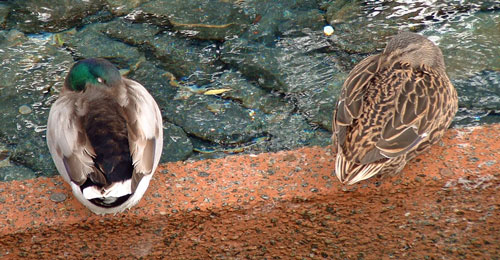
You don't need to go to the ends of the Earth to see wonderful, charming, beautiful, and meaningful nature. This pair, part of a trio, was at EPCOT, catching 40 winks while the crowds parted and surged around them. (Of course the fact that they were in a waterway no one could reach helped contribute to their relative nonchalance.)
And yes, what you're seeing in the male is the "whites of his eye." He seemed to go through a cycle of having ordinary black duck-eye and then this white look. I suppose it may have to do with predatory deterrence. Don't know, but it was interesting to watch.
Posted by Steven Riddle at 3:47 PM | Comments (4) | TrackBack
On the Beach at Lover's Key
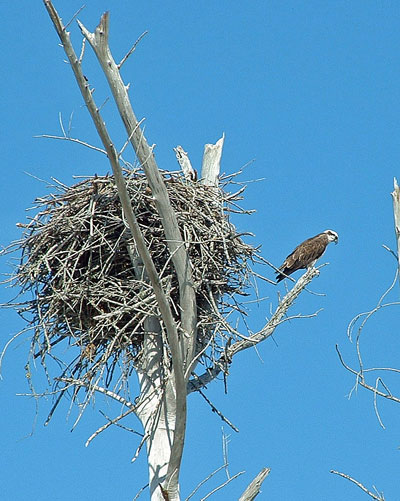
An Osprey and nest. I'm more used to the "platform" nests that seem to be common, but I'm told that when there's space, this is also a common form for the nest. Wasn't it polite of him to pose for me?
Posted by Steven Riddle at 3:40 PM | Comments (0) | TrackBack
A Face Only a Mother Could Love
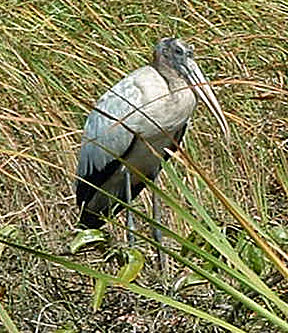
But one of the mighty wonders of the Everglades. Because of this natural habitat and measures taken to preserve it, the woodstork was brought back from the verge of extinction in Florida. Looks and noise aside, that's a good thing.
Posted by Steven Riddle at 3:37 PM | Comments (0) | TrackBack
Double Gator
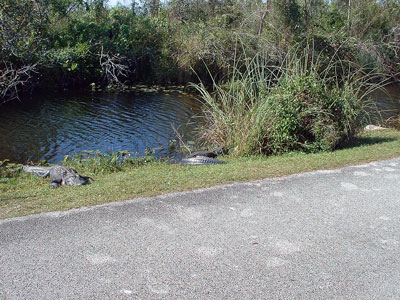
The nature experience at the Everglades is nothing like any other park you will go to. As close as the parking lot, you find the wildlife sunning itself and taking it easy. These two gators were no more than 10 feet away from me and Sam and that was after I was startled by turning a corner and nearly stepping on them. (I was walking on the far side of the tarmac shown here. There was a ranger nearby who chuckled at the startled tourists who, to a person, did what I did--stopped, did a double-take and walked to the far side of the road--as though that would be enough to protect us if a Gator took it in mind to have a two-legged lunch.
I loved it.
Posted by Steven Riddle at 3:27 PM | Comments (0) | TrackBack
There's a Reason It's Called "Sawgrass"
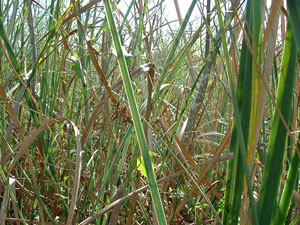
And this photo shows you why that is pretty well.
Imagine walking through this stuff for any distance? Even with heavy clothing, I'm sure the grass eventually takes its toll.
Posted by Steven Riddle at 3:22 PM | Comments (0) | TrackBack
January 11, 2007
Alligators and Others--The Everglades cont.
The Shark Valley Entrance to Everglades National Park has several possible ways to explore the park. You can rent a bicycle and presumably bicycle around the tram trail and other open trails--I don't know how many there might be. But for our first exposure we opted from the tram-trail to the observation tower. After purchasing tickets, we had a few minutes to spare and we spent them looking at the nearby canal and watching the alligators swim.
Note, this is a park. Not a theme park--a real park. Between us and the alligators there is no barrier. The alligator in the canal could just as easily have crawled up and sunned itself in the middle of the tram-trail.
How magnificent to see one of these animals in the wild. We've all seen them, probably in zoos, in attractions, or on television, but for reasons I cannot explain because I don't understand them well myself, the experience of just watching an alligator swim through the murky, tea-like water of the canal while the gar and other fish scatter before it is fascinating and strangely thrilling. You are first aware of its approach because the mullet start leaping out of the water and making little surface splashes in their panic to get away. (At least I think they were mullet.) Then you see the long black body that moves with an imperceptible motion of the tail--a slick gliding predator, cutting through the water on its way to. . . who knows where.
Turns out that alligators in the wild do not eat all that often. They can go for as much as a month between big meals so while the mullet are panicking, the alligator is just enjoying a warm winter afternoon in the water.
In the branches of the trees above the water where the alligator swam two blue heron and seemingly countless female anhingas. The ranger shared a story about anhinga mating practices--The male anhinga presents to the prospective mate a stick or a twig that he has collected. If the female likes the stick, the two form a mating pair and build a nest together. If she does not she is as likely as not to hit the male with the stick and chase him off. Later in the day Samuel witnessed two anhinga squawking at one another and he said matter-of-factly, "She must not have liked the stick." I never fail to be amazed by what and how much little sponges absorb.
Soon enough we were aboard the tram and on the way to the observation tower seven and a half miles, or so, into the the river of grass.
More later--you know, I love reliving the moment in these brief writings because I'm forced back to the day and to how wonderful it all was. We visited in perfect conditions, of course, but I'm not sure that that has all that much bearing on the matter.
Posted by Steven Riddle at 12:05 PM | Comments (0) | TrackBack
January 10, 2007
Yet More Everglades
The scope of the Everglades is not incomprehensible. Anyone who has driven past the cornfields west of Columbus or the wheat fields of Kansas or even the stretches of lonesome prairie has a clear understanding of scope--and even, to some degree of appearance--that brown or green against the endless sky with here and there a small copse of woodland growth. This image serves to fix the understanding of the river of grass.
What is difficult to comprehend is that all of this wheat field/corn field analogue is standing in a vast sheet of water, depending on the terrain, anywhere from one inch to several feet deep. And all of this water creeps and oozes a long slow way to the sea. As it does so, it picks up nutrients from the decaying mass of organic matter that lies just beneath the surface, so that as it approaches the brackish environs that border the sea, it is filled with the materials that make the Everglades system a nursery for much of the sea-life of Southern Florida--a place where the rich stocks of shrimp, fish, and other sea-life are born and grow to a certain viability before entering the ocean proper.
So here you stand, at the Shark Valley station, looking out over this field of brown and seeing here and there the glint of water where the vegetation does not hide it. Because you are in the "dry season" you may not see as much water as might be visible during the wet season. Also because you are in the dry season, the evidences of animal life are much more concentrated around the sources of water. From now (January) until April, when the rains begin to return, these areas of open water will become progressively more restricted until they amount to the standing bodies in pits dug by the Army Corps of Engineers and in the "solution holes" (mini-sinkholes that perforate the limestone sponge that is Florida) that form here and there in the park. Such solution holes can be several feet deep. They are dark, hidden, and unexpected and form perfect places for alligator wallows and moccasin holes.
This then was the situation I was in upon first visiting. And the impressions are indelible and hard to put into words, and perhaps not as affecting for many as for some. I have always loved the vast expanses of farmland in the midwest. There is about them an austere and somber beauty summed up in the famous line "amber waves of grain." And when the thunderheads of summer glower over them, and the winds whip up the heads of grain to give a sense of that roiling ocean, there is about these fields something that conjures up a kind of atavistic memory and delight.
So it is with the Everglades. And this is made even more profound when we regard these lands with the profound respect that Native Americans have for all the "peoples" of Earth, including the rock people and the water people. When we understand, even for a moment, the patent absurdity of thinking that one can "own" a piece of land, one comes to an understanding of the Everglades on its own terms. We can destroy it--we can alter it beyond all recognition, we can build on it or tear it apart--but this land is its own. It cannot be owned, it cannot be possessed except in memory. But it can captivate. It can capture you and hold you and your mind and your heart for as long as you will give it time to reign. And in so doing, it will put you in mind of Another--One Whose hand fashioned these beauties and all the beauties of the Earth for our delight and our care. He Who made them gave us stewardship over them and they become a patrimony for all generations--a rich and beautiful treasure to be passed on intact to those who come after us as a sign of Him Who made them.
There is something about the Everglades that turns the mind to God; something about them that captures the spirit and directs it upwards; something that purges, cleanses, and renews. It is as if, for a moment, one can stand in the world as God meant it to be and be in that world as we were meant to be.
(More later--sorry for the short chunks--but five or ten minutes don't allow either for lengthy composition or sufficient proofreading--all to come later.)
Posted by Steven Riddle at 9:17 AM | Comments (0) | TrackBack
January 9, 2007
The Everglades--Shark Valley
The concept of a valley in Florida is risible. However, as our guide pointed out, Miami is at an average elevation of about 36 inches, Naples and environs about 48 inches (above sea level) and Shark Valley is a mere 8 inches above see level. Thus, it is a true valley through which the outpouring of the waters from Okeechobee flow to the sea. Ooze to the sea may be more descriptive. The guide pointed out that water flows at a rate of about a quarter of a mile a day through the national park.
Changes in the recent past have diverted the flow of much of the water away from the Everglades. There is a desultory restoration project that is seeking to restore the flow, but no evidence yet that much of anything has really happened. In addition, we in the northern climes insist on building up around Shingle Creek, the so-called "headwaters of the Everglades." In the short time I have been here what were cow pastures and wooded lands have given way to yet another pair of mega-resorts and extensions to the convention center that are, shall we say, less than needed.
A city must grow or implode and die. I understand that; however, growth does not preclude reasonable planning to assure that so valuable a resource as the water that feeds the vast river of grass remains relatively pure. However, Orlando is not well known for either their vision of their future or the ability to temper their desire for yet more. I grit my teeth every time I see another thing built up along this fragile waterway.
Back to the Everglades. The Shark Valley entrance to the part shows one of the main and largely unknown ecotomes of the Everglades--the "river of grass." Well, not precisely grass. More like a sedge. In fact, a particularly nasty and unpleasant sedge misnamed "saw grass." Saw grass is a sharp-bladed sedge with actual saw-teeth running the length of each ray of the compound leaf. (At least I think it's a compound leaf--my botany is really poor.) If you run your hand along it one way you will feel nothing; however, the other way will render a fairly nasty cut.
Now, most people you ask seem to think of the Everglades as a huge cypress swamp, green darkness, Florida's jungle. But that is not at all the case. At least not entirely. There are hammocks and strands of this green darkness, but the Everglades proper is a glade--a wide expanse of green, or during the time I saw it brown. At first glance the Everglades look like nothing more exotic than a field of low-growing wheat with the occasional pampas grass plume.
But it is upon closer inspection that the reality of the Everglades hits home. And, it was in the course of reading a book by Connie Mae Fowler that I found out the truth of it. The Everglades can sneak up on you and steal away your heart.
More later.
Posted by Steven Riddle at 9:46 AM | Comments (0) | TrackBack
January 6, 2007
More About the Everglades
During the brief acquaintance I made with the Everglades in the past few years, I have grown progressively more in love and more incensed at the senseless rapine and uncontrolled growth that threatens this beautiful land. The problem is that the same conservationists who argue for the life of the Everglades also spend their time agitating about the preservation of the environment of the west Houston snail-darter found in a single ditch near an outhouse next to a downtown historical monument.
The excesses of the conservationists aside, the Everglades is a remarkable, indeed a unique environment and uniquely merits much of the rhetoric that has been lavished on it in its defense.
The beauty of this marvelous landscape stems, in part, from the great diversity of ecotomes which dot the national park. While not part of the Everglades National Park, the strands and forests of the Big Cypress show another face of the Everglades--that bayou like deep-green darkness that one associates with much of the coastlands of Louisiana. Large stands of cypress "knee-deep" in black water are homes to ghost orchids, alligators, wading birds, turtles, black bears, and the rare (but I understand slowly recovering) Florida panther. These are not landscapes comfortable or welcoming to human visitors. In the wet season the air is so thick with mosquitoes it is difficult to breathe. The windless heat and humidity can be stifling.
And yet, for those who endure these minor hardships for a glimpse of this majesty, part of the great mystery of God's creation is laid bare--not explained, not simplified, not subdued, but simply laid bare. One becomes more aware of the "two books" that God has written in the complexities of these majestic ecosystems. Imagine, for a moment, trees with a complex system of pneumatophores that make possible life in standing water.
On this brief trip I was made aware of yet more of the beauty. The mangroves were not something that had entered my mind as an integral part of these anastomosing and intermeshing systems of interdependent ecosystems. And yet are the natural consequence of one simple factor--the flow of water.
More later as I unravel my words.
Posted by Steven Riddle at 8:35 PM | Comments (1) | TrackBack
January 5, 2007
Paradise Withdrawal
As if it were not bad enough (from the point of view of the audience) that Florida will be experiencing highs of 84 degrees or so, I'm presently suffering from vacation withdrawal.
I spent much of the time after Christmas in Southern Florida exploring the beaches and Everglades.
A catalog:
An osprey nest and perched osprey, cattle egrets, snowy egrets, great blue heron, tri-color heron, yellow-crested night heron, royal terns, pilated woodpecker, red-bellied woodpecker, wood storks, green heron, little blue heron, dolphins and alligators galore.
That's just a start. In the course of the trip we visited the Everglades twice--once at each major southwestern/southcentral entrance.
The Gulf Coast entrance is just south of Everglades City near or on the causeway to Chokoloskee. I've passed by it before but never given it much consideration because I couldn't figure out how one actually got to the Everglades from it. Well, the reality is that this entrance allows the visitor to engage one of the ecotomes of the Everglades--the mangrove and estuarine environment. The main activities are kayaking and canoeing along a "wilderness trail" of waterways that the uninitiated are well advised to leave alone. It is not for lack of reason that this area of Florida is called "The Ten-Thousand Islands."
What we elected to do was take the boat ride out toward the gulf. On the way out we travelled through a shallow channel dredged in the limestone sponge that constitutes the state of Florida. There were channel marker signs all of which were populated by Royal Terns. These are black-headed tufted terns with bright orange-yellow bills. They sit almost always with bills pointed into the wind.
Among the thousands of mangrove islands we saw what seemed like hundreds of different types of birds including Bald Eagles and any number of herons, egrets, anhingas, cormorants, and wading birds galore.
The height of this trip, however, was the dolphins. We passed five or six different groups numbering from two to seven. The group of seven, persuaded by the seductive wake of the boat we were in, trailed along for several miles. The mother dolphin had a young dolphin with her that she kept steering into the relative ease of the boat wake. They jumped, played, rolled, and did any number of other things you can see at innumerable dolphin shows. In short, magnificent beyond the capacity of this hastily composed prose to convey.
For now, this must be it. I hope to write a bit later about the beaches and the Shark Valley entrance to the Everglades. In the meantime, may the winter, wherever you are be a little brighter and more pleasant today.
Posted by Steven Riddle at 8:36 AM | Comments (0) | TrackBack
December 22, 2006
Live Giant Squid
An incredibly cool Christmas gift for cephalopod fanatics the world over. Enjoy!
Posted by Steven Riddle at 1:41 PM | Comments (3) | TrackBack
December 8, 2006
Florida Weather Silliness
People elsewhere in the country would laugh themselves silly if they could see those of us basking in the [relative] warmth of Central Florida. Last night and this morning the weather forecasters put on their dire and doomed faces and warned us about bone-chilling and dangerous cold that was coming our way. Last night the temperatures were to plunge to 54 degrees, with a high not much above sixty today. And tonight, horrors! bring in the dogs, batten down the hatches, get out the emergency supplies--the temperature is to plunge into the forties, perhaps resolving at about 42 degrees.
I remember the first year I was hear, my wife and I were wandering around Sea World wearing shorts and a light jacket and the people manning the ticket stations were in parkas, gloves, hats, and even scarves. We had just come from Columbus, Ohio, where the temperatures were at a steady 30-40 degree range, and it was 65 and breezy here in Orlando. We laughed ourselves silly. Unfortunately, the next year, similar circumstances, and we had already adapted--parkas, gloves, and hats at 60 degrees.
Posted by Steven Riddle at 8:07 AM | Comments (3) | TrackBack
December 3, 2006
Florida Snow
No! Not Ft. Lauderdale Snow or Miami Snow, Florida Snow!
84 degrees and the late evening. Across the street my neighbor's yard is covered with Florida snow--25 or so white ibis, strutting across the yard plucking up lizards and small insects as they go. The "dirty" gray snow takes the form of three or four young among the blazing white. We watch, restraining boy from going and chasing them and the snow drifts across the yard. Five sentinel drifts on top of the house rise into the air and the drift speeds up, and then blows away, across the street, above the roofs of the house two down from us, and they're gone.
Just one of the reasons Florida is home.
Posted by Steven Riddle at 8:57 AM | Comments (0) | TrackBack
November 13, 2006
Eks-sellant! Everything is going according to my plan. . .
Saw this plan for a space-based solar shade mentioned at Dappled Things and all I could think of was Montgomery Burns's plans to increase energy consumption in Springfield. Ah, yes, Smithers, release the hounds.
Posted by Steven Riddle at 8:47 PM | Comments (1) | TrackBack
September 21, 2006
There Is Comfort in the Thunder
Comfort in the ThunderIn the dark of dawn
the double thunder signals
they are safely home.
Okay a bad haiku, but being awakened at 6:21 by the double sonic boom of the returning shuttle provides some small comfort to those of us who live nearby. Or perhaps, for some, just a momentary annoyance. I can only speak for myself.
Posted by Steven Riddle at 8:45 AM | Comments (0) | TrackBack
September 19, 2006
Apples and Pumpkins
As much as I love Florida, there are several things I miss about fall--the changing colors, certainly. But having spent much of my life in Virginia and Ohio, what I most miss is apple season. I was astonished and appalled by the narrow and uninteresting selection of apples that the grocery stores here in Florida have. Normally this time of year the apples were rolling into the stores--Stamen, Winesap, and Jonathan being the three favored varieties. So, instead of sending cash to my pay-pal account, if you are a resident of VA or OH, you can amply repay me by shipping me any of these three varieties of apples, in almost any quantity (so long as it is large.)
And for the residents of Columbus--TSO in particular, there is an event in Circleville, which approaches asymptotically close to heaven--yes, the world-renowned Circleville Pumpkin festival in which one can obtain, pumpkin soup, pumpkin bread, pumpkin cakes, pumpkin donuts, cooked pumpkin twelve ways, and, of course pumpkin Ice Cream. There is no way to ship Circleville or the pumpkin festival to me, but go or send an emissary to enjoy it for me. Eat a pumpkin donut or pumpkin ice cream. It's the very least you can do for a blogging pal.
Posted by Steven Riddle at 11:39 PM | Comments (2) | TrackBack
September 5, 2006
This Little Light of Mine
I think I found this article about the marvels of the fluorescent bulb at Semicolon. We've had a few for several years now and love them. I just didn't realize that they really were that energy efficient. However, if you put your hand near one you should be able to tell--there's nothing like the heat given off by the typical resistor bulb. So, check it out. It's simple, it's easy, and it apparently does help.
Posted by Steven Riddle at 5:09 PM | Comments (1) | TrackBack
September 4, 2006
Theistic Evolution
A scientist's alternative to ID?
I have yet to read Francis Collins's book, but here's an interview that may give some insight. What I like about it is that it keeps squarely in the realm of science those things that are science and recognizes the "break" in science that enters with Human Evolution, without trying to slap a scientific explanation on it. As I said, I haven't evaluated the theory in any detail, but here's the article
Posted by Steven Riddle at 5:20 PM | Comments (0) | TrackBack
August 30, 2006
Ernesto
For those paying attention--which probably only includes those of us in the path, Ernesto has become a lumber, wet, slow-moving blob of barely circulating air that will tumble across the peninsula, and with any good luck at all spill out into an Atlantic that simply can't give it back its punch. This is the best possible scenario for a TS/Hurricane. Let us pray that it be so.
Posted by Steven Riddle at 9:51 AM | Comments (0) | TrackBack
August 25, 2006
Pluto Demoted
By now you know this, and I sit in the peculiar position of having it have an enormous impact on my every-day work.
Personally, I think the definition adopted is poorly configured and poorly construed and erects new categories where there is no clear division or way to make a clear delineation. On the other hand, I hope the scientists get through their debate quickly so the matter can be settled. But this is not the sort of thing that tends to die down in scientific circles. I suppose one must just wait to see which way the majority.
Posted by Steven Riddle at 9:53 AM | Comments (0) | TrackBack
July 31, 2006
Kingdom of the Ants
Small, lovely, and in Africa, at least, potentially deadly even to cattle and humans. One marvels at the small wonders all around.
Posted by Steven Riddle at 12:06 PM | Comments (0) | TrackBack
July 28, 2006
Lest We Forget
the sheer marvels and prodigies of grace:
Xyloplax turnerae and X. medusaformis
Posted by Steven Riddle at 10:17 PM | Comments (0) | TrackBack
July 4, 2006
The Shuttle Ascends
And what a view from external-tank-cam. Most interesting. Today the space station, soon the Lunar Colony and finally we make it to Mars.
Posted by Steven Riddle at 3:47 PM | Comments (0) | TrackBack
May 25, 2006
More Geekiness--Living Fossils
French Scientists Find 'Living Fossil' - Yahoo! News
Today Neoglyphea tomorrow, who knows? Burgessia bella? Hallucigenia, Tullymonstrum gregarium, Dunkelosteus, Helicoplacus, Anomalocaris, or cornute and mitrate carpoids? Who can tell? The world is such an exciting place with news like this coming in every day.
Posted by Steven Riddle at 5:22 PM | Comments (0) | TrackBack
May 24, 2006
Science Geeky Things--Giant Squid

Cephalopods are the coolest. This critter really could be the Kraken of Legend and that's cooler yet. And the photo is purely creepy. I love it. I also love the sheer mystery of it--that this creature has been known mostly from washed up carcasses and remains and here it is on film. Not clearly, but on film nevertheless. Long live the giant squid!
Posted by Steven Riddle at 2:20 PM | Comments (4) | TrackBack
March 13, 2006
Mars Maps
Thanks to Julie (aka Happy Catholic) who posted this link. Now, I'll be able to visit Mars any time I want!
Posted by Steven Riddle at 4:40 PM | TrackBack
March 10, 2006
What KSC Means to Me
We spent the last two days at KSC (Kennedy Space Center) as part of a homeschooling "special." It was indeed special--two days admission and a lunch along with a plethora of special activities just for the homeschooling set. We saw two magnificent IMAX movies and went on two bus tours, one of which allowed us to look down on the components of the Space Station that have not yet made it into space.
I can't begin to convey the sheer excitement and wonder of all of this. I thought about the time I began to like Science Fiction and wondered why my taste for it had palled so--and then I realized. Much of science fiction reaches beyond the sheer excitement of the next twenty years. It takes for granted interstellar flight, and has produced a whole group of novels which disguise various genres in futuristic drag. We have the O'Brien Novels dressed up in interstellar fleet, and we have the soap operas dressed up as alien encounters.
I guess I'm looking for new writers who recover the wonder of those early years of Science Fiction. I think Kim Stanley Robinson might be one of them--Red Mars, Blue Mars, and Green Mars. Perhaps there are others you all might suggest.
But nothing in science fiction is remotely as exciting as the sheer possibility of the next twenty years or so. According to NASA's mission statement/vision, we will begin to see the establishment of a lunar colony as early as 2018. That is reach-out-and-touch it is so close.
Well, I guess you can tell that KSC really lit stirred some embers I had not realized had been so ashed over.
Posted by Steven Riddle at 8:38 PM | TrackBack
February 18, 2006
Orlando Wetlands Park
Orlando Wetlands Park had a festival today. It's a park that's about forty miles to the east of where I live in the "town" of Christmas, Florida--about a mile down the road from Fort Christmas.
The Orlando Wetlands Park is interesting because it is the final stage of a water treatment scheme before the water is return to the St. John's River. The wetlands were constructed about twenty years ago and they are the "polishing" arena for waste water that is treated at a treatment plant in east Orlando.
Enough of the background. They have an annual festival lasting only one day, but boy what a day! Had a hay ride through a working cattle ranch/conservancy area, a bus ride over the levees separating different areas of the wetlands. Saw red-shouldered hawk, mating ospreys and their nests, about a dozen alligators, soft-shelled turtle, snapping turtle and others, ibises, anhingas, vultures by the handful, little blue heron, great blue heron, American egret, bald eagle, and dozens of other animals. Fed a cow and bull in a pasture, climbed a rock wall, and Sam bounced in a bounce house. Gathered information about other local wildlife areas. Petted a milk snake and a small caiman or alligator. Saw rehabilitated Kestrel, Barn Owl, and Bald Eagle. (Barn Owls are really kind of spooky looking, with those huge feather patches around the eyes that flatten the face and make the eyes look to be about three times their real size.)
In short, a gorgeous Central Florida day--beautiful, clear, pleasant weather, and a nice gathering of people all celebrating the natural world and our park system. Couldn't have thought of a better way to spend a day.
Posted by Steven Riddle at 7:31 PM | Comments (0) | TrackBack
October 26, 2005
Seriously Bad News for Caribbean Ecosystems
Posted by Steven Riddle at 8:29 AM | Comments (4) | TrackBack
October 24, 2005
Wilma
Our relatively minor spinoff of Wilma flows by--it will continue throughout the day as she moves north eastward (Hopefully more east before north). And I think what a wonder these things are. Not a wonder I particularly enjoy participating in at the time, but it's great to talk about afterwards. I begin to understand the purpose and meaning of "hurricane parties" where people gather in large groups to wait out the storm. The sound of human companionship makes more bearable the terrible sounds that come from outside. They restore a perspective from primordial horror to major inconvenience; from waiting for the apocalypse to waiting out a bout of bad weather.
What is even more interesting about this storm is the huge, strong front that is driving it off. We're starting the morning at about 80 degrees and this evening we'll be down to 48. That's amazing for Florida, and almost unheard of for October. But it is another thing to thank God for--it is the whisk broom that forces this pesky storm out to sea so rapidly that we have merely two or three hours to endure of the worst weather. Like Charlie last year, it hits hard and fast and then is gone. There is probably nothing worse than what the Yucatan suffered--sitting under a glowering hurricane for hours upon hours on end.
Posted by Steven Riddle at 10:44 AM | Comments (4) | TrackBack
October 23, 2005
News You Can Use
Thank goodness for the diligent Priests of St. Blogs (nod to Dappled Things) who keep us apprised of these monumental <*ahem*> issues--a 1300 lb pumpkin threatens to take over New England! (How's that for a Tabloid Headline?)
Posted by Steven Riddle at 10:12 AM | Comments (0) | TrackBack
October 20, 2005
Micrographia Restaurata
An explanation of Hookes observations through the microscope with resizeable lpage images. Nice for historians of science.
Posted by Steven Riddle at 6:06 PM | Comments (0) | TrackBack
October 4, 2005
Things I Delight in--Carpoids
The world of science is filled with oddities--such as the recently filmed Architeuthis. In the course of my explorations of paleontology, I have happened on many wonderful, beautiful oddities. Those of the echinoderm world are amongst the oddest. If you want to see some odd animals, google helicoplacoids some time. Or perhaps edrioasteroids.
But over chez Darwin the other day I had cause to remember the great carpoid debate. The center of the debate was taxonomic--were carpoids echinoderms or chordates. (Curiously, echinoderms are the only other major group of deuterostomes--if one holds by evolutionary theory, that would make them our closest relatives in the invertebrate world--how close that would be is still miles off--nevertheless. . . )
Anyway--get a load of these odd little guys. (Ignore the picture that says Tetragraptus, I'll get to the graptolites some other time.)
Anyway, enjoy this momentary excursion into the odd as the first of my morning offerings--a sign of the greatness and the profound love of God for His creation.
Posted by Steven Riddle at 8:48 AM | Comments (0) | TrackBack
October 3, 2005
Architeuthis Live and in Person
CNN.com - Scientists�photograph giant squid - Sep 28, 2005
Critically important news--from Eve Tushnet, I think. Thank you!
Posted by Steven Riddle at 9:27 AM | Comments (0) | TrackBack
September 7, 2005
I've Seen This Before--Ophelia
Oh, how I don't like the present prediction of the track of Ophelia near the Florida coast. We're supposed to get about three days of exceedingly wet weather, which is not any big deal, but that big curling loop that seems to be forming is horribly reminiscent of Jeanne from last year. Present forecast discussion are quite naturally nebulous because the weather pattern is hard to interpret. They actually expect the storm to make a short loop and peel off into the Atlantic, which would be the best scenario for everyone.
So, while you all are praying for NO and the victims of Katrina, please throw in some good wearther prayers for the entire nation. I'm hoping the track means that Ophelia is being sucked into a vortex that drove Nate and Maria away, but it's hard to tell at this point.
Present forecast discussion are quite naturally nebulous because the weather pattern is hard to interpret.
Posted by Steven Riddle at 9:01 AM | Comments (0) | TrackBack
September 2, 2005
Shark v. Octopus
At first I thought this was a fake. But I'm now not so certain and I'm quite intrigued. (Warning: pop-ups).
Posted by Steven Riddle at 11:12 AM | Comments (0) | TrackBack
August 27, 2005
The Horticultural Wonder of the Week
I know you all have been waiting with bated breath wondering what I would share from this week's excursions. But before I unveil it. . .
Providence acts in so many kindly ways to perform so many seemingly minor services, all of which go toward reinforcing our love of God. God acts through natural means and the natural world to remind us always that He is present. Today, for me, was a case in point.
I had thought about going to EPCOT again. I really like EPCOT--the gardens, the spaces, the architecture, the music, etc. But I was really tired of EPCOT. I didn't really want to venture the Magic Kingdom on a Saturday before the rest of the world was in school, so that left MGM Studios or Animal Kingdom. Frankly, I am not all that wowed by Animal Kingdom. The designers built it to give you a sense of adventure, of being lost in the tangle of thicket, with the net result that if there are more than 15 people in the park, it seems crowded. The pathways are difficult to negotiate, and there's an awful lot of jostling, bustling and general knocking about that a crowd-sky person doesn't care for. MGM, on the other hand, has fewer gardens, more indoorsy stuff that generally leaves me with the "been there, done that" feeling of the over-familiar.
I opted for Animal Kingdom. Again sheer providence, because there is no coincidence, only purpose. When I got to the gate I saw an announcement that took my breath away. They had back in the hinterlands of the park a Titan Arum. Yes, children, that's what you'll be looking at. What, you may ask, is a Titan Arum. Why it's only the largest blossom structure in the world. It's a plant that grown naturally in Sumatra. A few years back a specimen was taken to Kew Gardens and encouraged to grow. Since then fewer than 100 specimens in the United States have grown to blossom and stink up the house. Because you see, the blossom smells a great deal like rotting meat--the better to attract pollinator flies.
Well, the largest "flower" of this plant was about twelve feet high. I use the word "flower" advisedly because it really is a flower-cover. The flowers are much smaller structures at the base of the plant covered by what looks like a large blossom that closes up at night to help prevent self-pollination. So it isn't really the largest single flower in the world--that honor is held by Rafflesia, but you've got to admit, a twelve foot blossom is a spectacular specimen.
Now, the specimen you are about to see is on its way to blossoming, but a ways off--perhaps as much as two weeks to a month. This specimen was grown from a 134 pound tuber and is two weeks old at the time of these pictures.
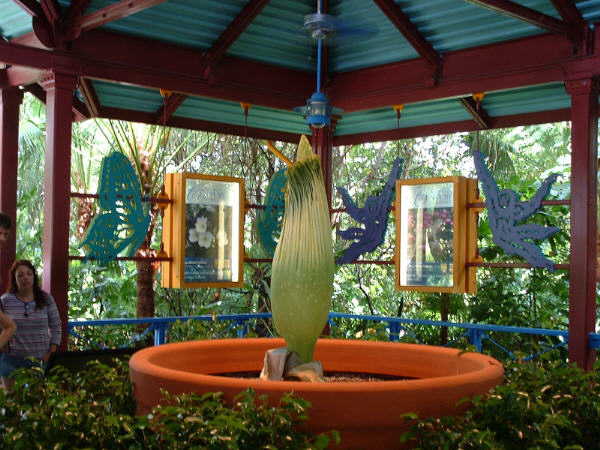
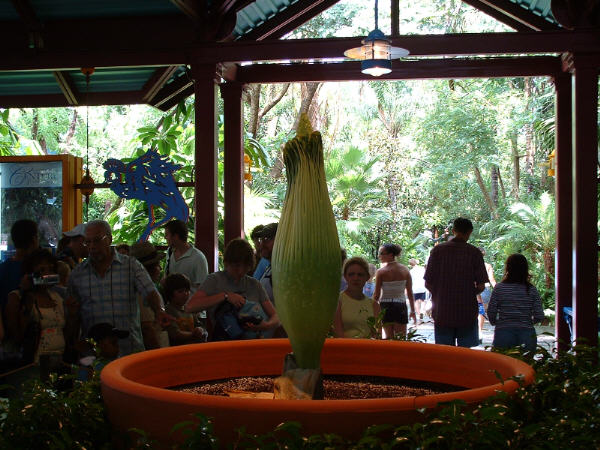
I honestly can't tell you when the last time I was so excited was. I'll be on the phone every day to the horticulturalist finding out when the blossom will open and I'll be out there the day it opens and every day after that I can be. This is one of those experiences that the mystics call "consolations." I don't look for them, but I am exceedingly thankful when they come around. This really is a blessing for me and I am so grateful to be able to share some small part of it. I know it isn't all that exciting for you all, but please accept my word that this is only overshadowed by the great good news that Spouse and Child return tomorrow. Hurray! The axial tilt problem that started back in June will come to an end and with it the blossoming to a Titan Arum!
Posted by Steven Riddle at 6:04 PM | Comments (0) | TrackBack
August 14, 2005
Opening Your Eyes May Lead to Surprizes
I have been to EPCOT hundreds of times. Yes, I'm one of those. I don't spend my time bemoaning the "disneyfication of culture." I leave that to people with far too much time on their hands. I love to walk around the parks and gardens and I love to watch the people here on vacation.
That's really kind of a side point. I was there this afternoon, and after lo! these many trips, I opened my eyes and what should I see but this lovely specimen of Dicksonia--a tree fern native to Australia and New Zealand and last of the remnant common on land several hundred million years ago--known variously (depending upon the part found) as Lepidodendron Sigillaria or Stigmaria.
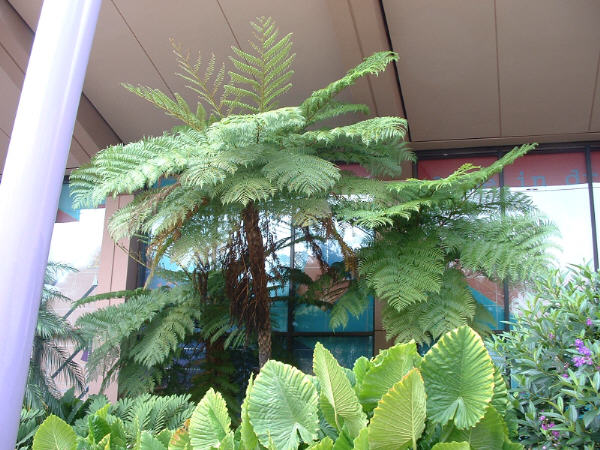
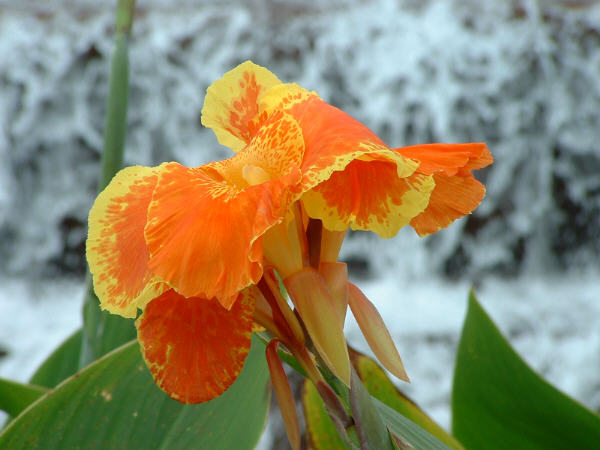
Also present near the grand waterworks fountain, this flower. I don't know it's name--I'm not a botantist. But it spoke to me as I passed so I took its picture.
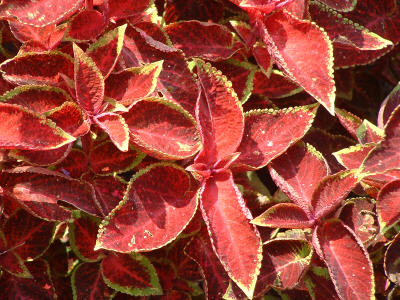
Also walking along, this stunning setting:
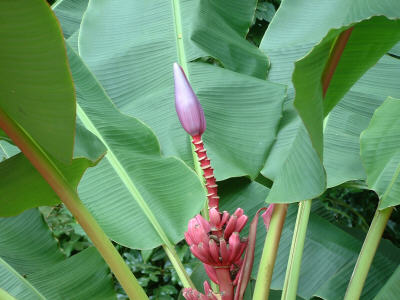
and this, for those who have not ever been so fortunate--the fruiting structure of a banana:
But the Dicksonia really wowed me. I thought I had seen it all, but it all goes to show what can happen when you open your eyes.
Posted by Steven Riddle at 7:33 PM | Comments (5) | TrackBack
July 26, 2005
She's Up!!
One of the great things about the place I work in Orlando is that it is one of the taller buildings in the area. As a result we all go up to the seventh or eighth floor and watch every launching. Usually they are sparsely attended, but today the bulding had a distinct list to the east as everyone crowded the windows to hope, pray, and wish Discovery on her way. Four, five-hundred people all watching the ascent. No, it's not the view from Canaveral, but it is very, very nice indeed, and very nice to see so many interested and so many praying for a safe journey.
I stood and peered anxiously out the window looking for the little flame and the plume of smoke that would mark her ascent. And there it was to the left of a crane of the horizon, arcing up into the clouds, flame strong, plume of smoke thick but quickly swept away so that the trace of her path was quickly removed. And with her my heart also ascended knowing that we were once again on our way. Here in Florida, this has been the constant subject of discussion for the last two weeks or more, and today we were able to witness its execution. Pray for a safe and fulfilling journey, for safety for the present crew and for those who return and for a return of information that will benefit all of humankind.
Oh, how wonderful it is to be able to see this continued movement into the next frontier.
Posted by Steven Riddle at 11:45 AM | Comments (0) | TrackBack
July 23, 2005
One Last Image
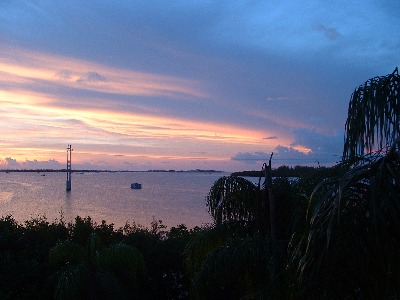
In a private communication one reader was surprised at how much I had liked Key West and how poetic I had waxed over it. Well, this little photo will give you a sense of why. That was the view from my hotel room. Three days after Dennis and sea and sky have returned to where they started. In other pictures the swirls of sea and sky reflect one another with the same apparent flatness. I cannot say enough about the water and its color. As soon as I can reasonably well capture it, I will likely substitute it for my background on this site. Problem has been that there has been no good way to capture it well.
Well, good night all.
Posted by Steven Riddle at 6:45 PM | Comments (2)
For Julie, by Request--but not the Spiny Lizard
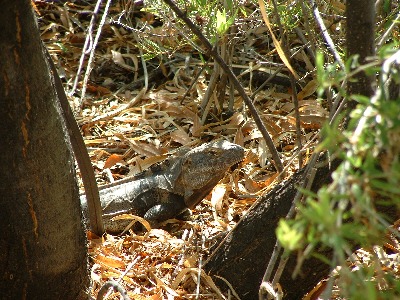
Sorry. Not the spiny lizard, but I thought you might prefer one in focus. I'm still sorting through the spiny lizard photos with some hope that I might find one that isn't all blurred out.
Posted by Steven Riddle at 6:40 PM | Comments (1)
And some Flora and Scenes from the Desert
My Javelina pictures did not come out as well as I would have liked and the Coyotes were downright dreadful. Got a lot of great spiny lizards, but figured you might enjoy these more.
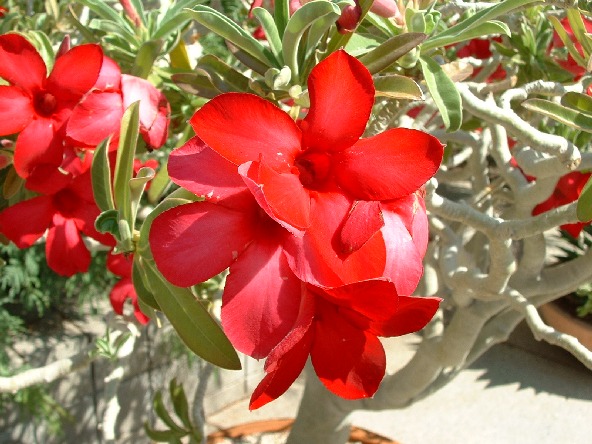
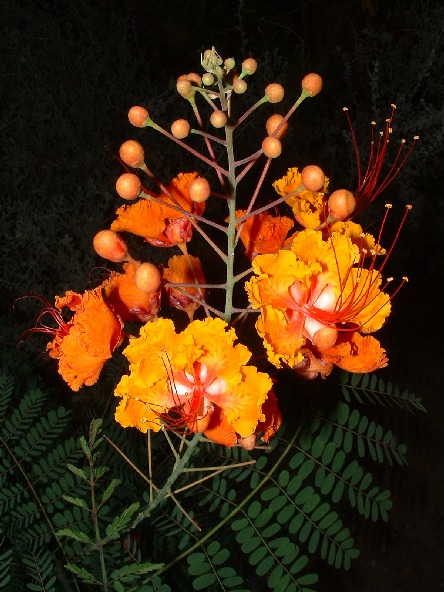
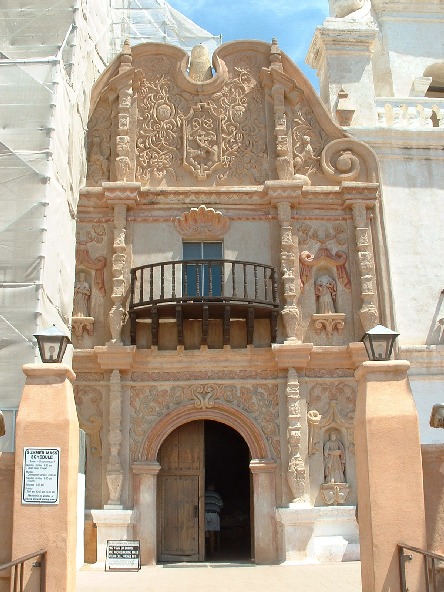
And the lovely San Xavier del Bac, presently undergoing restoration.
And to RC if he happens to drop by--I promise never, never, never to do this again. For one thing it is entirely too much effort--but I'll work really hard to reduce server strain.
Posted by Steven Riddle at 5:14 PM | Comments (3)
A Sample of the Flora and Fauna of My Trip
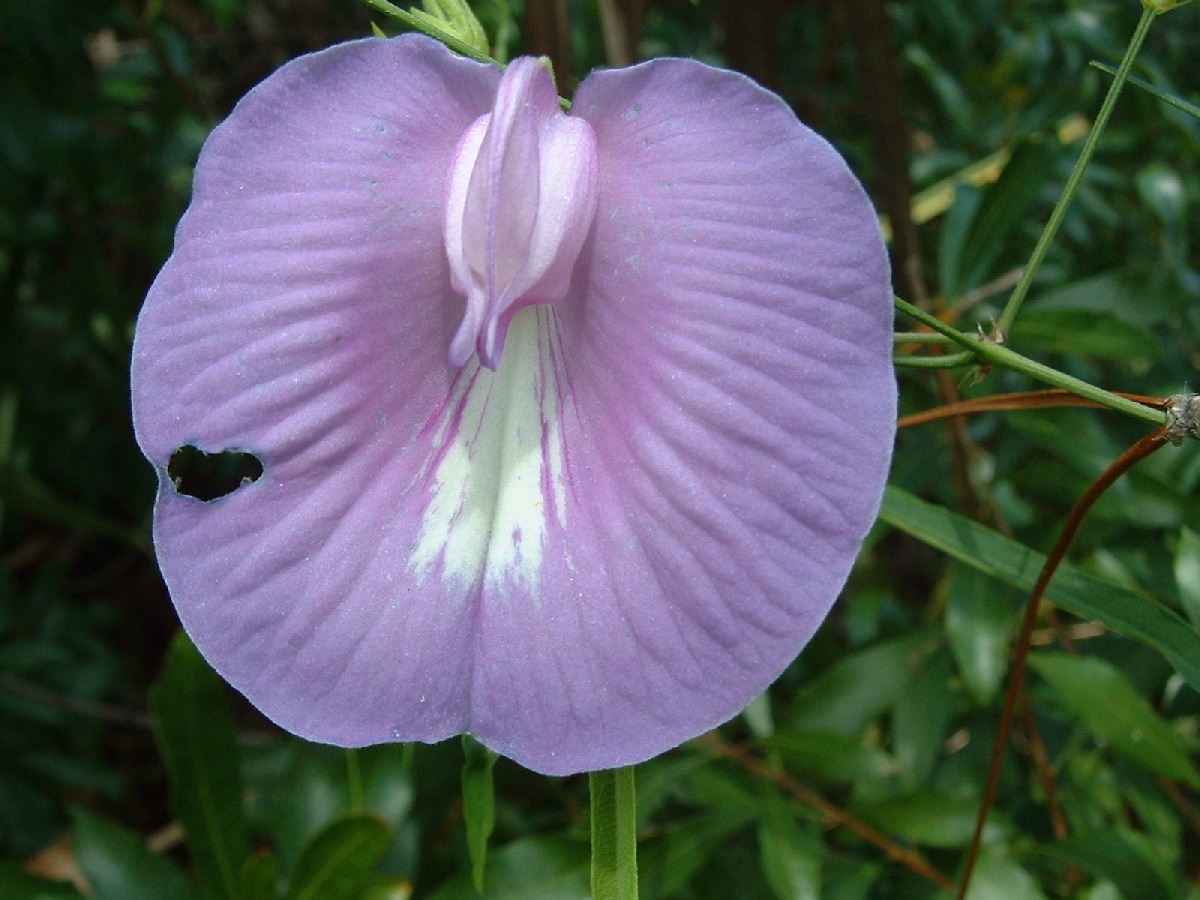
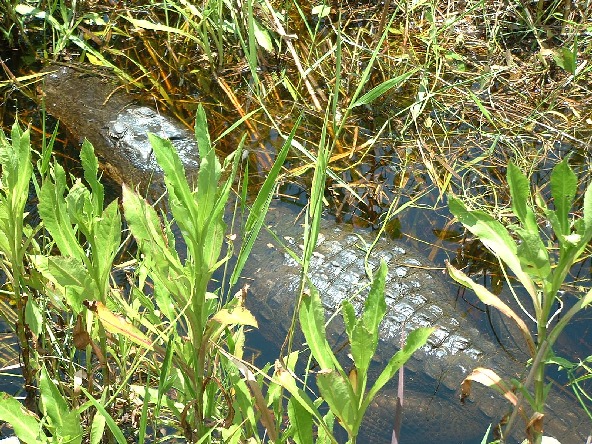
The flower above and the friend below were both experiences to be savored at Corkscrew Swamp--an Audubon preserve.
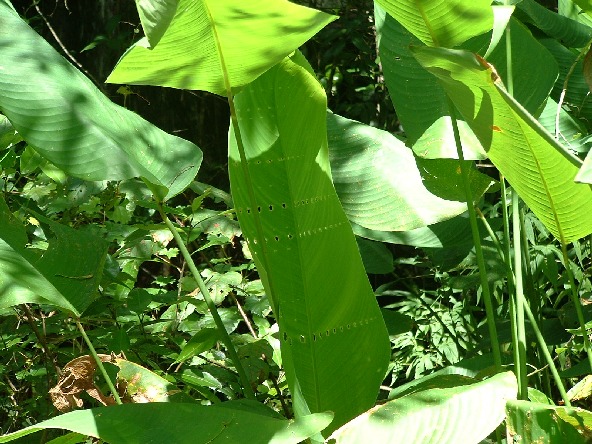
Said friend is heralded by this plant--appropriately enough called Alligator flag. Throughout the swamp we found them with these regular, even perforations. They were so perfect that it seemed unlikely to be caused by a browsing insect. I thought perhaps they functioned like the slits in banana leaves. Alas, I know too little about this mystery to help you resolve it.
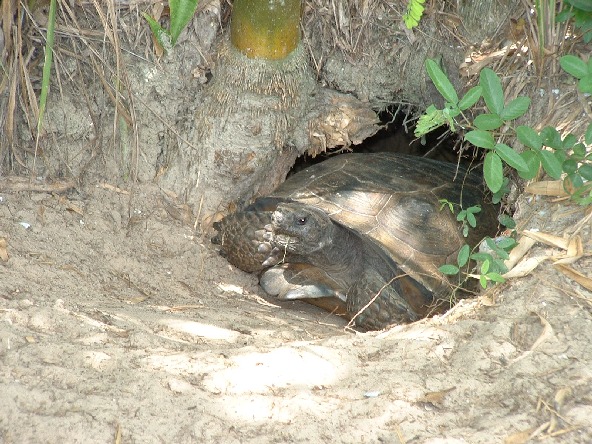
And the friend below brought to me courtesy of a short side-trip to Estero, Florida--the Koreshan Settlement.
Posted by Steven Riddle at 4:31 PM | Comments (0)
Why I Love the Dry Tortugas
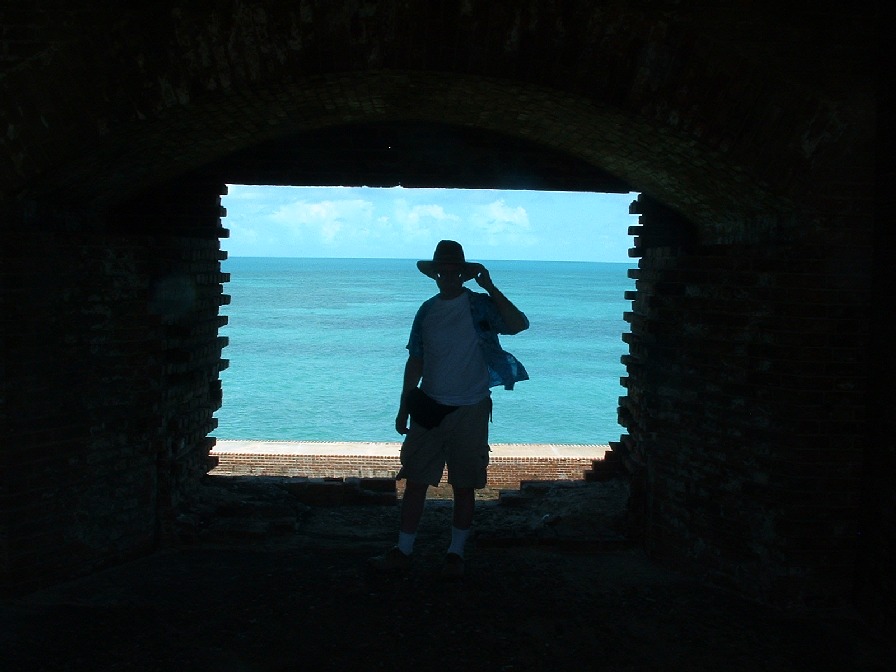
And yes, for many reasons, this is likely to be the best picture you see of me on this site.
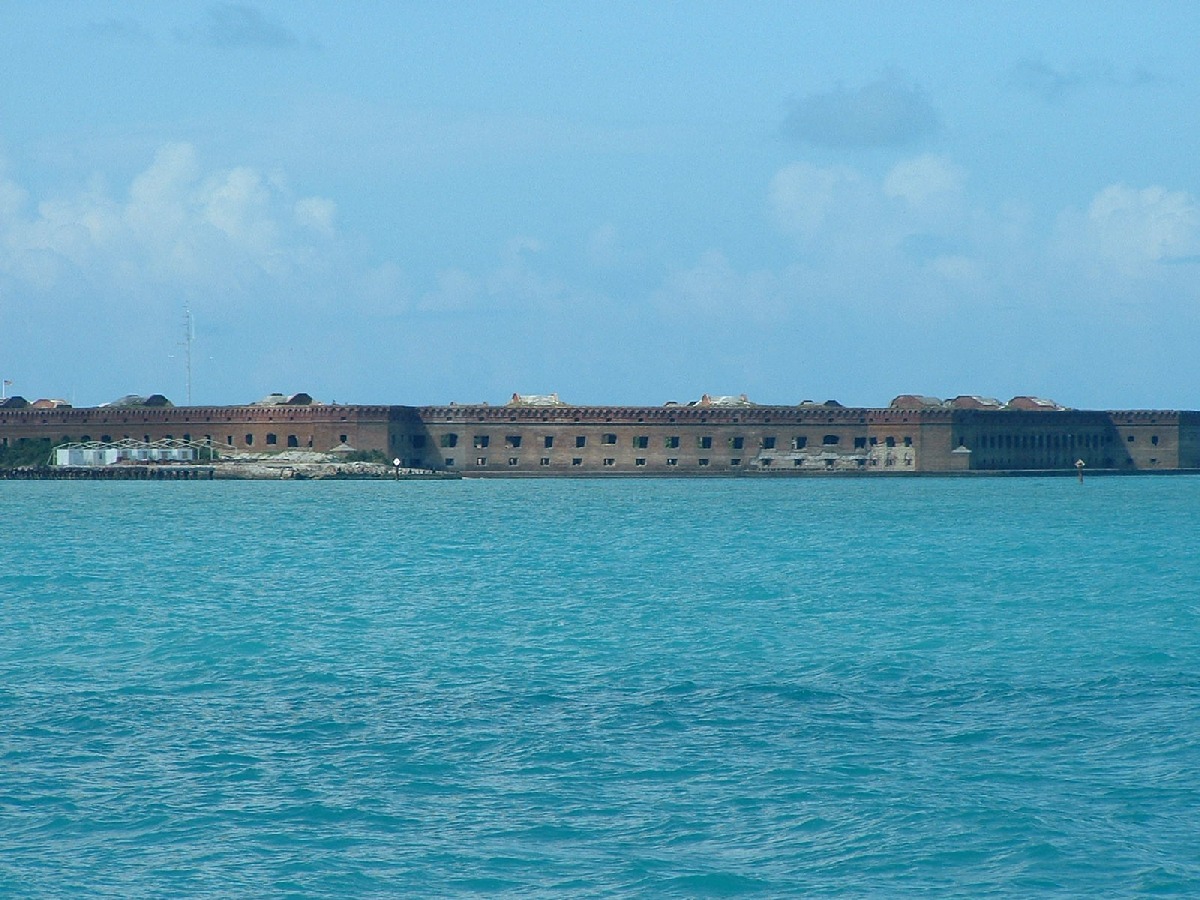
The view of Fort Jefferson--the place of incarceration of Dr. Samuel Mudd, unjustly railroaded into prison for setting John Wilkes Booth's leg and released after helping tend a yellow fever epidemic in the Fort. Certainly the acts of a traitorous coward.
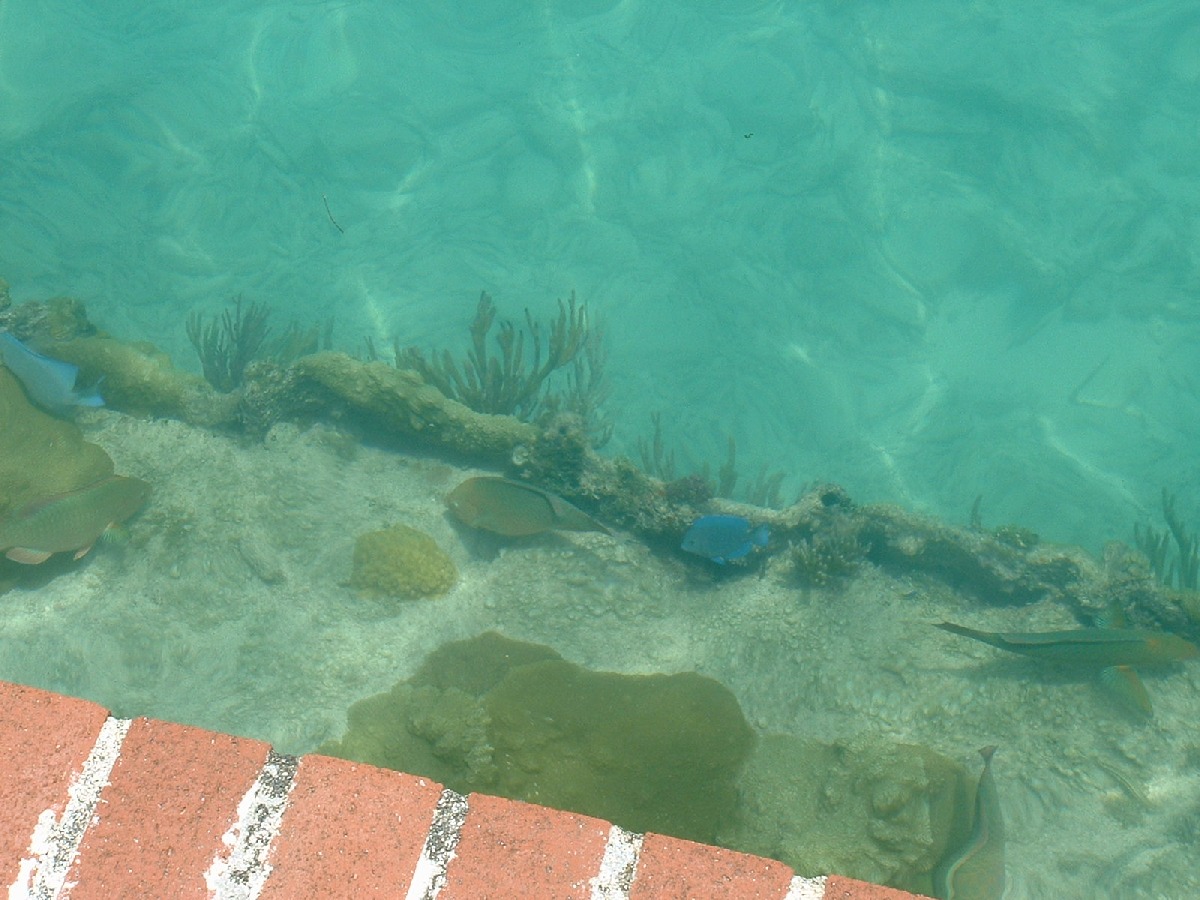
What you can see without ever entering the water. (From the moat walk around the fort.)
Posted by Steven Riddle at 4:16 PM | Comments (0)
December 28, 2004
Let All Creation Praise Him!
We find reasons for praise and sources of wonder in the oddest places. This after it was once again in Mandelbrot's book.
from The (Mis)Behavior of Markets
Benoit Mandelbrot and Richard L. HudsonIt is an extraordinary feature of science that the most diverse, seemingly unrelated, phenomena can be described with the same mathematical tools. The same quadratic equations with thich the ancients drew right angles to build their temples can be used today by a banker to calculate the yield to maturity of a new, two-year bond. The same techniques of calculus developed by Newton and Leibniz two centuries ago to study the orbits of Mars and Mercury can be used today by a civil engineer to calculate the maximum stress on a new bridge, or the volume of water to pass beneath it. Now, none of this means that the bridge, river, and planets work in the same way; or that an archaeologist at the Acropolis should help price an Accenture bond. . . . But the variety of natural phenomna is boundless while, despite all appearances to the contrary, the number of really distinct mathematical concepts and tools at our disposal is surprisingly small. When a man goes to clear a jungle he has relatively few types of tools: To cut, perhaps a machete; to knock down, a bulldozer; to burn, fire. Science is like that. When we explore the vast realms of natural and human behavior, we find our most useful tools of measurement and calculation are based on surprisingly few basic ideas. When a man has a hammer, all he sees around him are nails to hit. So it should be no great surprise that, with our small number of effective mathematical tools, we can find analogies between a wind tunnel and a Reuters screen.
This brief passage inspired in me a diffuse chain of thought. If these things may all be described with a limited number of tools (as Mandelbrot maintains) then the infinite diversity and complexity of phenomena that we see about are are really all variations of a few key themes.
I will not contend that this speculation proves anything at all, but merely that looking upon this possible conclusion, one can see for a moment the image of the mind of the maker--infinitely varied and yet discrete and accessible. That all of these varied things should have in common some underlying language, some limited group of descriptors either means that we are not truly describing them, or their relationships are by far more important than their perceived differences.
Posted by Steven Riddle at 3:16 PM | Comments (0) | TrackBack
November 11, 2004
On Edible Tomatoes
The things one has to find out in the course of a work day.
I read the supposed "fact" that A.W. Livingston of Reynoldsburg, Ohio developed the world's first edible tomato. This really bugged me. It suggested that up until about 1872 all of Italian cuisine had been tomatoless.
Now, it makes sense that tomato, a member of the nightshade family, might once not have been edible. But I kept finding references further and further back as to people eating tomatoes.
So what is it that Livingston actually did? He hybridized and hand selected wild tomatoes to produce a plump, ripe fruit that we know today. He commercialized the cultivation of tomatoes. It is to Livingston and his efforts that we owe a majority of the variety of tomatoes available today.
I know you all really wanted to know. Well, perhaps not, but it's been a lingering mystery to me for two days and I thought I'd share what I'd finally tracked down. So those of you in Reynoldsburg at the Tomato Festival, take a moment to correct the misconceptions, but still to honor the father of the appetizing tomato.
Posted by Steven Riddle at 3:58 PM | Comments (1) | TrackBack
October 28, 2004
Eclipse of the Moon
For those who did not see it last night--(I remember all too well awiting celestial events in Columbus only to have it overcast on the day(s).)
Gorgeous, full, goat-cheese moon unsullied by any hint of cloud, inch by inch seeming wiped out of the sky--but not, we find when the Eclipse has progressed half-way or farther, we can still see it, but dimly. Then with the lunar equivalent of the "diamond ring" effect of the solar eclipse we see it darkly shadowed and then turning progressively redder and oranger (as we pass through the umbra and the refraction of light around earth allows illumination only by the red end of the spectrum.)
What a wonderful autumnal sight. Better than that buttery harvest moon--so lovely and so perfect a sign of the season of gradual decline.
Not another one for a couple of years, 2007, I think.
Took Samuel out to see it as he had rested earlier in the day and we engaged in a "moon dance" much to his mother's chagrin "Whatever in the world will the neighbors think?" Well, malhuereusment, no neighbors. No one evinced the slightest interest in this relatively uncommon celestial event. They were probably riveted to the exotic enchantments of whatever reality show is running the gamut. Tant pis such souls really missed out on one of those fine moments that shows God's crafty hand--the hand of a skilled artist directing the beauties of the world.
Posted by Steven Riddle at 6:54 AM | Comments (1) | TrackBack
October 12, 2004
Mount St. Helen's Watch
Courtesy of a friend
Posted by Steven Riddle at 12:15 PM | TrackBack
September 26, 2004
In the Midst of Jeanne
Here we are in the midst of Jeanne. Tropical Storm winds. The sound is terrifying, and we aren't even near the very worst of it. You just hear that whistling winter sound (those of you in the midwest know what I'm talking about. The winds simply don't relent, and occasionally they increase sounding akin to train passing. I sure hope this is the last of these we have to endure this season, but Lisa doesn't look cooperative, particularly with the little loop-the-loops that this season has given us.
Will keep you updated because it mysterious helps me feel better. Please pray protection on us all. We need it.
Watching now as I see a shelter that needed to abandoned in Melbourne this morning. Please pray for these people. This was a special needs shelter and included heart patients, dialysis patients, those mobility impaired. Oh Good Lord, it is certainly a test of one's faith and hope. I suppose we fall back on love. Holy Mother of God, protect us all.
Posted by Steven Riddle at 4:47 AM | Comments (2) | TrackBack
September 25, 2004
Sponge-Bob Comments on the Florida Hurricane Season
An episode of Sponge-Bob Squarepants (could you guess I have a 6-year-old in the house) shows an anchor throwing competition between the inhabitants of Bikini Bottom. Each contestant throws an anchor, and the little fish judge runs around out in the field to avoid the anchor thrown. No matter where he runs the anchor falls on him. So with this season. Jeanne, by all rights should have been a distant memory of the tropical season that never so much as breathed on the United States. But no, it had to follow some weird perturbation of the atmosphere and go out of its way to make landfall in already storm-shocked East Central Florida.
You know, I guess it's kind of a privilege to witness a record season, but why couldn't it be a record season of Oyster recovery or of Pompano catch, or sea turtle recovery. I don't particularly like being in the middle of a meteorological high-water mark. (Pun intended.)
I ramble because I have time to wait and if I don't talk about it, I'll probably just internalize all the stress and let it cultivate over-producing acid cells.
Posted by Steven Riddle at 8:17 AM | Comments (6) | TrackBack
Hurricane Jeanne
Oh well, Jeanne is going to visit Florida. We don't know where it will make landfall, but none of the predictions is particularly good for Central Florida. Please pray that it comes quickly, goes quickly and does little damage.
I've noticed that people are so worn down by this season that there wasn't anything at all like the response to the first three. Of course, many people left their houses boarded up from Frances. Perhaps foolishly, I have not boarded up, so please pray for protection for the house and that the patch on the roof holds through the storm. (The roofers were supposed to be here and fix it this morning, but there didn't seem to be much point given the proximity of the next storm.)
Please pray for those in areas that have already been flooded, and pray that no further flooding will occur in this storm. They predict it to move through fairly quickly, which provides some comfort--but it's yet another storm. I'm hoping for merely 80-90 mph winds. Perhaps we will be even more fortunate and only at the fringes of the storm.
Nevertheless, I'd greatly appreciate prayers, particularly late this evening and early tomorrow. One track shows it going directly through Orlando, but I sometimes wonder if they don't just connect the cities with the most prominent names--as the NOAA forecasts show it moving to the west after entering near West Palm Beach/Melbourne.
Oh, we are tired here. Very tired. Not complacent, but I think weary beyond words of facing this yet again. We just had most of the major debris from Charley carted away and here we are facing another.
At any rate, God's will be done.
Posted by Steven Riddle at 7:55 AM | Comments (1) | TrackBack
September 24, 2004
Joke--Shamelessly Stolen
Math joke--very, very amusing, and I'm sure ancient:
from Oro et Laboro
Q: What is a topologist?
A: A person who cannot tell a doughnut from a coffee mug.
Posted by Steven Riddle at 9:30 AM | Comments (3) | TrackBack
September 23, 2004
Hurricane Jeanne
While still only a tropical Storm, Jeanne proved to be the deadliest storm of the season so far. Despite Ivan's huge reach and incredible power, it is Jeanne that caused the greatest loss of life.
And it looks as though Jeanne will visit Central Florida after all. For a week, perhaps more, it seemed as if she would wander off into the Atlantic and like Karl be lost to all ken. But not so, after moving well north of us, she rounded on herself and current forecasts have her making landfall at Daytona and then skimming up the entire coast to South Carolina. Needless to say, this is truly monstrous. One prayer is that the course deflect yet again. Another is that if she must hit, she move quickly, like Charley, rather than slowly, like Frances.
Pray God's will in this as in all things, but also pray for the great many people along the eastern coast of the U.S. who need protection from this Hurricane.
While we're talking bizarre meteorological events, you may be aware that Ivan, after his journey inland, returned south, regrouped Tropical Storm strength and found his way up to the Texas/Louisiana coast. Pray for yet more people subject to Ivan the Terrible.
Finally, chances seem good that Lisa will miss all land interests. Please pray that it be so.
A very, very active season with four storms running about at once. (For a while, there was a fifth brewing, but I think it combined with Lisa, if I interpret the NOAA information properly.
Posted by Steven Riddle at 6:31 AM | TrackBack
September 6, 2004
The "Trailing End" of Frances
The main body of the storm had some effect. But the trail rains are devastating to everyone. I have two large patches of ceiling in the family room that show signs of leaks in the roof. and we have one long rain band that has yet to fully have passed through. Pray that the ceilings do not leak.
More importantly, please pray that Ivan, which is a fast-moving powerful storm does not follow on the same track and take up residense in Florida and the East Coast. Right now that looks so improbable as to be ludicrous. You look at the map and it seems to be skirting the Brazilian/Venezuelan coast. Yet, the predicted courses all come up through that narrow corridor into the Caribbean, somehow keeping the storm in the Atlantic proper. We could really do without even the minimal side effects of such a storm.
Posted by Steven Riddle at 6:29 AM | Comments (2) | TrackBack
September 5, 2004
We're Through It
And we still have power, internet access, water, and all other commodities. The predicted 20 inches did not arrive (praise God). We still have some of the far side rain bands to endure. So far the roof has stood up to the storm (and we have a contractor on line already to come out and fix it). No water flooded into the house (as I had been led to fear, even though we are well out of the 100 year flood plain. Nevertheless, you can never tell about these things. ) Everyone is getting cabin fever, I sure hope tomorrow is better so i can get out of here!
Hope you all had a better Labor Day weekend.
Posted by Steven Riddle at 5:41 PM | Comments (8) | TrackBack
An "Incoherent" Storm
It's amazing--the storm has come ashore, and the winds continue unabated at the locality of entry. (Winds declined from 105 mph to 100 mph.) Here we have constant winds of about 55-60 m.p.h with rain harder at some times than at others. So far the patch on the roof is holding--in part, I think because the winds are from the opposite direction. However, when the storm passes and the winds are from the other direction we may not be so fortunate. Continue to pray--the storm moves exceedingly slowly--we have a curfew until at least 9:00 am and it may be longer, so I suspect we shall not be able to make it to Mass. Pray for us if you are able to receive the Lord and join your communion to those of us unable to get out of our houses.
At this writing (6:46 am) the storm center is just north of Lake Okeechobee which is quite a bit south of us and the rain is constant in this particularly arm or band. Pray that it all can flow away and spare us a flood. I can't see outside yet, so I don't know the state of the land around me.
It is all in God's will, and I suppose it could be much worse (and is in the path of the very slow-moving eye). Please keep praying.
Thank you.
Posted by Steven Riddle at 5:46 AM | Comments (2) | TrackBack
September 4, 2004
One Rain Band
Frances approaches, relentlessly and slowly. As in Andrew Marvell's "vaster than empires and more slow." She's a huge and slow behemoth. We experienced one rain band about 11:00 it dissipated in about 15 minutes. Strongish winds now, but nothing most of you haven't experienced in the course of a normal thunderstorm.
Frances is supposed to come ashore between West Palm Beach and Melbourne. The eye is so large and disorganized it may span much of that stretch. So eventually we will get hurricane winds (so the scientists tell us, I remain hopeful that God will ameliorate the worst of these possibilites. Prayer has been powerful in reduding this storm thus far.
So my message, keep praying. The Weather Channel is a good source of info, but they do tend toward the sensationalistic.
Thank heavens Florida Officials had the wisdom to clear people out of places that were likely to be most highly affected. We should not blame officials for taking all necessary action, nor should we become complacent and allow this to affect future actions. For one, I think I'll be looking into investing in some heavy duty installed shutters ASAP after the storm. They may provide only minimal protection, but then I will at least have the comfort of feeling that I have done as much as I can.
All I can say is that clear though it is now, please keep praying and praising God for the great good that is in His will as He breaks this storm apart. Flooding is still a real possibility, and we wait. . . .
Posted by Steven Riddle at 12:06 PM | Comments (9) | TrackBack
September 1, 2004
The Problem with Frances
If Frances were the only storm to have reached Florida this year, it would be bad news. Following less than a month after Charley if comes as particularly difficult news.
I speak from reports of people who have visited their properties in Southern Florida and from what I presently see around me. If Frances were to decide to take a direct route through the already damaged areas of Florida, the potential for harm would be greatly multiplied. We have not yet begun to recover from all the downed trees and removed shingles. While many of these have been picked up from the lawns, etc. and piled carefully to be taken away. In a storm with any sort of wind at all, these objects become projectiles--ready to plunge through glass, or given a high speed wind, even through concrete block.
Some people I know have only this week seen a return of power and water to their houses. (Admittedly this is because of massive bureaucratic bungling, however, it is the reality they face, regardless of the reason. Countless houses near me have had roofs stripped to bare wood. Some have had the wood stripped from the roof. This is to say nothing of the trailers and houses that were completely destroyed or rendered uninhabitable because of the previous storm. We are not in the position to take even the heavy rains that accompany the outer bands of a hurricane.
Naturally, I am quite beside myself with concern about the Storm. The present track seems to have it visiting southern Florida. This is terrible news considering the enormous population of the south, but if it deviates even a little from the course it could bring really bad news to people already hard hit. A friend of mine reported that in areas like Port Charlotte and Punta Gorda, there are long lines of tent cities near the major roads--residences for people whose homes were destroyed in the wake of Charley. Presumably the shelters would handle these people and keep them safe from the storm; however, the wreckage is would be unbelievable in its extent.
Please pray that the storm track in the course of least damage to all people, wherever it may go, and remember in your prayers those who have lost their homes and their lives in these terrible storms. God's hand redeems. God's will rules completely. "If you have the faither of a mustard seed you can say to this mountain, 'Go, be uprooted and plunged into the sea' and it shall be so." Let us count on this as we pray and God's guiding hand shall protect all those around us from harm. There are a great many natural means by which this storm can weaken, pray that it be sheared, pummeled and reduced to insignificance before it touches any land. Pray especially for those most immediately in its path.
Posted by Steven Riddle at 6:58 AM | TrackBack
August 28, 2004
Paleomaps
Another of Todd's links, Paleomaps, that I may or may not have already in my links. Bascially, roaming the web seeking links like these. This is of particular interest because I've attended some of the talks at GSA given by Mr. Scotese when this work was in its "infancy." Also toured a "paleomag" lab inside a giant magnet to neutralize Earth's present field. Cool!
Posted by Steven Riddle at 7:24 AM | TrackBack
Solar System Simulator
I got this NASA - JPL Solar System Simulator from Catholic Sensabilities. It is incredibly cool and interesting. See any body in the solar system form any other body on any given date. It probably does other things as well, but I really wanted to share this one! Thanks, Todd.
Posted by Steven Riddle at 7:18 AM | Comments (1) | TrackBack
December 17, 2003
Nearly Missed this Once-In -A-Lifetime Opportunity
to wish you all a happen centenary of Kitty Hawk.
Today's the day when 100 years ago the Wright brothers demonstrated that powered heavier-than-air vehicles could indeed fly.
Others had flown before them. Others had even shown that powered heavier-than-air travel was feasible. But the Wright Brothers applying the principles of a great many scientists and inventors before them demonstrated repeatable success in their attempts.
Posted by Steven Riddle at 11:15 AM | TrackBack
October 15, 2003
Seeing All Things New
I didn't want to leave so important a discussion in the comments box below, so I pull it out:
Comment from T.S. O'Rama
I'll have to think about it some more. I certainly am not implying a minimalist or Puritan philosophy! Not in the least. I guess my issue is how to live on a Wednesday afternoon - as Walker Percy put it so beautifully. Living in Central Ohio - mecca of civilization that it is - tends to make life a little dry sometimes. I know you won't believe it, but it's not exactly Florence, Italy. There's a part of me that believes/wants to believe that life is gloriously interesting in Central Ohio if I'd only see the spiritual war more clearly. But perhaps this comment is what I should've said on my blog (I can fix that)...
And my response
I understand what you're saying. I lived there for 10 years. And yet. . . there are places where things are even less exciting. I live in the entertainment capital of much of the East Coast and a Hub for most of the world, but after you've tasted of that spring the water begins to run a bit flat. Not to say that it isn't a wonderful place to be or that there is anything wrong with the wonders that surround me--but, believe it or not, there are aspects of life in Central Ohio that I do miss--to wit--
(1) The summer film series at the downtown theatre
(2) The Shekinah Glory festival with quilt auction out in Plain City
(3) The Bucyrus Bratwurst Festival, The Waynesville Sauerkraut festival, and the Circleville pumpkin festival.
(4) Ready accessibility of the Mounds at Newark, the Chilicothe Mounds and Governor's House, the not too distant Serpent Mound, and the place down near the Golden Lion -- ?Fort Ancient?
(5) The libraries and the booksales for various libaries
So there are delights in Central Ohio or Nearby. (Polka Barns up near Cleveland, for example). It isn't a hopping place--but on the other hand it is no worse than a great many. And life is exciting if one views it daily with the gratitude for the gift that it is.
My greatest anecdote about life in Central Ohio comes from a fieldtrip a friend of mine led when a graduate student there. They had a group of kids from inner city New York in a big bus--they're about twenty or thirty miles WEST of Columbus--you know how that gets, when suddenly there's a huge commotion from the back of the bus and the driver is told to "Stop the Bus, Stop the Bus!" Fearing the worst, he did so, and from the back three kids pile out of the bus. My friend got out with the other counselor to break up whatever is going on and they see the three kids with cameras taking pictures of one of those vast fields between Columbus and Dayton. One of the kids says, 'What's that?" pointing to the crop growing at the side of the road, and my friend answers "Corn." And they said, "Ain't no way that's corn--corn comes in a can." My friend says, "That's what it looks like before it goes in the can."
The point is merely to say that one of Thérèse's chief teachings is that we must become like little children to whom all things are new again. We need to teach ourselves to see that corn as though we had never seen it before--to marvel at its growth , and yes, its beauty. We need to accept what comes to us and rejoice in the great generosity with which it is given. THAT is what gives life savor and interest and THAT is what comes of loving Jesus as a little child--nothing can every be ordinary again.
Posted by Steven Riddle at 7:50 AM | Comments (1) | TrackBack
September 29, 2003
CRI--Creation Research Institute
Listening to the local Christian Music Radio station on my way home I just heard a gentleman who was introduced as a "geologist" from the Creation Research Institute utter what I most despise coming from these people.
After a long and elaborate description of a certain kind of pollinating symbiosis in one breed of orchids, the scientist reached his scientific climax, the coup de grace of evolution--the grand and oracular scientific utterance, "Natural selection could not bring this about, only God's design."
Now, I have no real problem with the sentiment--everyone is entitled to an opinion, and when faced with certain things like this, I am often stunned by the complexity of the relationship and the morphologies involved. But to claim that such a declamation was in any way scientific or evidence of anything other than a profoundly held opinion is, in fact, fraud. Opinions do not make science. My opinion that evolution is (or is not) the cause of every morphotype in adaptive space is not proof that it is so. When people attack the supposed proofs with solid reasoning (Michael Behe, and his ilk) I'm inclined to give an attentive ear. I find many of the defenses against Behe's argument, shall we say, defensive--each a case of special pleading.
But do not present an opinion, by a scientist or anyone else, and then call it documentary evidence. It is misleading and it makes the people who then quote this kind of thing look like absolute idiots. Worse, it makes the case presented by those with strong scientific credentials less plausible, because everyone can point to the opinionaters and group them together.
Science tries to be objective, but scientists are every bit the political animal every human being is--and so if you can show someone belonging to a fringe outlier, you don't need to pay attention.
Posted by Steven Riddle at 8:17 PM | Comments (6) | TrackBack
September 23, 2003
Ludwig Boltzmann
Ludwig Boltzmann needs no introduction, but I shall give one anyway. He is largely responsible for our theories of molecular motion and for the development of Boltzmann's Constant which helps us to calculate the kinetic energy of translation of gases. (I know, I hated that statics part of physics as well--bear with me, there is an interesting tale.)
Boltzmann was apparently a genius of the first water, and as with many geniuses, his discoveries went largely ignored until after his death. (Depressed by the lack of interaction and comment, he took his own life.)
To the story--it is said that Boltzmann invented a device that could find the harmonic frequency of any object to which it was attached. The story goes that Boltzmann decided to test the device on his own house.
Now for those who don't know, the harmonic frequency is the sound frequency which causes an object to vibrate. The classic example is the opera singer whose voice can shatter crystal. The other classic example with which everyone should become acquainted for its spectacular engineering failure is the Tacoma Narrows Bridge. (Link takes you to a short excerpt, find more here and here.)
Anyway, Boltzmann decided to test the device by placing it on his house. He set the device and left, returning several hours later to a pile of rubble and a device that had been destroyed in the test as well.
Though certainly apocryphal, I find something deeply resonant (pardon the pun) in this story. How many of us determine to test ultimately destructive things using ourselves, our loved ones, or our necessary things as test objects? We barrel headlong into spiritually questionable ventures without a thought as to the consequences. Some tinker with astrology, others with odd spiritualities, still others with "methods" of praying that appear to have little wrong with them, but are capable of spreading the infection of paganism and belief in sympathetic magic. Worse, we sometimes feel we can directly contravene divine will and thousands of years of teaching and put ourselves in the position of near occasions of sin. Humans being what they are, almost always a near occasion will preciptiate the sin itself. Not every time. But a near occasion of sin is a Boltzmann device, and when we choose to place ourselves in it, we set the device on our own houses. The oddest part is that we know full well what the consequences of that choice are likely to be, and yet we do it anyway, "just to see what might happen." Curiousity is a wonderful character trait, but we would do far better not to make a Tacoma-Narrows of our lives.
Posted by Steven Riddle at 8:10 AM | Comments (3) | TrackBack
September 12, 2003
Religion and Science
Here is a nice discussion of those questions may be answered by science and those that may be answered by religion.
Posted by Steven Riddle at 8:04 AM | TrackBack
November 7, 2002
The Poetry of Nature
I know Gilbert White more from his pioneering studies of what we would today call ecology. He worked in the eighteenth century and wrote a number of works about wildlife near his native Selbourne. He also happened to be an ordained, but non-practicing minister. Despite its unflinching metrical regularity (blame Dryden and Pope) this poem is quite nice in its evocation of some of the rhythms and sights of a summer night in the 18th century.
The Naturalist's Summer Evening Walk
Gilbert White
equidem credo, quia sit divinitus illis
Ingenium. VirgilWHEN day declining sheds a milder gleam,
What time the may-fly haunts the pool or stream;
When the still owl skims round the grassy mead,
What time the timorous hare limps forth to feed;
Then be the time to steal adown the vale,
And listen to the vagrant cuckoo's tale;
To hear the clamorous curlew call his mate,
Or the soft quail his tender pain relate;
To see the swallow sweep the dark'ning plain
Belated, to support her infant train;
To mark the swift in rapid giddy ring
Dash round the steeple, unsubdu'd of wing:
Amusive birds!- say where your hid retreat
When the frost rages and the tempests beat;
Whence your return, by such nice instinct led
When spring, soft season, lifts her bloomy head?
Such baffled searches mock man's prying pride,
The God of Nature is your secret guide!While deep'ning shades obscure the face of day,
To yonder bench leaf-shelter'd let us stray,
Till blended objects fail the swimming sight,
And all the facing landscape sinks in night;
To hear the drowsy beetle come brushing by
With buzzing wing, or the shrill cricket cry;
To see the feeding bat glance through the wood;
To catch the distant falling of the flood;
While o'er the cliff th'awaken'd churn-owl hung
Through the still gloom protracts his chattering song;
While high in air, and pois'd upon his wings,
Unseen, the soft enamour'd woodlark sings:
These, Nature's works, the curious mind employ,
Inspire a soothing melancholy joy:
As fancy warms, a pleasing kind of pain
Steals o'er the cheek, and thrills the creeping vein!Each rural sight, each sound, each smell, combine;
The tinkling sheep-bell, or the breath of kine;
The new-mown hay that scents the swelling breeze,
Or cottage-chimney smoking through the trees.
The chilling night-dews fall:--away, retire;
For see, the glow-worm lights her amorous fire!
Thus, e'er night's veil had half obscur'd the sky,
Th'impatient damsel hung her lamp on high:
True to the signal, by love's meteor led,
Leander hasten'd to his Hero's bed.
Posted by Steven Riddle at 7:33 AM
October 15, 2002
Observations from a Glorious
Observations from a Glorious St. Teresa Day
Giving thanks:
What could be lovelier
--to be in one's car on the way to Mass
--on a delightfully warm (75-80 F) day
--listening to the eerily beautiful original piano arrangement of "Trois Gymnopedies"
--seeing the single tree, a sycamore, that autumn has kissed with color, reds--deep maroon, yellows proclaimed against the lush tropical green.
Praise Him!
*Note--unlike some partisans that have elsewhere indicated their preference for ice, "I'd hold with those who favor fire." I hear that it's likely to drop to 60 as a low tomorrow and think, need to bring in the Dendrobium, the Phaelenopsis, and the Cattelya, the Odontoglossum can take a bit more, you know--all those "freezy" winter things.
Posted by Steven Riddle at 5:00 PM
August 5, 2002
The Fractal Feast
I mentioned in the very first of my blog impressions that I was interested in fractals. More than interested, much of my dissertation centered about fractals and non-linear dynamics. So, while I'm no expert, I do like them and so I thought I'd tell you about the most perfect (and my favorite) fractal--the Eucharist.
This is not meant as sacrilege, nor even as metaphor. God thought and imagined the fractal before we could ever name it, and little wonder that He should use it. What precisely is a fractal? Well, there are lot's and lot's of possible definitions--"a geometric figure with a non-integral dimension," for example. There are more technical definitions, and there are more informal definitions. For my purposes, I've settled on the midground definition of "an object or figure that exhibits self-similarity." Now admittedly, this is loosely true of all fractals and only completely true of perfect fractals. A perfect fractal would be exactly the same at whatever magnification you viewed it. Let me see if I can explain. Take an equilateral triangle. Now, from each of the three side, draw another equilateral triangle with base exactly one-third the length of the original base (however, in your drawing, you will exclude or erase the portion of the original base that is now "covered" by the new triangle. (You now have figure that looks a bit like a six-pointed star.) Now from each of the sides of the new figure, draw a new equilateral triangle with base one-third the length of the second, one-ninth the length of the first. I think you get the idea.
Consider now the Eucharist. It is the complete body and blood, soul and divinity of Jesus Christ, our Lord and Savior. You cannot get a "part of the body" or "some of the blood" or a "portion of the divinity" or a "fragment of the soul." In consuming the Eucharist we receive the complete Savior. Now, on some occasions, the priest may have to break a host in order to assure that there is enough for everyone. Does this broken host represent a part of the body of Christ. When he breaks it, do we only receive the body and not the blood, or the soul and not the divinity? Or do we receive half of each? No. We all know that no matter how small the fragment of the host, so long as it has been properly consecrated, it contains the fullness of the body and blood, soul and divinity of Jesus Christ. In fact, this is true down to the smallest possible fragment that could still be recognizable as bread (probably not true on an atomic level, although I'll leave that speculation to quantum physicists and others better qualified than me). But certainly, so long as the material is still recognizable as bread, it is the Body and Blood of Jesus Christ. (This is why some of the cleansing techniques I have seen in some churches approach blasphemy. It is also why the plumbing used in the sacristy to wash the vessels of Mass was (at least in the past) grounded--that is, not channeled into a sewer system. If we are at all serious about our faith, this should still be mandatory, but I don't know if it is.)
Everything written above about the consecrated host is also true of the consecrated wine. The smallest sip contains the exact image of the entire cup. There is no fragment of God that we receive. Indeed, the Eucharist is the perfect fractal, retaining to the smallest detail the exact image of Jesus Christ to all who consume it. It is awe-inspiring to contemplate this essential mystery of the Eucharist. It is the perfection of God's plan and in it one could read a message of Divine Love. No matter how little you receive, you receive all there is to receive. In this sense, the Eucharist is a perfect fractal feast. The person of God is complete in every part of every element, down to the smallest recognizable fraction of that element. This mystery deepens as you think about it and it leads you into an understanding of the pervasiveness of God. He is all in all in all. In everyone who consumes the Eucharist, every portion of that person (the entire person) is divinized by contact and intermingling with the Divine. And there is no end to this. As once said, in saecula saeculorum.
Of course, all of this is speculation and metaphor, and if incorrect in any way, I gladly accept all correction. Thanks.
Posted by Steven Riddle at 5:49 PM | Comments (1)