« April 6, 2008 - April 12, 2008 | Main | April 20, 2008 - April 26, 2008 »
April 14, 2008
Cayo Hueso the Poem
I know you're tired of seeing the words and probably don't much care what they are about. However, this is the first try after about thirty drafts of making sense of the title poem.
Cayo Hueso
i
Stark
beach-bleached
white, shards not sand
that stick up seaside
a primordial picket fence
or cage, clearly
visible even from the uneven
burnt blue ocean.ii
I cannot know how I am loved, I
do not know how I love. The word
means as much as "cloud" and has
all the substance--cotton puff
pushing across blue springtime's face.iii
"Call me an ambulance."The wind
rushing over the grey water's wash
drowns sound so I must say,
"Excuse me."
____________"I don't feel so good,"
and indeed on this very coldest
of days, the coldest seen here
in forty years, his face is as
grey as the sky and sea.
And so I call.
____________It's a small
island, a speck in the sea
and in no time measured from a
city-dweller's point of view,
the flashing lights pull up the narrow
way. "What's up, old man?" the beard speaks
almost before the ambulance has stopped.And I remember it started life
as Cayo Hueso, and bones,
even if shrouded in a little flesh
still stud the shores on windy days.iv
I wanted to go winter sailing
even though the sea upset
me. But I didn't
even get to see the sea I had
come to love.But consolation is a restaurant
on the marina that serves
steaming bowls of tomatoey
conch chowder. And so I rest
content in grey.v.
The bones are still here,
they hire small children
to walk the beaches before
dawn and collect them
in baskets, so the tourists
will not be upset and call
for help.
________Sometimes they fail.vi.
Named then for the strand washed
reminders of our interiority--
what is not seen lies below
and upholds what is.
For this there is no help
on cold grey days. Or,
it is indeed its own help.
It's rough, I admit--an still isn't quite there. It is, perhaps, at times too blunt and too much. And yet, it hints at what I'm trying to get at. It serves well as a draft to move forward with, perhaps adding parts, certainly reworking some lines and sections. It is, in sum, a very interior poem that really resisted ever becoming exterior.
Posted by Steven Riddle at 7:59 AM | Comments (2) | TrackBack
More (Not Less) of Cayo Hueso
Fragments toward an End
i
shard of beach bleached bone
shredding the shore sand
raised ribs breathing water
femur forming a bone bridge
tibia fibula phalanges
mandibula scapulum no scapula
vertebrae (amazing though they do not
know it hyoid bone)
radius ulna ilium ischium
a catalog of catastrophe
an abundance an overflowing of death
all applies a nameii
Breathing as through some horrible
dream, mist thick and magic
he sees without seeing.Breathing a thick mist dream
a laboring, long shuddering
intake that seeks to calm the inner
trembling that threatens to shake
all apart, he seeks to not see
what is plainly before him.
Posted by Steven Riddle at 8:16 AM | Comments (0) | TrackBack
Blue-Gray Gnatcatcher
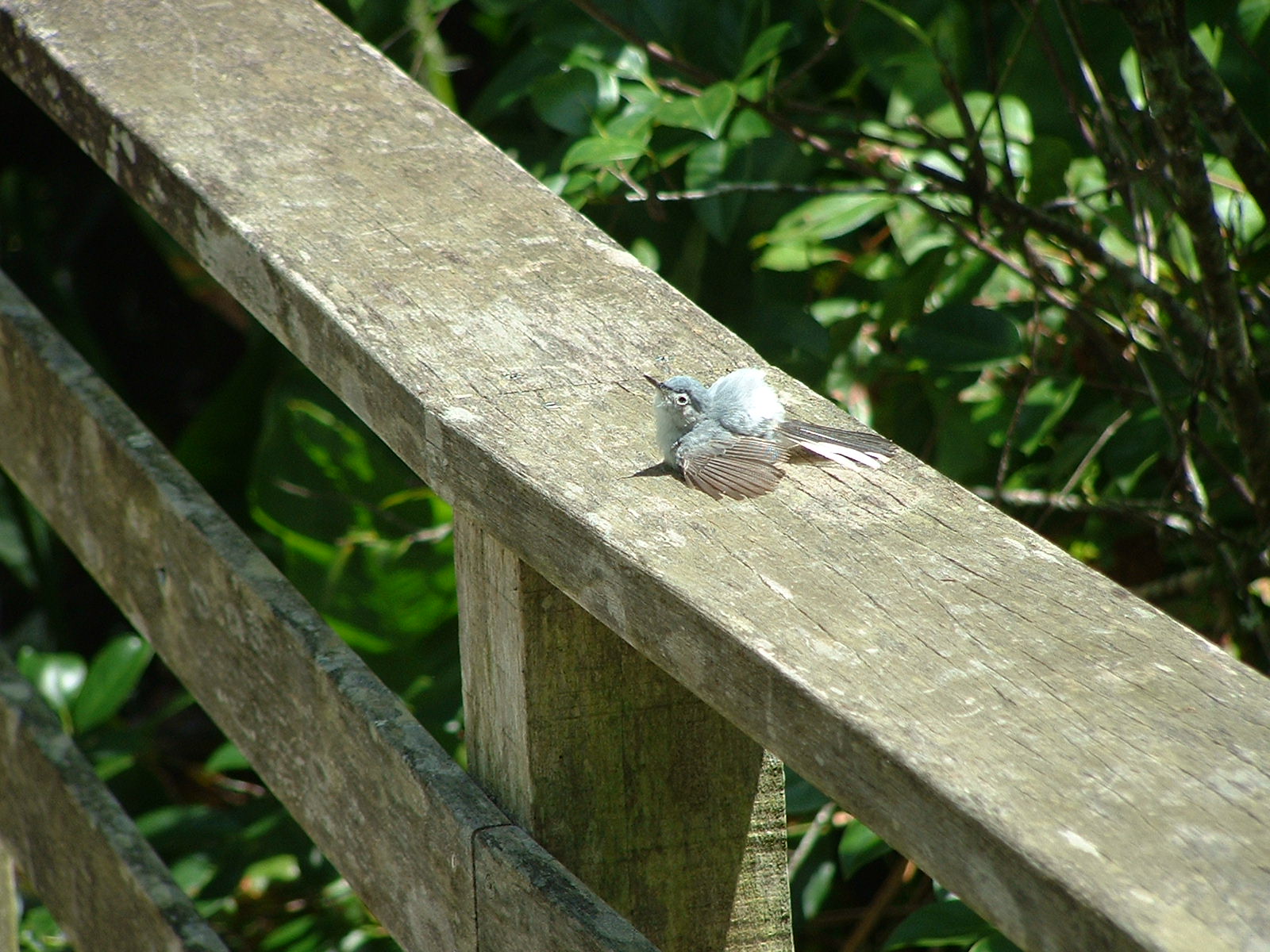
Blue-Gray Gnatcatcher
In sun-spotted shadow worn wood railing
half hidden, so at first I did not know
what I saw--a shadow that fluttered and limped
and then I saw the small wounded bird, wing
broken, it flopped pitifully, drawing
me closer, calling me for help, but not
really. Clever mother bird leads me far
from the nest of her precious young. I hear
a cry for help, she presents a meal
for the taking. All so her children, those
small peeps might live to one day
face their own monsters.
[cayo hueso]
Posted by Steven Riddle at 8:33 AM | Comments (0) | TrackBack
April 15, 2008
A Child's Guide to Theological Correctness
Yesterday, while driving home from work, the subject of Sunday's homily came up. I was surprised because when one of our priests starts speaking it is a signal for the shields to go up and to warp out of there for the brief span of the homily. There's nothing really wrong--the homilies just tend to be long and picaresque, bearing little or no resemblance to the passages that we had just heard. I attribute this to the Priest's advanced age and his 60's-type delivery and his own rather leftist political agenda.
In the course of the homily the Priest misspoke. I am certain, from what I know of him that he did not mean it when he said, "God created an imperfect world."
On the way home (to get back to the point) Sam said, "You know, when Fr. X said that God created an imperfect world, he was wrong. God created a perfect world and then they eated the apple and everything went all wrong."
Even if he's having trouble with English verb conjugations, he got the theological nicety correct. God did not create an imperfect world. His creation is perfect, our disobedience corrupted it and brought it all down with us.
I've often pondered why this should be so--why would Adam's disobedience affect the world of cats and dogs? Why is this necessarily so?
And it occurred to me, that it is, once more, a sign of His love for us. Humanity could not exist in a perfect world because of its own imperfection. It would be a constant stimulus to envy, jealousy, and destruction. The food of such a world would be like poison to us.
Regardless of why it is so, Samuel understood the concept of the fall and applied it better than our Priest in his homily. (Which is, as I noted, unsurprising. This particular Priest has more "off" than "on" homilies, but he has a loving and gracious heart and he works hard for all of us at a time in life when he is certainly entitled to rest, take it easy, and enjoy life.)
Posted by Steven Riddle at 7:29 AM | Comments (0) | TrackBack
The Wacky World of Henry James
As typified by two passages from the current read:
from The Portrait of a Lady
Henry JamesIsabel was sure moreover that her mild forehead and silver cross referred to some weird Anglican mystery, some delightful reinstitution perhaps of the quaint office of the canoness.
*****
[Harriet Stackpole speaking with Lord Warburton]". . . . I don't approve of you, you know; I feel as if I ought to tell you that."
"Don't approve of me?"
"Yes; I don't suppose any one ever said such a thing to you before, did they? I don't approve of lords as an institution. I think the world has got beyond them--far beyond."
"Oh, so do I. I don't approve of myself in the least. Sometimes it comes over me--how I should object to myself if I were not myself, don't you know? But that's rather good, by the wayl--not to be vainglorious."
"Why don't you give it up then?" Miss Stackpole enquired.
"Give up--a--?" asked Lord Warburton, meeting her harsh inflexion with a very mellow one.
"Give up being a lord."
"Oh, I'm so little of one! One would really forget all about it if you wretched Americans were not constantly remind one. However, I do think of giving it up, the litter there is left of it, one of these days."
"I should like to see you do it!" Henrietta exclaimed rather grimly.
"I'll invite you to the ceremony; we'll have supper and a dance."
Critics note that much of James's work is about this conflict between the Old World and the New World, with the New representing innocence and rugged individualism and self-determination (as noted in the character of Miss Archer herself.) Having not read sufficiently in his oeuvre to make such sweeping judgments, I'll accept the advise of the critics. If so, in these interchanges we see some of the downside of innocence and self-determination--a kind of naive arrogance that can pronounce with impunity on things it does not understand and look down upon all things foreign as "quaint" and "charming" or unlikeable institutions.
There is a price to pay for this sort of arrogance and previous reading has led me to believe that Miss Archer, much to her woe is to be brought up sharp against it.
Whatever the case, I'll keep you informed. And hopefully you can be as amused as I am.
Posted by Steven Riddle at 7:41 AM | Comments (0) | TrackBack
A Mitzvah for a Blogger Friend in Need
I have not posted memes or quiz answers in a very long time, and have no intention of resuming after this post. However, because Enbretheliel asks so nicely and is in need of our prayers and good wishes and acts, I offer this small mitzvah--an answer to her tag:
1. Do you associate reading particular books with the places you read them or events of the time you read them?
Unfortunately, in one case, quite vividly. I think I was reading Stephen King's Four Past Midnight or a collection of his short stories--I know it by looking at the cover, when my mother died. I never finished the book.
On a happier note, but a sadder book, I read Khaled Hosseini's The Kite Runner on a flight home from Sacramento California.
Similarly, I finished my most recent read of The Sound and the Fury on a flight back from Boston.
2. Do you remember the books you read or do they fade quickly? Or do you remember some better than others? How about remembering details like character names, not just overall plot?
Some books remain with me and pluck at me. Chief among those are Henry James's The Golden Bowl, which struck me as a very odd predecessor to the absurdist dramas of Samuel Beckett. It seemed to me that throughout this entire book there were four or five disembodied heads that swirled around making life miserable for one another.
Tom Sawyer is another. I think of Aunt Polly looking over her glasses and under her glasses, but never through her glasses for so small a thing as a boy.
Rohinton Mistry's A Fine Balance haunts all of my reading--most particularly the hair collector and the beggar-maker.
As a general rule, however, I forget most of a book and retain a sense of it or a scene or two. For example, I remember very clearly the climactic scene from Silence by Shusaku Endo. Same with near the end of The Violent Bear it Away, l was stunned by Flannery's venturing into the world she did.
But I've gone on too long. Suffice to say that some books, stylistically or incidentally remain firmly in mind, while other evaporate out of my head almost immediately.
3. Have you ever forgotten you've read/own a book and borrowed/bought it again?
All the time, particularly with unmemorable books that sound as though they ought to be memorable.
Not that I remember, if you don't mind such a perversely ironic answer.
Posted by Steven Riddle at 10:56 AM | Comments (0) | TrackBack
April 16, 2008
"Last Night I Dreamt I went to Manderley Again. . ."
Not really. Instead I had a creepy little dream in which a very punked out proto-goth androgyne was taking me somewhere for some unspecified but distinctly unsavory or unpleasant rendezvous. He asked me, "Haven't you ever defied God?"
I answered, "Of course I have. All the time. But. . ." and fortunately that little walk came to a screeching halt with the sound of the alarm.
But the question and its circumstances were salutary and rewarding because it caused me to think that while I do defy God and while I do sin and ignore the things I ought to do, and while I am imperfect in the practice of my faith and even in holding the central principles of it, nevertheless, I always do what I do knowing that God exists. That may not seem like much, but when I got down under the skin of that statement, I realized that it is not possible for me NOT to believe in God. Despite all of the arguments I have read and those I can dream up myself, the existence of God is more proven to me than any proven fact or visible reality. God exists. I know that is belief, but I have discovered the place that Mortimer Adler describes when he says that belief can be the strongest knowledge there is.
So it is for me. I cannot choose to not believe in God or to act as though I don't believe in Him. I can choose to do what I want anyway. I can choose to go against the law I know to be true. (And I frequently do both of these things.) But I can't say, "There is no God and so I'm free to do as I choose." That simply isn't an option.
The odd part is I can't tell you why there is this solid foundation. Or I can tell you why but it would be meaningless to someone who lacked it. Grace. Amazing grace. He has graced me with this gift, this rock to which I always return. I cannot escape from Him, but He is no relentless hound--no, He is an island in a cobalt sea where the breezes play day and night and I am the only person to see and enjoy its pleasant shores--or if I am not alone, the crowds on the island are as vapor and there is neither clamor nor anguish in it. When I stray far from my island, the memory of it always calls me home. It does not follow me, it sings to me and calls me back.
And here is the song I hear (though not necessarily in Dean Martin's voice--but also not necessary NOT in Dean Martin's voice.)
Return to Me
Return to me
Oh my dear I'm so lonely
Hurry back, hurry back
Oh my love hurry back I'm yoursReturn to me
For my heart wants you only
Hurry home, hurry home
Won't you please hurry home to my heartMy darling, if I hurt you I'm sorry
Forgive me and please say you are mineReturn to me
Please come back bella mia
Hurry back, hurry home to my arms
To my lips and my heartRetorna me
Cara mia ti amo
Solo tu, solo tu, solo tu, solo tu
Mio cuore
Yes, God sings that to me--all of it--not that He can err or He can be the cause of my straying. But His love is in His kenosis and He, being love, can know that love hurts even when it does not desire to.
(Okay, so my theology isn't so great, I'll admit that. But theology is only as good as the purpose it serves--and if that purpose is to make one cling to God, then the theology, however inexact performs the necessary, life-giving function. We don't get into heaven based on our quiz scores.)
Posted by Steven Riddle at 7:39 AM | Comments (0) | TrackBack
April 17, 2008
More Cayo Hueso, I'm Afraid
Things That Don't Travel Well
Glass balls and
unwrapped geegaws
and cut paper
pictures and
photographs
in boxes and
most mysteriously
of all
memories.
Posted by Steven Riddle at 7:28 AM | Comments (0) | TrackBack
Will It Never End?
Well, we're all mortal, but I hope until then not.
What You See When You Close Your Eyes
Depends upon the day.
__Sometimes it is the darkness of eyelids
__Sometimes it is the orange brightness
____of eyelids, or the red-heat glow
____of tired eyes.
But sometimes
it is the cobalt-verdigris sea, shifting
as you look.
___________Or the span of space
in the broken road crashing out
into the deep-blue air, deafening
in the difference.
________________Or the chain
of clouds that is the sky's
reflection of the crescent
curve of the tropical chain.[cayo hueso?]
Posted by Steven Riddle at 7:35 AM | Comments (0) | TrackBack
Definitely Cayo Hueso
While the previous poem certainly fits into the geographical category of Cayo Hueso, there is some question about its thematic link. Not so here.
Vision
i
Learn to see again, open
eyes and let the light vanquish.ii
It is darkness that trains the eye
to be thankful for the light,
because in the darkness the eye will
see things of its own invention--
spots of yellow light, a greater
darkness crawling across the less,
spidery veins of blue, of milky light
that does not focus. Light shine comes
as relief to the eye straining to make real.iii
Sometimes, as I lay in bed at night,
I practice seeing through my eyelids.
In that imperfect dark I can make
out every contour of the bed frame,
the dresser, the armoire. No eye
could see better in any light,
dark-sight sees the real contours
of unreal things.iv
The eye of the giant squid is as large
as a dinner plate. In the deep , cold
waters, even with its massive eye,
the squid becomes calimari for the sperm whale.
An untitled piece, this morning broken apart from the titled piece that follows it.
[untitled]
The perpetually shifting balance
of the egret prowling the hedge-tops
in search of food. What wonders
would be seen if we could see
all at once, but vision is itself
a limit, and we cannot see
all-at-once, often not even
little-by-little.What Lies Beneath
The water strider balances on a skin
of water dimpling the surface
with its six legs. And from
beneath, what does this look like
but a bubbled sky?
Posted by Steven Riddle at 7:45 AM | Comments (1) | TrackBack
I Have a Theory
Like Miss Archer herself, I am filled with useless theories and baseless speculations. But it occurred to me, while reading The Portrait of a Lady that Henry James himself resides within the novel in the skin of Henrietta Stackpole.
Ms. Stackpole tells Isabel that she has no affinity for inanimate objects and she doesn't care to write home about places and mere scenery. Her interest is in people and how they interact and what they are. She sees, of course, with her own blinders in place. However, she does see.
Henry James, for all of his skill with character, lacks any sense of place or time. You read through the book not knowing what people are dressed in, where they are standing, what the scenery is like. Isabel Archer's entire trip trough London is summed up in a short paragraph of about three sentences. We have no opportunity to visit with her the British Museum, much less to sit a moment under those grand trees of Kensington Gardens.
Yes indeed, James makes short shrift of scenery and, indeed, almost any form of set decoration. And we have characters who wander about in a largely and mysteriously featureless world. It amazes me how bereft of this sort of detail the book is.
On the other hand, it simply isn't required for what Mr. James wishes to divulge to us. And so, in that sense, it is handled perfectly.
However, I have theory. . .
Posted by Steven Riddle at 8:11 AM | Comments (0) | TrackBack
April 18, 2008
Hot off the Presses
and so, in need of work. But I like the contours.
[cayo hueso]Deconstruction of the Ant Hill
On the sill a pile of sand as
though the beach had come to visit,
and on it, thousands of golden
lithe-bodied ants fidgeted and
jittered, waving antennae and
pawing the air more forcefully
than any foam-flecked battle horse.
Across the wide expanse of wooden
plank, three golden soldiers dragged one
large black-bodied, full-bellied queen.
And through the brown mill on the stairs
that curled around the central shaft
the mournful hum of servant tykes
who hand one to one buckets
filled with syrup or water up
to some hidden destination.Here's what happened:
In panic, the heavy bottomed
glass bowl came down on the trekking
four. The fat black ant was smashed flat
as the boards themselves, a mere stain
for future pondering. And with
that motion the mill was freed. The sound
slowed then stopped and though the buckets
went awhile, they too slowed then stopped
and the dazed children turned and stared,
golden eyes filling with hot [fat?] tears
that did not spill. They stood, stock-still
on the stairs that circled the shaft
and waited in the weighty air
of the close summer day, as women
in bonnets last seen a century
ago entered, through a small pane
of light and led them two by two
away. The mournful sound settled
into the brown wood and the stairway
emptied into light.
A mere draft, but vividly seen and felt. Much to be done, but mostly tweaking--it says all it was meant to say, and what that might be, I leave up to you.
Posted by Steven Riddle at 7:26 AM | Comments (1) | TrackBack
Ants in Surrealism
The presence of ants in some surrealist imagery never fails to both amuse and, in some small way, horrify me. Luis Bunuel and Salvidor Dali brought this imagery to the forefront in Un Chien Andalou although it had been a staple of Dali's painting for some time before that. I won't pretend to know the significance of the ant, but it does present a compelling image for contemplation of the junction of the natural and supernatural which is where surrealism lives. (Even though its chief thinkers--not really being very profound thinkers--ever knew or acknowledged this. But then, we're talking André Breton and his crowd of absinthe-imbibing Parisomaniacs.)
Posted by Steven Riddle at 8:01 AM | Comments (0) | TrackBack